When the Boer War began on October 12, 1899, Australia was still a collection of separate British colonies with a total population of less than 4 million on a land mass nearly as large as the United States. When each colony immediately offered troops for the war, the War Office in London didn’t want unskilled, probably unreliable colonial volunteers. But the British government, facing criticism of its policies and actions in southern Africa from America and most European countries, chose to regard the offers from the Australian colonies as a mark of Empire solidarity, overrode the War Office and accepted the offers. Shiploads of soldiers and horses set sail from Australia for the Cape of Good Hope.
The first contingents arrived in South Africa in November 1899; they continued arriving throughout the war until more than 16,000 soldiers had been transported to the Cape. They were not regular soldiers, though; they were militia, part-tithe soldiers with anything from 36 to 80 of hours training or drill a year, depending on the colony they came from.
They arrived in small units, since the British government stipulated that the units should consist of about 125 then, with no more than a single captain and three subalterns to each one. If more than one unit carne from a single colonial force, these could be commanded by a major. The Aussies came under such names as the New South Wales Lancers, New South Wales Mounted Rifles, Queensland Mounted Infantry, Queensland Bushmen, South Australian Mounted Rifles, South Australian Imperial Bushmen, Victorian Bushmen, Western Australian Mounted Infantry, Tasmanian Bushmen, and Australian Commonwealth Horse. Ill-trained as soldiers, they would probably not have lasted very long in a conventional war against regular, disciplined troops.
The Boers, however, were fighting an unconventional war, one to which the Australians adapted easily and in which they were able to make a contribution quite out of proportion to their numbers. Like the colonial-steeped Boers themselves, the Australians were mostly countrymen, used to the bush, to living rough and living off the land when necessary, able to find their way day or night in any kind of country, and familiar with horses and guns from an early age.
Other volunteers for the war came from among Australians living and working in southern Africa. Some joined units such as the South African Constabulary, whose Australian James Rogers was awarded the Victoria Cross for bravery. Others joined irregular units such as that formed by the Australian Walter D. ‘Karri’ Davis, the Imperial Light Horse of South Africa. All units, wherever they came from, were dispersed among British units, under British command.
The war began badly for the British. Before the war was a month old, Boer General Pieter A. ‘Piet’ Cronjé had led a large force of horsemen out of the Transvaal and laid siege to Mafeking; Orange Free State forces had laid siege to diamond-rich Kimberley; and General Petrus Jacobus ‘Piet’ Joubert and his 15,000 horsemen had defeated General Sir George White’s Natal Defence Force at Laing’s Nek, defeated him again a week later at Talana Hill, and by November 2 had laid siege to Ladysmith. And then came “Black Week,” when between December 10 and 17 the Boers defeated the British at Magersfontein, where the British suffered 1,000 casualties; at Stormberg, where they lost 100 casualties and 600 prisoners; and at Colenso, where General Buller’s force took 1,200 casualties in an unsuccessful attempt to relieve Ladysmith. Buller–General Sir Redvers Buller–was commander in chief of all forces, but now the British government decided he had to go.
On the first day of January 1900, meanwhile, 200 Australians of the Queensland Mounted Infantry, with a supporting group of Canadians and British, mounted an attack on a Boer camp on Sunnyside Kopje, one of the low hills near the Vaal River west of Kimberley. While the Canadians and British held the Boers’ attention with a frontal attack, the Queenslanders moved in from the flank, using cover as they moved from ridge to ridge, until they were in position to launch a surprise attack on the Boers. The Boers retreated, leaving 30 dead and 41 prisoners and a large supply of food and weapons. The Queenslander casualties were two dead and two wounded. In another action, on January 16 at Slingersfontein, a Boer commando (group) of 400 attacked a small hill where 20 men of the Western Australian Mounted Infantry were positioned. The Australians, constantly moving in the scrub and rocks, beat off attack after attack from sunrise to sunset, at which time the Boers finally withdrew. These small successes were given much publicity, drawing attention to the unorthodox fighting tactics of the colonial horsemen.
General Buller’s replacement arrived in mid-January 1900. He was Field Marshal Lord Frederick Sleigh Roberts, 1st Baron of Kandahar. He brought with him General Lord Horatio Herbert Kitchener as his chief of staff.
Roberts realized immediately that this was no conventional war and that vast changes would have to be made if he was to defeat the Boers. A much more mobile army was needed, and different tactics. The Australian horse soldiers already were working successfully against the Boers, an example of what was needed. Roberts began putting every man he could on horseback and concentrating his forces at Enslin near the Modder River for an invasion of the Orange Free State.
Meanwhile, General Buller was still in the field. Disobeying his commander in chief’s order to stay put, he crossed the Tugela River into Natal–and there he was badly beaten by the Boers at Spion Kop and at Vaal Kranz. He blundered deeper into Natal.
While concentrating his own forces at Enslin, Roberts sent Maj. Gen. John French in a wide, flanking move toward Kimberley, as if intending to relieve the diamond town. French’s forces, in addition to British cavalry regiments such as the Inniskilling Fusiliers and the Scots Greys, included the New South Wales Lancers, Queensland Mounted Infantry and New South Wales Mounted Rifles. Then Roberts himself moved with massive force across the Modder taking with him 30,000 infantry, 7,500 cavalry, 3,600 mounted infantry and 120 guns, and a transport unit of 4,000 drivers, 11,000 mules and 9,600 oxen.
He sent Lord Methuen’s 1st Division along the rail line leading to Kimberley to convince Boer General Piet Cronjé that this was the main assault and that he should hold his forces at Magersfontein to oppose it. With Cronjé taking the bait, Roberts ordered General French’s British and Australian horsemen to avoid Magersfontein and spearhead the drive on Kimberley.
French drove hard for the Modder River, where a large Boer force was in position. On one of that summer’s hottest days French’s cavalrymen and mounted infantry raced nonstop for the Modder. It was so hot, horses pulling the guns died in their traces. The cavalrymen and infantrymen trotted alongside their horses to give them some relief, with dead and dying horses littering the back trail. Even 21 of the men died on the march. But the Boers were completely surprised and hastily retreated, leaving their supply wagons behind.
Roberts’ forces caught up with French and they moved on toward Kimberley together. Cronjé, however, had moved 1,000 Boers, with field guns, into positions in the hills overlooking the pass that led to Kimberley. The only alternative for the British was a long march around the hills, a march inviting harassment and attacks by Boer horsemen and fire from the guns in the hills. Roberts sent French and his British and Australian horsemen into the pass.
Lances down, sabers swinging, mounted infantry shooting from the saddle, they charged so fast the Boer gunners could not alter range quickly enough to keep up with them. The Boer riflemen also were beaten by the speed of the charge and the clouds of dust kicked up by the horses’ hoofs. Reinforcements followed the charge, and the Boers slipped away. The horsemen rode on into Kimberley, raising a siege that had lasted 124 days.
Next day French could find only 2,000 horses that could possibly be ridden. Mounting some of his cavalrymen and his Australians, he set off after Cronjé, who was making for Bloemfontein. Hampered by the slowness of his supply wagons and the women and children in his column, Cronjé reached the Modder River at Paardeberg Drift, and there French, followed by some of Roberts’ force, caught up with him. The Boers dug in. General Christiaan de Wet and his commando arrived to help Cronjé, attacking and skirmishing around the British force. The Australians were sent out to contain them while the main force concentrated on Cronjé. He held out for eight days, then surrendered with 4,000 fighting men on February 27.
In Natal, General Buller had captured Hlangwane, a dominant height southeast of the Tugela River, and advanced on Ladysmith. The Boers waited for him at Pieter’s Hill. True to form, Buller sent in his troops in massed attack. They were saved by the Natal Carbineers and the Imperial Light Horse, each unit including Australian volunteers. Those rescuers broke through the Boer lines–but only after 1,900 of Buller’s troops were dead or wounded. Ladysmith was relieved on February 28, and Buller at last was sent back to England.
Advancing next on Bloemfontein, Roberts caught up with Boer commander Christiaan de Wet, who made a stand at Dreifontein Kopjes (the Hills of the Three Springs). The Ist Australian Horse dismounted and went into the assault, keeping low in the long grass and shooting as they moved while artillery fired over their heads. In the face of this implacable advance, the Boers took flight on their horses, although scene of their guns continued firing until the riders of the New South Wales Mounted Rifles and Queensland Mounted Infantry charged on horseback and silenced them. The Aussies then went after de Wet, but he disappeared in the dark hills.
Roberts’ army moved on to Bloemfontein, where the hills around the town were thick with Boer riflemen, machine-gunners and artillerymen, but when he began shelling their positions they faded away. The army stayed in Bloemfontein for six weeks. A quarter of the army was ineffective because of an epidemic of enteric fever, from which more than a thousand died. The horses were in such terrible condition that the soldiers shot them in batches of 100. Replacement horses arrived from Argentina, but they were mostly of poor quality–and wild. The Australian bushmen were given the job of breaking them, and dazzled the British with their expertise.
Out on the veldt, Boer commandos were still skirmishing and attacking. At Sannah’s Post, not far from Bloemfontein, three squadrons of British cavalry, two Royal Horse Artillery batteries and some infantry were guarding a large convoy of supplies when de Wet struck with 2,000 men and field guns. In a fast, savage fight, 19 British officers and 136 of their men were killed or wounded and 426 taken prisoner. Seven guns were lost and the whole of the convoy.
Roberts got his army moving again, 45,000 men, 11,000 horses, 120 guns and 2,500 wagons. Spearheading it was Maj. Gen. Ian Hamilton’s division, which included a brigade commanded by Maj. Gen. ‘Curly’ Hutton and mostly made up of colonials-New Zealanders, Canadians, and mounted infantry from all the Australian colonies. On May 5, the brigade came up against Boer positions at Coetzee’s Drift on the Vet River. The Boers, estimated at 1,000, occupied positions along the riverbank while artillery covered them from a hill behind.
The Royal Horse Artillery softened up both positions, then the New South Wales Mounted Rifles dismounted and went into the attack. Under heavy fire they pushed the Boers back from the river bank and, after another bombardment of the hill, joined Queenslanders and New Zealanders in clearing the hill. The division moved on.
A young reporter riding with the division, Winston Churchill (the future British prime minister during World War II), described how the soldiers lived off the flocks of sheep they drove with them and off chickens and anything else they could find to eat on the deserted Boer farms, while nearly every day there was Boer rifle fire from the front, the flanks or the rear. “This,” he wrote, “made us conscious of the great fighting qualities of these rifle-armed horsemen of the wilderness.”
In May 1900, a column of Hussars commanded by Colonel Bryan Mahon and a column commanded by Colonel Sir Herbert Plumer (which included Australians) galloped across the border from Rhodesia and relieved Mafeking. Colonel Robert Stephenson Smyth Baden-Powell (later the founder of the Boy Scouts and Girl Guides), who had commanded during the siege, reviewed the relieving forces. In Natal, the last Boer resistance was crushed at Glencoe and Dundee, and on May 24, the Orange Free State was annexed as a colony of Britain.
With Australians leading his spearhead, Roberts now advanced on Johannesburg in the Transvaal. And holding a line on the Klip River south of Johannesburg was Boer General Louis Botha.
While the New South Wales Mounted Rifles drew Boer fire as a diversion, the Queenslanders crossed the river and held fast on the other side. Next day, the rest of Ian Hamilton’s division crossed the river under heavy fire, and the Australians then raced on to Johannesburg. The first unit entering the city apparently was a troop of South Australian Mounted Infantry commanded by Lieutenant Peter Rowell. It was May 30.
Roberts next marched on Pretoria, the capital of the Transvaal, which he occupied on June 4. The president of the Orange Free State, Marthinus Steyn, Commando Commandant Marthinus Prinsloo and the elusive Christiaan de Wet had all been in the city, but they abandoned it with all their forces when Roberts’ army came close.
The army went after them. New South Welshmen and West Australians caught up with the Boer rear guard in the mountains east of the city at Diamond Hill and attacked with bayonets. They captured the rear guard’s positions, but the main force kept moving and managed to get away.
It was, however, only a matter of time. The Boers, for all their bush skills, could not long evade the huge number of British, Australian, Canadian and other troops searching the mountains for them. Before long, Commando Commandant Prinsloo and 4,000 Boers were rounded up.
Even so, the Boers were still not beaten. Boer commandos roamed the veldt attacking outposts and supply lines and disappearing to turn up somewhere else to fight again.
In early August, a force of 150 Queensland Mounted Infantry, 100 New South Wales Bushmen, smaller numbers of Victorian and Western Australian Bushmen and 75 Rhodesians under command of a British officer, a Colonel Hore, were sent to guard a huge consignment of stores at the Elands River Post. They arrived at the post after a running fight with Boers front a commando of 2,500 to 3,000, commanded by General Jacobus ‘Koos’ de la Rey, and quickly improvised a defensive position out of ox wagons and boxes and bags of stores. The commando surrounded the post and during the next two days poured 2,500 artillery shells into it from the hills around. Nearly all of the 1,500 horses, mules and oxen were killed or died of wounds from the shelling, but the troop casualties were very light, since the men burrowed into the rocky ground and stayed down. After the second day the bombardment eased, probably because the Boers realized they were destroying the stores they badly needed, but they kept up intense rifle and machine-gun fire.
During the day, the defenders lay motionless in their holes in the ground, but at night they came out. Some ran the gauntlet of fire to bring water from the river, while others repaired shattered defenses and dug deeper holes and others went out into the darkness looking for Boer field-gun and machine-gun positions, which they attacked loudly with grenades or silently with knives and bayonets. Many sleeping Boers and even wide-awake sentries lost their lives in this night stalking and attack. A Boer who had been at Elands River wrote: “For the first time in the war, we were fighting men who used our own tactics against us. They were Australian volunteers and though small in number we could not take their position. They were the only troops who could scout our lines at night and kill our sentries while killing and capturing our scouts. Our men admitted that the Australians were more formidable opponents and far more dangerous than any other British troops.”
On August 8, de la Rey, under a flag of truce, advised the Australians that the whole area was in Boer hands and there was no hope of relief for the post. He offered safe conduct to the nearest British garrison if they would surrender. It was that, or destruction by his artillery. The offer was refused, and the bombardment began again. On the 12th, de la Rey sent another offer of honorable surrender, to which Colonel Hore replied: “Even if I wished to surrender to you—and I don’t—I am commanding Australians who would cut my throat if I accepted your terms.”
During the truce a messenger got through the Boer lines and made it to Mafeking, where he reported that the force was still holding out at the Elands River; it had not surrendered or been taken as was believed at headquarters. General Lord Kitchener himself led a column in relief. When the Boers saw it approaching they withdrew, and the column marched into the post in the afternoon of August 16. Looking about him, Kitchener remarked: ‘Only colonials could have held out and survived in such impossible conditions.’
The Transvaal had now all but fallen, and like the Orange Free State, it was annexed as a colony of Britain.
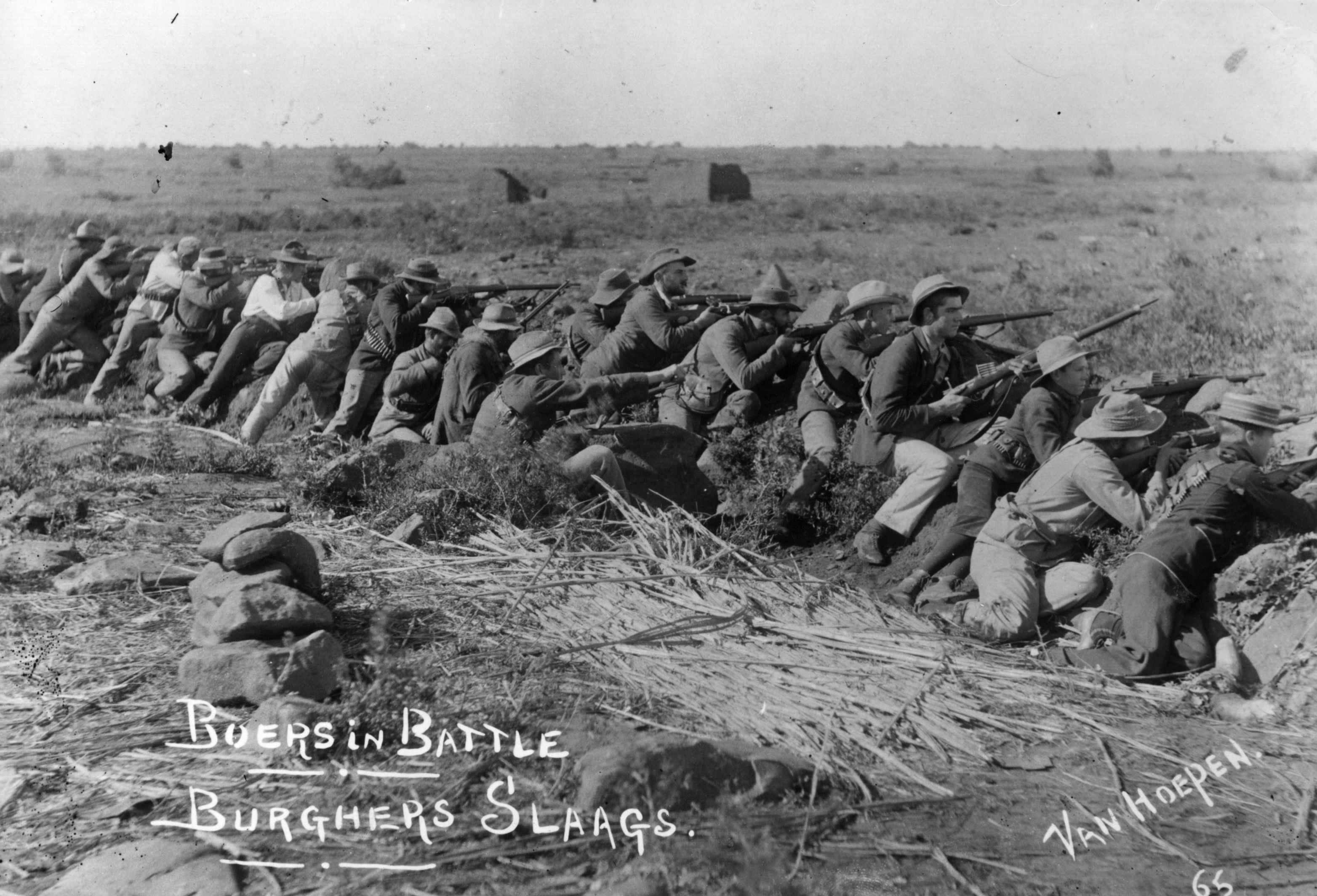
The war had passed through two phases. In the first phase of some three months, British forces of mainly foot soldiers led by incompetent generals were besieged or defeated by highly mobile Boer mounted infantry. It was a period of bloody fighting in which the only real battles of the war occurred. The second phase was the British offensive, during which British and colonial troops, vastly outnumbering the Boers, smashed and dispersed the Boer forces and annexed their two states. But the war was by no means over. There were still strong Boer commandos at large, led by experienced and successful leaders such as Koos de le Rey, Jan Smuts, Danie Theron, Christiaan de Wet and others. The British held the cities and towns, but a vast amount of territory was left to the commandos, which now broke into smaller groups and began a guerrilla war, intercepting telegraph messages for intelligence, infiltrating bases, making lightning raids on posts and convoys, and sabotaging rail and road communications.
Wearing captured British uniforms, Boers of one command rode into a British cavalry post and opened fire, killing or wounding more than 70 troopers. They took supplies and arms and drove off all the horses. After that success, they often wore British uniforms to get close enough to kill. For greater killing power, they used dumdum and expanding bullets. The Boer soldier only needed to hide his rifle to become a farmer again. Many were the times when British soldiers searching farms for weapons were shot in the back by a farmer who had reached for his hidden rifle. And many were the times they were fired on from under a flag of truce. When the Boers went into action, almost every civilian in the area was ready to provide them with intelligence, food, shelter, medical help and hiding places.
Field Marshal Roberts put into action his plan to combat this situation. The map of South Africa was marked in squares to show where ‘protected areas’ would be established. On the ground, blockhouses were built in the squares, each within rifle shot of the next, and barbed wire was strung between them, enclosing the veldt in an interlocking system of armed squares. Then, one at a time, the squares were cleared of Boer guerrillas, and the occupants of farms and settlements were concentrated in camps, their homes and crops destroyed, their wells poisoned, and their livestock slaughtered or driven off. Outside these ‘protected areas,’ however, the war went on more savagely than ever.
At the end of November, Roberts handed over command to Kitchener and returned to England. Kitchener intensified the clearing of ‘protected areas’ and by the end of the year some 26,000 square kilometers of the Transvaal and north Orange Free State and 10,000 square kilometers around Bloemfontein had been declared free of Boer fighting men.
Many Australians took part in this scorching of the South African earth, and many more were in the columns searching the veldt for Boer guerrillas, while others were fighting with irregular units. Under a variety of names, irregular units had existed since the beginning of the war, and now they mush-roomed. They were used mainly on the outer edges of the war, where there was little control. The irregulars fought, as did the Boers themselves, giving and expecting no quarter. One such unit, working in the rough country north of Pietersburg, called the Spelonken, was the Bushveldt Carbineers. It was a unit of tough Australians, British and South Africans. One of its officers was Lieutenant Harry ‘The Breaker’ Morant.
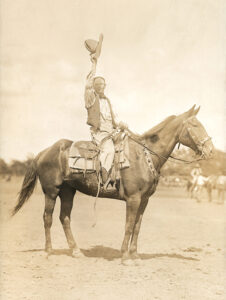
Harry Morant was born in England and arrived in Australia in 1885. His background in England remains a mystery, but he was a well-spoken, charming young man who settled easily into a bushman’s life, working on cattle and sheep stations from Queensland to South Australia. He became well-known for his remarkable horsemanship and for his verse. He rode as if he and a horse were one; he could get a horse to do anything it was possible for a horse to do, and he could break the wildest of horses. This skill earned him the nickname ‘The Breaker,’ which he used to sign the verses, bush ballads, satirical odes and lyrical love poems he wrote for publication in district newspapers and across Australia in the periodical called The Bulletin.
He landed at the Cape in February 1900 with the South Australian Mounted Rifles. He was said to be an efficient soldier, skilled in moving and fighting in rough country. When his one-year enlistment ended, he went on leave to England, where he became friends with a Hussar officer, Captain Frederick Hunt. Both returned to the Cape to take commissions in the newly formed Bushveldt Carbineers. A few months later, in the deadly guerrilla war being fought in the Spelonken, Hunt was killed and apparently mutilated. For Morant, the war became a vendetta.
On a patrol, Morant stopped and questioned a Dr. Heese, a German missionary who later reported that in one of the wagons with the patrol were the corpses of eight Boers. Shortly afterward, Heese was found shot dead. Six officers of the Bush veldt Carbineers, including Morant, were arrested by the British and charged with looting, manslaughter and the murder of the missionary.
Of the six, the commanding officer of the Carbineers was reprimanded and sent back to Australia. The second, the unit’s intelligence officer, had finished his military term and was no longer subject to military law, and the third, a regular British officer, was cashiered. The other three, Lieutenants Harry Morant, Peter Handcock and George Witton, were sentenced to death, although none was ever found guilty of the murder of the missionary. Witton’s sentence was afterward commuted to life imprisonment; he spent four years in English jails before a petition secured his release and return to Australia.
During his court-martial, Morant argued that the killing of prisoners and wounded was common to both sides and that it was, in fact, done on orders from above. The only rule in the Spelonken, he said, was ‘rule 303’ (.303 was the caliber of the British military rifle). None of his arguments was accepted, and on February 27, 1902, he and Handcock were taken before firing squads of British soldiers. Refusing a blindfold, Morant called to his squad, ‘Shoot straight; don’t make a mess of it.’ Then the rifles cracked, and Breaker Morant, bushman, balladist, horsebreaker, soldier, passed into Australian legend.
The Boers were still carrying out successful and bloody raids, but the war was going against them. The system of blockhouses and barbed wire was having a telling effect, and no help was forthcoming from the various countries that nominally supported the Boer cause. Then, in April 1902 at Rooiwal (formerly Roodewal), the Red Valley, occurred the last action of any consequence of the war, when 1,200 Boer horsemen charged 1,500 British soldiers armed with bayonets, backed by field guns. The charge was broken, the Boers suffering heavy casualties. A week later peace delegates from both sides met in Pretoria.
This article was written by John Brown and originally published in the October 2001 issue of Military History magazine. For more great articles be sure to subscribe to Military History magazine today!