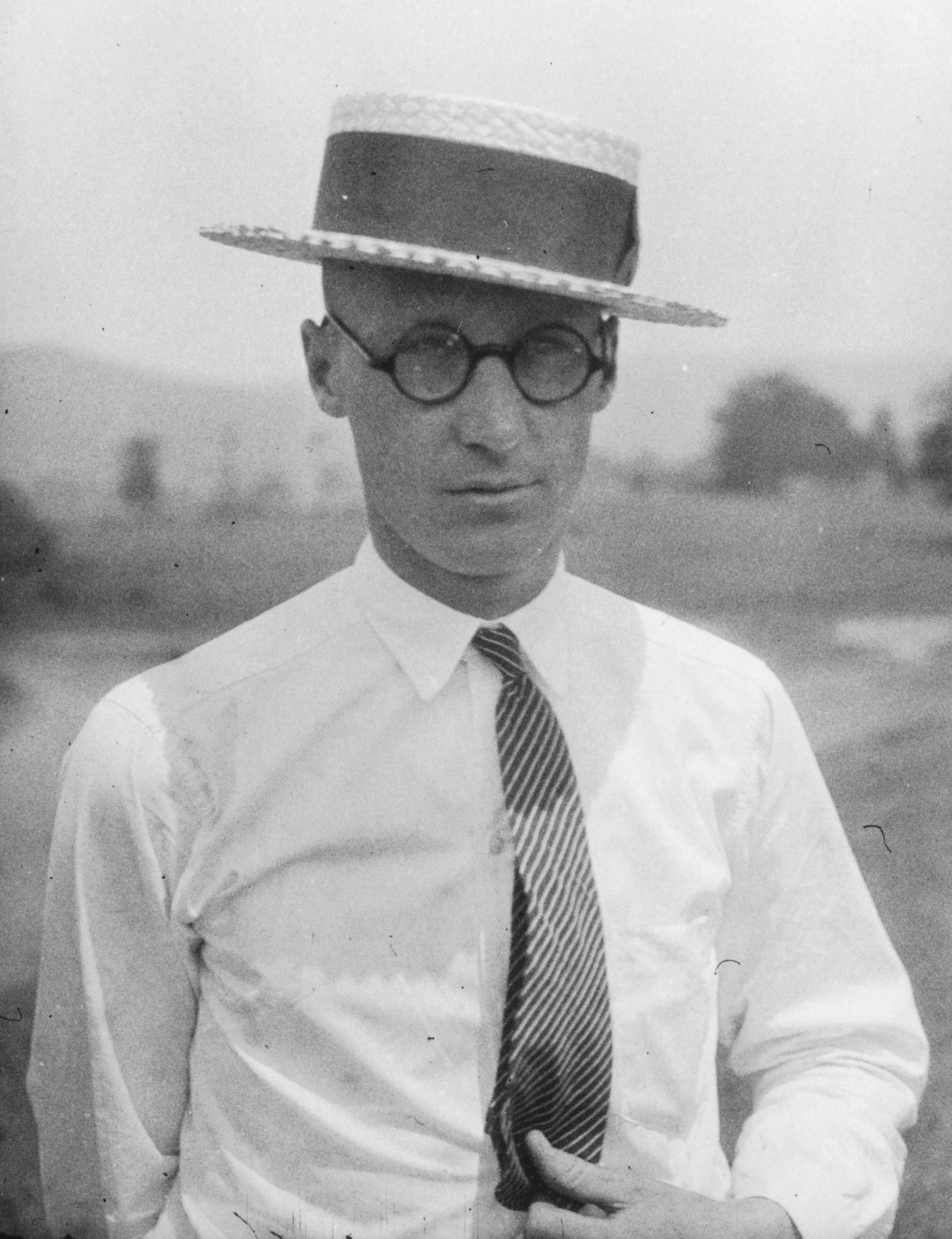
Scopes Trial Summary: The Scopes Trial, commonly referred to as the Scopes Evolution Trial or the Scopes Monkey trial, began on July 10th, 1925. The defendant, John Thomas Scopes, was a high school coach and substitute teacher who had been charged with violating the Butler Act by teaching the theory of evolution in his classes. The Butler Act forbid the teaching of any theory that denied the biblical story of Creationism. By teaching that man had descended from apes, the theory of evolution, Scopes was charged with breaking the law.
The trial took place in Dayton, Tennessee, and was the result of a carefully orchestrated series of events that were intended to bring publicity, and therefore money, into the town by a group of local businessmen. In reality, Scopes was unsure of whether he had ever technically taught the theory of evolution, but he had reviewed the chapter in the evolution chapter in the textbook with students, and he agreed to incriminate himself so that the Butler Act could be challenged by the American Civil Liberties Union. Several students were encouraged to testify against Scopes at the trial.
The Scopes Trial brought in hundreds of reporters from all over the country, and it was the first trial to be broadcast on radio. Both the prosecuting attorney and Scopes’ defense attorney were charismatic men and drew significant attention to the case, which for the defense was more about defeating the Butler Act then about defending Scopes. Scopes was found guilty and charged a fine of $100, but the verdict was thrown out on a technicality on an appeal. For the next few years, textbooks in Tennessee had all mention of evolution removed. The Butler Act was repealed in 1967.
One Man’s Religion …
Travelers wandering through Dayton, Tennessee, in mid-July 1925 might have been excused for thinking that the tiny hill town was holding a carnival or perhaps a religious revival. The street leading to the local courthouse was busy with vendors peddling sandwiches, watermelon, calico, and books on biology. Evangelists had erected an open-air tabernacle, and nearby buildings were covered with posters exhorting people to “read your Bible” and avoid eternal damnation.
If there was a consistent theme to the garish exhibits and most of the gossip in Dayton it was, of all things, monkeys. Monkey jokes were faddish. Monkey toys and souvenirs were ubiquitous. A soda fountain advertised something called a “monkey fizz,” and the town’s butcher shop featured a sign reading, ‘We handle all kinds of meat except monkey.’
As comical as this scene sounds, its background was anything but amusing. Sixty-six years after Charles Darwin published his controversial Origin of Species, the debate he’d engendered over humankind’s evolution from primates had suddenly reached a fever pitch in this hamlet on the Tennessee River. Efforts to enforce a new state statute against the teaching of evolution in public schools had precipitated the arrest of Dayton educator John T. Scopes. His subsequent prosecution drew international press attention as well as the involvement of the American Civil Liberties Union. It also attracted two headliners of that era–Chicago criminal attorney Clarence Darrow and former presidential candidate William Jennings Bryan — to act as opposing counsel.
Bryan characterized the coming courtroom battle as a “duel to the death” — one that would pit religious fundamentalists against others who trusted in scientific conclusions, and would finally determine the right of citizens to dictate the curricula of the schools their tax dollars supported. The case rapidly took on a farcical edge, however, as attorneys shouted at each other and outsiders strove to capitalize on the extraordinary publicity surrounding this litigation. (At one point, for instance, a Black man with a cone-shaped head who worked New York’s Coney Island sideshows as Zip, the ‘humanoid ape,’ was offered to the defense as the “missing link” necessary to prove Darwin’s scientific claims.) The ‘Scopes Monkey Trial,’ as history would come to know it, also included a personal dimension, becoming a hard-fought contest not just between rival ideas, but between Bryan and Darrow, former allies whose political differences had turned them into fierce adversaries.
GET HISTORY’S GREATEST TALES—RIGHT IN YOUR INBOX
Subscribe to our HistoryNet Now! newsletter for the best of the past, delivered every Monday and Thursday.
Anti-Evolution
Crusades to purge Darwinism from American public education began as early as 1917 and were most successful in the South, where Fundamentalists controlled the big Protestant denominations. In 1923, the Oklahoma Legislature passed a bill banning the use of all school texts that included evolutionist instruction. Later that same year, the Florida Legislature approved a joint resolution declaring it ‘improper and subversive for any teacher in a public school to teach Atheism or Agnosticism, or to teach as true, Darwinism, or any other hypothesis that links man in blood relationship to any other form of life.’
To Fundamentalists, for whom literal interpretation of the Bible was central to their faith, there was no room for compromise between the story of God’s unilateral creation of man and Darwin’s eons-long development of the species. Moreover, these critics deemed evolutionist theories a threat not only to the belief in God but to the very structure of a Christian society.
“To hell with science if it is going to damn souls,” was how one Fundamentalist framed the debate.
John Washington Butler couldn’t have agreed more. In January 1925, this second-term member of the Tennessee House of Representatives introduced a bill that would make it unlawful for teachers working in schools financed wholly or in part by the state to “teach any theory that denies the story of the divine creation of man as taught in the Bible.” Violation of the statute would constitute a misdemeanor punishable by a fine of not less than $100 or more than $500 for each offense.
Butler’s bill flummoxed government observers but delighted its predominately Baptist backers, and it sailed through the Tennessee House on a lopsided 71 to 5 vote. It went on to the state Senate, where objections were more numerous, and where one member tried to kill the legislation by proposing an amendment to also “prohibit the teaching that the earth is round.” Yet senators ultimately sanctioned the measure 24 to 6. As the story goes, many Tennessee lawmakers thought they were safe in voting for this “absurd” bill because Governor Austin Peay, a well-recognized progressive, was bound to veto it. However, Peay — in a prickly political trade-off that won him the support of rural representatives he needed in order to pass educational and infrastructural reforms–signed the Butler Act into law. As he did so, though, he noted that he had no intention of enforcing it.
“Probably,” the governor said in a special message to his Legislature, “the law will never be applied.”
Recommended for you

Picking a Fight
Peay’s prediction might have come true, had not the ACLU chosen to make the statute a cause célèbre. Worried that other states would follow Tennessee’s lead, the ACLU agreed in late April 1925 to guarantee legal and financial assistance to any teacher who would test the law.
John Scopes wasn’t the obvious candidate. A gawky, 24-year-old Illinois native, he was still new to his job as a general science teacher and football coach at Rhea County Central High School. Yet his views on evolution were unequivocal.
“I don’t see how a teacher can teach biology without teaching evolution,” Scopes insisted, adding that the state-approved science textbook included lessons in evolution.
And he was a vocal supporter of academic freedom and freedom of thought. Yet Scopes was reluctant to participate in the ACLU’s efforts until talked into it by Dayton neighbors who hoped that a prominent local trial would stimulate prosperity in their sleepy southeastern Tennessee town.
On May 7, Scopes was officially arrested for violating Tennessee’s anti-evolution statute. Less than a week later, William Jennings Bryan accepted an invitation from the World’s Christian Fundamentals Association to assist in Scopes’ prosecution.
Bigshot Bryan
No one who knew the 65-year-old Bryan well should have been surprised by his involvement in the case. Bryan had been trained in the law before being elected as a congressman from Nebraska, and he made three spirited but unsuccessful runs at the presidency on the Democratic ticket. He had served as secretary of state during President Woodrow Wilson’s first term but had spent the last decade writing and lecturing more often about theology than politics. With the same silver tongue he’d once used to excoriate Republican office seekers and decry U.S. involvement in World War I, Bryan had since promoted religious ethics over man’s exaltation of science.
“It is better to trust in the Rock of Ages than to know the ages of the rocks,” Bryan pronounced. “It is better for one to know that he is close to the Heavenly Father than to know how far the stars in the heavens are apart.”
Ever the rural populist — he was dubbed “the Great Commoner” — Bryan saw religion as the crucial backbone of agrarian America, and he reserved special enmity for accommodationists who struggled to reconcile Christianity and evolution. Such modernism, he wrote, ‘permits one to believe in a God, but puts the creative act so far away that reverence for the Creator is likely to be lost.’
Bryan’s role elevated the Scopes trial from a backwoods event into a national story. Clarence Darrow’s agreement to act in the teacher’s defense guaranteed the story would be sensational. A courtroom firebrand and a political and social reformer, the 68-year-old Darrow was still riding high from his success of the year before, when his eloquent insanity defense of Chicago teenagers Nathan Leopold and Richard Loeb, who had kidnapped and murdered a younger neighbor, had won them life imprisonment instead of the electric chair. The ACLU would have preferred a less controversial and more religiously conservative counsel than Darrow, an agnostic who characterized Christianity as a “slave religion” that encouraged complacency and acquiescence toward injustices. According to biographer Kevin Tierney, the Chicago attorney “believed that religion was a sanctifier of bigotry, of narrowness, of ignorance and the status quo.” The ACLU feared that with Darrow taking part, the case would, to quote Scopes, ‘become a carnival and any possible dignity in the fight for liberties would be lost.’ In the end, Darrow took part in the Dayton trial only after offering his services free of charge — “for the first, the last, and the only time in my life,” the attorney later remarked.
LEGAL Proceedings
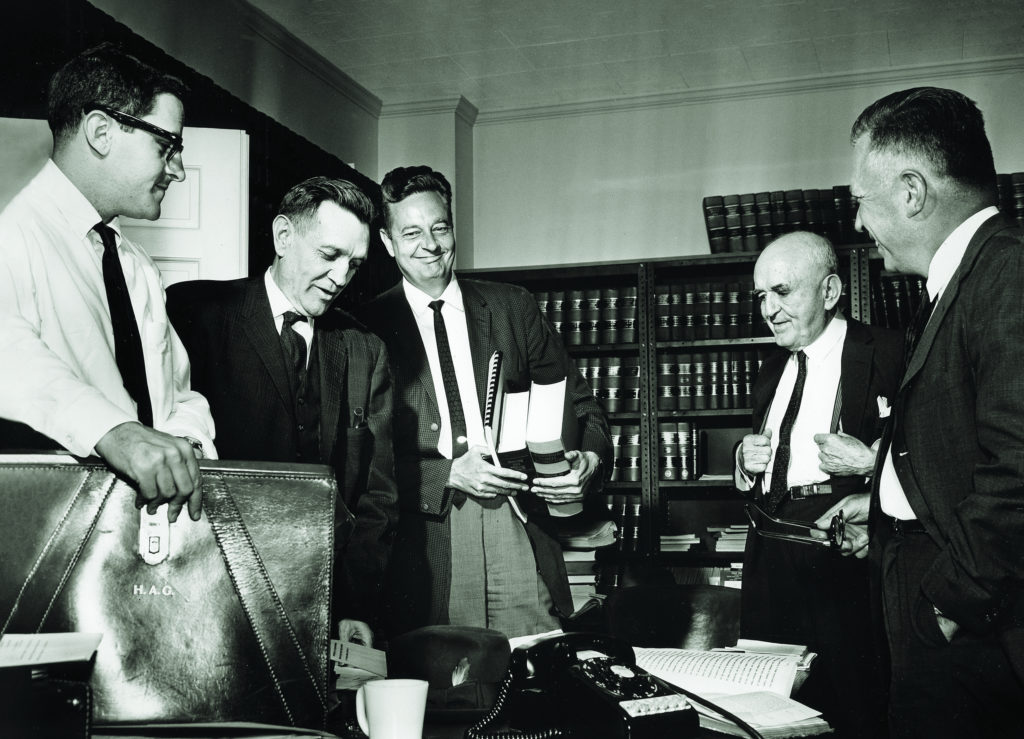
After spending the previous Friday impaneling a jury (most members of which turned out to be churchgoing farmers), all parties gathered for the start of the real legal drama on Monday, July 13, 1925. Approximately 600 spectators — including newspaper and radio reporters, along with a substantial percentage of Dayton’s 1,700 residents — elbowed their way into the Eighteenth Tennessee Circuit Court. Presiding was Judge John T. Raulston, who liked to call himself ‘jest a reg’lar mountin’er jedge.’ The crowded courtroom made the week’s stifling heat even more unbearable. Advocates on both sides of the case quickly resorted to shirtsleeves. The prosecution included Bryan, Circuit Attorney General Arthur Thomas Stewart, and Bryan’s son, William Jennings Bryan, Jr., a Los Angeles lawyer. For the defense were Darrow, New York lawyer and co-counsel Dudley Field Malone, ACLU attorney Arthur Garfield Hays, and Scopes’ local lawyer, John Randolph Neal.
The prosecution’s strategy was straightforward. It wasn’t interested in debating the value or wisdom of the Butler Law, only in proving that John Scopes had broken it.
“While I am perfectly willing to go into the question of evolution,” Bryan had told an acquaintance, “I am not sure that it is involved. The right of the people speaking through the legislature, to control the schools which they create and support is the real issue as I see it.”
With this direction in mind, Bryan and his fellow attorneys took two days to call four witnesses. All of them confirmed that Scopes had lectured his biology classes on evolution, with two students adding that these lessons hadn’t seemed to hurt them. The prosecution then rested its case.
THE Defense
Scopes’ defense was more problematic. Once a plea of innocence had been lodged, Darrow moved to quash the indictment against his client by arguing that the Butler Law was a “foolish, mischievous, and wicked act … as brazen and bold an attempt to destroy liberty as ever was seen in the Middle Ages.” Neal went on to point out how the Tennessee constitution held that “no preference shall be given, by law, to any religious establishment or mode of worship.” Since the anti-evolution law gave preference to the Bible over other religious books, he concluded, it was thus unconstitutional. Raulston rejected these challenges.
From the outset, defense attorneys focused their arguments on issues related to religion and the influences of a fundamentalist morality. Early in the proceedings, Darrow objected to the fact that Judge Raulston’s court opened, as was customary, with a prayer, saying that it could prejudice the jury against his client. The judge overruled Darrow’s objection. Later the defense examined the first of what were to be 12 expert witnesses — scientists and clergymen both — to show that the Butler Law was unreasonable and represented an improper exercise of Tennessee’s authority over education. When the state took exception, however, Raulston declared such testimony inadmissible (though he allowed affidavits to be entered into the record for appeal purposes).
With the defense’s entire case resting on those 12 experts, veteran courtroom watchers figured that this decision effectively ended the trial.
“All that remains of the great case of the State of Tennessee against the infidel Scopes is the formal business of bumping off the defendant …” harrumphed journalist H.L. Mencken after the sixth day of litigation. “[T]he main battle is over, with Genesis completely triumphant.”
So sure were they of a swift summation that Mencken and others in the press corps simply packed their bags and left town. Yet Darrow had a surprise up his sleeve. When the court reconvened on Monday, July 20, the ACLU’s Arthur Hays rose to summon one more witness: William Jennings Bryan.
“Hell is going to pop now,” attorney Malone whispered to John Scopes.
BRYAN ON the Stand
Calling Bryan was a highly unusual move, but an extremely popular one. Throughout the trial, the politician-cum-preacher had been the toast of Dayton. Admirers greeted Bryan wherever he went and sat through long, humid hours in court just for the opportunity to hear him speak. He’d generally been silent, listening calmly, cooling himself with a fan that he’d received from a local funeral home, and saving his voice for an hour-and-a-half-long closing argument that he hoped would be ‘the mountain peak of my life’s effort.’ But Bryan didn’t put up a fight when asked to testify. In fact, he agreed with some enthusiasm, convinced–as he always had been–of his righteous cause.
Judge Raulston, concerned that the crowd massing to watch this clash of legal titans would prove injurious to the courthouse, ordered that the trial reconvene on the adjacent lawn. There, while slouched back in his chair and pulling now and then on his signature suspenders, Darrow examined Bryan for almost two hours, all but ignoring the specific case against Scopes while he did his best to demonstrate that Fundamentalism — and Bryan, as its representative — were both open to ridicule.
Darrow wanted to know if Bryan really believed, as the Bible asserted, that a whale had swallowed Jonah. Did he believe that Adam and Eve were the first humans on the planet? That all languages dated back to the Tower of Babel?
“I accept the Bible absolutely,” Bryan stated.
As Darrow continued his verbal assault, however, it became clear that Bryan’s acceptance of the Bible was not as literal as his followers believed.
“[S]ome of the Bible is given illustratively,” he observed at one point. “For instance: `Ye are the salt of the earth.’ I would not insist that man was actually salt, or that he had flesh of salt, but it is used in the sense of salt as saving God’s people.”
Similarly, when discussing the creation, Bryan conceded that the six days described in the Bible were probably not literal days but periods of time lasting many years.
With this examination dragging on, the two men’s tempers became frayed, and humorous banter gave way to insults and fists shaken in anger. Fundamentalists in the audience listened with increasing discomfort as their champion questioned Biblical “truths,” and Bryan slowly came to realize that he had stepped into a trap. The sort of faith he represented could not adequately be presented or justly parsed in a court of law. His only recourse was to impugn Darrow’s motives for quizzing him, as he sought to do in this exchange:
BRYAN: Your Honor, I think I can shorten this testimony. The only purpose Mr. Darrow has is to slur at the Bible, but I will answer his questions … and I have no objection in the world. I want the world to know that this man, who does not believe in God, is trying to use a court in Tennessee —
DARROW: I object to that.
BRYAN: — to slur at it, and, while it will require time I am willing to take it.
DARROW: I object to your statement. I am examining you on your fool ideas that no intelligent Christian on earth believes.
It was a bleak moment in what had been Bryan’s brilliant career. He hoped to regain control of events and the trust of his followers the next day by putting Darrow on the stand. But Attorney General Stewart, who’d opposed Bryan’s cross-examination, blocked him and instead convinced the judge to expunge Bryan’s testimony from the record.
Bryan’s Last stand
Before the jury was called to the courtroom the following day, Darrow addressed Judge Raulston.
“I think to save time,” he declared, “we will ask the court to bring in the jury and instruct the jury to find the defendant guilty.”
This final ploy by Darrow would ensure that the defense could appeal the case to a higher court that might overturn the Butler Law. The defense also waived its right to a final address, which, under Tennessee law, deprived the prosecution of a closing statement. Bryan would not get an opportunity to make his last grandiloquent speech.
The jury conferred for only nine minutes before returning a verdict of guilty. Yet Bryan’s public embarrassment in Dayton would become legend — one that the prosecutor could never overcome, for he died in his sleep five days after the trial ended.
Scopes’ Coda
Following the trial, the school board offered to renew Scopes’ contract for another year providing he complied with the anti-evolution law. But a group of scientists arranged a scholarship so he could attend graduate school, and Scopes began his studies at the University of Chicago in September. Mencken’s Baltimore Sun agreed to pay the $100 fine Judge Raulston levied against Scopes. On appeal, the Tennessee Supreme Court ruled that the jury, rather than the judge, should have determined Scopes’ fine, but it upheld the Butler Law’s constitutionality. Darrow had hoped to take the matter all the way to the U.S. Supreme Court. Any chance of that, though, was foreclosed when Tennessee’s chief justice nullified Scopes’ indictment and threw what he called ‘this bizarre case’ out of the courts.
Not until April 1967 — 42 years after the Butler Law was passed, and 12 years after “Inherit the Wind,” a play based on the Scopes Monkey Trial, became a Broadway hit — did the Tennessee Legislature repeal the anti-evolution law.
Since then, a series of court decisions has barred creationists’ efforts to have their beliefs taught in public schools. Yet 75 years after the Scopes trial, debate over evolution still continues to simmer as states and education boards struggle with the subject that pits science against religion.
This article was written by J. Kingston Pierce and originally published in the August 2000 issue of American History Magazine.
historynet magazines
Our 9 best-selling history titles feature in-depth storytelling and iconic imagery to engage and inform on the people, the wars, and the events that shaped America and the world.