
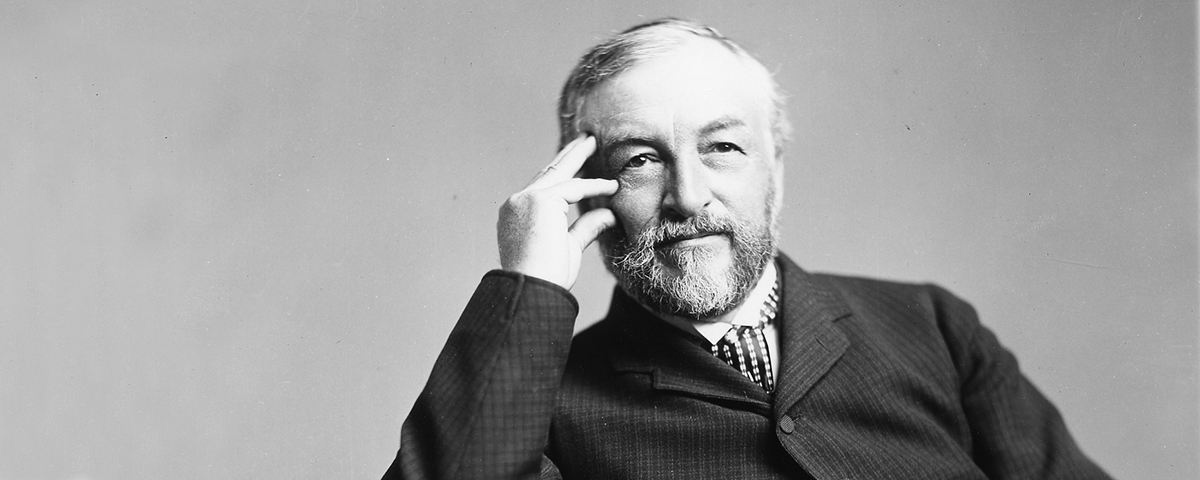
Samuel Pierpont Langley paced impatiently on the deck of a houseboat on May 6, 1896. His friend and fellow scientist, Alexander Graham Bell, stood nearby. The previous day, they had taken the train 41 miles from Washington, D.C., to the village of Quantico, Virginia. In a shallow, remote cove on the Potomac River, they watched nervously while workmen made final adjustments to the sixth in a series of experimental steam-powered flying models that Langley called “Aerodromes.” Finally, at 1:10 p.m., with the model’s propellers turning at maximum speed, Langley gave the signal to launch. When the launch lever was pulled, powerful springs catapulted the large model along its 20-foot launching rail. Takeoff!
Instantly, the left forward wing twisted to an acute angle, and the giant dragonfly barrel-rolled into the water with a mighty splash. After the crew pulled the wreckage from the river, Langley examined it. He declared that a truss wire had snapped when it snagged part of the launching apparatus, causing the wing to warp wildly out of alignment. Concealing his disappointment, he ordered immediate preparations to launch the remaining Aerodrome.
The 1890s witnessed an unprecedented period of scientific and technological growth in a variety of fields: Rudolf Diesel patented his engine in 1892; Henry Ford built his first auto in 1893; the Lowell Observatory was erected at Flagstaff, Ariz., in 1894; Guglielmo Marconi invented radio telegraphy in 1895; and hydroelectricity became a reality at Niagara Falls in 1896. Independently, several scientists and engineers began to experiment with powered heavier-than-air flight.

Scientists interested in aviation had to exercise the utmost care, however. This was a field in which reputations and even careers could easily be ruined. Aviators were considered cranks or crackpots by most newspaper reporters, but they were tolerated because of the provocative copy they provided—jumping off cliffs, bridges or barn roofs, emerging from their wrecked machines battered and bloody. Even more dramatic, sometimes they did not emerge at all. The public was generally amused by tales of such adventures because everyone knew that aerial navigation, like perpetual motion, was impossible. The serious enthusiasts were widely scattered: Lawrence Hargrave in Australia, Hiram Maxim and Percy Sinclair Pilcher in England, Louis Pierre Mouillard in France, Otto Lilienthal in Germany, Augustus Herring and Samuel Langley in the United States. Still, these pioneers found a way to communicate, informally united by French expatriate Octave Chanute of Chicago, who corresponded with most of the leading aeronautical inventors. His classic book, Progress in Flying Machines, was published in 1894. In that chronicle, spanning almost 400 years of thought, observation and experimentation, Chanute recorded and analyzed the primitive beginnings of flight. It was considered the bible of aerial navigation by enthusiasts of the era.
Langley became interested in astronomy in his youth. With his brother’s help, he labored many hours constructing several small telescopes. Although he had talents in mathematics and mechanics, he was not sent to Harvard like his older brother. Instead, Langley studied as an apprentice in an architect’s office. He moved west in 1857, establishing his own architectural firms in Chicago and St. Louis. By 1864, the Civil War had adversely affected his business, and Langley returned to Boston.
The war over and his architectural business in shambles, Langley decided to switch careers and pursue astronomy. Using family connections, he began a meteoric rise in the field. He was appointed assistant to the director of the Harvard Observatory in 1865. He served as assistant professor of mathematics at the U.S. Naval Academy in 1866, then became director of the observatory and professor of astronomy and physics at Western University of Pennsylvania at Pittsburgh in 1867. That position also included directorship of the Allegheny Observatory—a run-down facility lacking equipment, personnel and funding.
It was there that Langley proved to be a resourceful manager. While at the observatory he originated the practice of selling the exact time to the Pennsylvania Railway twice a day. When combined with the instantaneous communication of the telegraph, exact time allowed the maintenance of precise schedules at all stations along the line. During the next 20 years, Langley’s administration realized more than $60,000 from that idea—funds that were used exclusively for the observatory.
Recommended for you
Between 1870 and 1887, Langley’s devotion to the study of solar physics produced valuable information concerning the sun’s radiation spectrum. He also established the unit for measuring solar radiation that still bears his name: the langley. Colleges and universities around the world recognized the value of his research, awarding him honorary degrees, while his peers lauded his achievements. Langley’s new career was a splendid success, but he was not happy—he felt unfulfilled and intellectually isolated from mainstream science.
In an article published in the Aeronautical Annual for 1897, Langley revealed his lifelong curiosity about flight: “The subject of flight interested me as long as I can remember anything, but it was a communication from Mr. Lancaster, read at the Buffalo [N.Y.] meeting of the American Association for the Advancement of Science, in 1886, which aroused my then dormant attention to the subject….” Israel Lancaster, an amateur naturalist and aeronautical experimenter, presented a paper containing so many theoretical errors that it drew roars of laughter from the assembly of professionals. Since he gave no demonstrations, few believed Lancaster’s crude wooden flying models could soar without internal power for up to 15 minutes. Octave Chanute, who had planned the program, was disappointed, but his most prominent guest, Langley, left Buffalo enthusiastic about the new challenge. Was powered, heavier-than-air flight possible? A series of experiments would be required to discover the secrets of flight. New and original measuring equipment had to be invented. At 52, Langley felt invigorated—it was like starting his solar project all over again.
Langley’s large “whirling table” apparatus was constructed at Western University of Pennsylvania in 1887. He masked his intentions from the public by referring to the research program as “experiments in pneumatics.” The steam-powered device measured the lift and drift (drag) of flat surfaces set at various angles to air blowing at velocities up to 70 mph. About the same time, anemometers (wind gauges) and small lifting surfaces were hoisted to the top of tall poles to study wind currents and updrafts.
After launching those experiments, Langley was named the assistant secretary of the Smithsonian Institution by the then-current secretary, who died within the year. Langley, the natural choice as successor, was officially elected to the position toward the end of 1887. He moved to Washington, D.C., where he held the most influential and prestigious scientific position in the United States.
Langley supervised the continuing whirling table research from Washington, giving his assistants directions by letter and telegraph. Additional experiments, conducted in the spacious laboratories and shops of the Smithsonian, provided Langley with the necessary data to write his paper of 1891, “Experiments in Aerodynamics.” Perhaps his most significant conclusion was that “mechanical flight was possible with engines we could then build.”
In his paper of 1893, “The Internal Work of the Wind,” he arrived at startling conclusions concerning air currents and the power required to fly. Because of problems with apparatus and methods, some of Langley’s data was faulty, leading him to conclude that less power was required to fly fast than slow. Because of his scientific reputation, “Langley’s Law” was accepted—although tentatively—but would later be disproved.
To validate the results of his research, which had been questioned in some quarters, Langley started mounting stuffed birds, obtained from the Smithsonian’s vast archives, to the whirling table and measuring their lift and drift. Often there was not enough lift to raise the carcass.
Between 1887 and 1891, Langley’s staff constructed more than 100 models powered by twisted strands of rubber. None proved capable of staying airborne for more than six seconds. At that juncture, the team investigated every known alternative— electric motors and batteries, compressed-air motors, hot-water motors and even flywheels. All were too heavy. While carbonic acid (H2CO3) looked promising as a fuel, nagging technical problems dampened enthusiasm for that option. Germany’s Nicholas Otto had recently invented an internal combustion engine, but early examples were big, heavy and underpowered.
Lightness, strength and power were prerequisites for successful Aerodromes, and the steam engine seemed to be Langley’s last hope. Over the next five years, a tremendous effort was expended to optimize the delicate steam power plant. By 1896, the system consisted of an engine, burner, boiler coils, pump, fuel reservoir and associated delivery tubes and fittings. One example, which produced one brake horsepower, weighed only 7 pounds.
Langley, true to form, avoided theoretical considerations and resorted to empirical methods for determining the airframe design. Large rubber-band-powered test models (Nos. 30 and 31) were used to settle the wing configuration issue. Today those two models would be considered conventional—a monoplane and a biplane, each equipped with a Cayley-type cruciform tail. Yet a puzzling question remains: How did the final tandem-wing arrangement emerge from those test models? Whatever the reason, all Aerodrome models sported tandem wings.
Work began on the first Aerodrome in November 1891. (Langley’s numbering system for identifying the Aerodrome models gets confusing—his first model was No. 0, the second No. 1, the third No. 2, etc. Later, No. 4—the 5th model—was modified, becoming No. 6. According to Langley, Aerodrome No. 0 had “a single pair of large wings containing about 50 square feet, and a smaller one in the rear about half as much, or in all some 75 feet of sustaining surface, for a weight which…would not exceed 25 pounds.” Six months later, that first attempt at a working model was abandoned as hopelessly overweight. Three new Aerodromes (Nos. 1, 2 and 3) were built between June and November 1892. Different engines, burners, boilers, fuels, working fluids and a variety of construction materials were tried in the Aerodromes, all in an effort to save weight.
Determining the ideal size of the Aerodrome was an exercise in trial and error. The second prototype (No. 1), which was much smaller than its predecessor, was designed to operate on compressed air or H2CO3 acting on the piston of a modified steam engine. Its total supporting surface was only 6.5 square feet, but the engine was weak, producing only a fraction of the power required for flight.
The third model (No. 2) was steam-powered. It had a lifting area of 50 square feet and was larger than No. 1 but smaller than No. 0. It also turned out to be overweight and underpowered.
The fourth Aerodrome (No. 3), about the size of No. 2, showed the best power-to-weight ratio thus far, but Langley was not happy. “There was…,’ Langley said, “so much that was unsatisfactory about it, that it was deemed best to proceed to another construction before an actual trial was made in the field.”
Design and construction of the fifth Aerodrome (No. 4) began in December 1892. Its relatively small wings totaled 14 square feet, and the weight was a modest 10 pounds. Its power plant and propulsion system lifted 40 percent of the Aerodrome’s weight during static tests—the best performance yet.
No. 4 was ready by mid-March 1893, but Langley’s crew had difficulty throughout the summer and fall with the complicated overhead launching system. The apparatus used nine sturdy coil springs in tension, operating through two pulleys. A small launching cart, with the Aerodrome hung below, was to accelerate along the 20-foot track. At its end, an automatic release mechanism would free the model, allowing it to proceed in flight.
Langley believed until the end of his life that less power was required to fly faster than slower. In an Aeronautical Annual article, he wrote that “it is necessary for an aerodrome, as it is for a soaring bird, to have a certain considerable initial velocity before it can advantageously use its own momentum for flight, and the difficulties of imparting this initial velocity…are surprisingly great.” Believing the power requirements to be unacceptably high at lower velocities, Langley attempted to leapfrog the problem by launching at higher velocities.
Flight testing was always halted during the summer months while Langley and his family vacationed in Europe. By the middle of November 1893, however, everything looked ready for a trial. Aerodrome No. 4 was moved from the Smithsonian to the houseboat, anchored on the Potomac off tiny Chopawamsic Island.
Immediately, two problems surfaced. First, in mild breezes, the model swung wildly below the launch cart, jeopardizing a smooth run down the launch rail. Second, the burner, difficult to maintain in the best of circumstances, refused to stay lit. No attempt to launch could be made until those problems were corrected by Langley and his assistants. Over the next six weeks, nine round trips were made between the Smithsonian and the houseboat, but all efforts to make the launcher work proved fruitless.
Frustrated and desperate, in January 1894 Langley tried dropping the Aerodrome into a gentle breeze from an arm 25 feet above the water, hoping it would gain flying speed before it reached the river. Its propellers whirled at maximum rpm as No. 4 plunged straight into the frigid Potomac.
Another new Aerodrome was almost ready when Langley decided to concentrate his team’s effort on the abortive flight tests with No. 4. Throughout the winter and spring months of 1894, work proceeded to complete No. 5 and retrofit No. 4 with a bigger set of wings. No. 5 was a large machine, with a wingspan of 13 feet 8 inches, length of 13 feet 2 inches and height of 4 feet 1 inch. Weighing 30 pounds, it was fitted with a new and more powerful single-cylinder steam engine.
Trials resumed once again on October 7, 1894, after the summer layoff. The crew practiced using a new launching system. After a few throws with nonpowered “dummy” Aerodromes and some minor adjustments, the launcher seemed to be working perfectly.
The rebuilt No. 4 was prepared for flight at once. Unlike previous attempts, the model launched perfectly, but then the wings twisted, plunging it into the water.
Although it was late in the day, Aerodrome No. 5 was readied for a trial. Again, the launching system worked perfectly, but as the Aerodrome left the rail, it nosed up steeply, slowed and then slid backward into the Potomac. To everyone’s surprise, Langley was ecstatic. He thought he saw signs of progress for the first time.
Over the next two months, Aerodromes No. 4 and 5 were launched numerous times. The launcher continued to work well, but the models just would not fly. By late November, the team had again retreated to the warmth of the Smithsonian’s shops, where serious static experiments were conducted to determine the strength of the wings. As Langley ordered, No. 4 and No. 5 “were inverted, and sand was spread uniformly over the wings until its weight represented that of the machine.” Langley was shocked by the lack of stability and general weakness of the structure when loaded in that manner. More modifications were in order, including a new system of guy wiring for No. 5. The changes to No. 4 were so extensive that everyone felt justified in renaming it No. 6.
Quantico flight testing began again in early May 1895. Three attempts using No. 5 and No. 6 were considered failures. The longest time aloft was only six seconds.
After more than three years of intensive work, Langley was feeling pressure from many sources to show better results. His critics were becoming more vocal. Having exhausted all the available brainpower within the Smithsonian, Langley decided to conduct an outside search for technical help. He found Augustus Moore Herring.
“Gus” Herring’s father had instilled a lifelong fascination with flight in his preteen son by presenting him with a rubber-band-powered flying model. Soon young Herring began to design, build and fly his own models by trial and error. A few years later, while Herring was attending Stevens Institute of Technology in Hoboken, N.J., his father died, leaving his son independently wealthy and in a position to continue experimenting with flight. Young Herring developed several new flying models. One was actually a full-sized glider that flew but would not support his weight.
Herring completed four years of study in mathematics, engineering and drafting and then proposed a bold study for his required thesis: “The Heavier Than Air Flying Machine As a Mechanical Engineering Problem.” His professor rejected the topic as “fanciful,” an understandable reaction in 1888. Instead, Herring was assigned a topic on marine steam engines. Because he adamantly refused to work on the thesis, he didn’t complete his degree.
After leaving Stevens in 1888, Herring became a successful engineering consultant in New York City. He produced many progressive flying models, several of which are described in the Aeronautical Annual for 1896. Herring also had limited success in 1893 and ’94 with self-constructed replicas of Lilienthal-type monoplane gliders. Otto Lilienthal, the German gliding master, had captivated the imaginations of newspaper and magazine readers around the world since 1891. Herring built three similar gliders. In one of these machines, narrow control surfaces were hinged to the left and right sides of the wing’s leading edge. Connected by short handles, they were manipulated by the pilot to assist with pitch control. Later, he suggested that those surfaces could also be used for lateral control, thus anticipating ailerons.
Langley learned about Herring’s activities through a chance conversation with James Means, the influential editor of the Aeronautical Annual. Langley and Herring met in New York City on May 13, 1895, and Herring showed him the Lilienthal-type machines and some of his rubber-band-powered models. They discussed construction techniques, control and stability, steam engines, propellers and a host of other aeronautical topics. Langley was impressed. Before leaving for Washington, he offered Herring a position at the Smithsonian as “Overseer of the Work in Aerodromics,” for $150 per month.
Herring arrived in Washington late in the month. After a few days it became apparent that major problems existed between Langley and his staff. Although he hired overseers such as Herring, it was obvious that Langley never really believed in delegating authority. He constantly interfered with the workmen and confused everyone’s assignments. Langley kept control by demanding that his employees work within their job descriptions—while he absorbed their ideas. Herring alluded to that tactic in a letter to Octave Chanute, saying, “One of the disagreeable features [of Herring’s position] is Mr. Langley’s inability to distinguish between the ideas of other people and his own.” Langley demanded complete subservience from his employees. Anyone who did not agree with his methods was dismissed.
Herring’s first trip to the test site, in early June 1895, gave him firsthand knowledge of problems facing the program. A frustrated Langley decided that all further testing should be terminated until Herring analyzed the problems and made changes where necessary. The entire summer was set aside to address the situation.
Unfortunately, Langley continued to exert his stifling domination on the Smithsonian team. For example, he suddenly required his signature on all drawings produced by Herring before they could be turned over to workmen. In a letter to Chanute on June 25, Herring again vented his frustration with working conditions at the institution, pointing out that the situation “is likely to give them the impression that although I am in charge of the work, the Secretary does not trust me and is calculated to lessen their respect for my authority.” Fortunately for all concerned, it was time for Langley to leave for vacation. At Herring’s suggestion, his annual jaunt to Europe would include a visit with Lilienthal in Germany.
With the exception of Herring, Lilienthal was held in low regard by the workers in Washington. Langley believed that inherent stability was as important for manned flight as it was for free-flying models. Lilienthal was adamant concerning the need for pilot control. Langley felt that flat planes performed almost as well as curved surfaces and were easier to construct. Lilienthal saw advantages in curved surfaces, including their ability to produce high lift-to-drag ratios. And, of course, Langley believed that less energy was needed to fly fast than slow.
Herring reported that when Langley returned in September, he was “loud in his condemnation of several changes that were made to the Aerodromes, and several that were not.” Herring said that Langley’s compulsion to achieve visual perfection had required hundreds of additional man-hours to fit and polish dozens of metal components to instrumentlike perfection. Langley decided that the disrespectful Herring, the admirer of Lilienthal, was of no further use to him. Although it was late in November, he informed Herring that Aerodrome No. 6 must be tested at Quantico within a week. Recognizing that the secretary was forcing the issue by making unrealistic demands, Herring resigned. Langley postponed the tests.
Herring was not finished with aeronautics, however. He headed for Chicago to work with Octave Chanute. Within months, he would design and fly the most successful and influential man-carrying glider of the 19th century.
By the spring of 1896, Langley and his team had not produced one successful flight. Insiders at the Smithsonian whispered about Langley’s obsession and how it was beginning to affect the institution’s credibility, not to mention its coffers. Then came the watery failure of Aerodrome No. 6 on May 6, 1896. Soon afterward, having instructed his staff to ready No. 5 for a trial, Langley moved to a better vantage point on the shore of tiny Chopawamsic Island. As he stood alone watching the preparations, the nearly 62-year-old scientist thought about his career and wondered what the future held. Suddenly, the “All’s ready!” signal rang out from the scow.
This time, Edward Chalmers Huffaker was responsible for launching the machine. Forty-year-old Huffaker had earned a master’s degree in physics from the University of Virginia before becoming an aeronautical protégé of Octave Chanute. Impressed by Huffaker’s credentials, Langley had hired Edward to assist with the Aerodrome project. Later, because of Chanute’s influence, Huffaker was an invited guest of the Wright brothers for their 1901 gliding trials near Kitty Hawk, N.C.
Alexander Bell, the official observer, was on the port deck with a nervous Smithsonian photographer who had earlier missed taking a photograph of No. 6 splashing into the Potomac. Langley had angrily told him not to let it happen again. When the steam pressure reached a predetermined 150 pounds, the signal was given to go. At 3:05 p.m., Aerodrome No. 5 catapulted from the launch rail. Unlike earlier attempts, the throw was perfect—slightly nose high with its wings level. At first, the machine dropped three or four feet but then began to climb as it headed into a slight breeze from the north. The workmen, accustomed to hauling soaked and broken Aerodromes out of the water after a failure, were astounded to see the big dragonfly actually remain aloft.
The machine started a gentle right turn, passing almost directly over Langley’s head. It continued flying this pattern until it reached a maximum estimated altitude of 80 feet. After about one minute and 20 seconds, the propellers suddenly stopped turning, probably from lack of steam to the engine. To everyone’s surprise, the model glided beautifully for another 10 seconds before landing lightly on the surface of the bay, 425 feet from the houseboat. The Aerodrome had made three complete circles, each with an estimated diameter of 300 feet, as it drifted to the northwest. Calculations revealed that it had traveled about 3,300 feet in 90 seconds, generating a speed of between 20 and 25 mph.
Shouts, applause and cheers erupted from the astounded members of the launch team and observers. Everyone knew they had just witnessed history, a first in aerial navigation.
The workmen retrieved the machine, then dried and carefully re-guyed the wings, one of which had sustained a kink. Langley believed that the shock of launching or the air pressures of flight might have caused the problem. He also suggested that the right-hand turn may have been caused by the wing’s misalignment.

No. 5 was ready to fly again within two hours. At exactly 5:10 p.m., the model was off on another successful flight. As before, the Aerodrome made three ascending circles to the right, reaching a maximum altitude of 60 feet. When the propellers finally stilled, the model pitched slightly nose down and glided majestically to a perfect water touchdown. Calculations showed it had flown about 2,300 feet.
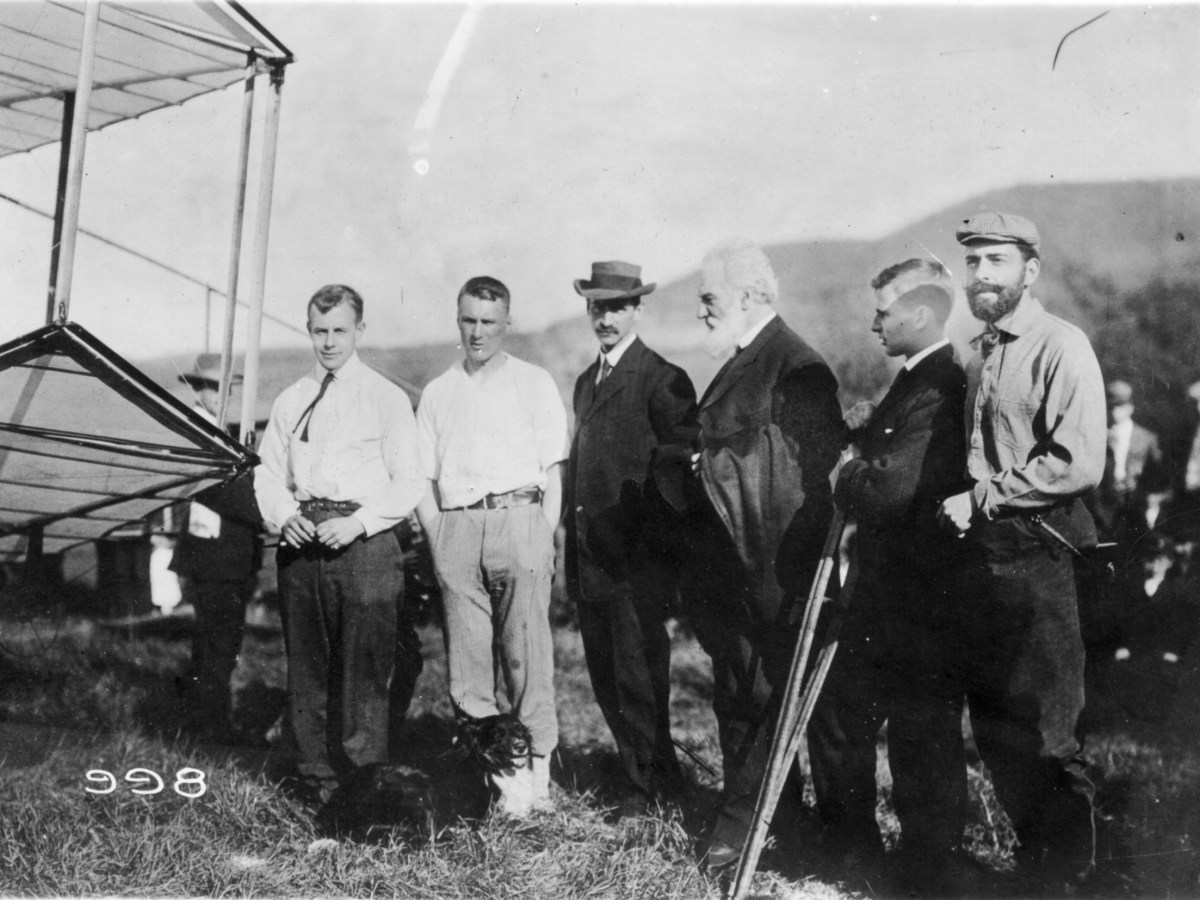
It was Alexander Graham Bell’s privilege to inform the scientific world of Langley’s triumph. “It seems to me that no one who was present on this interesting occasion could have failed to recognize that the practicality of mechanical flight had been demonstrated,” said Bell. Critics, including Britain’s renowned scientist, Lord Kelvin, would have to admit that he was right after all. Langley was prompt in sending Bell’s detailed account of the flights to prestigious international scientific and popular journals of the day. The news inaugurated a change in perception about heavier-than-air flight—maybe aviation was not just for cranks after all.
Before he left on his annual European excursion, Langley had directed the staff to prepare Aerodrome No. 6 for flight when he returned in the fall. Everything was ready on November 27, but the weather was wet and windy until late in the afternoon. With propellers whirling, the flying machine was thrust into the gentle breeze. Almost immediately it began to bank, causing the nose to drop. The flight ended 612 seconds later. Inspection revealed a defective transmission component that allowed one propeller to spin faster than the other, causing the bank.
Saturday, November 28, started out wet and windy, but conditions gradually improved. At 4:20 p.m., the Aerodrome was launched into a gentle breeze from the south. That time it flew, proceeding in a gentle climbing turn to the right and reaching a maximum altitude of about 30 feet. At one point, observers feared that the machine might collide with tall trees along the west bank of the bay. Fortunately, it simply followed the curved contour of the shoreline—almost as if it had eyes. After one minute and 45 seconds, the Aerodrome lightly touched down in the bay. Calculations showed it had traveled 4,200 feet at 30 mph. Langley now had two successful Aerodromes.
If Langley had stopped there, he would have earned a well-deserved place in history for demonstrating the practicality of heavier-than-air flight. However, the War Department was impressed with his accomplishments. By 1898, with the Spanish-American War near, the military decided to finance the development of a man-carrying flying machine.

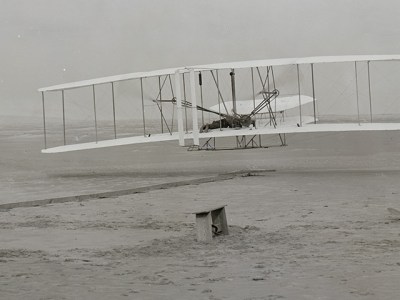
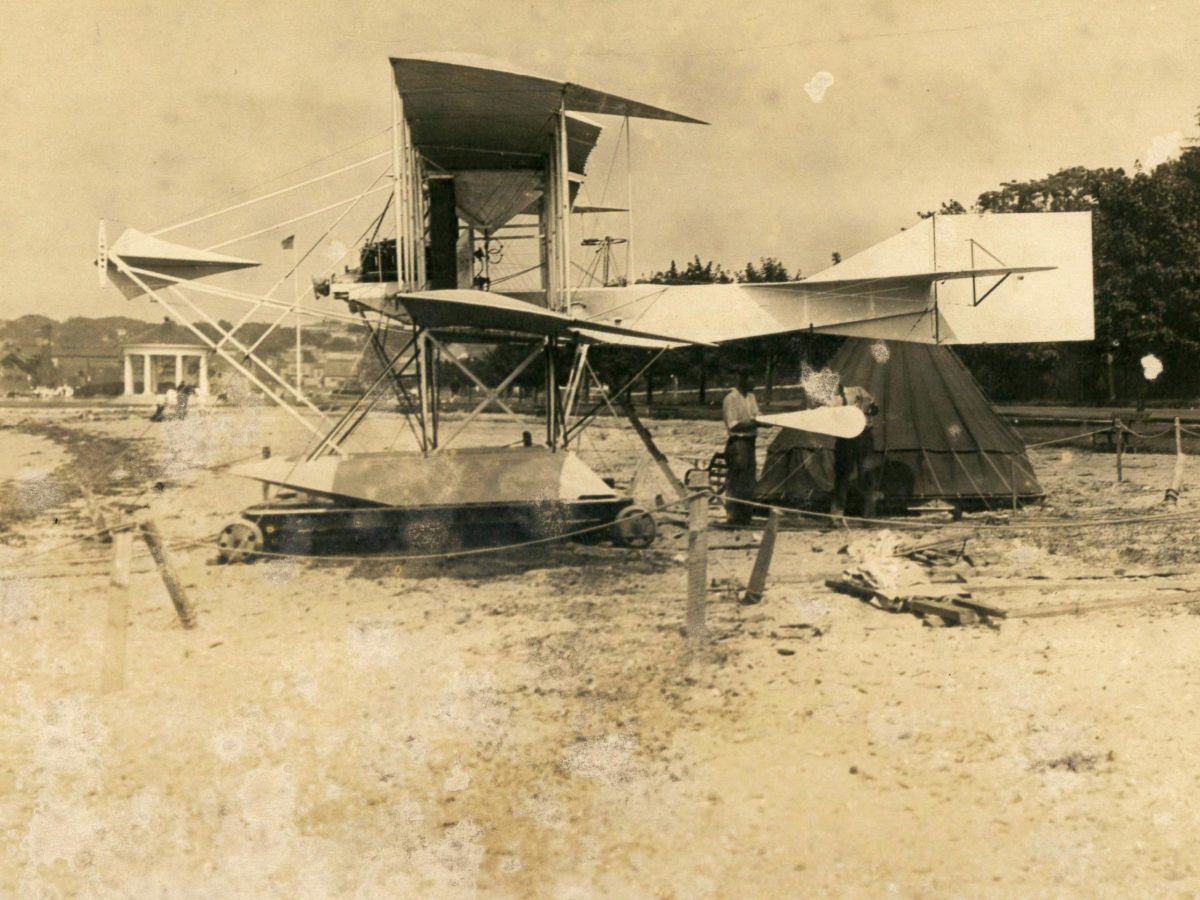
Over the next five years, Langley developed a scaled-up version of Aerodrome No. 5. Powered by a gasoline engine, the “Great Aerodrome” experienced similar problems to those of early steam-powered models. On October 7, 1903, the machine snagged on part of the launching mechanism and plunged into the Potomac like “a handful of mortar.” Two months later, on December 8, a similar misfortune caused the Great Aerodrome to collapse in midair. Fortunately, Langley’s chief engineer and designated pilot, Charles Manly, was unhurt in both accidents. But these failures would continue to haunt Langley. With money exhausted and public opinion running heavily against him, Langley reluctantly abandoned his quest for powered, manned, heavier-than-air flight. Ironically, nine days after Langley came to that decision, the world’s first successful flights of that kind were performed by Wilbur and Orville Wright at Kill Devil Hills.
This story was originally published in the July 1998 issue of Aviation History. It was written by C. David Gierke, who is the author of more than three dozen magazine articles concerning aviation. For further reading, he recommends: A Dream of Wings, by Tom Crouch; “Augustus M. Herring,” by Eugene Husting, in W.W.I Aero, No. 130, November 1990; and Langley’s Model Aero Engine of 1903, by Robert B. Meyer, Jr.
For more great articles subscribe to Aviation History magazine today!