
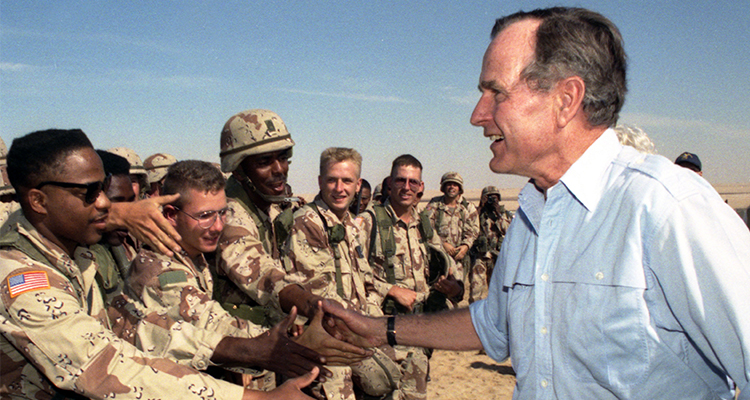

At the end of the cold war, 20 years ago, the first President Bush established a geopolitical policy aimed at bringing about a more secure and peaceful world. Mostly through the use of military forces, that policy, the “New World Order” and its successors, preserved what had been won during the cold war and expanded democracy’s reach.
Casualty and other war statistics suggest that despite terrorism’s terrible toll, the New World Order really has created a more secure world.
Obscured both by the rise of terrorism in the last two decades and the United States’ role in the increasingly unpopular war in Iraq is the startling fact that the world—because of that new order imposed by America and its allies—is a far safer place today than it was during the cold war. There have been many fewer combatant deaths and wars in recent years, period. In fact, recently released figures indicate a 60 percent decline in major war battle deaths during these last two decades than were suffered in the much bloodier cold war era, chiefly due to a 57 percent decline in the number of major wars.
Why? First, there has been an enormous reduction in the number of innocent civilian deaths through acts of genocide. Second, the United States and its allies have laid the groundwork for and have overseen the dramatic worldwide increase in electoral governance. Indeed the age-old practice of territorial conquest has practically disappeared, whatever deadly saber rattling there has been in the Gaza Strip and South Ossetia. And the rule of law, an essential component of security and stability, is also on the rise: a permanent institution is now steadily investigating, indicting, convicting, and punishing those who commit war crimes and crimes against humanity. In short, it has been a brief but extraordinary era, one vastly different and far more peaceful than the preceding 40-year-long cold war.
What would become the central foreign policy aim of three successive American presidents has been explained in many ways and known by various names, but its origin can be traced to the first White House strategy meeting several weeks after the January 1989 inauguration of George Herbert Walker Bush and nine months before the fall of the Berlin Wall. It was a time of growing destabilization in the Soviet Union. Moscow’s control over East European communist regimes was in tatters. And there was unprecedented, open resistance to China’s communist government by prodemocracy student protesters. With external threats diminishing rapidly, many Americans believed the United States would lapse into its traditional postwar default position, withdrawing its armies from abroad and reducing the size of its armed forces, with the pleasant prospect of managing the “peace dividend”: all that surplus tax money from a much smaller defense establishment.
At the meeting, Secretary of State James Baker suggested negotiations with the Soviet Union for a simultaneous withdrawal of armored forces from the inter-German border. The secretary of defense, Dick Cheney, largely supported by the CIA director, Robert Gates, disagreed and proposed taking a wait-and-see attitude.
The president rejected both recommendations. He did not want the United States to lose the initiative in a time of change. He believed America should lead, not follow. And, he wanted bold, far-reaching initiatives. Instead of a return to normality, Americans were destined to ponder the meaning of a term the president used to describe his new policy: the New World Order. Over the next two decades, they would see U.S. forces in 130 different countries, American troops in near continuous combat in strange and dangerous places, and a new, self-imposed role as the world’s reluctant sheriff.
Before his first year in office was out, the first president Bush sent a heavily armed, 24,000-man task force to Panama, removed from power the thuggish drug trafficker, Manuel Noriega, and installed a legitimate government. When Saddam Hussein seized Kuwait the next year, the United States organized a massive military coalition, defeated the Iraqi army, and reinstalled Kuwait’s emir. It’s been that way ever since in Bosnia-Herzegovina, Kosovo, Haiti, Afghanistan, once more in Iraq, and in that ignoble failure in Somalia. Succeeding administrations have often called the policy something else, “Engagement” or the “Global War on Terror,” but at its heart it is still the New World Order with unchanged tenets: aggression must be punished, not rewarded; democracy must be expanded and supported; and peace gained is to be safeguarded—almost anywhere.
By key measures, the last 20 years has been an extraordinarily successful period of global policing by America and its allies. Little-noted present-day studies of the world’s armed conflicts show a dramatic decrease in the number of major wars and battle deaths during the last two decades. Reports through calendar year 2007 from institutions in the Swiss-backed International Relations and Security Network (ISN) state that the incidence of major wars (conflicts with at least 1,000 war-related combatant deaths per year) has fallen from 32 in 1990 to 19 in 2003 and to 14 in 2007.
In 2007, this same report from the Stockholm International Peace Research Institute, which has been keeping track of major wars since the 1960s, identified ongoing major conflicts in Somalia, Colombia, Peru, Afghanistan, India (Kashmir), Myanmar, Sri Lanka, Russia (Chechnya), Iraq, Israel (Palestinian territories), and Turkey (Kurdistan). The institute also concluded there were two separate major wars being conducted in the Philippines, one of which was limited to the island of Mindanao. Also, 2007 marked a rare fourth consecutive year when no new major war was initiated. What is more, this decline was achieved in the face of a growing number of nations capable of beginning a war. There was a dramatic increase in the number of countries in this period: 170 in 1990 became 193 at the beginning of 2008, a 12 percent increase.
Of the major conflicts, interstate wars were the most deadly. One ISN study from the Vancouver, Canada–based Human Security Project concluded that since 1946, interstate conflicts averaged 34,677 combat deaths among opposing forces per year, while intrastate conflicts averaged far less—some 2,430 combatant deaths per year. For a broader perspective, combatant deaths in a single average major interstate war were 35 percent higher than the total worldwide deaths from terrorism for calendar year 2007.
The decline in the number of major wars has, of course, resulted in a substantial decrease in the loss of human life among fighting combatants. Worldwide annual battle deaths averaged about 300,000 in the 1950s, 170,000 in the 1960s, and 125,000 in the 1970s. They rose to about 150,000 in the 1980s, then dropped to 80,000 to 90,000 per year in the early 1990s. Since then, annual worldwide battle deaths have plummeted about 60 percent to an estimated 25,000 to 33,000 combatant fatalities per year. Even by adding worldwide terrorism deaths (mostly civilians) to these latter 21st-century combatant estimates, the annual number of deaths due to major wars and terrorism incidents would be in the range of 45,000 to 55,000 per year. As in the case of the decline in the number of major wars, this welcome change was made in the face of more potential soldiers who could have been conducting combat. During the last two decades, the world population soared from 5.3 billion to 6.7 billion, a 23 percent increase.
Due in major part to U.S.–led military operations during these initial two decades of the post–cold war era, freedom and democracy around the globe have blossomed. Freedom House, an organization that has assessed the world’s status of individual political rights and civil liberties since 1972, reports substantial growth in these last 20 years in the number of countries that adhere to the standards set forth in the 30 articles of the Universal Declaration of Human Rights. The articles include the right to life, liberty, and security; equality before the law; freedom of movement and religion; ownership of property; and universal and equal suffrage. In its 1989 survey, Freedom House staff members, augmented with regional experts and scholars, concluded that less than half (41 percent) of the world’s nations could be considered electoral democracies. Using the same standards in its 2007 survey of 193 countries, 64 percent were electoral democracies.
The United States and its allies have also stabilized enough troubled territory in the last two decades to make these strife-laden lands safe enough to introduce peacekeepers. During the last 20 years, peacekeeping forces and peacekeeping missions have steadily grown. In 2007, another record was broken when a total of 61 peace operations were conducted, employing a record high of almost 170,000 military and civilian personnel from 119 countries.
At the beginning of the American-led coalition’s advance to liberate Kuwait on January 16, 1991, President Bush told the American people, “We have before us the opportunity to forge for ourselves and for future generations a new world order—a world where the rule of law, not the law of the jungle, governs the conduct of nations.” That wish was transformed into reality in the 1990s with the establishment of the International Criminal Tribunal for the former Yugoslavia in The Hague. As of November 2008, that court has indicted 161 people for violations of international humanitarian law, including such notorious figures as Radovan Karadzic and Slobodan Milosevic. As of 2008, 24 of those indicted had been found guilty and had been sentenced to terms of imprisonment.
In 2002, a permanent standing international court was created with a global jurisdiction, the International Criminal Court (ICC), in The Hague—despite some U.S. resistance. (Since the United States is more likely than any other state to combat the world’s miscreants, its soldiers are more vulnerable than others to charges of misconduct.) However, Status of Forces Agreements are usually worked out with nations where U.S. forces are located. Many of these agreements exclude American soldiers from indictments. The parade of accused war criminals or participants in genocide has begun. The path leads through arrest, trial, judgment, and incarceration. The ICC is currently investigating crimes against humanity and war crimes committed in the Democratic Republic of Congo, Uganda, the Central African Republic, and Sudan.
Has it been worth it? The New World Order, or whatever we choose to label the current endeavor of the volunteer U.S. armed forces, was launched in 1989. It has both costs and benefits. For Americans, the highest cost has been in the lives of American servicemen and -women. U.S. battle deaths in Panama, the Gulf War, Somalia, Haiti, and in Afghanistan and Iraq (the latter two as of December 2008) are short of 4,500—roughly 225 per year. By comparison, about 81,173 Americans, many of them draftees, died in battle during the 40-year-long cold war in two armed conflicts in Korea and Vietnam. The average annual rate of American battle deaths during the entire cold war was about 2,030 per year—almost 10 times that of the last 20 years. The annual monetary cost of the American defense establishment during the last 20 years has been relatively modest compared with that of the cold war. As a percentage of the U.S. GDP, defense costs amounted to about 12 percent of GDP during the Korean War, dropping to approximately 10 percent during the Vietnam War. At the end of the cold war, the average defense costs were near 5 percent of GDP. During these last two decades, costs have dropped to an average of about 4 percent of GDP, or less than one-half the burden borne by American taxpayers during most of the cold war.
 What of civilian deaths in the last two decades at the hand of a government, military forces, or groups deliberately killing innocents? Statistics are notoriously imprecise on the number of civilian deaths attributed to collateral battle damage. Those governments or individuals seeking to represent civilian victims in these cases will often exaggerate the number of lives lost for propaganda purposes and the perpetrators will almost invariably minimize the estimates. Calculations of the number of civilian deaths of innocents purposely caused by armed forces, religious or ethnic groups practicing genocide or other such crimes against humanity are marginally more accurate than counts of civilian victims of collateral battle damage—if those reports are made reliable by respected nongovernmental groups and organizations.
One such study conducted by six European scholars was published in Paris in 1997. These researchers restricted their examination to the crimes perpetrated by communist regimes. The criteria employed were those defined in the Charter of the International Military Tribunal of 1945 during the Nuremberg Trials. Crimes included summary executions, starvation through man-made famine, deportation deaths during transit or forced labor, and disease due to deprivation of basic necessities. Discounting the millions of deaths in the Soviet Union from 1917 until 1989, communist regimes during the cold war (1949–1989) are estimated to have caused approximately 74 million civilian deaths (China, 65 million; Cambodia, 2 million; North Korea, 2 million; Africa, 1.7 million; Afghanistan, 1.5 million; Vietnam, 1 million; Eastern Europe, 1 million; and Latin America, 150,000). The annual rate of communist killing of civilians during the cold war averaged 1.85 million per year. In this gruesome category of butchery, the succeeding 20 years has been far more peaceful.
 Post-1989 estimates of the death toll of crimes against humanity (as they are now called) clearly show a massive reduction in the loss of innocent lives when compared to similar criminal activity during the cold war. The most prominent cases in the current era include grim events in East Timor, Rwanda, Bosnia-Herzegovina, Kosovo, and Darfur (Sudan). The wanton killing in East Timor has been calculated as high as about 200,000. The 1994 disaster in Rwanda is estimated to have cost the lives of about 800,000 innocent tribesmen. The number of civilians slaughtered in Bosnia-Herzegovina, 1992–1995, was approximately 200,000. In Kosovo during 1998–2001, an estimated 4,400 to 10,000 civilians are believed to have been purposely murdered by Serbian ground forces, and from 200 to 400 Serb civilians are thought to have been deliberately killed by the Kosovo Liberation Army. Crimes in Darfur are estimated at approximately 400,000 civilian deaths since 2003. The average annual rate of civilian deaths due to international crimes against humanity is roughly 80,500 or about 95 percent less than that rate during the badly misnamed cold war.
Allied operations have forestalled or curtailed genocidal acts against Iraqi Kurds and Muslims in Bosnia and Kosovo. America and its allies did not intervene in Rwanda or Darfur. The Western policy in Africa has usually been to assist African nations in solving their own problems. For example, in 1997 the United States established and has since operated the African Contingency Operations Training and Assistance program. The program’s partners include 19 African governments that have participated in peacekeeping training in preparation for active operations in the Democratic Republic of Congo, Ivory Coast, Liberia, Burundi, Darfur (Sudan), Somalia, and Lebanon.
There have been important political benefits as well. Since 1989, the United States has successfully prevented aggressors from conquering territory. America has eliminated rogue regimes and sided with friendly nations in defeating either internal or external malevolent opponents. These largely unprecedented American military intrusions—such as those in Panama, Iraqi-conquered Kuwait, Haiti, Bosnia-Herzegovina, Kosovo, Afghanistan, and elsewhere—put would-be attackers on notice they would risk facing the world’s most powerful military force.
Undoubtedly, that potent deterrent effect has had much to do with the decline in the outbreak of interstate wars since the end of the cold war. The number of major wars has been cut by more than half and the number of battle deaths has been slashed by about 60 percent. The number of intentional mass killings of civilians has been drastically reduced since the cold war as well. Allied interventions from 1989 until 2008 played a major role in bringing about the important political gain of seeing the percentage of the world’s democracies rise by 35 percent, so that the majority of countries in the world in 2008 maintained acceptable standards of individual political and civil rights. Among the benefits of this phenomenon is a more peaceful world, since democracies rarely, if ever, fight one another.
There is also the positive aspect of the creation of the International Criminal Court. That institution would probably never have seen the light of day without the military operations of America and its allies to identify crimes and criminals that violate international laws, and then to pressure nations to arrest and offer up their citizens who have been guilty of war crimes and crimes against humanity.
In pursuing a New World Order, the United States has secured Western gains made during the cold war, extended democracy’s borders, defeated aggressors, and expanded peacekeeping. The price included worldwide, round-the-clock military operations, lives of American servicemen and -women and daily censure from the world press and those foreign leaders who prefer to criticize the United States rather than offer support or alternative solutions. In the face of these costs, future American leaders may decide on a more passive, less risky course. But whether or not future policymakers continue to support the New World Order, the numbers tell the story: These last 20 years were an historic and fruitful era, when global peace, security, and justice were dramatically extended and nurtured. MHQ