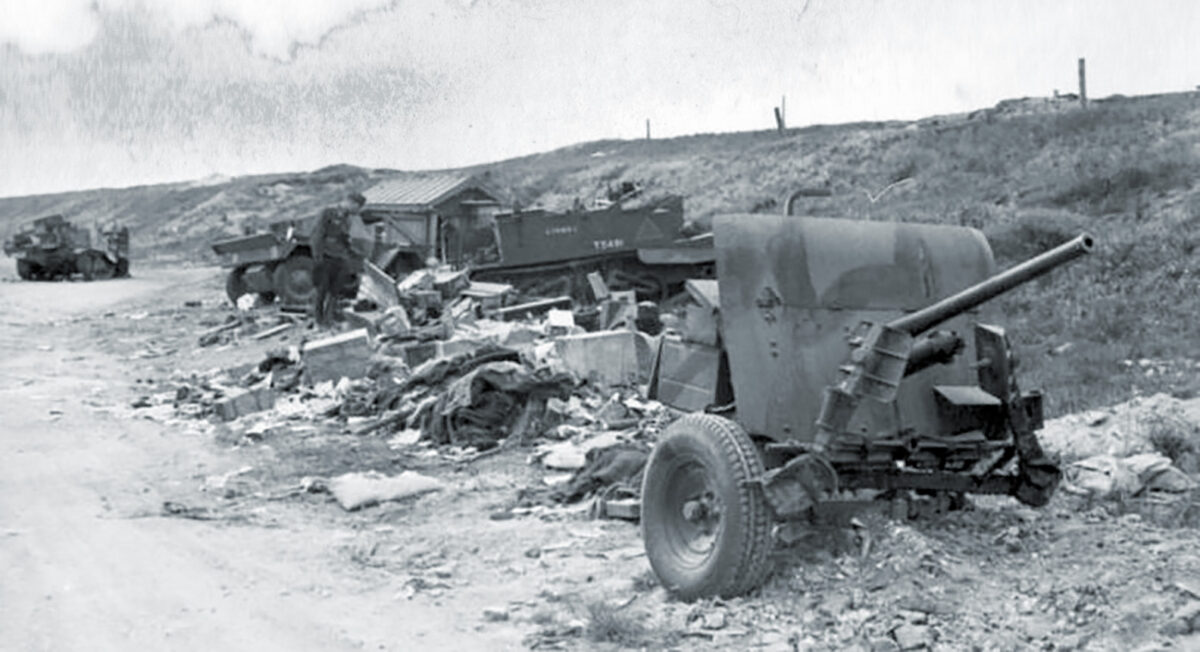
When the English Channel port of Boulogne fell to the Germans on May 25, 1940, the troops defending Calais a little to the north were the only line of defense between the German panzers and the remnants of the British Expeditionary Force (BEF), desperately hoping for evacuation from Dunkirk.
At 9 p.m. that evening, Prime Minister Winston Churchill sent the following communiqué to the British commander at Calais, Brigadier Claude Nicholson: “Every hour you continue to exist is of the greatest help to the BEF. Government has therefore decided you must continue to fight. Have greatest possible admiration for your splendid stand. Evacuation will not (repeat not) take place, and craft required for above purpose are to return to Dover….” Churchill wrote later, “One has to eat and drink in war, but I could not help feeling physically sick as we afterwards sat silently at the table.” As he did so, the defenders clung grimly to their positions, fighting until the following evening when their heroic resistance finally petered out. If one episode might be said to have permitted the miracle of Dunkirk to succeed, then it is probably the defense of Calais.
The German forces that crossed the frontiers of the Netherlands, Belgium and France on May 10, 1940, so completely succeeded in their aim of cutting through the Allies’ defenses that within 10 days they had reached the Channel coast and cut the BEF and a French army off from the rest of France. On May 19, the commander in chief of the BEF, General John Vereker, 6th Viscount Gort, warned the British War Office that it might have to consider evacuating the BEF. The same day, discussions began between the War Office and the Admiralty under the code name “Dynamo” about the “possible but unlikely evacuation of a very large force in hazardous circumstances.”
Following an enforced day of rest, the panzers were on the move again on May 22. Having reached the coast near St. Valéry two days earlier, they were now instructed to swing northeast toward the Channel ports. Resistance was patchy and disorganized, and by the evening they had reached the gates of both Boulogne and Calais. The next day, the 1st Panzer Division was moved from the gates of Calais to attack the British toward the line of the Aa Canal to the east, and the 10th Panzer Division was brought in to mop up the defenders of the famous old port. The 20th (Guards) Brigade was holed up in Boulogne, where the medieval ramparts proved more formidable than expected, while in Calais a defense was being hurriedly prepared.
Calais had been used extensively throughout the so-called “Phoney War” period as a transit camp for men on compassionate leave. On May 20, Colonel R.T. Holland was appointed base commandant and ordered to arrange for the evacuation of “useless mouths.” At the same time, the anti-aircraft defenses were to be greatly improved and the 6th Heavy Anti-Aircraft Battery, Royal Artillery (RA), the 172nd Light Anti-Aircraft Battery, RA, and the 1st and 2nd Searchlight batteries were moved up from Arras and deployed in a semicircle around the town. Over the next four days, Holland began the process of evacuation on steamers from the Gare Maritime, while combat troops arrived on incoming vessels. In the meantime, he located some 150 noncombatants in the town, and a platoon of Argyll and Sutherland Highlanders was detailed to guard a Royal Air Force (RAF) radar station. There were also 1 1/2 French infantry companies based at Fort Risban, to the west, with two field guns at the citadel and a number of other French troops manning the coastal defenses.
There was considerable confusion throughout the next few days, with contradictory orders and a lack of firm control, so that it was not clear to anybody if the Channel ports were even to be defended. At 10 p.m. on May 21, Lt. Col. Reginald Keller was taking his wife to dinner on the eve of his expected departure for France when he was called to the telephone. He was ordered to return immediately to his unit, the 3rd Battalion, Royal Tank Regiment (RTR), for embarkation. After putting out calls in local cinemas and pubs, only one officer and 25 men were missing when the unit entrained for Dover at midnight. The tanks, however, were buried in the hold of the ship City of Christchurch in Southampton when the men left aboard Maid of Orleans at 11 the next morning. Arriving at the Gare Maritime at 1:15 p.m., they had no knowledge of their vehicles until they appeared out of the mist at 4 p.m. Had either ship been hit in the meantime, the battalion would have been useless.
Amid a mass of confusion and panic as refugees and noncombatants struggled to make good their escapes, Keller managed to locate Holland, who told him to get unloaded as soon as possible. At that point, Lt. Gen. Sir Douglas Brownrigg, adjutant general of the BEF, appeared on his way to be evacuated. He ordered Keller to “move into harbor at the Forêt de Boulogne and get in touch with 20th (Guards) Brigade.” Fortunately for Keller, he would be unable to comply with that order. Some three hours after the conversation, elements of the 1st Panzer Division were occupying the Forêt de Boulogne.
The unloading went slowly. Visits from the Luftwaffe were compounded by the discovery that all the weapons were packed in mineral jelly, and that many parts for weapons, vehicles and radios were missing. During the night, contradictory orders were received from Gort’s headquarters and from Brownrigg (now safely ensconced in Dover). A patrol of light tanks was sent out at 6:30 a.m., May 23, but ran into trouble, and the unloading was still incomplete when Keller decided that he must try his best to follow Gort’s instructions and move toward St. Omer in the opposite direction from Boulogne. At 2:15 p.m., his column moved out through a dense swarm of refugees. After a mile, they saw an armored column halted under some trees. Major Quentin Carpendale described what happened: “I moved my troop across country to investigate and thought they must be French because I had never been led to believe that there was any chance of meeting Germans in force. We came upon the column which was stationary and resting and they were as surprised to see us as we them—there was only 20 yards between us when I realized they were Germans. An officer fired a revolver at my head as I was looking out of the turret.”
Keller was forced to retire to the village of Coquelles. There he was told that Brigadier Claude Nicholson wanted to meet him. “Get off the air,” he replied. “I’m trying to fight a battle!” Around 5 p.m., the two met at the village, and Keller learned that Nicholson had been appointed commander of the Calais garrison, which included Keller’s command. Known collectively as the 30th Brigade, formed the previous April for service in Norway, the infantry component was comprised of the 2nd Battalion, King’s Royal Rifle Corps (KRRC), and the 1st Battalion, The Rifle Brigade (RB), both of which were regular motor battalions, and the 1st Battalion, Queen Victoria’s Rifles (QVR), which was a Territorial Army motorcycle battalion.
The latter was equipped and trained to act as divisional cavalry for the 1st London Motor Division, a home-defense formation. The commanding officer, Lt. Col. J.A.M. Ellison-McCartney, was the bursar of Queen Mary College of the University of London. Many of his best men were away attending officer training courses or had returned to industry. In their place, he had 200 militiamen, but the unit was hopelessly ill-equipped, even to undertake its intended role. A third of the men were armed only with pistols, for which they had received no training. Having received orders to move overseas, they were then told that they could not take their transport and arrived on the quayside at Calais in circumstances very similar to those of the 3rd Battalion, RTR, on the afternoon of May 23. Colonel Holland was astonished to find that a motorcycle battalion had been ordered to leave its transport in England; nevertheless, he directed them to block the six main roads into town, an enormous perimeter for less than 600 men with no transport.
The Green Jackets of the 1st Battalion, RB, under Lt. Col. Chandos Hoskyns, and the 2nd Battalion, KRRC, commanded by Lt. Col. Euan Miller, were much stronger and better equipped, as well as being prewar Regulars from regiments with outstanding traditions. The first to arrive on May 23 were the men of the 2nd Battalion. They had made a long and difficult journey from East Anglia via Southampton and were fortunate to be short only a few scout cars. Embarkation was a complete muddle as overzealous staff officers took over the proceedings, and the regimental officers were pushed to one side. Consequently, disembarkation was equally chaotic as men were separated from their units. Accompanying the battalions were the 229th Anti-Tank Battery, RA, and Brigadier Nicholson and his headquarters staff. However, nobody in either battalion was at all clear as to what was expected of them.
During the crossing, as they were subjected to air attacks and the sound of gunfire ashore grew louder and more distinct, Nicholson directed the first unit off to take the right side of the town. Thus, the 2nd Battalion, KRRC, marched by companies along the south edge of the Bassin des Chasses de l’Est, arriving at 2:30 p.m. to await their transport. The 1st Battalion, RB, took a position in the sandhills to the north. Major Alexander Allan wrote an account of their arrival: “Broken glass from the station and hotel buildings littered the quay and platforms in which many bomb craters were visible besides overturned and bombed trucks on the lines.” Troops were being loaded for the return journey to England. “These troops were in the main non-combatant personnel, RAF ground staff, HQ clerks, etc., who suffered a severe battering from the Luftwaffe on their way to the coast,” Allan wrote. “They bore every sign of this and made a far from cheerful welcome to the theater of war.”
With the personnel ashore only an hour before the vehicle ships arrived, Nicholson received an order from the War Office which could only be carried out with motor transport. The Rifle Brigade was to accompany a column of 10-ton trucks carrrying rations to Dunkirk for the BEF, which had been on half rations since the retreat to the coast began. The task was to be given “priority over all other considerations.” The only chance of success was to move immediately, but that was impossible.
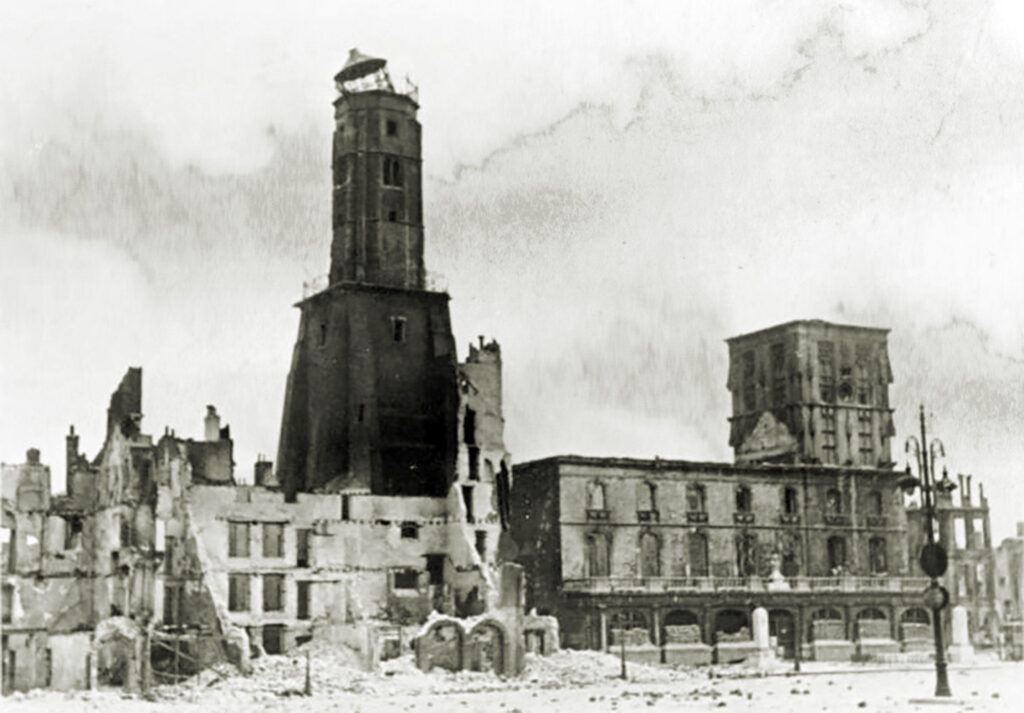
While the 30th Brigade was disembarking and trying to get organized, the battle for Calais was commencing in earnest in the countryside beyond. Assault Group Krüger of the 1st Panzer Division was moving eastward, outside the southern perimeter, when it encountered the 3rd Battalion, RTR. After a brief fight, German light tanks advanced on the St. Omer canal, where they were held up for half an hour by C Troop of the 1st Searchlight Battery under 2nd Lt. R.J. Barr. Even when assaulted by heavier German tanks, the troop held on for three more hours before surrendering. The defense of Orphanage Farm, site of Air Defence Calais’ headquarters, under Lt. Col. R.M. Goldney, became the focal point of the battle for the next five hours. Between 2 and 7 p.m., the defending force was subjected to fierce shelling and bombing until Goldney decided that the position was no longer tenable. With the farm in flames, the defenders retired into the town.
The panzers’ remorseless advance had been hampered on its left flank by tanks and searchlights. The 1st Panzer Division’s war diary for May 23 stated: “Assault Group Krüger…stood at the gates of Calais when darkness fell. It was reported that the town was strongly held by the enemy and that a surprise attack was out of the question. The capture of Calais was handed over to 10th Panzer Division while 1st Panzer Division was ordered to push on towards Gravelines and Dunkirk.” Had Calais fallen on the 23rd, there would have been nothing to stop the panzers from reaching Dunkirk before the defenses were organized. At the same time, the day’s fight had bought a breathing space for Nicholson to organize his own defense.
Nicholson had received orders from Brownrigg to advance from Calais and attempt to relieve Boulogne. Had he made such a move with the 3rd Battalion, RTR, and his motor battalions, he would have been quickly overwhelmed, lacking any artillery support as he did. But Nicholson was a cool-headed professional and soon realized that Brownrigg’s orders were impossible. He appreciated that the defense of Calais itself was the urgent task.
While the engagement of the afternoon was in progress, the 10th Panzer Division was ordered by General Heinz Guderian to take the town as soon as possible. The divisional commander, Maj. Gen. Ferdinand Schaal, initially planned a coup de main but was to be disappointed. His men had been in continuous and fast-moving action for almost two weeks and were exhausted and suffering from casualties, most recently from sustained RAF air attack. Throughout May 23 and 24, Schaal demanded heavy anti-aircraft protection, and Guderian was concerned himself. At 5 p.m. on May 24, some hours after the attack on the town had been launched, Guderian told Schaal: “If there are heavy losses during the attack on Calais, it should only be continued with support from dive bombers and when heavy artillery can be brought up after the surrender of Boulogne. There must be no unnecessary losses.”
As Schaal pondered his plan of attack, Nicholson was in Holland’s cellar headquarters on the Boulevard Léon Gambetta. He had problems of his own, stemming from his large perimeter and limited resources. A senior French army officer had arrived from Dunkirk and was placed under Nicholson’s command by the French Corps at Dunkirk. A number of coastal artillery emplacements were also taken over, although most were designed to fire out to sea and were of limited value. The fixed defenses of Calais had a long history and were begun in the 16th century when it was an English town. The remaining ramparts and bastions, even where they had been improved since the FrancoPrussian War of 1870, could not stop a determined force with modern artillery and air support, however. Nicholson knew it was pointless to put his regular troops in front of those ramparts, and after careful study of the street plan, he decided that the best hope lay in the canal lines within the town. He therefore issued orders that the outer perimeter was to be held and all roads, railroads and other approaches were to be blocked. As the battalion commanders left to organize their areas, the sound of firing could be heard drawing closer.
Throughout the night of May 23-24, it remained unclear whether the brigade would be evacuated. Conflicting reports were received, and by the early morning of the 24th, around 2,000 of the defenders of Boulogne had been evacuated. At 3 a.m., a message was received that the 30th Brigade would also be evacuated. The message arrived while Nicholson was with Hoskyns on the Dunkirk road preparing to escort the BEF rations. He duly ordered his staff to prepare an operation order to that effect, to be implemented the following night. The attempted ration run ended inevitably in failure, with tanks lost and the riflemen returning to Calais. It was now obvious that the town was surrounded.
By 7:30 a.m., it was widely known that the plan was to evacuate and, consequently, unloading at the Gare Maritime stopped, although only half of the 1st Battalion’s transport had been brought ashore. With shells falling and her decks already covered with wounded, City of Canterbury departed at 8:30 a.m., taking the other half of the vital transport. Throughout the morning of the 24th, nonfighting men were released to join those aboard Kohistan, which left at noon. Nobody knew at the time that Kohistan was the last ship to do so.
After the incident on the Dunkirk road, Nicholson returned to the Boulevard Léon Gambetta, and the real battle for the town began. The Germans attacked at dawn, under cover of heavy and accurate mortar and artillery fire, moving against the south and southwest of the town and the advanced positions held by the 1st Battalion, QVR, who were pulled back to strengthen the 2nd Battalion, KRRC. The 10th Panzer Division was surprised by the strength of the resistance, but by 10:15 a.m. it had driven back Rifle Regiment 69 from Guines, captured the Pont de Coulogne and breached the outer perimeter. On the western side, Rifle Regiment 86 took Coquelles and directed shellfire onto the harbor, Oyez farm and Fort Nieulay–the latter a critical position in the next few hours.
Many French and Belgian soldiers were sheltering in cellars and other havens and took no part in the fighting. Others were to play important roles, particularly manning the fixed defenses. French naval tugs were operating, and many personnel had already embarked when Capitaine de Frégate Carlos de Lambertye asked for volunteers to man his forts. Those “Volunteers of Calais” marched back to occupy the crucial Bastion 11. That evening, about 100 more occupied Bastion 12, and in all, some 800 played a part in defending the honor of France—while the remainder waited in the cellars for the town to fall.
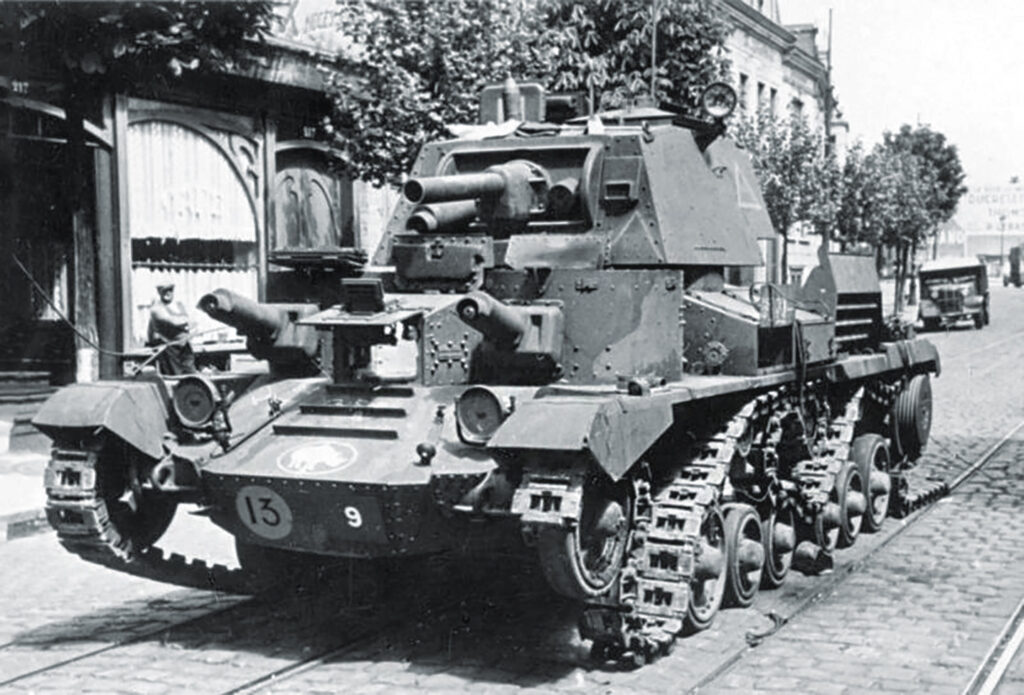
Captain A.N.L. Munby of 1st Battalion, QVR, was ordered to block the road to Boulogne, now open after the retirement of 3rd Battalion, RTR. His 59 men joined a French contingent of around 40 in Fort Nieulay, which they held under heavy fire until 4:30 p.m. on May 24. The Germans bypassed the fort and launched fierce attacks against the Allied center all day. There, the line was held by 2nd Battalion, KRRC, which destroyed two light tanks and drove the others off.
With the departure of Kohistan, Colonel Holland attempted to get as much support together as possible from the ranks of the largely unarmed rabble crowding the docks. Second Lieutenant Airey Neave from a searchlight unit was sent to support B Company, 2nd Battalion, KRRC. The commanding officer, Major J.S. Poole, was a veteran of World War I. “I am afraid they may break through,” said Poole, surprising Neave with the anxiety in his voice. “Get your people in the houses either side of the bridge. You must fight like bloody hell.”
Nicholson’s plans for withdrawal to the inner perimeter of Calais involved the 2nd Battalion, KRRC, the 1st Battalion, QVR, and the searchlight units that were most heavily engaged that day. He knew he must hold out as long as possible but still expected to be evacuated. He hoped to keep 1st Battalion, RB, in reserve to cover evacuation from the Gare Maritime. By 6 p.m., he had completed his plans, and 1st Battalion, QVR, was pulled back to a cellulose factory to act as a reserve for 2nd Battalion, KRRC. The Germans did not interfere. That evening, Nicholson retired his own headquarters to the Gare Maritime and later to the citadel to form a combined headquarters with the senior French officer, a Commandant Le Tellier. During the night, Nicholson received incorrect reports of relief, which raised false hopes.
Schaal had limited his attacks during the 24th to probing the outer perimeter. Before commencing major attacks the following morning, he sent his panzers to join those of the 1st Panzer Division east of the town, now halted at Gravelines to prevent the escape of any troops from Calais while preparing for a major assault with his infantry. He was confident of a speedy conclusion but did not follow up the British retirement during the night.
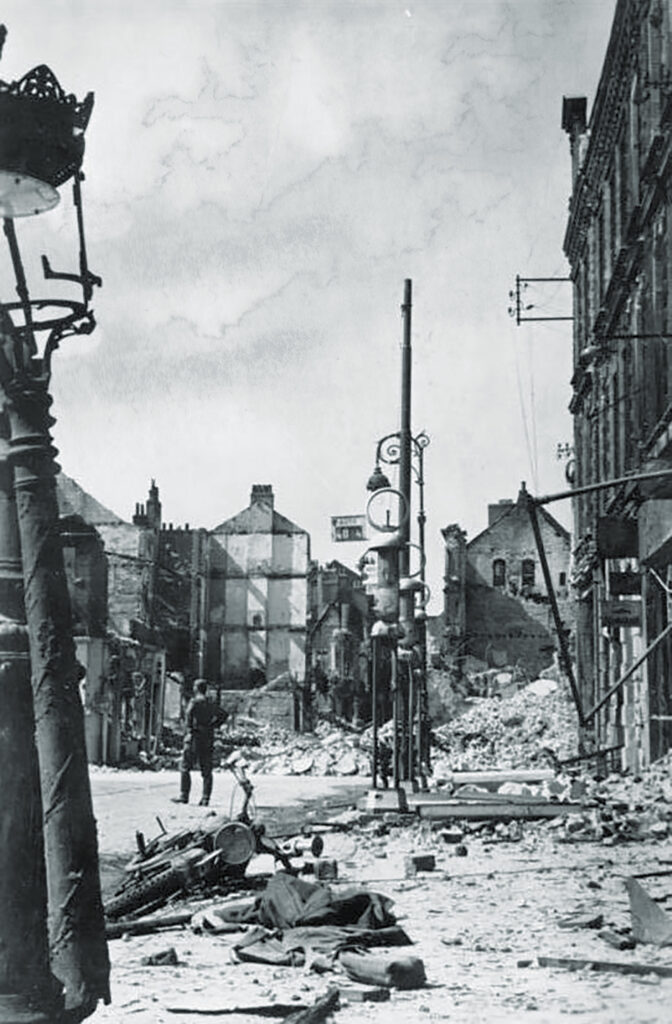
Throughout the 25th, the Germans mounted sustained attacks supported by artillery and dive bombers. They made little headway, however, and Nicholson twice refused to surrender. British patrols in the area of Boulevard Léon Gambetta engaged the approaching Germans, but by 8 a.m. the swastika was flying above the Hôtel de Ville. Land-line communications with London were cut, and Nicholson now had to rely on wireless. Some of the Germans thought the battle over, which slowed the attack.
The Germans sent the mayor of the town as a delegate to request surrender. “Surrender?” said Nicholson. “If the Germans want Calais, they will have to fight for it.” When the mayor failed to return, Schaal sent another envoy. The reply was recorded in the German war diary. “The answer is no as it is the British Army’s duty to fight as well as the German’s.” After a lull, Schaal ordered the battle renewed and the citadel destroyed. That was easier said than done. Built to withstand the most devastating bombardments, it still stands today despite the worst attentions of the RAF in 1944.
At 2 p.m., with the battle intensifying, Nicholson received a message from British Foreign Secretary Anthony Eden. “Defense of Calais to the utmost is of the highest importance to our country as symbolizing our continued co-operation with France.” That was the first indication that evacuation might not actually happen. As the bitter street fighting continued, British casualties were mounting inexorably. Unfortunately, a plan to launch a counterattack, using some tanks of the 3rd Battalion, RTR, moving to the southeast, disorganized the 1st Battalion, RB, as the pressure mounted. At 3:30 p.m., Colonel Hoskyns was mortally wounded. The defenders never managed to recover their balance, although they continued to fight on doggedly.
After a renewed bombardment, the Germans began to advance again at 7 p.m., this time closely supported by tanks recalled from Guines to the east. Despite severe casualties, the 2nd Battalion, KRRC, managed to stem the advance. As darkness approached, the bitter fighting died down. The staff of the 1st Panzer Division announced, “The attack on the Old Town has been held back. The enemy fights in a most tough and ferocious manner.” Schaal decided to call off the attack at 9:45 that evening and asked Guderian for further fire support. The Germans were unaware that the defenders were exhausted and desperately short of ammunition. By midnight, except for the fires burning around the Place des Armes, all was quiet. The battalions faced the morning with about 250 men each, with no tank, anti-tank or artillery support, but still undefeated.
On the morning of May 26, supported by Junkers Ju-87 Stuka dive bombers and precise mortar fire, the Germans came on once more. Steadily the British were driven back, and the French at Fort Risban finally raised a white flag. The defense clung tenaciously to some positions, fighting to the last man. Finally, at 11 a.m., Bastion 11 was forced to surrender with barely a man unwounded. The defense at last began to collapse. Soldiers were rounded up in small groups, and the citadel finally succumbed at 3 p.m. The final surrender came at Oyez farm where B Company, 1st Battalion, QVR, had held out since the beginning.
For most of the defenders, it was the beginning of five years in captivity. Nicholson died in 1943. Airey Neave became the first man to escape from the notorious Colditz Castle in 1942. He later served as a member of Parliament until his assassination by the Irish National Liberation Army in a bomb attack in 1979.
The defense of Calais is a story of determination against enormous odds that, according to important German sources, contributed to the successful evacuation at Dunkirk. Three hours after the fall of the citadel, the Admiralty announced that Operation Dynamo, the Dunkirk miracle, was about to begin.
the blitz across france
The 10th Panzer’s Blitz Across France Prior to Operation Barbarossa, Major General Ferdinand Schaal had already proved that his 10th Panzer Division was a fast moving, hard hitting weapon. During the invasion of France, the 10th served as part of the southern thrust under the XIX Corps, which was led by one of Germany’s most audacious commanders, Lieutenant General Heinz Guderian.
When the code word “Danzig” reached Schaal on the morning of May 10, 1940, the division exploded forward, advancing 45 miles on the first day. The 10th was the first division to encounter the enemy and quickly routed the 2nd French Cavalry. As the division advanced, its greatest problem proved to be not the enemy to its front but the congested roads to its rear, which hampered efforts to resupply the rapidly advancing tanks. The problem with resupply became so acute that Guderian was forced to declare a general halt to return marching discipline to the ranks.
The next day the 10th Panzer got bogged down in a large forest, falling behind the other panzer divisions until it broke through into open country. By May 12, Schaal’s 10th Panzer had reached the Meuse River near Sedan, France. The division deployed around the town and prepared to cross the river, ignoring the French artillery that harassed its flanks.
Crossing the Meuse on the 13th did not go as planned. First, the Luftwaffe did not hit many of the French positions on the opposite bank, and second, the French artillery had zeroed in on the open terrain all along the river. The 10th Panzers first attempt to cross the river failed under the withering French artillery fire. Schaal refused air support during this assault, having lost confidence in the Luftwaffe’s ability to destroy the French defenses. Late that day, a single German rifle company managed to established a small bridgehead, but it was nightfall before bridges were laid and tanks could cross the river. The 10th Panzer’s infantry made the initial advances until forced to wait for the tanks. When the tanks finally arrived, they broke through the last French defenses and began the race to the English Channel.
During the 10th’s advance, Guderian visited the division twice. On the first visit, he found Schaal close to the front, where one of his colonels was directing a reconnaissance battalion in an attack on French defenses. Guderian later commented, “The steady way the division moved forward under the command of its officers was an impressive sight.” The second time Guderian visited the 10th’s headquarters, he was briefed by Schaal’s staff, because Schaal was forward with his troops.
With virtually no resistance to slow its advance, the 10th raced across France and then turned north, arriving at the coastal town of Calais on May 24. Guderian again visited Schaal and offered to have the Luftwaffe strike the town. Schaal refused, not wanting to pull his men back and not believing that the Luftwaffe could fulfill the job. The 10th Panzer took Calais two days later, capturing 20,000 prisoners.
Farther east, however, Guderian’s entire corps was halted outside of Dunkirk on May 24 because Hitler ordered the town left to the Luftwaffe. Troops advancing on Dunkirk pulled back, and the Luftwaffe attacked, allowing two-thirds of the British army to escape and fight another day.
Despite his frustration at Dunkirk, Guderian, in an address to the XIX Corps, praised his panzer divisions for advancing more than 400 miles in 17 days, reaching the English Channel without faltering and carrying out every order with devotion. Guderian concluded his address rather ominously, proclaiming, “Now we shall arm ourselves for new deeds.”