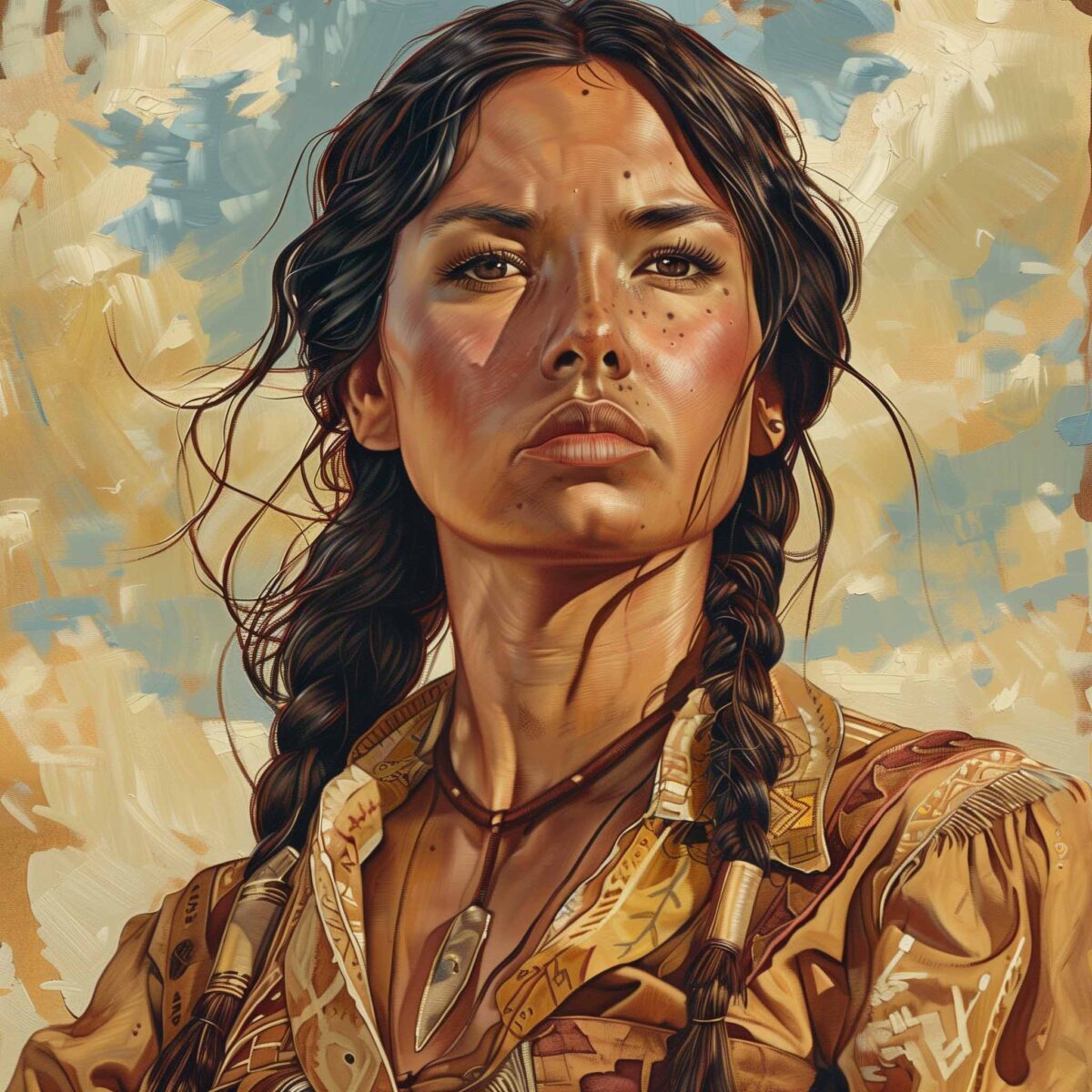
The Lewis and Clark Expedition of 1804-06 was the fulfillment of a longtime dream of Thomas Jefferson, and the success of that incredible enterprise owes much to its two leaders, the scientific-minded Meriwether Lewis and the more practical-minded William Clark. What their Corps of Discovery accomplished—essentially opening up all the possibilities of the vast trans-Mississippi West to the people of the United States—has rightly been called one of the great feats of exploration. But Lewis and Clark did not do it alone. Their most famous assistant during the transcontinental trek was a young Indian woman whose life remains largely a mystery but whose legend lives on as strong as ever—Sacagawea.
Many know her better as Sacajawea (and some know her as Sakakawea). ‘Among scholars there’s a preferred spelling [Sacagawea], said Lewis and Clark scholar James P. Ronda during an interview that appeared in the August 1999 Wild West Magazine, but there is never going to be a preferred spelling among the general public. In any case, hers is a Hidatsa name and was translated by Captains Lewis and Clark as Bird Woman.
Early twentieth-century historians tended to glorify her role, writes Harold P. Howard in his 1971 book Sacajawea. More recent writers are inclined to minimize her contribution, and even to adopt a somewhat scornful view of her assistance to the explorers. The truth no doubt lies somewhere in between. It certainly was not the Sacagawea Expedition; she did not guide Captains Lewis and Clark all the way to the Pacific Ocean. But she did know some of the geography they passed through, and she did interpret for them when they came across Shoshone-speaking Indians. Her accomplishments have not been overlooked by the U.S. government. A Sacagawea one-dollar coin (if you see it spelled Saca-jawea, you can assume it’s a counterfeit) is expected to replace the Susan B. Anthony dollar coin in the year 2000.
The Corps of Discovery left Camp Dubois, outside St. Louis, on May 14, 1804, but Sacagawea only became part of the picture in November, after the explorers made winter camp at Fort Mandan in present-day North Dakota. The two captains hired her husband, the French-Canadian fur trapper Toussaint Charbonneau, as an interpreter, with the understanding that she would come along to interpret the Shoshone language. Sacagawea was only about 16 and pregnant.
Her people were the Lemhi Shoshones, who made their home in what is now southeastern Idaho and southwestern Montana. About 1800 she was captured by a Hidatsa raiding party at the Three Forks of the Missouri River. Sometime in 1804, she and another woman were purchased by middle-aged Charbonneau, who lived among the Hidatsa and Mandan Indians, to be his wives. Eight weeks before Lewis and Clark and company departed their camp on the upper Missouri, Sacagawea gave birth to her first child. The boy was named Jean Baptiste Charbonneau, but he was more often called Pompey or Pomp. When the Corps of Discovery continued upriver in early April 1805, Toussaint Charbonneau and Sacagawea were part of the team, and so was Pomp, whom his mother carried on a cradleboard.
The late Wyoming writer Rhea Eliza Porter White, who knew many descendants of Sacagawea, said that the young mother had almost died during childbirth. As she was suffering and in great agony, Clark, in an effort to raise her spirits, presented her with a beaded turquoise belt that he had been wearing, White wrote in Things That I Appreciate, an unpublished manuscript penned in the early 1970s. He had been watching her admire it and knew she wanted it more than anything else in the world. As she lay suffering and at death’s door, he took it off and laid it across her.
Suddenly, he saw her eyes sparkle and a smile come across her face as she put her arms around the belt and pulled it against her face. The Indian girl gave birth to a boy, Pomp, who became the pet of the corps.
White added that before the expedition left its winter camp, the men became aware of the great love this young braided Indian girl had for them, and as she [Sacagawea] told her story many years later she would say…as she held her hand over her heart…’I knew that first day…when I first saw Lewis and Clark…that I would die at any time to save their lives…and I knew that their lives were in danger right there in Dakota.’
The Corps of Discovery hadn’t been back on the Missouri River for very long when Sacagawea demonstrated her commitment to the expedition. The boat in which she was traveling with several of the men almost capsized in a gale. And it was she, according to the 1951 book Makers of the Americas (by Marion Lansing, W. Linwood Chase and Allan Nevins), who caught and saved many of the valuable supplies and surveying instruments as they were washed overboard. Rhea Porter White also wrote about the boating episode, saying that Sacagawea (or Sacajawea, as White wrote it) sat calmly in the stern and rescued most of the equipment as it floated past on the foaming water. Then, the frail Indian girl of only 110 pounds…dove into the water and brought up the few remaining pieces of vital equipment and instruments. Sacajawea’s legendary strength, wisdom and love for the white leaders was beginning to unfold.
White, who died in 1995 at age 93, was constantly searching for more information about Sacagawea, according to her son Dale Porter White. He added that she wrote Things That I Appreciate–about two-thirds of which is devoted to Sacagawea’s story—mainly for her children and friends and had no interest in getting the manuscript published. While some historians might question the accuracy of some of her information, White certainly captured the very real mutual admiration society that Sacagawea had with the two captains. Clark called her Janey, and he would name a prominent rock formation (in present-day eastern Montana) Pompey’s Pillar after her baby boy.
Sacagawea became sick in the spring of 1805 after the group left Fort Mandan, and Lewis expressed concern for her in his journal. He also was concerned about the expedition, since she was our only dependence for a friendly negotiation with the Snake [Shoshone] Indians on whom we depend for horses to assist us in our portage from the Missouri to the Columbia River. In July, after Sacagawea recovered and began recognizing some landmarks, Lewis and Clark felt better about things.
The Corps of Discovery reached Three Forks, where three rivers join to form the Missouri proper, on July 27. Sacagawea assured Lewis and Clark that the Shoshones, who had never seen Europeans before, were somewhere nearby. Indeed Lewis came across a Shoshone warrior in early August, but the Indian bolted when the captain tried to say something in Shoshone that Sacagawea had been teaching him. In Lewis’ journal entry of August 13, 1805, he writes about coming across three terrified Shoshone women who eventually led him toward the Shoshone camp after he had given them trinkets and calmed them down. Chief Cameahwait and a band of 60 warriors came out to meet them. Soon, according to Lewis, bothe parties now advanced and we wer all carresed and besmeared with their grease and paint till I was heartily tired of the national hug. It turned out, amazingly enough, that Cameahwait was Sacagawea’s older brother and that he had inherited their father’s place as chief of the band. After much hugging and explaining, White wrote, the Shoshones agreed to make available the horses and guides the white men needed.
Sacagawea had proved her value again, this time as an interpreter and mediator. By the end of August, she had bid farewell to her brother and was continuing westward with her husband and the explorers. In September, the group crossed the rugged Bitterroot Range of the Rocky Mountains, using an Indian route known as the Lolo Trail. Although it was still technically summer, the travelers faced snow, cold and near starvation before they finally reached a Nez Perce village on the other side of the mountains (in present-day Idaho).
From this point on in the westward journey, Sacagawea was no doubt as unfamiliar with the geographic features as the others. She certainly was not someone who could guide them to the West coast. Still, her presence—and that of her baby—was important. Clark wrote in his journal entry for October 13, 1805, that Sacagawea reconsiles all the Indians, as to our friendly intentions—a woman with a party of men is a token of peace. Relations were friendly with the Nez Perce people. Starvation was no longer a concern, but after they had stuffed themselves on camas (a root the Nez Perces used to make bread) and salmon, indigestion and diarrhea were. Still, they were able to make new canoes and to gain information from the Nez Perces about the path, or rivers, ahead.
They drank from the Salmon, from the Snake and the Columbia rivers, built canoes that carried them down to the Columbia’s mouth, White wrote in her manuscript. On November 15, 1805, they saw the shine of the Pacific…after this the expedition raised the Stars and Stripes above the great Pacific Ocean.
In December, the Corps of Discovery built Fort Clatsop, near the mouth of the Columbia River, and settled in for a long winter. The 23 men, the usually drunk French-Canadian Charbonneau, Sacajawea and her son Pomp had a very hard winter there on the coast, White wrote. Food was scarce, and Sacajawea gave a starving and sick Clark some bread she had been carrying with her in a little leather pouch that had been intended for her child.
One day in January, Clark and some of the others, including Sacagawea, ventured from camp to check out a beached whale. The starving men came upon a beached whale and began to overeat, not realizing how the concentrated fats and oils would affect their bodies, White wrote. They became deathly ill. Years later, the men would tell the story of how they would have surely died had it not been for a little Indian girl who somehow miraculously was able to know what the dying men needed to recover. Sacajawea spent days upon end searching for and trying to grow and cultivate fennel roots,…a perennial herb of the carrot family…for its aromatic seeds. ‘Janey,’…as Clark called her, did indeed nurse the men back to health.
Not too long after that, another incident occurred that further showed Sacagawea’s affection for Captain Clark and the other explorers. At one of the Indian camps, Clark noticed an exquisitely made sea otter coat. He had to have it! White wrote. Most of his [Clark’s] trading material brought along to barter with the Indian tribes for food…was gone now. Nevertheless, he lost his head and offered whatever they had left…to the Indian woman for the beautiful fur coat. He must have it…they must see it in St. Louis and the president of the United States [Jefferson] must see it.
Unfortunately, the Indian woman was not tempted to trade with Clark. He didn’t have anything that even interested her. She shook her head and made negative motions with her hand. The coat was not for sale. She walked away leaving a dejected and disappointed Clark, who went to his tent to lick his wounds. The next morning, as the camp and men were packing up…they noticed that Sacajawea was missing. Where was she? She was nowhere to be found. The men were concerned.
They were standing around discussing where to go to look for her when they saw her come over the hill from the Indian camp carrying something on her arm. She walked over to Clark and, smiling at him, handed him the beautiful sea otter coat….’Janey, how did you do it?’ [Clark asked her]….The little Indian girl didn’t say anything, just smiled back and turned and walked away to find her boy, Pomp….Clark noticed for the first time that the old brown buffalo robe that she wore was hanging loose on her where before it had been drawn tight around her waist with a beautiful beaded turquoise belt. A tear came down Clark’s face as he remembered how she had loved this belt and how he had given it to her when she was near death a few months earlier. Sacajawea looked back again at Clark before hoisting her son upon her back…
Sacajawea had known that the Indian woman with the sea otter coat would probably want the beautiful turquoise belt, too, just like she did. She was right. After a night of bartering and discussions she had unselfishly traded her precious belt for a fur coat her white friend wanted so much.
The Corps of Discovery finally left Fort Clatsop on March 23, 1806, heading east and passing many familiar landmarks. Once back in what is now Montana, Clark and Lewis temporarily parted company to explore different areas. Sacagawea, now back on more familiar ground, stayed with Clark’s larger group and helped lead those men to the Yellowstone River. Lewis and Clark were back together and back at the Mandan village by mid-August. The Corps of Discovery started to disband. One of its members, John Colter, headed west again with two fur traders. Charbonneau, Sacagawea and Pomp returned to the Hidatsa village at the mouth of the Knife River. Charbonneau was paid $500 for his services to the Corps of Discovery, but his wife, Sacagawea, was apparently not paid at all.
Toussaint Charbonneau would later do some trading and become a longtime government interpreter for the Indian Bureau. He probably died in 1843. There is also some uncertainty—and a lot more controversy—about when Sacagawea died. Most Lewis and Clark scholars believe that she died in December 1812 at Fort Manuel, the Missouri River trading post of Manuel Lisa in what would become northern South Dakota. Lisa’s clerk, John C. Luttig, recorded in his journal the death of the wife of Charbonneau, a Snake squaw….aged about twenty-five years. A note that Clark wrote in a ledger book in the 1820s seems to support the view that Sacagawea died in 1812. It has been argued, however, that it was another wife of Charbonneau who died at Fort Manuel. These people believe that Sacagawea died on the Wind River Reservation in Wyoming Territory in 1884 and is buried at the Fort Washakie cemetery, near Lander, Wyo. Rhea Porter White was one of those people, and she played a leading role in having a monument erected at Sacagawea’s Wyoming gravesite in 1963. The site of Fort Manuel is now covered by the waters of Lake Oahe. If Sacagawea did die there, her grave is no doubt also under those waters. A monument to Sacagawea stands on a hill just west of the Missouri River, across from Mobridge, S.D.
In the early 1960s, the governors of South Dakota and Wyoming had a dispute over where she was buried. The Wyoming governor asked Rhea Porter White if she really had proof that the grave was at the Wind River Reservation, where Sacagawea had reportedly gone in the 1840s after living for many years among the Comanches in Indian Territory (present-day Oklahoma). My mother answered calmly that she could prove Sacajawea was buried in Fort Washakie from the records of the Mormon Church, said Dale Porter White. There was no question about it at all and she could show him the paperwork. The governor laughed and said, ‘Mrs. White…that’s good enough for me, and it ought to be good enough for the people of South Dakota. I will see that justice is done.’
Rhea Porter White also made the argument that John Roberts, onetime Episcopalian minister at the Wind River Reservation, had conducted a burial on April 9, 1884, of a Shoshone woman, who was identified as Bazil’s mother and near one hundred years old. The Rev. Roberts later identified Sacagawea as Bazil’s mother.
In any case, Jean Baptiste Pomp Charbonneau, the baby boy that Sacagawea carried on her back all the way to the Pacific Ocean and back, was not her only child. U.S. Indian Inspector Charles A. Eastman reported in 1925 that Sacagawea had five children…. As for the first of them, Pomp, he grew up to be a mountain man, spending some 15 adventurous years in the Rocky Mountains before guiding Philip St. George Cooke and the Mormon Battalion through New Mexico Territory to California in 1846. Considering who his parents were, that was no doubt a most logical career path.