Trench warfare and intractable mud ultimately made the Royal Naval Air Service cars unsuited for combat on the Western Front, but they were to see other fields of action
Our Rolls-Royce armored car is one of the top exhibits we have,” says David Willey, curator of the Tank Museum in Dorset, England. “It’s one of those vehicles that still has cachet. There’s an aura about it, and all of us here have a certain pride that it’s part of the collection.”
The car in question was constructed on the chassis of a 1920 Rolls-Royce Silver Ghost, regarded in contemporary motoring circles as “the best car in the world.” Built between 1906 and 1926, the elegant Ghost was certainly never intended for military service. It edged into that role after gaining a reputation for toughness and durability. The fledgling enterprise of automaker F. Henry Royce and London-based car dealer Charles Rolls got a tremendous boost from the bulletproof Ghost.
The duo first unveiled the Ghost in Britain at the 1906 Olympia car show, in four-cylinder and six-cylinder versions. It was so successful (7,824 were sold) that the company built nothing else until the launch of the Phantom I in 1925. The company’s short-lived Springfield, Mass., factory built an additional 1,701 Ghosts.
This was the era of the bespoke luxury car, thus few Silver Ghosts were exactly alike. Coachbuilders vied to equip them with opulent bodies, suitable for everything from chauffeuring madam to the London opera to pigsticking (boar hunting) in India. Silver Ghosts were especially popular with Indian maharajas. The Richard J. Solove collection, recently sold for charity, included a 1910 Ghost roadster purpose-built for Charles Rolls to retrieve his hot-air balloons; a 1911 model with a canopy to protect the Maharajah of Mysore from the punishing Indian sun; and a 1912 limousine whose rear compartment contains an alcohol stove and tea service for four.
The six-cylinder Ghost, known as the 40/50 for its horsepower rating, was called up for military service early in World War I. The initial impetus was a 1914 report that the Belgians had armored a Minerva touring sedan for raids on the German army.
Britain’s Royal Naval Air Service (RNAS) raised the first Rolls-equipped armored car squadron and had vehicles at the front within weeks of the August 1914 outbreak of war. The Rolls-Royce proved the most effective vehicle in the field, and by September all available Silver Ghost chassis had been requisitioned. Civilian production of the car essentially stopped, although in 1915 the company built one very special limousine (with elephant ivory door handles, among other amenities) at the personal request of King George V as a favor for American explosives manufacturer Pierre du Pont. A few private citizens donated their Ghosts for military use, though these were not necessarily armored. One prominent donor was Hugh Grosvenor, second Duke of Westminster, whose 1914 Ghost saw considerable action, first in France and then in Egypt.
Soon, however, the Derby factory was providing bare chassis to Eastern Armored Car (EAC) specifications, which included stiffer leaf springs. As many as 120 of these vehicles saw service during the war. The fearsome-looking armored bodywork was topped with a revolving turret mounted with a .303-inch Vickers water-cooled machine gun. Various running updates made them more effective in combat. Versions built after 1920 were fitted with Michelin double-steel rear wheels.
Thus armored, the cars were extremely heavy, and though the Rolls-Royce engine was quiet, the military models were thirsty and ungainly to handle. They tended to overheat when the protective radiator shutters were closed. But they performed well under fire. “As a fighting vehicle, the design was adequate, although the traditional comfort left much to be desired,” wrote Frank Canvin, who manned a Ghost in the Middle East.
“The Rolls-Royce armored car was significant in many ways,” says Philip Brooks, a historian with the Rolls-Royce Owners’ Club. “It wasn’t a tank, but it was a very effective fighting vehicle. It brought mobility to the battlefield that the great cavalry officers of the 19th century like Jeb Stuart would have appreciated. And the simplicity and elegance of Rolls-Royce made it possible.”
Of course, these paragons were not infallible. David Fletcher, historian at the Tank Museum, notes, “They were bulletproof against rifle fire at reasonable range, but there were still plenty of places where bullets could get in.”
A 1963 account in The Rolls-Royce Owner describes the dispatch of staff cars—a Rolls-Royce open tourer, a Mercedes and a Talbot—to Ostend, Belgium, in August 1914 with the East-church Squadron, under Commander Charles Rumney Samson. Ordered to protect Dunkirk, Samson fitted his staff cars with Maxim guns and promptly engaged a German staff car, wounding two of its occupants.
Two days later, Samson set off with his fleet of cars to Lille, which had only recently been evacuated by the Germans. He was reportedly hit in the jaw by a ginger beer bottle thrown through the windshield of his staff car. The cold welcome didn’t prevent him from posting proclamations around the liberated city: I have this day occupied Lille with an armed English and French force—C.R. Samson, Commander, RN.
Emboldened by his success, Samson had his Rolls and Mercedes sheathed in quarter-inch boiler plate. Soon the armored cars were coordinating operations with British aircraft. They took on German cavalry near Aniche in late September, and in early October screened the evacuation of French troops from Douai by securing a strategic escape bridge and crossroads.
Six more Rolls-Royces soon arrived from England, these thickly armored and equipped with gun turrets. When the necessity of abandoning Antwerp became clear, the Ghosts were given the vital task of fending off German troops along the escape routes to Ostend.
Trench warfare and intractable mud ultimately made the RNAS cars unsuited for combat on the Western Front, but they were to see other fields of action. Number 3 Armored Car Squadron, under Lt. Cmdr. J.C. Wedgwood, went into action against Turkish forces at Gallipoli in 1915. The cars’ Maxim guns put out withering fire, enabling Irish landing forces to gain control of the beach at Sedd el Bahr on April 25. Squadrons No. 3 and 4 continued to attack and harass Turkish troops at Gallipoli through the summer of 1915 until, again, trench warfare made the vehicles impractical.
The armored cars eventually transferred over to the British army for use in the Light Armored Motor Batteries. The vehicles supported Russian and Romanian troops in the winter of 1916, attacking German and Bulgarian positions near the Danube bridge at Cernavoda, Romania. As The Rolls-Royce Owner put it, the “warriors on wheels” had fought admirably in the first 16 months of the war, “successfully attacking the enemy with gusto at every opportunity in an element totally removed from that in which their normal activities lay.”
Armored Rolls-Royces were to prove invaluable to Lt. Col. T.E. Lawrence (the legendary Lawrence of Arabia), who pronounced them “more valuable than rubies” for desert combat. Posted to military intelligence in Cairo, Lawrence became the British liaison to the Arabs in 1916 and coordinated their revolt against the Ottoman Empire. He would eventually command a unit of nine armored Rolls-Royces, which he touted in Revolt in the Desert as “that most involved and intricate weapon.” In a vivid account from that book, Lawrence described using the cars on a one-day mission to blow up bridges, rip up miles of track, capture a Turkish fort and liberate 200 rifles and 80,000 rounds of ammunition.
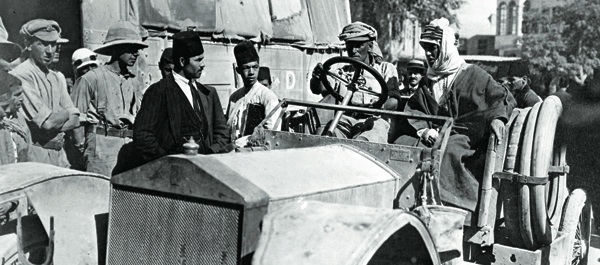
Harold Orlans, in his book T.E. Lawrence: Biography of a Broken Hero, reports that in October 1918 an exhausted Lawrence entered Damascus in the passenger seat of “a desert-dirtied Rolls.” The war was over, but Lawrence’s military escapades were not. He enlisted in the British Tank Corps under the name Thomas Edward Shaw and subsequently scored 93 percent on the Rolls-Royce armored car course, the “highest mark ever given.”
When queried by the journalist Lowell Thomas after the war as to what he might most value, Lawrence replied, “Perhaps it is childish, but I should like my own Rolls-Royce car with enough tires and petrol to last me all my life.”
The armored Rolls-Royces were called up again when the Irish Civil War broke out in 1922. The Free State government was equipped with 13 examples to help break the back of the Irish Republican Army. The Irish called the cars “Whippets.” In July 1922, Free State General Eoin O’Duffy went after the IRA in Limerick with a Whippet, two Lancia armored cars, 10 Lewis machine guns and an 18-pound cannon. In three days of fighting, he forced the rebels from the city. Another Free State column routed the Republicans from Waterford, again with the help of cannon and four armored cars.
The Republicans built their own improvised armored cars, bearing such monikers as Queen of the West and The River Lee. (Free State cars included Tom Keogh, Sliabh na mBan, The Fighting 2nd, The Big Fellow and The Baby.) One celebrated car the Republicans requisitioned was a yellow Silver Ghost tourer owned by the Clarke family of tobacconists in County Cork. It ended up as The Moon Car in IRA hands, covered in steel plates and equipped with twin Lewis machine guns. In 1924 it reportedly took part in a daring raid on Queenstown, killing or wounding nearly two dozen British soldiers. Fearing reprisal, the IRA burned the car and buried its charred remains in a bog. In the 1980s, a local historian located and raised the badly decayed hulk.
The Silver Ghosts in British service received updates in 1920 and 1924. A 1922 letter by Lt. Col. C.D.V. Cary-Barnard describes a trip from Jerusalem to Baghdad and back with three of the Vickers-equipped cars. The convoy, he noted, included “some other makes, over which [the Rolls-Royces] demonstrated only too often their vast superiority.” Thirteen back axles broke on the accompanying vehicles, but the Ghosts (which ended up towing some of the other vehicles) returned unscathed.
The armored Rolls-Royce followed the flag of the British Empire into India, Burma, Iran and elsewhere. Some of the Ghosts, modernized with antitank rifles, .303-inch Bren machine guns and smoke grenade launchers, even saw limited service during World War II. Until at least 1941, they worked alongside much heavier Humber armored cars in the North African campaigns.
After World War II, most remaining military Ghosts were decommissioned, scrapped or rebodied as civilian vehicles. There are just two complete original survivors, one being the Tank Museum model, which has led an adventurous life. The car was issued in 1921 to the British No. 5 Armored Car Squadron and served during the Irish Civil War. In 1927 it shipped out with the company to Shanghai as part of a British League of Nations contingent to protect European nationals after conflict broke out between nationalist and communist forces. From 1929 to 1938 it served in Egypt. It returned to England the following year to participate in anti-invasion patrols along the northeast coast. The Tank Museum acquired it in 1946.
The other survivor, Sliabh na mBan (“Mountain of the Women,” named for the Tipperary landmark), belongs to the Irish army. The car was accompanying IRA organizer-turned-Free State general Michael Collins on Aug. 22, 1922, when IRA gunmen ambushed his convoy. Sliabh might actually have saved his life, had its machine gun not jammed. Republicans later stole the Rolls, using it in forays against government outposts until it was recovered on a tip. Retired in 1945, it appeared in all its glory in the 1959 James Cagney film Shake Hands With the Devil. When not on parade, Sliabh na mBan is on display at the Defense Forces Training Centre in Curragh.
Armored Ghosts are holy grails to car collectors. A British collector owns the restored Tom Keogh, named after an Irish Free State colonel killed by a mine in 1922. Dennis Ambruso, of Bridgeport, Conn., has owned four armored cars (all World War II vintage) and restored six of them. “The Silver Ghost armored vehicle was state of the art and very well made,” he said. “Any collector would like to get their hands on one, because they’re unique.” Replicas have been constructed on authentic Ghost chassis, including a 1925 version built by the late Frank Cooke that sold at auction in 2006 for $87,750.
The Duke of Westminster’s car survives in civilian guise, and the shell of an armored Ghost is rumored to exist in India. “There’s always a chance that another intact car will turn up,” says David Willey, who notes that the Tank Museum’s model is insured for £2 million, regardless of its dents and bent bolts to which mechanics applied an incorrectly sized spanner. “Some people would much prefer to see it immaculate,” he said, “but we like it as it is, with a bit of history visible.”
For further reading, Jim Motavalli recommends: War Cars: British Armoured Cars in the First World War, by David Fletcher, and British Tanks and Fighting Vehicles, 1914–1945, by B.T. White. Visit the Tank Museum online.