
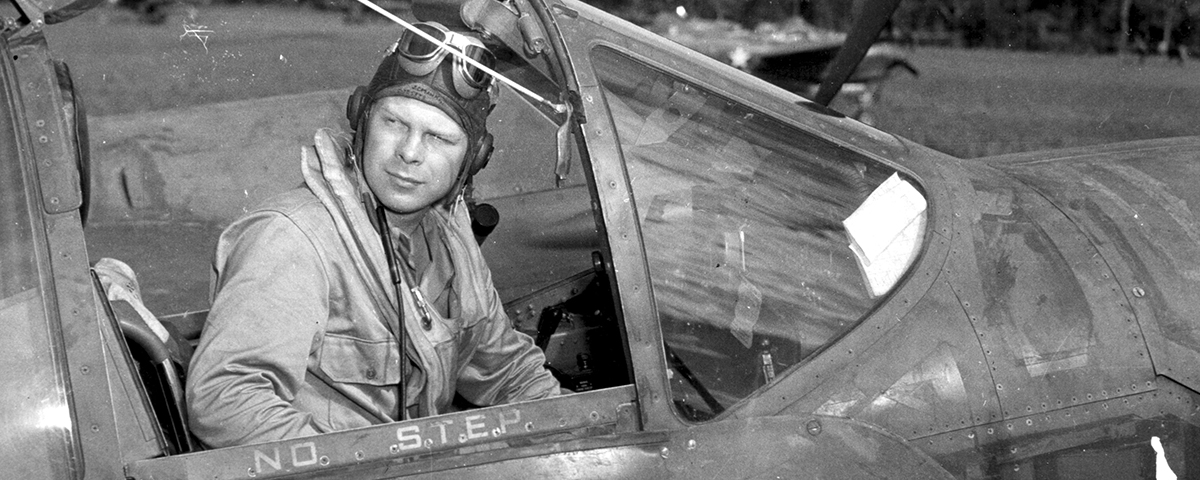
Major General George C. Kenney had had enough. Ever since a certain pilot arrived at Hamilton Field for combat training on May 6, 1942, he had been using nearby San Francisco as his private playground, looping his Lockheed P-38 Lightning around the Golden Gate Bridge and waving at secretaries as he zoomed past their office windows. But when the young hotshot’s prop wash blew a housewife’s wet clothes into the dirt and she reported it to his air base, Kenney called him on the carpet for disciplinary action.
“Lieutenant Bong,” the general ordered, “Monday morning you check this address out in Oakland, and if the woman has any washing to be hung out on the line…you do it for her. Then, when the clothes are dry, take them off the line and bring them into the house. And don’t drop any of them on the ground or you will have to wash them all over again. I want this woman to think we are good for something else besides annoying people. Now get out of here, before I change my mind. That’s all!”
While 2nd Lt. Richard I. Bong carried out the order, Kenney made a mental note to have that headstrong but undeniably skillful fighter pilot with him at whichever overseas assignment he got. Within the coming year, Bong would indeed prove himself good for something besides annoying people—except, of course, for the enemy.
Born in Superior, Wis., on September 24, 1920, Dick Bong was the eldest of nine children raised on a farm in Poplar, Wis. His life changed in 1928 when President Calvin Coolidge spent his summer vacation in Superior. “The President’s mailplane flew right over my house,” Bong recalled. “I knew then I wanted to be a pilot.”
Graduating from high school 10th in his class of 428, Bong had found time between studies and chores to play baseball, basketball and hockey. A skilled hunter, he also built and flew model airplanes.
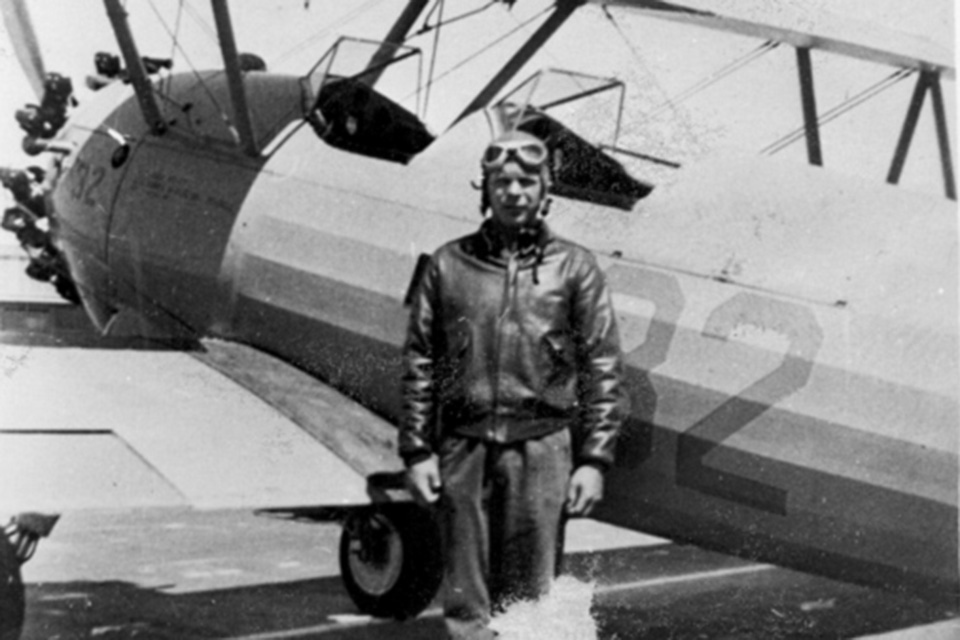
In 1938 Bong began studying engineering at the State Teachers College in Superior. At the same time, he enrolled in the Civil Pilot’s Training Program, soloing on his 20th birthday and earning a private pilot’s license in a Piper Cub. After completing two years of college, Bong enlisted in the U.S. Army Air Forces Aviation Cadet Program in June 1941. From primary training in Boeing-Stearman PT-13 biplanes, he went on to fly Vultee BT-13s at Gardner Field, Calif., and North American AT-6s at Luke Field, Ariz. One of Bong’s instructors at Luke, Captain Barry Goldwater, later said of him: “He was a very bright gunnery student. But the most important thing came from a P-38 check pilot who said Bong was the finest natural pilot he ever met. There was no way he could keep Bong from getting on his tail, even though he was flying an AT-6, a very slow airplane.”
After the Japanese attack on Pearl Harbor plunged the United States into World War II, Bong’s high gunnery scores resulted in his being retained as a gunnery instructor for several months. Finally, on May 6, 1942, he was sent to train on P-38s at Hamilton Field, where his extracurricular stunts drew both the ire and admiration of General Kenney. Selected by General Douglas MacArthur to lead the Fifth Air Force in the South Pacific, Kenney wanted 50 of the best P-38 pilots he knew to join him when he took command at Brisbane, Australia, on September 3. Bong was one of them.
Bong was assigned to the 9th Squadron of the 49th Fighter Group, but that unit was still flying Curtiss P-40s. Rather than waste Bong’s time on an aging fighter when he had already mastered its imminent replacement, in December 1942 Lt. Gen. Kenney attached him temporarily to the 39th Squadron, 35th Fighter Group, based at Laloki airfield near Port Moresby, New Guinea. There, Bong made the acquaintance of Captain Thomas J. Lynch, who had scored three victories the previous May while flying Bell P-39 Airacobras. Hailing from Catasaugua, Pa., Tommy Lynch was a good pilot and a cool-headed, technically minded tactician whose aerial audacity never clashed with his sense of responsibility for the men he led. Honing his fighting skills under Lynch’s tutelage, Bong came to regard him as both a mentor and a friend.
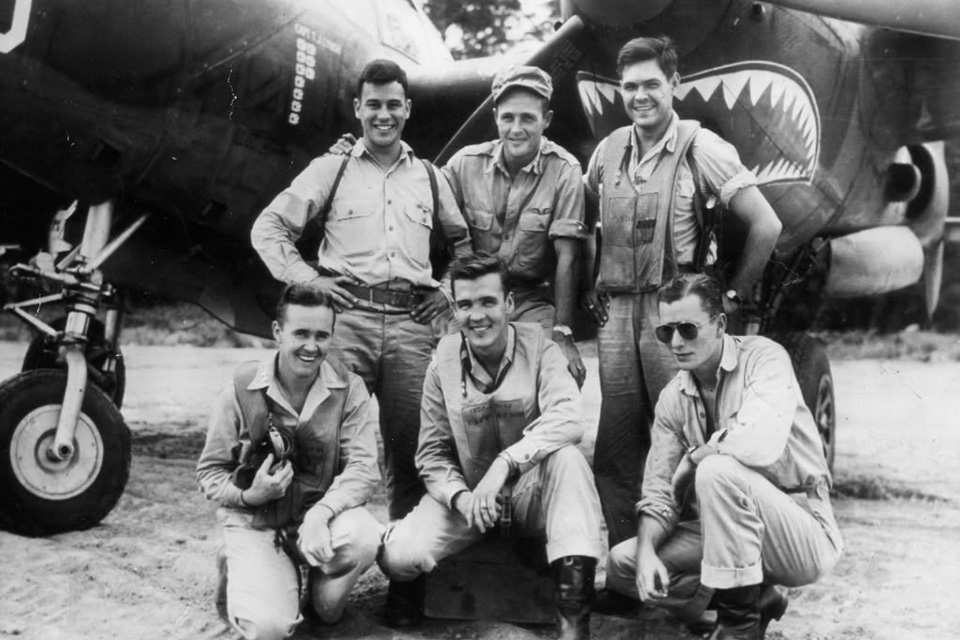
Dick Bong impressed his squadron mates as someone who was introverted and unobtrusive on the ground but stunningly aggressive in the air. He first showed his mettle on December 27, when the Japanese army and navy launched their first major joint air operation in the southwest Pacific, involving about 40 Mitsubishi A6M2 Zero carrier fighters, Nakajima Ki.43 army fighters (code-named “Oscar” by the Allies) and Aichi D3A1 navy dive bombers (“Val” to the Allies). As the D3As attacked Allied installations at newly seized Buna, 12 P-38s of the 39th Fighter Squadron met them. Lynch was leading 2nd Lts. Dick Bong, Kenneth Sparks and John Magnus down on the Vals when their escorts crossed the Americans’ paths. Lynch’s gunfire disintegrated one fighter, and then a Zero threatened him. Bong sideslipped, fired at Lynch’s assailant and saw it spin away, then sped earthward as three other Zeros moved in on him, finally pulling out, as he described it, “2 inches above the shortest tree in Buna.” At that moment he caught a Val just pulling out of its dive and quickly turned it into a fireball. Too low to accomplish anything more, Bong headed back to Port Moresby to report his first two victories—the first credited to a P-38 pilot of the 49th Group. The 39th Squadron claimed a total of 12 victories, including an additional Oscar for Lynch, making him an ace, and a Zero by 2nd Lt. Carl G. Planck Jr., another 9th Squadron pilot on loan to the 39th.
On January 6, 1943, Allied coastwatchers on New Britain reported a Japanese convoy along the south shore, heading west. The next day, after 36 Curtiss P-40Ks of the 49th Group’s 7th and 8th squadrons took off to bomb the convoy, a Consolidated Catalina flying boat of the Royal Australian Air Force (RAAF) sank a straggling Japanese freighter and reported that the convoy had altered course for Salamaua. Meanwhile, Lynch led eight P-38s, including Bong and Planck, across the Owen Stanley Mountains to rendezvous with the P-40s, unaware of their change in course. Consequently, they missed the fighter-bombers but ran into the convoy’s 11th Sentai (army air regiment) air umbrella at 1315 hours. The 39th claimed six Oscars in the fight, including one by Bong after a five-minute duel. Returning to Dobodura to refuel, the Lightnings then took off for Lae, where they encountered another 16 of the 11th Sentai’s Ki.43 fighters at 1530. Bong and Planck damaged two Oscars on their first pass, and Bong destroyed one on his second.
During a January 8 mission escorting Boeing B-17Es and Consolidated B-24Ds over Markham Bay, Bong spotted 2nd Lt. Richard Suehr of the 39th, who had already downed two Ki.43s, hotly engaged with a persistent adversary. Bong joined in with a frontal attack from above, and Suehr saw the Oscar explode and fall 18,000 feet into Huon Gulf. In only four aerial engagements Bong had become the Fifth Air Force’s first Lightning ace, and General Kenney rewarded him with a trip to Australia for R&R.
On January 6, 1943, Allied coastwatchers on New Britain reported a Japanese convoy along the south shore, heading west. The next day, after 36 Curtiss P-40Ks of the 49th Group’s 7th and 8th squadrons took off to bomb the convoy, a Consolidated Catalina flying boat of the Royal Australian Air Force (RAAF) sank a straggling Japanese freighter and reported that the convoy had altered course for Salamaua. Meanwhile, Lynch led eight P-38s, including Bong and Planck, across the Owen Stanley Mountains to rendezvous with the P-40s, unaware of their change in course. Consequently, they missed the fighter-bombers but ran into the convoy’s 11th Sentai (army air regiment) air umbrella at 1315 hours. The 39th claimed six Oscars in the fight, including one by Bong after a five-minute duel. Returning to Dobodura to refuel, the Lightnings then took off for Lae, where they encountered another 16 of the 11th Sentai’s Ki.43 fighters at 1530. Bong and Planck damaged two Oscars on their first pass, and Bong destroyed one on his second.
Quiet, shy and introverted on the ground; aggressive, hostile and fearless in the air.
On February 3, Bong rejoined the 9th Squadron, now fully equipped with its own P-38s. On the morning of March 2, a B-24 spotted Japanese troop transports and destroyers 100 miles northeast of Lae, and Kenney dispatched all available squadrons to attack them. In spite of heavy rain, B-17s sank two transports and dispersed the convoy formation. The punishment continued on March 3, with some 300 U.S. Army Air Forces and RAAF bombers hammering the Japanese ships. While escorting B-17s and North American B-25s to the target, Bong saw seven 11th Sentai Oscars pass below him, making for the bombers. Dropping behind one, he started it smoking with one burst and watched it crash five miles offshore in Huon Gulf. By the time the three-day Battle of the Bismarck Sea ended, 14 Japanese merchant ships and eight warships had been sunk, more than 7,000 Japanese killed and almost 60 enemy aircraft destroyed.
The Japanese struck back on March 11, when a force of Mitsubishi G4M1 “Betty” bombers attacked the 9th Squadron’s airstrip at Horanda. The Americans scrambled up, and Bong took off just before enemy bombs landed on the strip. Pursuing the bombers, he fired into one without result and twice had to dive away from attacking Zeros. As he pulled out of his second dive, Bong turned to engage one that was still on his tail. His rounds struck home, but when he swept past the Zero he was startled to see another plane coming at him. He fired a short burst into that antagonist, only to find seven more boring in on him. Turning right, he fired a long 20-degree deflection shot into the closest assailant. He later reported, “First two Zeros were burning all around the cockpit and the third was trailing a long column of smoke.” Before he escaped the rest in a dive, one Zero shot up his left wing and engine, causing a coolant leak. “Feathered left engine and landed at home field safety,” Bong wrote after he returned to Horanda, requesting—and receiving—credit for “two certains and one probable.”
During a high-altitude patrol north of Buna on March 29, 2nd Lt. Clay Barnes led Bong after a suspicious lone airplane that turned and raced toward New Britain. After a 20-mile chase at 400 mph, they caught up with their quarry, a Mitsubishi Ki.46 twin-engine army reconnaissance plane, over the Bismarck Sea. On his fourth firing pass dead astern, Bong hit the Ki.46’s fuel tank, and the plane disintegrated in flames. His ninth victory tied him with Lynch as the leading American ace in New Guinea. Soon afterward, Kenney promoted Bong to first lieutenant.
By this time Bong had established his fundamentals of success. He explained one in a letter to his mother on April 10, 1944, that included advice for his younger brother, who was planning to join the Army Air Forces: “He must not get contemptuous of any airplane, no matter how simple and easy it may be to fly. Don’t just get in and fly it, but know what makes it tick….If he forgets, why, any airplane in the world can kill him if he isn’t its complete master.” Bong regarded aerial combat as a game whose risks made life interesting, but he was not above quitting a fight if he judged the odds were too heavy against him. He claimed to be a poor shot, yet his squadron mates stated that he hit whatever he fired at 90 percent of the time. Bong said one secret of his success was a policy of getting close enough to “put the gun muzzles in the Jap’s cockpit.” Another was his penchant for engaging his opponents head-on, which gave the P-38, a stable gun platform with firepower superior to the Zero and Oscar, a distinct advantage. At least 16 of his victories were attained in head-on gun duels.
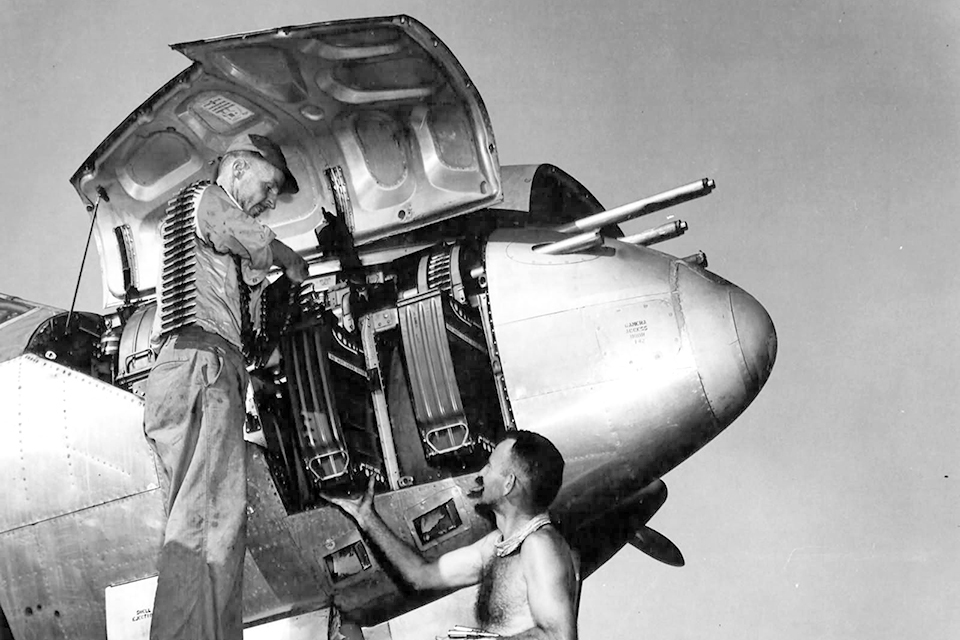
On April 1, Admiral Isoroku Yamamoto launched Operation I, a massive air offensive meant to reverse the Allied advance that had been gradually gaining momentum in the wake of Japan’s failures at Midway, Guadalcanal and New Guinea. During a Japanese attack on U.S. shipping in Milne Bay on April 14, Bong became a double ace when he shot down a G4M1 off Cape Frere. On that same day Yamamoto, satisfied that Operation I had accomplished its goals—thanks to overoptimistic claims by his aircrews—concluded the air campaign. On the 18th, he flew off to inspect the air base at Ballale, only to be intercepted, shot down and killed over Bougainville by P-38Gs of the 339th Fighter Squadron.
After another stint of Australian R&R, Bong went through a “dry spell” until June 12, when his flight engaged eight Ki.43s of the 1st Sentai, en route from Wewak to strafe the 9th Squadron’s new airstrip at Bena Bena. In a series of duels with the nimble Oscars, Bong managed to get a deflection shot into one, scoring two 20mm hits mid-fuselage and watching it spin down. Bong returned with a flat right tire and his right tail boom riddled with 7.7mm hits that had severed hydraulic lines, but he just smiled as he surveyed the damage.
Ten Lightnings of the 9th Squadron were flying a sweep over the Markham Valley on July 26 when they encountered 10 Ki.43s and 10 new Kawasaki Ki.61 “Tony” fighters just beyond Lae. Failing to score in his first pass at the slim Tonys, Bong dived his P-38G to gain speed, then went head-on at an Oscar and set it afire. He next blew part of a Tony’s rear fuselage away and downed another in a left-hand turn from the rear quarter. Another head-on pass shredded a second Oscar. Bong’s quadruple success in that fight was matched by 1st Lt. Jim “Duckbutt” Watkins, while Captain Gerald R. Johnson accounted for an Oscar and a Tony, returning in spite of the latter’s colliding with his Lightning and tearing away the lower tail assembly.
Two days later, the 49th Fighter Group escorted B-25Ds of the 3rd Bombardment Group against Japanese ships off Cape Gloucester. When Rabaul-based Ki.43s arrived to intervene, the 9th Squadron claimed seven of them. Repeatedly attacked, Bong took five 7.7mm hits in his left wing. After diving and pulling up to reengage, he spotted two Oscars turning to pursue some departing B-25s. Making a shallow diving turn, Bong fired a 45-degree deflection shot into the rearmost fighter and saw it turn northeast trailing smoke and splash into Rein Bay. He was now the top-scoring American in the Pacific with 16, and on August 24, Kenney promoted him to captain.
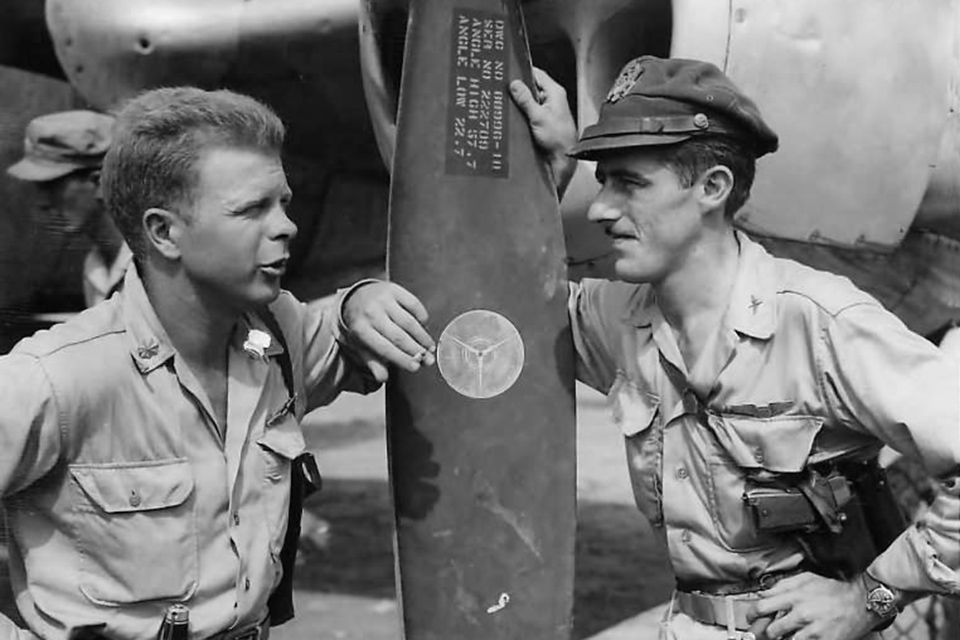
Following a two-week furlough, Bong returned to his squadron in early September. During an attack on a formation of Bettys on the 6th he was credited with two probables (matched by two G4M1s of the 751st Kokutai, or naval air group, that came back damaged), but their gunners shot up his right engine. Bong was fortunate to reach Marilinan airstrip before crash landing his P-38H, which was subsequently written off.
Shortly after downing a Ki.46 over Cape Hoskins, New Britain, on October 2, Bong was made a flight commander. On the 29th he dispatched two Zeros over Rabaul. American forces landed on Bougainville on November 1, and on the 5th aircraft from both the Fifth Air Force and U.S. Navy aircraft carriers Saratoga and Princeton attacked a Japanese cruiser force gathered in Rabaul Harbor that threatened the beachhead. Wading into a hornet’s nest of Zeros, Bong claimed two of them.
At that point, Kenney dispatched Bong Stateside with orders for General Henry H. “Hap” Arnold in Washington, D.C. Along the way, Bong got a chance to see his family, enjoy his mother’s cooking and hang out with hometown friends. He also met Marjorie Vattendahl, a local beauty who had been recently elected homecoming queen at State Teachers College in Superior, Wis. Bong was promptly made king, and for much of his leave the two were inseparable.
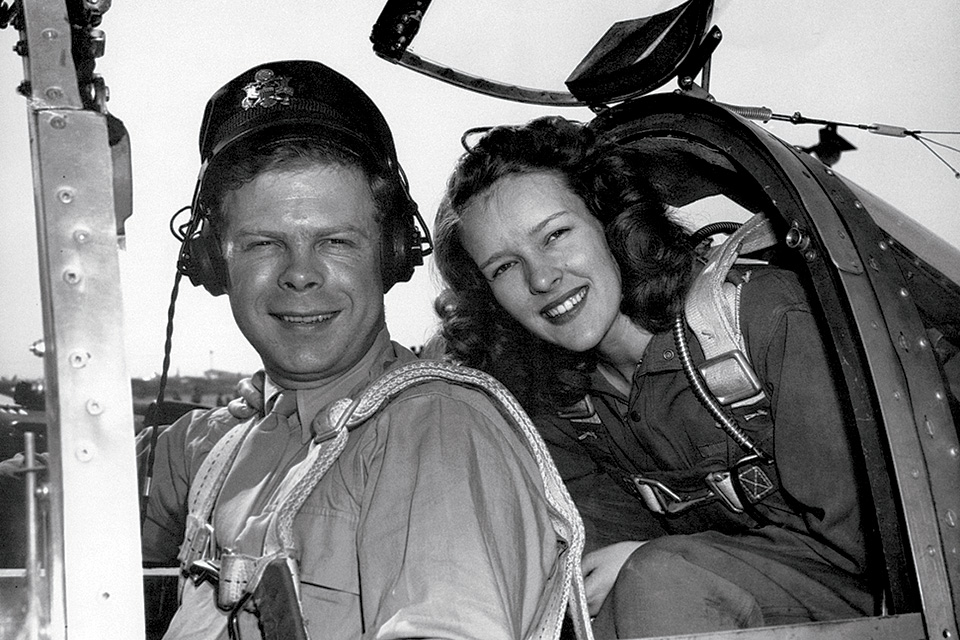
After participating in a succession of parades, speeches and awards ceremonies to boost home front morale, Bong finally returned to the South Pacific. There, Kenney put him in charge of replacement aircraft for V Fighter Command, an assignment that allowed him to choose his combat missions. He also acquired a brand-new P-38J, one of the first in the area to boast a bare aluminum finish, on whose nacelle he applied a portrait of Marjorie, along with the legend “Marge.” His first victory in Marge came on February 15, 1944, when he claimed a Tony. A couple of weeks later, Bong destroyed a Japanese transport plane carrying high-ranking Japanese officers as it taxied along a landing strip. He didn’t count that incident as an aerial victory.
No longer affiliated with any squadron, Bong sometimes used his “roving commission” to fly missions with Major Tommy Lynch, indulging in a friendly rivalry at the enemy’s expense. During one such sweep over Tadji air base at 1800 hours on March 3, Bong destroyed a Mitsubishi Ki.21 “Sally” bomber and Lynch damaged another. Over the next 15 minutes, Bong downed a second Sally offshore while Lynch accounted for a Tony and another enemy fighter. They returned to base to congratulations and news of Lynch’s promotion to lieutenant colonel. Lynch scored his 20th victory on March 5, but as he and Bong were strafing Japanese fishing luggers and barges in Aitape Harbor three days later, Lynch’s right engine was hit by small-arms fire. Bong radioed him to bail out, but the burning Lightning had descended below 200 feet by the time he saw the canopy break free and Lynch tumble out, just before his plane exploded. After a hopeless search of the jungle area in which Lynch fell, Bong had to feather the propeller of his own damaged right engine and sadly flew back to his base at Nadzab.
Soon thereafter Kenney gave Bong another R&R, during which he met with General MacArthur. The ace was back in New Guinea by April 3, however, when he downed an Oscar of the 33rd Sentai near Hollandia, for his 25th victory. During another strike on the 12th, Bong splashed an Oscar in Tanamerah Bay and destroyed two more over Hollandia.
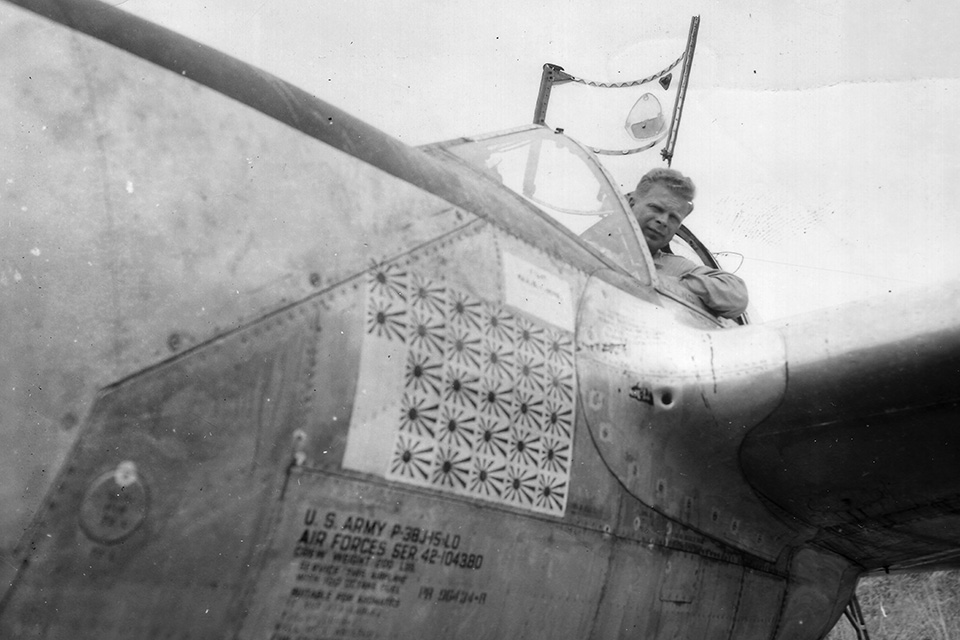
Bong’s score now surpassed the 26 of Edward V. Rickenbacker, the leading American ace of World War I. Kenney promoted him to major, and Eddie Rickenbacker sent him a message: “I just received the good news that you are the first one to break my record by bringing down 27 planes in combat. I hasten to offer my sincere congratulations with the hope that you’ll double or triple this number.”
In May Kenney dispatched Bong to the United States with a letter to Hap Arnold, asking that he be allowed to research the latest techniques and technology for conducting gunnery training in the Pacific. Arnold assented and also gave Bong a pass to go home, where he became engaged to Vattendahl. Upon Bong’s return to Washington, Arnold sent him on a 15-state tour to promote war bonds.
After visiting various training bases, Bong returned to the Pacific to find the Fifth and Thirteenth Air forces combined into the Far East Air Force (FEAF), under General Kenney’s command. Assigned as an advanced gunnery instructor, Bong was permitted to go on missions to see how his students fared with the new techniques, but he was only supposed to defend himself if attacked, not seek combat.
On October 10, B-24s of the FEAF attacked the Japanese oil refineries at Balikpapan, Borneo. Fourteen P-38Js of the 9th Fighter Squadron flew ahead of the bombers, and Bong, serving as an element leader, spotted a twin-engine Nakajima J1N1-S “Irving” at 5,000 feet. He did an abrupt wingover, overtook the Irving, shot it down and saw at least one of its crewmen bail out. As Bong rejoined the formation, the other P-38s were engaging a group of fighters, one of which Bong sent down in flames.
Bong’s score now stood at 30, but when Kenney heard that he had participated in the long, hazardous Balikpapan raid he barred him from further such missions. Among the P-38 pilots escorting the next Balikpapan strike on October 14 was Major Thomas J. McGuire, the commander and leading ace of the 431st Fighter Squadron, whose ambition was to overtake Bong’s score—and indeed he raised his own to 24 that day, claming an Oscar, a Zero and a Nakajima Ki.44 “Tojo” interceptor.
On October 20, U.S. Army troops waded ashore on Leyte Island in the Philippines. Two air bases vital to the invasion were prepared to receive fighters, and Bong accompanied his old squadron, the 9th, when it flew from Morotai to Tacloban airfield on the 27th. Kenney was waiting there to personally greet each pilot and joked with Bong about his noncombat training role. Bong coyly replied that he probably would not join in operations right away, then asked, “Could I just join up the first patrol to get to know the place?”
Bong apparently got to know the place quickly—at 1720 that same afternoon he downed an Oscar off Biliran Island. The next day another Oscar fell to his guns off the west coast of Leyte, and when a bomb-carrying Ki.43 he encountered over the southern tip of Masbate Island tried to dive away, its own just-released ordnance struck it and tore away the tail assembly.
While escorting a bombing attack on a Japanese troop convoy near Ormoc airstrip on November 1, Bong destroyed an Oscar of the 204th Sentai. On the 11th he encountered A6M5 Zeroes off the southern coast of Ormoc Bay and swiftly dispatched two of them. He marked the third anniversary of the Japanese attack on Pearl Harbor with another double: a Sally near Bohol Island at 1505 hours and a Tojo over Ormoc Bay at 1610.
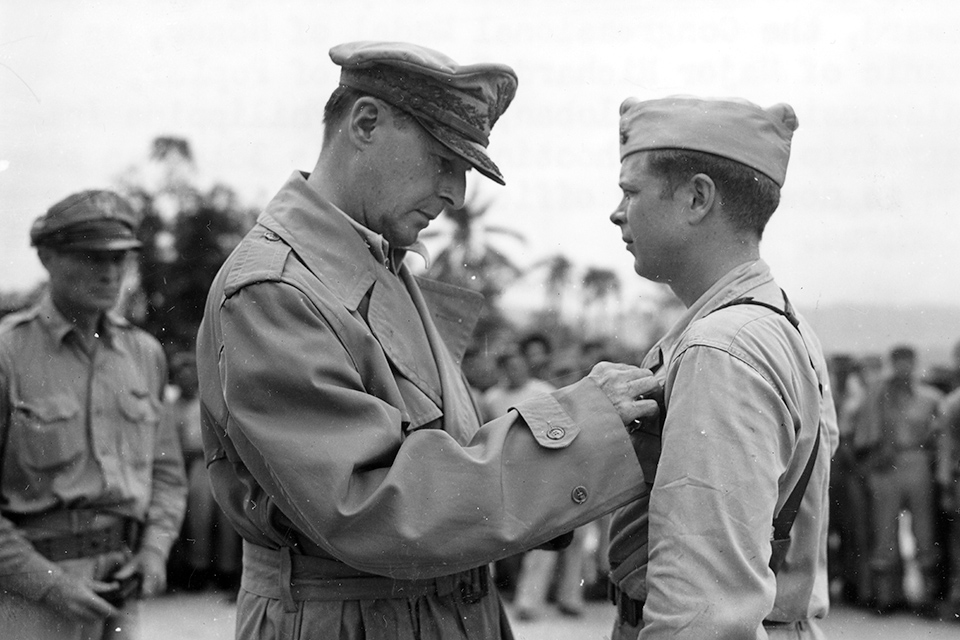
Meanwhile, General Kenney had recommended Bong for the Medal of Honor, a request that MacArthur wholeheartedly approved. The citation read: “For conspicuous gallantry and intrepidity in action above and beyond the call of duty in the Southwest Pacific Area from 10 October to 15 November 1944. Though assigned to duty as gunner instructor and neither required nor expected to perform combat duty, Major Bong voluntarily, and at his own urgent request, engaged in repeated combat missions, including unusually hazardous sorties over Balikpapan, Borneo, and the Philippines. His aggressiveness and daring resulted in his shooting down eight enemy planes during this critical period.”
Congress authorized the award, which MacArthur personally presented to Bong. Throwing away his prepared speech, the smiling general said, “Major Richard Ira Bong, who has ruled the air from New Guinea to the Philippines, I now induct you into the society of the bravest of the brave, the wearers of the Medal of Honor of the United States of America.”
When two Ki.43s tried to attack American shipping off Mindoro on December 15, Bong shot down one of them near Panubolon Island. On the 17th he was credited with another Oscar over San José, Mindoro. That brought his total to 40, along with seven probable victories and 11 enemy planes damaged in two years and 500 combat hours. When Kenney learned of it, he ordered Bong to park his P-38L and walk away from it. Like it or not, the American ace of aces was going home for the last time.
Bong arrived in the States on Christmas Eve to a hero’s welcome. After grounding Major Tommy McGuire just long enough for Bong to bask in the glory of his achievement (and endure another propaganda tour, which he described to a fellow ace as “worse than having a Zero on your tail”), Kenney let him resume his quest to surpass Bong’s score, but McGuire never did; after scoring 38 victories he was killed in action on January 7, 1945.
On February 10, 1945, Dick Bong married Marge in a ceremony attended by 1,200 guests. They honeymooned in California. When his leave was over, he was assigned to the Flight Test Section at Wright-Patterson air base in Ohio, to work with the Lockheed P-80 jet fighter. Bong was intrigued with the new plane, and in June he reported to Lockheed’s plant in Burbank, Calif.
Bong had logged 10 flights and accumulated four jet-flying hours when he got into P-80 Bureau No. 44-85048 and lifted off from Lockheed’s Runway 15 at 1450 hours on August 6. Eyewitnesses saw puffs of black smoke exit the tailpipe as he climbed to 300 or 400 feet, then the plane rolled right, the canopy flew off and the jet pitched nose-first into the ground. Two minutes after the takeoff, Bong’s body was found about 100 feet from the engine, partially wrapped in the shrouds of his parachute. Apparently he had not engaged the “takeoff and land” backup switch to his electric fuel pump prior to takeoff, and the engine had stalled.
Bong had survived many air battles only to die in a routine test flight accident. On the same day an atomic bomb was dropped on Hiroshima, heralding both the end of the war and the dawn of a new era. News of his death threw a pall over the entire FEAF. “You see,” General Kenny explained, “we not only loved him, we boasted about him, we were proud of him. That’s why each of us got a lump in our throats when we read that telegram about his death.” Richard I. Bong was buried in his hometown of Poplar. His honors included the Medal of Honor, Distinguished Service Cross, Silver Star with oak leaf cluster, Distinguished Flying Cross with six oak leaf clusters and Air Medal with 14 oak leaves.
Bong is memorialized in a variety of ways in his home state. There is a Bong Memorial room in his high school, which includes his uniform, all 26 of his decorations, photographs, newspaper clippings and a fragment of the plane in which he was killed. His widow, Marge Bong Drucker, also worked to help build the Richard I. Bong Memorial Center in Superior, Wis. The center was dedicated on September 24, 2002, and includes a restored P-38L with Marge’s picture emblazoned on its side.
This article written by HistoryNet research director Jon Guttman was originally published in the March 2007 issue of Aviation History magazine. For more great articles subscribe to Aviation History today!
Want to build your own replica of Bong’s P-38J Marge? Click here.