Black flak bursts blossomed in the air around Lt. Thomas Oliver’s B-24 bomber as he flew high above the town of Bor, Yugoslavia. The earlier loss of two engines to enemy fire over the railroad marshalling yards at Campina, Romania, was already making it difficult to control the aircraft when a sudden, violent jolt signaled the loss of a third engine.
Oliver knew that the last hit was the straw that broke the camel’s back—there’d be no making it back to the 756th Bombardment Squadron’s Italian base. With two engines dead and a third on fire, he made the only possible decision—he hit the crew alarm button and yelled, “Bail out! Bail out!” over the intercom.
Seconds later, Oliver turned toward the rear of the B-24 and saw navigator John Thibodeau, the only other crewman left aboard, motioning for him to come. Oliver waved to him to get out; he didn’t want anyone in his way when he let go of the wheel to sprint for the escape hatch. Minutes later, the young pilot was floating earthward by parachute, watching helplessly as his plane slammed into the ground and exploded in a massive fireball.
Oliver himself landed almost on top of a Serb farm family eating lunch at a picnic table. The friendly Serbs offered Oliver the eyeballs from a sheep’s head. Queasy enough already, the young officer opted for a glass of wine instead.
Within ten minutes a couple of men in military jackets, carrying slung weapons, arrived on horseback and motioned for Oliver to mount a horse and accompany them. As he rode off with them, Oliver had no idea that his sojourn in this strange country behind enemy lines would last ninety-six days. Nor could he have imagined that the U.S. Army Air Forces and the Office of Strategic Services would rescue him, and hundreds like him, in one of the largest and most daring air evacuation operations of World War II.
Lieutenant Oliver and his fellow downed airmen were frontline warriors in the oil campaign of 1944, an Allied attempt to destroy Nazi Germany’s vast network of petroleum resources. The most vital target was Ploesti, Romania, where a huge complex of oil refineries supplied 35 percent of Germany’s petroleum. In April 1944, bombers of the Fifteenth Air Force began to blast the heavily guarded plant nonstop in an effort to halt petroleum production altogether. By August, Ploesti was destroyed—but at the cost of 350 bombers lost, their crews killed, captured, or missing.
The assault on Ploesti forced hundreds of airmen to bail out over Nazi-occupied eastern Serbia, an area patrolled by the Allied-friendly Chetnik guerrilla army. When the Chetnik commander, Gen. Draza Mihailovich, realized that Allied airmen were parachuting into his territory, he ordered his troops to aid the aviators by taking them to Chetnik headquarters in Pranjani for evacuation.
Mihailovich’s attempts to alert American authorities to the situation initially failed to produce action. But when word of the airmen’s plight reached Mirjana Vujnovich, a Serb employee of the Yugoslav embassy in Washington, D.C., she immediately wrote to her husband, an operations officer at the OSS field station in Bari, Italy. George Vujnovich, the American son of Serb parents, knew what it was like to be trapped behind enemy lines: he had been a medical student in Belgrade when Yugoslavia fell to the Axis powers in 1941, and he and his wife spent months sneaking through minefields and begging for visas before they escaped from German-occupied territory. Vujnovich knew he had to get the airmen out.
Enlisting the help of Nathan Twining, commanding general of the Fifteenth Air Force, and like-minded OSS leaders in Bari, Vujnovich began to formulate a plan. The men agreed that transporting what they believed to be about one hundred airmen, many injured or sick, out from under the Germans’ noses could only be accomplished by making contact with Mihailovich and airlifting the men right out of Pranjani. Since no airstrip existed there, they would have to create their own, under constant risk of Nazi detection.
But shepherding Vujnovich’s plan through to approval would be no easy task, and not just because of the convoluted logistics. Relations within the Anglo-American intelligence community had become increasingly characterized by suspicion, a lack of cooperation, and occasional outright antagonism. The British Special Operations Executive controlled the planning and staffing of all Allied covert operations in Yugoslavia , a prerogative they guarded jealously against any OSS attempts to run an independent operation.
Moreover, by 1943 the British had dropped their initial enthusiastic support of Mihailovich. Only a year earlier, the Chetnik leader had captured the fancy of the Western media: in a 1942 cover story, Time magazine heralded him as “the great symbol of the unknown thousands of supposedly conquered Europeans who still resist Adolf Hitler,” and an overwhelming number of that publication’s readers nominated him for Man of the Year. “In that dark corner of the Balkans…he has kept liberty’s torch flaring in the murderous Nazi night,” read one enthusiastic nomination.
Mihailovich, however, grew increasingly reluctant to call for a general anti-Nazi uprising across Yugoslavia, fearing German reprisals against civilians, and the British government became frustrated by his inaction. A letter from Winston Churchill to Yugoslav prime minister Slobodan Jovanovich warned, “Unless General Mihailovich is prepared to change his policy towards the Italian enemy and towards his Yugoslav compatriots who are resisting the enemy, it may well prove necessary for His Majesty’s Government to revise their present policy of favouring General Mihailovich to the exclusion of the other resistance movements in Yugoslavia.” And after Mihailovich engaged in an ill-advised public rant against the British, that’s exactly what the Allies did, throwing their support behind the Croat leader Josip Broz, also known as Tito.
Tito, former general secretary of the Yugoslav communist party, commanded the Partisan army, a rival force to Mihailovich’s Chetniks. Though he was known to favor a Soviet-style communist future for Yugoslavia, his vigorous opposition to the Axis impressed the Allies, especially in light of intelligence reports alleging Chetnik inaction against, and even collaboration with, the Germans. Chetnik supporters in the OSS, Vujnovich included, suspected that an anti-Mihailovich smear campaign conducted by communist moles and sympathizers in the SOE had unduly influenced the decision to dump the Chetnik leader. But the decision was final: no more aid or comfort would come to Mihailovich from the Allies.
Not surprisingly, the British bitterly opposed Vujnovich’s rescue plan, by now code named Halyard. Determined resistance from both the SOE and the State Department ultimately forced OSS director William “Wild Bill” Donovan to go straight to the top. In a July 1944 meeting with President Roosevelt, the straight-talking Donovan summed up his case for Halyard by saying, “Screw the British! Let’s get our boys out!” FDR agreed, and the British were ordered to cooperate.
Though Halyard had gotten the green light, a telegram from Roosevelt put an end to Vujnovich’s plans to lead the OSS team himself: “Former naval person objects to George Vujnovich going into Mihailovich’s headquarters. Therefore he will not be sent.” “Former naval person” was Winston Churchill (who had been first lord of the Admiralty before he became prime minister); clearly, word of Vujnovich’s pro-Mihailovich leanings had reached Churchill. So Vujnovich chose Lt. George Musulin, a Serb American, to lead the team instead. An experienced Allied liaison agent formerly assigned to Mihailovich, Musulin was the next best thing to Vujnovich himself. Joining Musulin in the field would be Sgt. Mike Rajacich, also Serb American, and radio operator Arthur Jibilian.
The OSS team readied and British planes, pilots, navigators, and jumpmasters procured, the British alerted the Chetniks to a possible agent drop between July 15 and 20—a schedule that went out the window when a string of snafus delayed the Halyard team’s infiltration. The first few insertion attempts were aborted for seemingly routine reasons: the absence of ground signals at the drop zone, bad weather, and heavy antiaircraft fire along the insertion aircraft’s flight path. But Musulin began to suspect sabotage from communist moles in the SOE when, on one insertion attempt, he discovered that the drop coordinates given to the pilot lay in Partisan territory.
The last straw came on the sixth try when, just as the Halyard team readied themselves to jump, Musulin spotted a battle in progress directly beneath their plane. That did it. When the team returned to Bari for the sixth time, Musulin demanded an American plane, crew, and jumpmaster be found to undertake the insertion mission.
Meanwhile, Lieutenant Oliver and the other Allied airmen in Pranjani were unaware that a plan had been set in motion for their rescue. Deciding that a radio message was their best hope of rescue, Oliver and a small committee of airmen cooked up a message coded with American slang and squadron-specific in-jokes designed to confuse eavesdropping Germans while reassuring Allied radio operators in Italy that the message was from a trustworthy source:
Mudcat driver to CO APO520. 150 Yanks in Yugo, some sick. Shoot us workhorses. Our challenge first letter of bombardier’s name, color of Banana Nose’s scarf. Your authenticator last letter of chief lug’s name color of fist on wall. Must refer to shark squadron, 459th BG, for decoding. Signed, TKO, Flat Rat 4 in lug order.
“It was a shot in the dark,” Oliver said about the last-ditch communication attempt, “especially since for the Chetnik radio operators, no communications were scheduled with the air force. We just hoped someone would pick it up on the other side.”
A Royal Air Force radio operator in Italy picked up the cryptic message, whose telltale signs helped members of the 459th Bomb Group identify the sender as Lt. Thomas Oliver, pilot of the Fighting Mudcat. After answering a request for longitude and latitude using captured German maps of Serbia, Oliver was told to “prepare reception for 31 July or first clear night following.”
August 2, 1944, marked the seventh—and final—insertion attempt for Musulin’s OSS team. This time, receiving correct ground signals at the correct drop zone, Musulin, Rajacich, and Jibilian jumped into the right area and made contact with a group of Chetniks who took them into Pranjani. For the downed airmen, the arrival of the Halyard team turned their hopes of rescue into a reality. “It was a tremendous thrill to see them coming in,” said Oliver, “because we knew that things were underway to get us out of there.”
Fashioning an airstrip was the first and most urgent task for the OSS team and the airmen (who, to Musulin’s dismay, actually numbered 250 and counting). The Serb workers tasked with building the airstrip had only simple farm implements, so clearing and smoothing the makeshift runway had to be done by hand. A 700-yard-long swath had already been hacked out on a narrow plateau halfway up the neighboring mountainside, but the clearing was still too short for a C-47 to land with a comfortable margin of error. Dense woods bordered one side and a steep drop-off loomed on the other side. It promised to be a true white-knuckle experience for the crews of the incoming planes.
The Serb villagers and Chetnik soldiers got cracking. They labored for a week, cutting down trees, hauling away rocks with bare and bloodied hands, bringing gravel in, and tamping down the earth with their feet. According to Oliver, airmen were not expected to work. “I thought it was a good idea, something that ought to be done,” he remembers. “We would have been willing to help, but we weren’t asked. The Serbs were quite willing to do it.” The work stopped only when the approach of German aircraft forced everyone into hiding in the adjacent tree line.
When the field was finished, Jibilian radioed Bari to schedule evacuations for the following night. On August 9, 1944, the first evacuees, their fellow airmen, the Halyard OSS team, and the dozens of Serb villagers and Chetniks who had opened their homes and their pantries to the downed Allies gathered at the airstrip to await the planes. They were surrounded by the four thousand troops of Mihailovich’s First Ravna Gorski Corps, deployed around Pranjani to deflect possible German interference. Tom Oliver was among the group of airmen who were to be evacuated first. “We were a little apprehensive,” Oliver recalls. “Was this thing going to work?”
Muted cheers erupted when the crowd caught the sound of the approaching C-47s. Rajacich rushed out onto the field with an Aldis lamp to give the identification code, squeezing the trigger three times with the predetermined signal: Red, Red, Red. The lead C-47 responded with the same signal. Rajacich gave the go-ahead signal for landing, to which the plane responded with the prearranged code word, X-ray.
“We’re on boys! This is it!” Musulin shouted to his men, who again burst into cheers. On Musulin’s orders, his men torched hay bales and set off flares to mark the edges of the field.
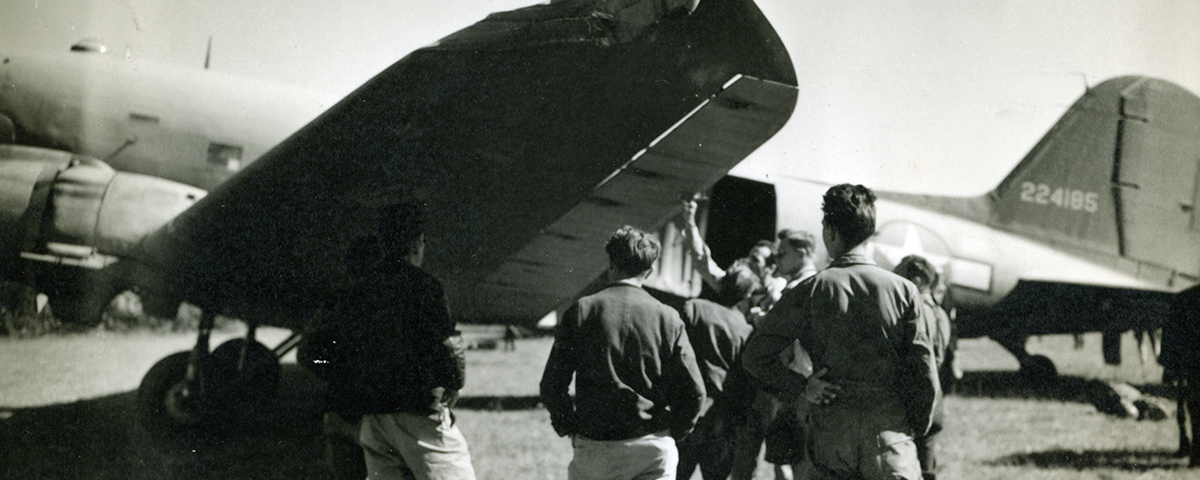
Now came the trickiest, most terrifying part of the operation for the pilots of the Fifteenth Air Force’s 60th Troop Carrier Group—landing in near-darkness on an improvised runway deep in enemy territory. The first of four C-47s overshot the runway and was forced to go around again. The other planes touched down successfully, followed by the first aircraft on its second try. The only mishap was one aircraft’s minor run-in with a haystack, which dented the C-47’s wingtip.
Within a half-hour of the lead aircraft’s touchdown, the first evacuees had said their emotional farewells to the Serb families who had sheltered them, and the fully loaded planes were ready to go. Seconds before takeoff, the side doors of all four planes swung open to reveal the rescued airmen unlacing their boots and holding them up for the villagers to see. One after another, the airmen tossed their boots out to the Serb villagers as a final expression of gratitude to their caretakers, many of whom had nothing to wear on their feet but traditional Serb felt slippers.
All four C-47s took off successfully, though just barely. Two more flights of C-47s duly arrived at the makeshift airfield the next morning, this time with a strong escort of P-51 and P-38 fighters. The fighters peeled off, shooting up neighboring German garrisons as a diversion, and the C-47s were able to land much more safely than they had the previous night.
In only the first two days, Operation Halyard successfully retrieved 241 American airmen—but the OSS team was less successful when it came to obeying the government edict that the agents not furnish any supplies or give any aid to Mihailovich’s men. George Musulin, who approved the evacuation of two seriously wounded Chetniks along with the Allied airmen, was ordered home in August 1944 for aiding Mihailovich’s forces; he was replaced as mission commander by Lt. Nick Lalich.
But as Halyard continued, events in the rest of Yugoslavia conspired to interrupt it. Tito, now firmly in control of all Yugoslav provinces except Serbia and parts of Bosnia, launched a final drive in September 1944 to solidify his grasp on power, surrounding Pranjani with his Partisan army and crushing Mihailovich’s forces. The Chetniks were forced to evacuate Pranjani on September 10, and from that point forward, Operation Halyard resembled a traveling road show throughout Serbia and Bosnia. Evacuations over the next three months were improvised affairs, using whatever broad, flat spaces were available—mostly farm fields. And even as the Chetniks moved into Bosnia in Halyard’s final phase, they collected airmen to be brought for evacuation: not just Americans, but British, French, Italian, and Russian aviators as well.
By December 1944, the OSS decided that Operation Halyard had run its course. The end of the Ploesti campaign meant there were no more planes flying over the region, and no newly downed airmen requiring rescue. By the time of its termination, Vujnovich’s team had airlifted 512 downed Allied airmen without the loss of a single airman or plane—a truly impressive accomplishment. The last evacuation flight, which also carried the operation’s OSS team, left Boljanic, Bosnia, on December 27, 1944. In a final and surprising gesture of generosity, Nick Lalich’s OSS superiors radioed Draza Mihailovich an offer to evacuate him on the last flight out. Though he was in desperate straits due to Partisan resistance and the Allied ban on material aid and support, Mihailovich declined, preferring to share the fate of his people instead.
By March 1946, news of Mihailovich’s capture and impending trial for alleged war crimes by Yugoslavia’s Tito-led communist government reached Halyard participants in the United States. Outraged and strongly convinced of Mihailovich’s loyalty to the Allied cause, the former airmen reunited to mount a public campaign to clear the Chetnik leader’s name. They contacted newspapers and magazines, speaking out about their experiences in Pranjani; they protested outside the Yugoslav consulate in New York City; and they staged a highly publicized trip to Washington, D.C., where they met with congressmen in an effort to declassify the government records documenting Operation Halyard, thus providing evidence of Mihailovich’s cooperation with the Allies. A meeting with Secretary of State Dean Acheson secured State Department aid in forwarding the airmen’s testimonies to Tito, but Tito refused them. Mihailovich was tried and convicted, executed by firing squad on July 17, 1946, and buried in an unmarked grave.
For nearly sixty years, the airmen involved in Operation Halyard believed they had failed in their effort to bestow widespread recognition on Mihailovich for the part he played in their rescue. But in reality, their voices were heard. In 1948, urged on by a group of military officials, President Truman awarded a posthumous—but secret—Legion of Merit to Mihailovich for his contributions to the Allied cause, including Operation Halyard. “Through the undaunted efforts of his troops,” the accompanying citation read, “many United States airmen were rescued and returned safely to friendly control.”
The award, like the government reports of the OSS operation, remained classified for decades. The exact reason is still unclear. The American and British governments, concerned about maintaining their relationship with Yugoslavia during the cold war, feared that making the award public would anger Tito. The State Department might also have been concerned about potential damage to American prestige in Italy, where Italian-Yugoslav tensions ran high over the disputed territory of Trieste. But a breakthrough came in 1997 when the British declassified their wartime reports of Halyard, and Mihailovich’s Legion of Merit was released from the National Archives soon afterward. On May 9, 2005, a group of Halyard participants, including George Vujnovich and Arthur Jibilian, traveled to Serbia to formally present the award to Mihailovich’s daughter, Gordana, bringing the operation’s story to completion.
Operation Halyard fought opposition from the outset—from the State Department, from communist sympathizers in the SOE, even from Churchill himself. It was an operation that seemed condemned from the start, but through the collaborative efforts of the Chetnik army, the Fifteenth Air Force, and the OSS agents and airmen who remained dedicated to the operation long after the last man had been airlifted out of the Balkans, Halyard defied the odds to become one of the most successful rescues in air force history.