In mid-May 1862–little more than a year after South Carolina secessionists had fired the opening rounds of the Civil War at Fort Sumter–the end of the conflict seemed invitingly within the Union’s reach. In spite of a spirited and resourceful defense by a hopelessly outnumbered Confederate Army, aided by a Union commander who constantly overestimated the Rebels’ numbers and consequently had been advancing up the Virginia Peninsula at a snail’s pace, a powerful Union force was now making its way up the James River toward the Confederate capital of Richmond.
In Richmond itself, panic reigned. Runaway soldiers and refugee families poured in from the peninsula, doubling the city’s prewar population of 40,000. Some residents set aside small quantities of tobacco to be used as currency in their future dealings with Union occupation forces, while others fled. President Jefferson Davis’ wife, Varina, and their four children were sent to Raleigh, N.C. Preparations were made to ship the Confederate archives to South Carolina, while the treasury’s gold was crated up, ready to be removed at a moment’s notice aboard a train kept under steam for just that purpose.
Given the lethargy with which Union Maj. Gen. George B. McClellan was executing his end run up the peninsula, it was fitting that the cause of Richmond’s atmosphere of impending doom was not his Army of the Potomac but the U.S. Navy and Marine Corps.
When McClellan commenced his Peninsula offensive in March 1862, he was supported by a sizable naval contingent that would accompany his army as it advanced up the James River. On March 8, however, a serious threat emerged in the form of the Confederate ship Virginia, an armored casemate ram converted from the salvaged burned-out hull of the Union steam sloop Merrimack. Accompanied by the wooden gunboats Patrick Henry, Jamestown and Teaser, Virginia attacked the Union blockading squadron in Hampton Roads, where she rammed and sank the wooden frigate Cumberland, set the frigate Congress ablaze and forced the steam frigates Minnesota, Roanoke and St. Lawrence to run aground. Those unfortunate Union vessels thus had the dubious distinction of being the first victims of an ironclad warship.
It was Virginia’s turn to be surprised, however, when she returned to Hampton Roads the next morning to finish off the still-grounded Minnesota. There to confront the Rebel ram was the new and even more innovative Union ironclad Monitor, which had a round, two-gun turret mounted on her low, flat hull. History was made for the second day in a row, as two ironclad vessels fought each other for the first time.
The two-hour duel ended in a standoff, with little damage inflicted on either side. Virginia was compelled to withdraw to Sewell’s Point, however, and she then retired up the Elizabeth River to Norfolk. Virginia’s captain, Franklin Buchanan, had been wounded in the fight, and Flag Officer Josiah Tattnall took command of the ironclad.
During the next two months, whenever Virginia ventured into Hampton Roads, the Union naval commander there, Commodore Louis M. Goldsborough, would prudently withdraw his fleet to within range of Fort Monroe’s guns. As for Monitor, President Abraham Lincoln had given specific orders not to risk her in another confrontation with Virginia until more ironclads could be built. Consequently, when the Confederate ram entered Hampton Roads on April 11 and captured three Union transports within sight of Monitor, the Union ironclad did not steam out to engage her. But when Monitor and five other Union vessels bombarded Sewell’s Point on May 8, Virginia did come out to confront them, only to see the Union vessels retire beyond cannon range. An uneasy standoff ensued.
While Virginia’s officers were planning a desperate, all-out strike against the Union fleet, Lincoln arrived at Fort Monroe and directed Maj. Gen. John Wool to land a force on the other side of Hampton Roads, at Willoughby’s Point. Soon, Union troops were ashore and marching toward Norfolk, prompting the Confederate garrison commander, Maj. Gen. Benjamin Huger, to set fire to the Gosport Navy Yard and withdraw his forces. He did so without informing Tattnall, whose first indication of trouble came on May 9, when he noticed that there was no longer a Confederate flag flying over the battery at Sewell’s Point.
By the night of May 10, Virginia was a warship without a port, and Tattnall decided to try to escape up the James to Richmond. Blocking his way, however, was Harrison’s Bar, a stretch of riverbottom where the water was only 18 feet deep. In order to clear that obstacle, Virginia’s 20-foot draft would have to be reduced. Her crew spent five desperate hours throwing coal and ballast overboard, exposing the ironclad’s thinly armored lower quarters but reducing her draft by 3 feet.
Even those measures did not seem to be enough, however, because the local river pilots informed Tattnall that heavy winds were sweeping so much water off the bar that the lightened Virginia would still not be able to clear it. Tattnall distrusted the pilots’ claims, but he was also unwilling to risk the lives of his crew in the event Virginia did run aground, leaving her immobilized and vulnerable to Union gunfire.
Late that night, Tattnall intentionally ran Virginia aground beside Craney Island, near the mouth of the Elizabeth River, then ordered her abandoned and set afire. At 4:58 a.m., the flames reached Virginia’s 16-ton powder magazine, and the pride of the Confederate Navy exploded into fragments in a bright flash that could be seen from as far away as Fort Monroe.
The situation now looked completely hopeless for the Confederate cause. Outnumbered by McClellan’s 118,000-man Army of the Potomac, General Joseph E. Johnston’s 56,000 Confederate troops were already slowly retreating up the peninsula. With Virginia gone, nothing stood in the way of the Union Navy, either. On May 13, a pessimistic Jefferson Davis wrote to his wife: “The hasty evacuation of the defenses below and the destruction of the Virginia hastens the coming of the enemy’s gun-boats. I do not know what to expect when so many failures are to be remembered, yet will try to make a successful resistance.”
As Lincoln returned to Washington on May 11, word of Virginia’s demise reached McClellan at his camp near West Point at the head of the York River. Seeing an opportunity to intimidate Richmond into surrender without having to fight his way through the Confederate Army, McClellan urged Goldsborough to dispatch a flotilla of Federal warships, including Monitor, up the James toward the Rebel capital, some 70 miles away.
Unfortunately for Goldsborough, the manner in which his force would proceed was typically McClellanesque. The Rebels had evacuated the east bank of the James, but they still had several forts on the west bank. Although those positions were too weakly defended to stop the Federal ships, McClellan’s orders were for Goldsborough’s men “to reduce all the works of the enemy as they go along, spike all their guns, blow up all their magazines,” and only then move on Richmond and shell the city into surrender. Because Goldsborough dutifully adhered to those orders, minor strongpoints that might have been bypassed were dealt with in turn and generally given more attention than was really necessary. Each delay in the flotilla’s progress bought that much more time for Richmond’s mixed bag of troops and tars to shore up her defenses.
On the morning of May 14, a Confederate soldier stationed at Battery Park, an outpost at the mouth of the Pagan River guarding Smithfield, spotted three Union vessels steaming up the James. In the van was Galena, one of three experimental armored vessels laid down for the U.S. Navy in 1861. Designed by Samuel H. Pook for C.H. Bushnell & Co. and commissioned on April 21, Galena was an ironclad corvette with unusual round sides and armor made of interlocking iron bars, 31Ž4 inches thick at the sides, which made her look, one witness said, “like a great fish with iron scales.” Galena had a two-mast schooner rig, two Ericsson vibrating-lever steam engines and two boilers, generating 800 horsepower and driving a single screw to give her a maximum speed of 8 knots. Armament consisted of two 100-pounder rifles and four 9-inch Dahlgren rifles.
Although she was brand-new, Galena did not inspire much confidence in Goldsborough, who considered her to be “a most miserable contrivance.” He would not commit her to action until additional shields of boiler plate had been installed inside the bulwarks to prevent the armor-securing nuts from flying off at the first hit and wreaking havoc on the gun crews. Even after that modification, Goldsborough still judged Galena “a sad affair.”
Another unusual vessel in the flotilla was the little gunboat Naugatuck. Built by John Stevens in 1844 as a single-screw ship, the 192-ton, 110-foot-long Naugatuck was later given two screws, driven by two inclined engines with one boiler. Originally serving in the U.S. Revenue Cutter Service (the forerunner of the Coast Guard) under the name E.A. Stevens, Naugatuck subsequently was loaned to the Navy and armed with a single 100-pounder rifle, two 1-pounder rifles and a 12-pounder howitzer. Her main protection was her ability to partially submerge by flooding compartments to increase her draft from 7 feet, 8 inches to 9 feet, 10 inches.
Rounding out the force were Monitor and two wooden vessels, the screw gunboat Aroostook and the side-wheel gunboat Port Royal. Commander John Rodgers led the small but potent flotilla. Born in Maryland in 1812, Rodgers had entered the Navy as a midshipman in 1828 and subsequently saw service in the Seminole War and in the Pacific Ocean. Serving as skipper of the gunboat Flag when war broke out in April 1861, Rodgers became the first commander of naval forces on the western rivers on May 16, but left three months later after clashing with the commanding general of the Western Department, Maj. Gen. John C. Frémont. Rodgers returned east in time to participate in the attack on Port Royal, S.C., on November 7. He served as an aide to Captain Samuel F. Du Pont, commander of the South Atlantic Blockading Squadron, before hoisting his pennant aboard Galena in early 1862.
Rodgers was anxious to duplicate what Flag Officer David G. Farragut had done in New Orleans in April 1862–run straight upriver, brushing aside any enemy fort that stood in his way–but Goldsborough’s orders compelled him to pay more attention to the minor strongpoints he encountered. The first was Fort Boykin, whose position at the lower end of Burwell’s Bay had been selected by Colonel Andrew Talcott at the behest of President Davis’ military adviser, General Robert E. Lee. Armed with eight 3-pounders, three 42-pounders and two 8-inch guns, the fort was defended by a small garrison of Virginia militia, who rushed to their positions and started firing away when Galena came in sight. The two wooden gunboats dropped back and let Galena deal with the enemy batteries, which were quickly silenced. Fort Huger, located four miles farther up the river, received similar treatment.
The next Rebel strongpoint, Fort Powhatan, had been built before the War of 1812 and challenged the oncoming Union vessels with only puny fire. Contemptuously bypassing the fort after dropping a few shells into it, the Union gunboats steamed on past City Point and Appomattox Manor, similarly subjecting each to a brief shelling as they made their way toward their ultimate prize–Richmond.
On the same day, the Virginia General Assembly met and resolved to defend the Confederate capital “to the last extremity,” assuring Davis that any destruction or loss of property in the process would “be cheerfully submitted to.” Davis then called upon Lee to propose the best line of defense south of Richmond if the government should be forced to relinquish the capital. Lee suggested the Staunton River, about 100 miles to the southwest, but then suddenly cried, “But Richmond must not be given up; it shall not be given up!”
Lee’s emotional outburst came as a surprise to political and military officials alike. For one thing, he was well-known for his reserve and self-control. For another, Lee did not have the most fearsome of fighting reputations at that time. Although he had distinguished himself as a captain of engineers during the Mexican War in 1847, Lee had not been very successful in his first year as a Confederate general; his attempt to retake western Virginia from Union control in the fall of 1861 had ended in miserable failure. Now, however, that statement of heartfelt resolve from the hitherto unaggressive “Granny Lee” galvanized similar feelings among the capital’s defenders. The Richmond Dispatch echoed the general’s sentiments: “To lose Richmond is to lose Virginia, and to lose Virginia is to lose the key to the Southern Confederacy.”
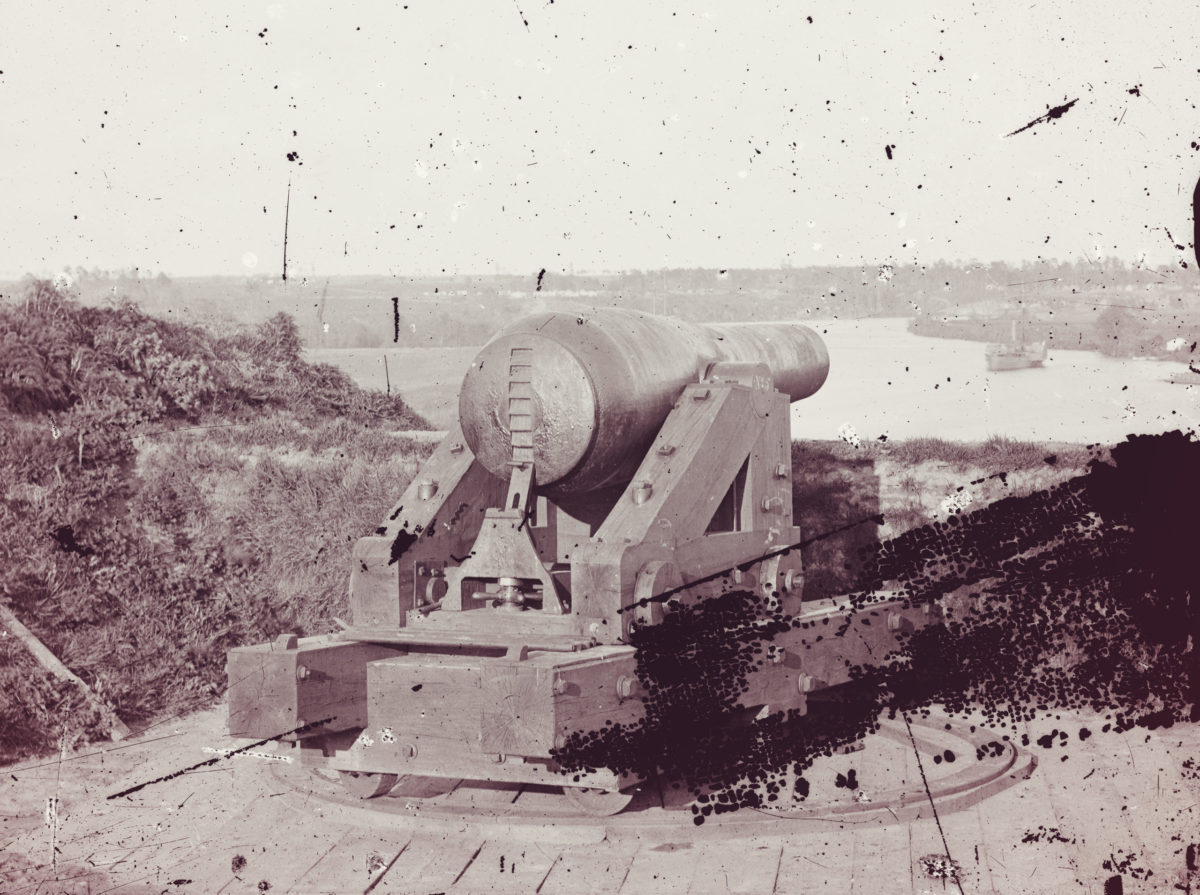
Meanwhile, the most immediate threat, the five Federal gunboats, were less than a day’s journey from the capital, with only one serious obstacle lying in their path. Eight miles below the city the James River made a sharp bend, its south bank rising to a 90-foot bluff that was located on the property of Augustus H. Drewry. From the outset, Confederate leaders had recognized the value of Drewry’s Bluff as a last line of defense, and in the winter of 1861 they had built a redoubt on it, mounting one 10-inch and two 8-inch Columbiads. Fort Darling, as the Union troops called the redoubt, commanded a mile-long stretch of the James.
With Rodgers’ flotilla now bearing down on Richmond, Lee reverted to his original specialty as an army engineer and set about bolstering the defenses around Drewry’s Bluff. Rebel sailors hauled five more heavy cannons, taken from the James River gunboat squadron, up the bluff to augment the three original guns, giving the defenders a total of four smoothbore and four rifled weapons. Lee’s eldest son, Colonel George Washington Custis Lee, personally supervised crews of soldiers, sailors and laborers who were hastily pressed into service to expand the existing entrenchments along the south bank of the river. About 300 yards downstream from the foot of the bluff, the gunboat Jamestown was scuttled in the main channel, and huge crates of stones and scrap iron were sunk between rows of pilings driven into the riverbed, forming two lines of obstructions across the 120-yard-wide river.
Just upstream from the double line of obstacles, the gunboat Patrick Henry, armed with a single 8-inch smoothbore, took up station. At the foot of the bluff on the north side of the river, Confederate Marine sharpshooters who had recently evacuated Norfolk deployed in trenches, under the command of Virginia’s gunnery officer, Lieutenant John Taylor Wood. All through the night of May 14, with the Federal gunboats only a few miles away, Lee’s men worked feverishly, digging rifle pits and filling sandbags in a drenching rain.
By the morning of May 15, the Confederates were as ready as they could ever hope to be. Captain Augustus Drewry, who was defending not only the capital and the cause but also his own property, commanded the Rebel army gunners of the Southside Heavy Artillery. Since most of the defenders were navy men, however, overall command on Drewry’s Bluff was held by Commander Ebenezer Ferrand. Also present in command of a battery was Lieutenant Catesby ap Roger Jones, Tattnall’s former executive officer aboard Virginia.
Rodgers had learned about the Confederate efforts to close the bend at Drewry’s Bluff late on May 14 and had waited until the next morning to try to force the defenses. Now, out of the morning mist, Galena emerged to inspect the enemy obstructions. At 7:35 a.m., she had reached a point 400 yards from the barriers when Ferrand ordered his batteries on the bluff to open fire.
Galena immediately took two hits on the port bow, but Rodgers held his fire. He recognized that this would be the first real test for his thinly armored flagship, and as he later put it, “I resolved to give the matter a fair trial.” He calmly moved Galena forward and maneuvered her in the narrow channel so that she could bring a full broadside to bear upon the bluff. Then Galena and her consorts commenced firing. The roar of the guns–Union and Confederate–shook the windows in an apprehensive Richmond.
On the bluff, Confederate gunners were hard pressed as fragments from 100-pound shells lobbed by Galena showered down on their emplacements. Their 10-inch Columbiad, accidentally loaded with a double charge of powder, recoiled off its platform. Nearby, a rain-soaked log casemate collapsed on its gun. Other guns had to cease fire temporarily so their limited supplies of ammunition could be rationed.
For all their problems, the Confederate gunners held one distinct advantage. They were able to pour plunging fire down on Galena, repeatedly penetrating the ironclad’s thin deck armor, whereas the Yankee gunners found their shells, more often than not, crashing harmlessly into the sides of the bluff below the redoubt. Monitor, attempting to relieve Galena, moved forward at about 9 a.m., but at close range she could not elevate her guns sufficiently to reach the top of the bluff and soon had to retire downstream. The Confederates fired only three shots at the seemingly invulnerable Monitor before giving up and concentrating on Galena.
Naugatuck also attempted to move forward and relieve Galena, but fared no better than Monitor at reaching Fort Darling with her gunfire. Upon firing a 16th round, her single 100-pounder Parrott gun burst, hurling part of its breech into the river and effectively putting her out of the fight.
Meanwhile, the wooden gunboats Aroostook and Port Royal remained at anchor half a mile downstream. Their crews did not dare to venture closer, and in any case they were preoccupied with a lively crossfire from Confederate sharpshooters entrenched on both riverbanks, one of whose bullets wounded Port Royal’s captain. A few shells came their way, but most of the Confederate gunners’ wrath was still concentrated on Galena.
Galena was also under a steady hail of musket fire, mostly from Fort Darling. Unmindful of the shot and shell that pelted the embattled ironclad, one member of Galena’s U.S. Marine contingent, Corporal John F. Mackie from New York City, could frequently be seen poking his head out of the gunports to return fire–his intended targets included counterparts from the Confederate Marine Corps. His actions were later described in an official citation: “As enemy shellfire raked the deck of his ship, Corporal Mackie fearlessly maintained his musket fire against the rifle pits along the shore and, when ordered to fill vacancies at guns caused by men wounded and killed in action, manned the weapon with skill and courage.” With the reading of that citation, Mackie became the first member of the U.S. Marine Corps to be awarded the Medal of Honor.
By 11 a.m., Galena had taken 44 hits, 18 of which had penetrated her armor. Other plates were jarred loose; timbers and frames were splintered and broken. A solid shot had gone completely through one of her bulwarks and embedded itself in the other. Her railings were shot away, her smokestack was riddled and on her shattered decks 13 men lay dead. Another 11 were wounded or injured, one of whom later died.
Rodgers stubbornly stood fast until Confederate Captain J.R. Tucker in Patrick Henry, unobtrusively lying at anchor among the obstructions, loosed an 8-inch shot that tore through the bow gunport and set Galena on fire. At 11:05, Rodgers, noting that Galena was almost out of ammunition and starting to take on water, finally gave the order to withdraw.
As the Federal squadron limped back downriver, the Confederates gave three cheers and hurled their caps into the air. Monitor’s pilot heard a Rebel sharpshooter call out mockingly, “Tell the captain that is not the way to Richmond!”
Seven defenders of Drewry’s Bluff had been killed and eight wounded, but their steadfast stand had staved off the waterborne threat to Richmond. Lee, witnessing the drama from the other side of the James at Chaffin’s Bluff, was relieved but chastened to see how close the enemy ships had come.
Southern sharpshooters continued to snipe at Rodgers’ retiring flotilla all the way down the James. The ships also came under fire from Fort Powhatan. Its guns were no more effective than they had been the first time, but they were annoying enough for the Union gunboat Sebago to come up later and raze the fortification.
Without a doubt, Galena had borne the brunt of the exchange, leading Rodgers to remark in a quiet understatement, “We demonstrated that she was not shot proof.” She would be repaired and fight in several more engagements in the Peninsula campaign, most notably off Malvern Hill on August 1. An examination in 1863, however, showed Galena’s armor to be so badly cracked that it was removed, turning her back into an ordinary wooden screw sloop with a three-mast rig.
Monitor was hit three times during the advance on Richmond but escaped completely unharmed. Port Royal and Aroostook suffered only light damage. Naugatuck was judged to be so useless that she was returned to the U.S. Revenue Cutter Service.
Richmond celebrated, although everyone felt that her deliverance was temporary. McClellan’s Army of the Potomac still lay about 23 miles from the Confederate capital and was advancing against Johnston, who was rapidly running out of space in which to conduct his fighting retreat. On May 31, Johnston was wounded during the Battle of Seven Pines. Major General Gustavus W. Smith briefly took charge of the Confederate Army but proved to be unsuited to the task. Command was then reluctantly handed over to the most senior officer left in Richmond–General Robert E. Lee.
Nobody in the Confederate capital would have suspected it at the time, but their army, which Lee christened the Army of Northern Virginia, was about to undergo a profound change–and so was the conduct of the war. The days of retreating were over.