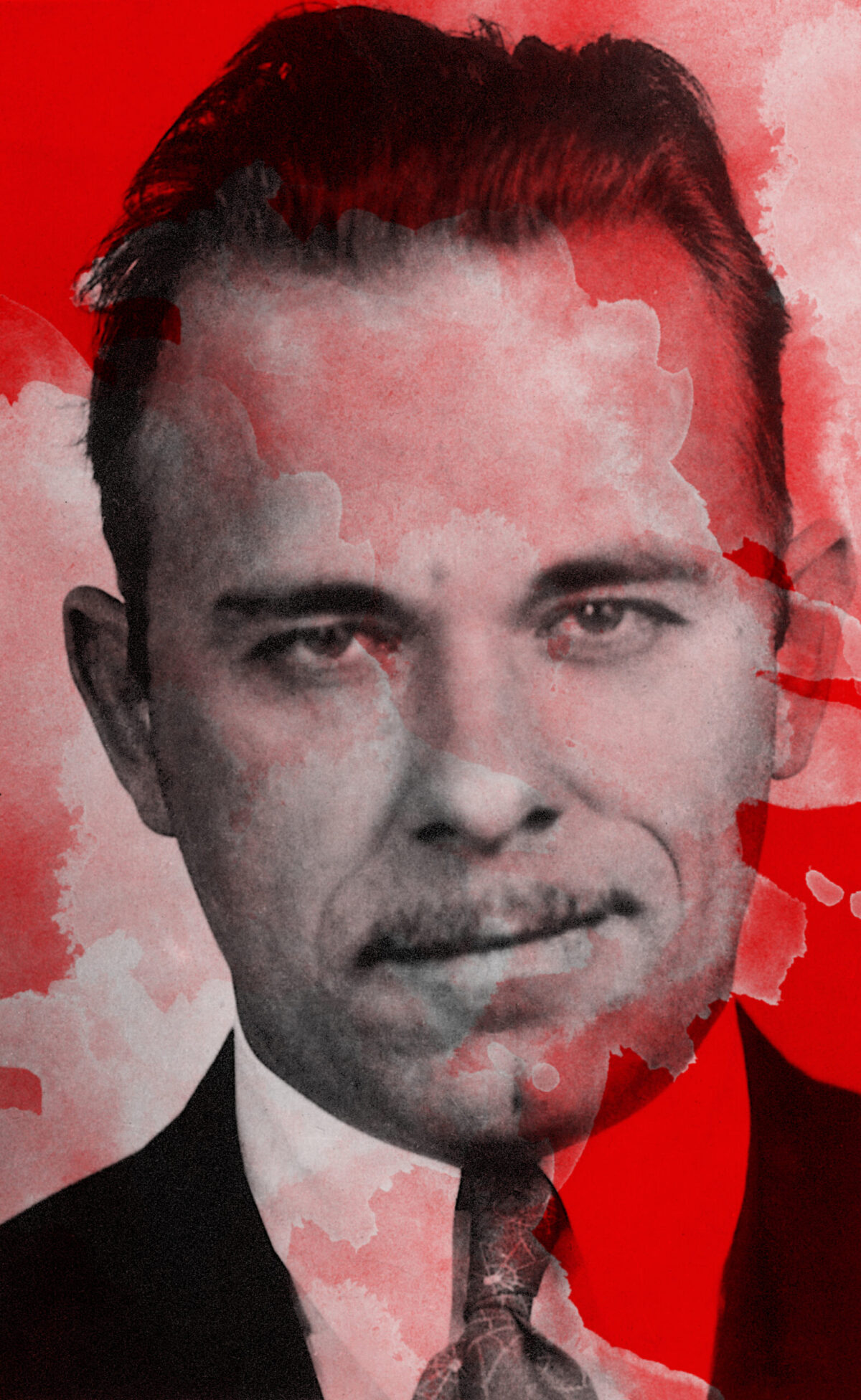
When Dillinger walked out of the Biograph Theater, he saw a bunch of men staring at him and reached for his .38.
The moonless night was pitch dark but the G-men shut off their headlights as they approached a rural Wisconsin inn called Little Bohemia. They didn’t want John Dillinger and his gang of bank robbers to see them coming. When the feds slipped quietly out of the cars, guns ready, they spotted three men hustling out of the darkness and into a Chevy coupe. The Chevy’s lights flashed on, music blared from the radio and it took off.
“Stop!” the G-men yelled. “Federal Agents!”
The car kept going. The feds unleashed several bursts of fire from their Tommy guns. The Chevy’s windshield shattered, its tires popped and it rolled to a halt. Inside, one man was dead and two were badly wounded. None was Dillinger. The three men were local workers who happened to stop at the inn for a drink.
At the sound of gunfire, the real bank robbers inside Little Bohemia bolted, darting out doors and leaping from windows, shooting as they fled. The G-men responded by blasting the lodge, then turning to fire at the cars as they raced away from the site.
When the shooting stopped and the smoke cleared, one federal agent was dead and two lawmen lay wounded while Dillinger and his cronies slipped away unscathed.
It was April 22, 1934, and once again the elusive John Dillinger had escaped his pursuers, making monkeys of the cops who’d been chasing him for months.
Seventy-five years ago this summer, Dillinger and a dozen other outlaws were the stars of the Great Depression’s greatest show—a cops-and-robbers soap opera complete with blood, sex, death, money and amazing, hair-raising escapes. Newspapers, eager to cover their exploits, invented colorful nicknames for them—“Gentleman Johnny” Dillinger, “Pretty Boy” Floyd, Alvin “Creepy” Karpis, “Ma” Barker, Bonnie and Clyde, and “Baby Face” Nelson.
They were bank robbers, which was not an un-popular occupation in 1934. In the depths of the Depression, bankers were even less beloved than they are in 2009. In the ’20s, banks speculated in stocks, then went bust, leaving depositors high and dry. In the ’30s, banks foreclosed on farmers who’d been devastated by drought, forcing thousands off their land. By 1934 many Americans smiled when banks got robbed, and in movie theaters, audiences applauded when newsreels showed pictures of Dillinger.
“You robbed the bank, did you?” a North Dakota farmer asked a member of Ma Barker’s gang. “Well, I don’t care. All the banks ever do is foreclose on us farmers.”
The savviest bank robbers knew how to capitalize on their Robin Hood appeal. When the governor of Oklahoma offered $1,000 for Pretty Boy Floyd’s capture, Floyd wrote a letter of protest: “I have robbed no one but the monied men.”
The famous criminals of the ’30s differed from the celebrated crooks of the previous decade. The gangsters of the ’20s were men of the sinful cities, many of them immigrants. The bank robbers of the ’30s were country boys and girls, all-American bands of homegrown sociopaths from the heartland.
Charles “Pretty Boy” Floyd was an Oklahoma farm boy who robbed small-town banks, survived several shootouts with lawmen and liked to hide out with his Oklahoma relatives, drinking Choctaw beer and baking pies.
“Ma” Barker was a short, dumpy Oklahoma farm wife who wore overalls, liked jigsaw puzzles and raised four sons, all of them criminals. J. Edgar Hoover described her as a “vicious, dangerous and resourceful criminal brain” but that was just propaganda. Neither Ma nor her sons were very bright. The real brains of their gang was Karpis, a Kansas kidnapper with a scary stare that earned him the nickname “Creepy.”
“Baby Face Nelson,” a member of Dillinger’s gang, was born Lester Gillis, son of an Illinois tannery worker. As a teenage mechanic, he fixed cars, then started stealing them, and earned his nickname when a woman he’d robbed—who happened to be the wife of Chicago’s mayor—told a reporter “he had a baby face.”
Bonnie Parker and Clyde Barrow grew up in the slums of Dallas, children of poor farmers who’d moved to the city. Clyde ushered in a movie theater, played the saxophone and burglarized stores. Bonnie waited on tables, read movie magazines and longed for excitement. “Haven’t been anywhere this week,” she wrote in her diary in 1928. “Why don’t something happen?” They met in 1930, fell in love and drove aimlessly around America with their pet rabbit Sonny Boy, robbing stores and rural banks. They might have remained obscure petty crooks if police hadn’t raided their hideout in Joplin, Mo., in 1933. In the shootout, Clyde and his brother killed two cops before the gang escaped, leaving behind a camera containing pictures of Bonnie and Clyde smooching and fondling guns. Printed in countless newspapers, the photos made them famous.
But not nearly as famous as Dillinger, whose career in crime was wilder than anything Hollywood could concoct. Son of an Indiana grocer, Dillinger took to crime in grade school, forming a gang called the Dirty Dozen and heisting watermelons. He dropped out of school, joined the navy, then deserted. Back home, he mugged a grocer and was sentenced to 10 to 20 years in prison. After nine years, he was paroled in May 1933. A month later, he gathered some friends and robbed a bank. The gang made off with $10,600 and celebrated by robbing a grocery store and a pharmacy that night.
Dillinger used his loot to bribe somebody to smuggle guns to his pals in prison. In September, they escaped, only to learn that Dillinger had been locked up in Lima, Ohio. So they stormed the jail, killed a sheriff and freed him. Then the reunited outlaws raided two police arsenals, stealing guns, ammo and bulletproof vests.
Soon the well-armed gang commenced robbing banks. In October 1933, they hit one in Greencastle, Ind., emptying the vault of nearly $75,000. In November, they raided one in Racine, Wis., wounding a teller and a cop and escaping in a blast of gunfire. In January 1934, after a three-week vacation in sunny Florida, they hit a bank in East Chicago, Ind., stealing $20,000. A cop fired at Dillinger, hitting his bulletproof vest. Dillinger was unhurt, but the cop was killed with a blast from a Tommy gun.
Now wanted for murder, Dillinger fled to Tucson, where he was recognized, captured, shipped to Indiana and locked in the Crown Point jail. There, the warden let reporters interview Dillinger, who joked about his crimes.
“How long does it take you to go through a bank?”
“One minute and 40 seconds flat,” he said, smiling.
The reporters loved Dillinger’s bravura performance and lamented that a murder conviction would send the wonderfully colorful character to the electric chair. But that didn’t happen. On March 3, 1934, Dillinger, waving a pistol, captured Crown Point’s warden and several guards, locked them in a cell and fled in the warden’s car. Before leaving, he showed them his gun. It was a fake that he’d carved out of wood.
“You should have seen their faces,” Dillinger wrote in a letter to his sister. “Ha! Ha! Ha!”
Dillinger wasn’t the only one laughing. Newspapers mocked America’s hapless cops and prison guards. The snickering incensed J. Edgar Hoover, who was then the obscure head of the Justice Department’s obscure Bureau of Investigation. Hoover saw Dillinger as a way to win publicity and power for his little outfit. He ordered his Chicago bureau chief, Melvin Purvis, to find the infamous outlaw.
But Purvis and his G-men proved inept. They raided the wrong apartments in Chicago and Minneapolis, and when they hit the right apartment in St. Paul, Dillinger escaped in a blast of Tommy gun bullets. Then came the debacle at Little Bohemia, which ended with a G-man and an innocent bystander dead and Dillinger’s gang still at large. Two weeks later, they robbed yet another bank, this one in Fostoria, Ohio.
“COMIC OPERA COPS,” read a headline in the Milwaukee Sentinel.
Reporters speculated that Hoover might be fired for the botched job. He wasn’t. Instead, he doubled the size of his anti-Dillinger squad and dubbed the outlaw “Public Enemy Number One,” a phrase the newspapers loved.
Hoover also offered a $10,000 reward for information on Dillinger’s whereabouts. That did the trick. A Chicago madam named Anna Sage informed Purvis that her roommate was Dillinger’s girlfriend. Sage said she was going to the movies with the happy couple the next night and agreed to wear a bright orange skirt so the G-men could pick her out of the crowd.
When Dillinger walked out of the Biograph Theater with the two women on Sunday, July 22, 1934, he looked around, saw a bunch of men staring at him and reached for his .38. The G-men instantly blew him away.
The news spread fast, crowds flocked to the Biograph and souvenir-seekers dipped handkerchiefs in the blood on the sidewalk.
In Washington, Hoover promised that the law would soon catch up with the rest of America’s infamous bank robbers. He was right. Bonnie and Clyde were already dead, riddled with dozens of bullets in an ambush in Louisiana in May. In October, G-men led by Purvis gunned down Pretty Boy Floyd. A month later, the feds killed Baby Face Nelson in a gunfight that left two G-men dead. In January 1935, the feds managed to corner Ma Barker and her son Fred in a Florida cottage and blew them away.
By then, only one of the “public enemies” was still at large—Creepy Karpis. Hoover, who’d been mocked because he’d never personally made an arrest, was determined to collar Creepy himself. In April 1936, G-men informed their boss that they’d found Karpis in New Orleans. Hoover immediately flew down so he could join the squad that nabbed Creepy as he sat in a parked car.
“Put the cuffs on him, boys,” Hoover said.
Alas, nobody had remembered to bring handcuffs. An embarrassed agent used his tie to bind Creepy’s wrists. The headline in the next day’s New York Times read, “KARPIS CAPTURED IN NEW ORLEANS BY HOOVER HIMSELF.”
The era of the bank robbers was over but their legends lived on. Like Jesse James, Billy the Kid and other Wild West desperadoes, the ’30s outlaws became part of pop culture. Hollywood has produced three movies called Dillinger and two called Baby Face Nelson. Pretty Boy Floyd’s story was chronicled in a Woody Guthrie song, a Larry McMurtry novel and at least three films, one starring Fabian. Bonnie and Clyde were immortalized in a Merle Haggard song and a blockbuster 1967 movie starring Faye Dunaway and Warren Beatty. Their stolen, bullet-ridden “death car” is still displayed in casinos. Shelley Winters played Ma Barker in the 1970 movie Bloody Mama. The rock band Jesus Lizard cut a song called “Karpis.” And the Indiana Welcome Center on Interstate 80 houses the John Dillinger Museum, where visitors can buy a keychain decorated with a replica of Dillinger’s famous wooden gun.
This summer, the big-budget movie Public Enemies features Johnny Depp as Dillinger, Giovanni Ribisi as Karpis, Stephen Graham as Nelson and Channing Tatum as Floyd.
But posthumous fame is a thrill that nobody lives long enough to enjoy. The real winner of the ’30s “war on crime” was Hoover. When that war began, he and his little investigative bureau were virtually unknown. When it ended, Hoover and his newly re-named “Federal Bureau of Investigation” were famous, hailed in newspapers, radio shows, comic strips and James Cagney’s hit movie G-Men.
The debacle at Little Bohemia could have cost Hoover his job but he was a genius in the arts of bureaucracy and public relations and he convinced Congress to grant him more money, personnel and power. For the next four decades, he reigned as the undisputed dictator of a law enforcement agency that frightened criminals, spies, dissenters, congressmen, even presidents.
A few weeks after Dillinger’s death, Hoover ordered his underlings to create a display outside his office—a glass case containing the bank robber’s gun, straw hat and death mask. The strange shrine remained until Hoover died in 1972.
When the director was an old man, an interviewer asked him to name his greatest thrill. Hoover didn’t even have to ponder the question. “The night we got Dillinger,” he replied.