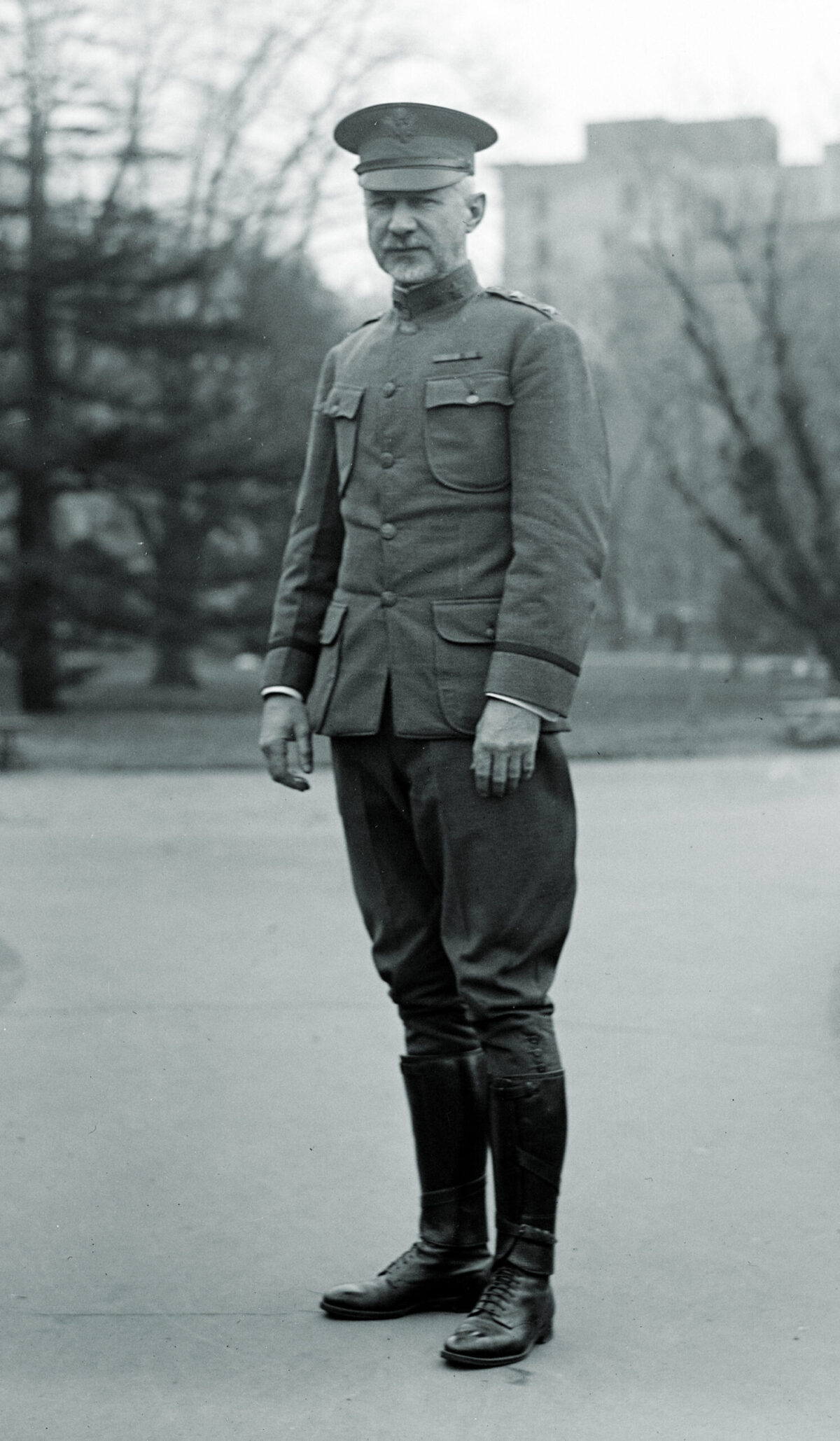
In 1918 John J. Pershing and Peyton C. March were the American generals who gave the edge to Allied victory over Germany. Pershing was the commander who organized and led the American Expeditionary Forces (AEF) of two million men in France while, during the last eight months of the war, March was in Washington, D.C., as the chief of staff who oversaw the logistics and general development of the army, and the shipment of some 1.8 million troops across the Atlantic. As Secretary of War Newton D. Baker noted shortly after the war, “Together they wrought…victory.”
During the war, Pershing became famous, and he is still remembered today, yet March, who was little known then, has been virtually forgotten. As cadets at West Point and as officers in the small regular army, they knew each other, and their careers briefly overlapped. Their service encompassed the transformation of the United States into a world power and the role of the army as the cutting edge of that great change.
Hard, tough men, they played prominent roles in the Philippine Insurrection (1899-1903) before they reached the culmination of their careers during World War I. Their stories reflect the differences in background, personality, and position that ultimately resulted in friction between them and affected their places in history.
Pershing’s early years were marked by the guerrilla war that lasted throughout the Civil War in Missouri and made life more uncertain. The Pershings, nevertheless, were better off than their neighbors in the small village of Laclede. At one time, John F. Pershing owned a store, a lumberyard, and two farms; however, he lost all but one farm in the Panic of 1873 and had to take a job as a traveling salesman, while young John was left to run the farm. In his teens, the young Pershing also worked on the railroad and as a janitor and teacher. An ambitious boy, he saved money to pay for a year at a state teacher’s college, but his goal was higher. He wanted to go to West Point because of the free education and the opportunities it offered.
March, who was almost five years younger, grew up on the campus of Lafayette College in Easton, Pennsylvania. His father, Francis A. March, became one of the most distinguished academics in the United States. His mother, Mildred Conway, was a direct descendant of a signer of the Declaration of Independence. Peyton majored in classics at Lafayette, earned a Phi Beta Kappa key, and played on the football and baseball teams. Only nineteen when he graduated, he went to West Point a few weeks later because he wanted to be a soldier.
Both his classmates and the supervising officers at West Point recognized Pershing as a leader. As one cadet remembered, he was a fine figure of a man. At 5 feet 9 inches tall, with compact build, he looked as if he were born to wear a uniform. Older and more experienced than his classmates, he was class president throughout his years at the academy and served as the first captain his last year. He graduated in the middle of his class in 1886. March, who was in the class of 1888, was a lieutenant his last year but graduated in the top quarter of his class. With a bearing as erect as Pershing’s, March was taller at 6 feet 2 inches, and thinner. The two served in the same company one summer, but the cadet corps, which numbered fewer than four hundred, was small enough that everyone knew everyone else. Their classes produced a large number of generals — twenty-six of the twenty-seven graduates in 1886 and twenty-three of forty-four in 1888.
Their early service in the army sent them in different directions. As a cavalry officer, Pershing went to frontier posts as the Indian wars were ending. He had one significant break for four years when he was the professor of military science at the University of Nebraska, which afforded him the opportunity to earn a law degree. He still had hopes of making a career in civilian life. In 1897 he left the frontier again to be a tactical officer at West Point. Unlike in Nebraska, where students heaped adulation on him, the cadets at the military academy thoroughly disliked Pershing for his martinet ways. Since he had served in one of the army’s four black regiments, they started calling him N—— Jack, which in later years became Black Jack. After a difficult eleven months, he returned to the 10th Cavalry to take part in the expedition to Cuba in the Spanish-American War.
As an artilleryman, March had more prosaic duties in various East Coast forts. The war in 1898 took him away from garrison life, and he was awarded a citation for leading his battery in a charge against a blockhouse during the Battle of Manila. After the discharge of this wartime unit, he returned to the Philippines, where the war with Emilio Aguinaldo’s nationalist forces was in progress. After brief service as Maj. Gen. Arthur MacArthur’s aide, he received a temporary majority in the 33rd Volunteer Infantry. When Aguinaldo’s army disintegrated and the guerrilla war began, March’s battalion was close on the leader’s trail. March almost caught Aguinaldo and did kill the commander of his bodyguard and capture his chief of staff. MacArthur commended March as he returned to his regular rank of captain, saying, No officer has rendered more efficient or brilliant field service on Luzon.
In 1899 Pershing went to the Philippines as a volunteer major but served for almost two years as an adjutant general before he returned to his regular rank of captain and had his first great opportunity for fame. The Moros on Mindanao and Jolo were resisting attempts to establish American control in the interior of their islands. While on staff duty, Pershing had studied these fierce Muslim warriors, and the commanding general assigned him a battalion-size force of infantry, cavalry, and artillery to deal with the Moros near Lake Lanao on Mindanao. Pershing employed both diplomacy and the skillful use of force in dominating the several Moro tribes in that area. During his two-year service, he impressed the Moros, who even made him an honorary tribal chieftain, and he earned praise up the chain of command to the White House.
At this stage of their careers, both men were promising captains. In 1903 they were among the officers assigned to the initial General Staff in Washington, where they shared the same office for two months. Later they served at different times as observers with the Japanese in Manchuria during the Russo-Japanese War. Then in 1906, Pershing, with President Theodore Roosevelt’s recommendation and the approval of the Senate, was promoted over the heads of 862 officers to the rank of brigadier general.
Throughout the next decade, while March rose through the ranks to colonel and held appropriate command and staff assignments in the States, Pershing returned to the Philippines for two tours, totaling five years, and wound up the Moro Wars with two large-scale battles. In March 1916, newly appointed Secretary of War Newton D. Baker gave him command of a combined-arms punitive expedition of some eleven thousand troops into Mexico. Although he did not capture Pancho Villa, whose attack on Columbus, N.M., had triggered this intervention, Pershing pushed him back from the border and handled the complex problems of dealing with both Villistas and the supporters of the central government. By the time the expedition left Mexico, he was a major general.
When the United States entered World War I in April 1917, Pershing was the Southern Department commander in Texas, and March commanded a field artillery regiment. March had had a successful career, and Pershing had experienced extraordinary success, but both had suffered great personal loss. March’s wife died while he was in Manchuria and left him with five small children. Pershing suffered a stunning blow in 1915, losing his wife and three daughters in a fire, which his son survived. As officers, they had similar characteristics. They were relentless drivers as commanders. Ben Lear, who served under them, said that both were very harsh–quiet–abrupt and inconsiderate of subordinates. He illustrated his point about Pershing by telling of an incident when he was on an expedition against the Moros. Lear, a lieutenant, was checking outposts when one of the sentries fired on him. When Pershing heard about this the next morning, he commented, “He should have killed you.”
March’s first sergeant during the Spanish-American War remembered, “Everybody was scared of him,” a lieutenant who served in his battalion in garrison at Fort Riley, Kansas, wrote. “He could cut one down to size more completely and in fewer words than any other commander I ever had.” Another young officer in that battalion flatly stated, “He was absolutely cold-blooded in performance of his duties.”
Frederick Palmer, one of the most famous war correspondents of the time, brought a different perspective to March and Pershing, both of whom he had gotten to know in Manchuria. He was less fond of March, who knew every subject and thought that he knew it better than anyone else and was impatient with inferior minds. He was impressed, however, by March’s absolute absorption in the task at hand. Pershing was more companionable, and Palmer considered him a friend. Over the weeks they were together the correspondent learned that he was always a little late…but God was he fast when he did move.
Less than a month after the United States declared war, Secretary of War Newton Baker selected Pershing to command the AEF in France. Although several major generals were senior, all but Leonard Wood were obviously beyond their prime. Wood–a close friend of President Woodrow Wilson’s political enemy, Theodore Roosevelt–had publicly criticized Wilson’s reluctance to enter the war. He also had a severe limp resulting from an accident a few years before. The clincher for Baker was that Pershing had performed well in command of an expedition, while Wood did not have comparable experience. When he received his orders, Pershing went to Washington where, in less than three weeks, he picked a staff, organized his force, and sailed with his staff for France.
Promoted to brigadier general in June, March soon joined Pershing as commander of the 1st Division artillery. Three months later, he received another star and became the AEF’s chief of artillery. While Pershing went about laying the foundation for the entire AEF, March prepared the artillery units for combat. During this training period, he differed with Pershing’s staff in that he thought the officers should be kept with their units rather than sent off to various schools. While some of the staff apparently held this against him, Pershing obviously liked what he saw and considered March an energetic and able commander. In December he invited March to his headquarters; the artillery chief stayed in his home, and the two conferred for a few days.
Earlier, in September, Secretary Baker informed Pershing that he was considering making March chief of staff. Chief of Staff Tasker H. Bliss, who was deservedly well known as one of the army’s leading intellectuals, was due to retire at the end of the year. Baker wanted a younger, more vigorous, dynamic man and had been impressed by March while he served in the Adjutant General’s Office. When Pershing told March of this message, March made it clear he wanted to stay in France. In turn, Pershing agreed and wrote Baker that he did not want to lose such an outstanding officer; he suggested Maj. Gen. John Biddle, a former superintendent of West Point who was then serving as commander of an engineer brigade in the AEF. Baker accepted the recommendation and brought Biddle back as acting chief of staff in October.
The tremendous problems of mobilization overwhelmed Biddle as they had Bliss. With the onset of winter, supply shortages and general conditions at the hastily erected camps came to the attention of Congress, and the chairman of the Senate Military Affairs Committee, George E. Chamberlain, began a hearing in December that continued into January. Newspapers headlined the testimony of witness after witness who detailed the situation at the camps. Finally, on January 19, 1918, Senator Chamberlain dramatically announced that the military establishment of America has fallen down and followed up with a recommendation that a War Cabinet of three leaders be put in control of the war effort. Baker’s response came in his appearance before the committee a few days later when he gave a lengthy explanation of what was going on and what could be expected.
Before that, however, he called the builder of the Panama Canal, George W. Goethals, back to active duty, put him in charge of the Quartermaster Department, and cabled Pershing that he urgently needed March. Pershing brought March to his headquarters at Chaumont, thoroughly briefed him on the GHQ staff, and sent him on a brief visit to the American part of the front before he sailed for home. On March 4, March formally assumed the position of acting chief of staff.
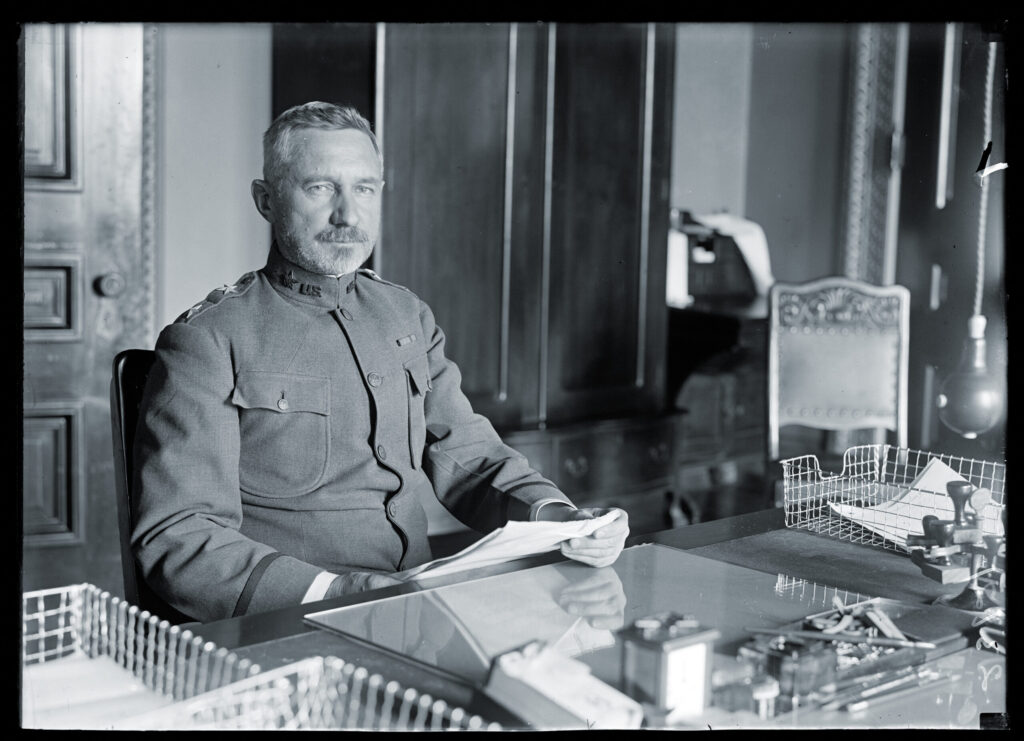
After 11 months of war, the army and the National Guard had multiplied more than eight times to slightly fewer than 1.7 million, of which a quarter million were in France. Over there, Pershing had the foundation of the AEF in place, but as yet only a relative few American troops had seen frontline service, and they had not staged even a regimental assault. Ahead of him, Pershing had major confrontations with Allied political and military leaders over the issue of whether the AEF would fight as an independent force or distribute its troops as replacements in the British and French ranks. Pershing’s firm stand for independence won that battle, but before the AEF could have a significant impact, the War Department would have to send a lot more troops across the Atlantic and establish a logistical supply chain adequate to meet their demands. It was March’s challenge to achieve those goals.
As chief of staff, March brought to the position qualities that his predecessors lacked—a solid sense of the proper place and power of his office and the dynamism and ruthlessness necessary to galvanize the army’s effort. As one of the General Staff officers commented, He took the War Department like a dog takes a cat by the neck and he shook it. Another recalled that there was an immediate change: Everyone worked longer hours and with far greater efficiency.
For more than a century, the bureau chiefs who controlled the army’s logistics had dominated the War Department. Their power continued despite the creation in 1903 of the General Staff, which was supposed to coordinate all army affairs. March, who had recently served in one of the most powerful bureaus, the Adjutant General’s Office, fully understood the bureau chiefs’ degree of power and knew that it was an obstacle to the efficiency of the War Department. Within weeks he neutralized their power by ousting some, restricting others, and bringing in younger AEF veterans to head the Quartermaster and Ordnance departments. He made no effort to salve the feelings of those he relieved. Soon after he became chief of staff he decided to organize a more comprehensive and powerful agency in the general staff to coordinate logistics: the Purchase, Storage, and Traffic Division. He put Goethals at its head. March called into his office the director of the division that was to be folded into this new organization and bluntly told him, I have cut your head off and ordered you out of the War Department. The acting quartermaster general who succeeded Goethals, Robert E. Wood–one of those AEF veterans–recalled that March supported him 100 percent. He succinctly explained March’s method of command: He did not work out problems with people–he ordered. He was the War Department.
When the secretary of the General Staff who sifted through the pile of staff papers and correspondence to select those to pass on to March each morning asked him what his policy was as to letters requesting favors, March curtly responded, “As chief of staff I have no friends. Such a policy might bruise egos.” But his refusal to respond to requests for special treatment for friends of senators and congressmen naturally alienated the powerful on Capitol Hill.
Even President Wilson was not exempt. When Secretary Baker forwarded a note from Wilson specifying that, War Department policy permitting, he would like to see a person get a commission or particular assignment, March read the note and then went to see the secretary. After a lengthy discussion, March returned to his desk and Baker went to the White House with the note in hand. There were no more such letters from the White House. Baker did point out that he had to waste a lot of time going around with a cruse of oil and bandage to fix up the wounds which he had made. But March did not change his methods.
The German offensives in the spring of 1918 forced the British to make available the transports necessary to bring larger numbers of Americans to France. Meanwhile, the draft kept bringing in hundreds of thousands of men to the training camps, and Bernard M. Baruch, whom President Wilson had named to coordinate industry during the war, pushed industrial leaders to provide the myriad supplies necessary to sustain such a great force. On one occasion, Baruch questioned March about the capacity of the transports and the French railroads to carry the numbers of men March was pushing to the embarkation points. March bluntly responded, “We’ll pack them in like sardines and What did God give them feet for?” Baruch, who had participated in the war effort from its beginning, appreciated the changes that March had made and later complimented him, saying, “He was the right man in the right place.”
During the eight months from March’s arrival to the end of the war, the size of the U.S. Army more than doubled, to about 3.7 million. In that period, more men, almost 1.8 million, went to France than were in the entire army on March 1. This enabled the AEF to commit large numbers of troops to battle, and they played a significant role during the fighting in the summer and fall of 1918. Secretary Baker summed up March’s role: “The war was won by days. Your energy and drive supplied the days necessary for our side to win.”
As he celebrated the great victory in France, John J. Pershing was not pleased with March. He could see the fruits of his accomplishments, but he was infuriated by March’s different conception of the role of chief of staff. He had also come to fear that March wanted to replace him. Their most significant disagreement was over the power of the chief of staff. Pershing, who had given himself the title of commander in chief of the AEF, assumed that his position resembled that of the commanding general as held by Ulysses S. Grant during the Civil War. The commanding general, who actually had limited power in peacetime, was traditionally the dominant leader in war. The previous chiefs of staff in the early months of the war had accepted this concept. March, however, believed that the chief of staff was the dominant army officer, and he spelled this out in General Order No. 80 in August 1918. The fact that he considered the national war effort as a whole rather than simply that of the AEF also irritated Pershing.
Pershing’s staff customarily planned for a strength larger than the War Department thought possible. In the climactic summer months, when the tide of the war on the Western Front began to turn for the Allies, Pershing sent a plan for a buildup of the AEF to one hundred divisions, a force he reckoned would be five million men. Astounded by this huge number, General Staff planners studied the problem and concluded that the maximum force the nation could sustain in France was eighty divisions–which was, they estimated, some 1.6 million men fewer than Pershing’s figure. Despite this, the AEF continued to base plans and manpower and supply requests on a force of more than 4.7 million. This led to frustration on both sides during the war and recriminations afterward.
Soon after March returned to the States in the spring of 1918, James G. Harbord, Pershing’s chief of staff, fueled his general’s suspicion that March wanted ultimately to replace him as the AEF commander. The first cause came when the new chief of staff asked for a few AEF officers to serve on the General Staff and in other stateside units. Pershing was not too concerned about this, but later he was furious about March’s handling of recommendations for promotion to general. Pershing recommended AEF officers for all of the available slots. March’s predecessors had always accepted the recommendations, but March made some recommendations of his own. When the affronted AEF commander asked about this change, March replied that he had to consider the entire army rather than just the AEF. That was reasonable, but March was probably wrong in promoting some AEF officers, including Douglas MacArthur, whom Pershing had not recommended.
The crux came in the summer, when the great flow of men and materiel to France seemed to overwhelm the AEF commander. The British proposed to Woodrow Wilson that Pershing be relieved of responsibility for logistics. Secretary Baker and March agreed and proposed that Goethals take over the AEF supply operation. Pershing understandably saw this as an attempt to undermine him, and both he and Harbord suspected that March was using this as a steppingstone to the command of the AEF. He promptly relieved his Services of Supply commander and replaced him with his most loyal subordinate, Harbord, who was then commander of the 2nd Division, and informed the secretary that this was the appropriate solution. Baker acceded to his request, but early that fall during his visit to France he rejected Harbord’s and Pershing’s views of March’s intentions and their suggestions that he be relieved.
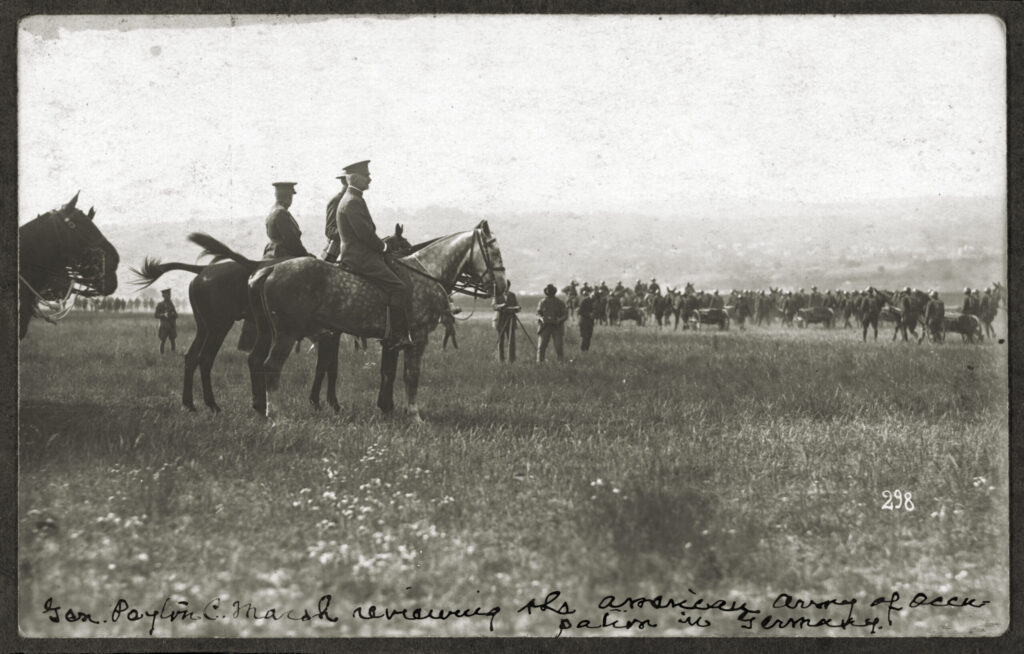
The end of the war came on November 11–far sooner than either March or Pershing anticipated–and it was won with slightly fewer than two million men in the AEF. While Pershing dealt with the problems of maintaining an occupation zone in Germany and keeping up the morale of men restive to go home, March supervised the demobilization and return of the AEF. By August 1, 1919, only 133,000 American soldiers were in Europe and fewer than 575,000 were in the entire army. In September Baker and March greeted Pershing when his transport arrived in New York. Over the next year, Pershing toured the nation and reviewed victory parades. Baker had recommended permanent four-star rank for both March and Pershing, but while Congress created and bestowed the rank of general of the armies for the latter, it refused to continue March in his temporary rank of full general. Thus came congressional revenge for March’s refusal to consider requests for favors. Nor were returning regular army officers pleased with March, or indeed any of the War Department officers. Many had worn stars as brigade or division commanders or in key staff positions, yet they had reverted to their permanent ranks when their units and the AEF ceased to exist. Those men were embittered when they learned that War Department officers continued to hold their wartime ranks because the department was still in operation. On June 30, 1920, as wartime rank legislation came to an end, March along with the others lost their temporary ranks. Ten years later, Congress restored the highest wartime rank to those on the retired list.
March continued as chief of staff until his retirement at the end of June 1921. Pershing replaced him and brought in Harbord as his assistant chief of staff. They reorganized the General Staff in the form of their GHQ General Staff and attempted to keep up an army beset by severe budget restrictions. Three years later, Pershing retired and began work on his memoirs.
In 1931 My Experiences in the World War appeared to critical acclaim and won the Pulitzer Prize for history. Rather than a personal memoir–although Pershing did quote diary entries, letters, and cables as well as some reminiscences–this two-volume work is essentially a history of the AEF. Not surprisingly, March was displeased with the criticism of the War Department. He immediately set to work on his own account of the war, which emphasized his and the War Department’s accomplishments and at times harshly criticized Pershing. When The Nation at War came out in 1932, it did not have as grand a reception as Pershing’s book, but the general of the armies was badly stung by the criticism. Pershing wanted redress, and he and Harbord debated the best medium for this. Ultimately they decided that Harbord would write a book detailing the achievements of the AEF while rebutting March’s book. After consultation with the two most distinguished former secretaries of war, Elihu Root and Newton Baker, their solution was to sum up their views on March in a lengthy footnote that, incidentally, Baker wrote. Baker, like March, had been hurt by Pershing’s book, but March’s fanning the flames of the controversy irritated him even more. The American Army in France: 1917-1919 came out in 1936, which wound up the battle of the generals. Both lived to see World War II, with Pershing dying in 1948 and March, who commented on the Korean War, living until 1955.
Two of the greatest American generals of World War II, Douglas MacArthur and George C. Marshall, held somewhat different views of their predecessors. MacArthur had known March before the war and, as chief of staff, provided office space for him to write his book. Although a brigade and division commander in the AEF, MacArthur was not one of Pershing’s favorites, and he knew it. In 1960 he evaluated both of these officers: “As a soldier, my opinion of March is of the highest. He was, in my estimation, perhaps the greatest chief of staff of all time….When you left March’s office, you knew exactly what he wanted.” He said Pershing’s greatest point was his strength and firmness of character. MacArthur attributed the disputes that arose during the war to the fact that March and Pershing were unable to meet and confer, and MacArthur blamed Pershing’s staff for poisoning the AEF commander’s attitude toward March.
George C. Marshall talked with his biographer, Forrest C. Pogue, in the late 1950s about the two principal American generals of a war that was already fading from national memory. Marshall had served as a division, corps, field army, and GHQ staff officer in the AEF and was Pershing’s aide for five years after the war. He was as close to Pershing as anyone and greatly admired him. General Pershing as a leader always dominated any gathering where he was, Marshall said. He was a tremendous driver, if necessary; a kindly, likeable man on off-duty status, but very stern on a duty basis.
Marshall never was closely associated with March, but he had studied the operations of the War Department during World War I and concluded that March was a master administrator, an executive with a great weakness of antagonizing everybody. Marshall considered both at fault in the strained relationship, saying, “It was essential that they get together and they didn’t.” Baker won his highest praise for saving the situation. Marshall said Baker rode a very difficult horse there between General Pershing and General March and did it extraordinarily well.
The virtues of both men far outstripped their flaws, as their accomplishments bear witness. Their efforts gave the United States and the Allies victory in this first great modern war. They also set standards in particular for those in high command during World War II. The army and the nation should not forget them.