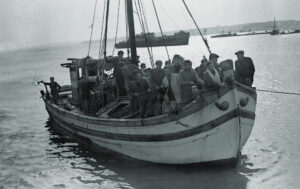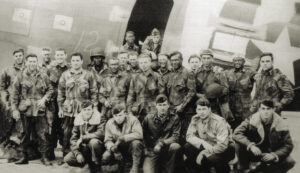

“The documentation of forced and slave labor reveals the workings of the system at ground level, and the horrendous consequences of seeing human beings as mere ‘assets’”
For the last few years, Paul Shapiro, director of the Center for Advanced Holocaust Studies at the United States Holocaust Memorial Museum, has helped lead a campaign to make documents of the International Tracing Service (ITS) available to the public. Created by the Allies in 1943 to help repatriate people displaced by World War II, ITS grew into an immense archive of materials from Gestapo offices, prisons, and police stations. During the last half-century, many other institutions and individuals also contributed documents to it. These records—50 million pages on sixteen miles of shelves in six buildings in the small German town of Bad Arolsen—detail the fates of all 17.5 million Holocaust victims, including forced and slave laborers, and displaced persons (DPs) of many ethnic groups.
As the United States’ ITS depository, the museum made the first batch of documentation available in January. While survivors and families seek closure, scholars can use the data to follow the money through the Axis war machine into the pockets of collaborators—individual, corporate, or government. This is among the reasons the eleven signatories of the 1955 Berne Treaty governing ITS were loath to open it. Shapiro recounts how and why that changed.
Why has it taken so long to open ITS?
A combination of factors. The Allies’ principal goal initially was to reunite families and send people home. Later, the documentation relating to forced laborers was used to underpin requests for pensions from the German government and, in this decade, to provide compensation for forced and slave laborers who could document their history. The institution was very much focused on those specific tasks. Simultaneously, for a long time there were not major institutions, aside from those in Israel, dedicated to Holocaust study, so demand on ITS was not very great. When it increased over the last twenty years—in part because of the U.S. Holocaust Museum—there was a different problem: the ITS management and governing structure made it almost impossible to get action.
How?
Eleven governments sit on the International Commission for ITS. They determined that any change in the operation required unanimity, which was very difficult to achieve. And in fact the management of ITS, for a period of time, worked hard to make sure it wouldn’t be achieved. The International Committee of the Red Cross was contracted in 1955 to run the place, which it did for fifty years with no controversy and no change. When change appeared, the Red Cross was not quick to embrace it. Over two decades, leadership on-site at ITS was opposed to opening the archive for research and providing survivors with documents relating to them, and opposed to sharing the documentation. Add a fourth piece: the German government ministry responsible for funding ITS as part of the postwar settlement was opposed. So you had to get all those players to agree to bring about change, and any one player could generate enough opposition so that nothing happened for years.
And many opposed change.
Every country had a reason not to have this at the top of their agenda. German chancellor Gerhard Schröder had a policy called Schlussstrich, which means drawing a line under the Holocaust: this is the past, now we move on. Now, no country has done as much as Germany to address Holocaust issues head-on. But you don’t draw a line under the past by making 50 million documents about it available. The United States was reluctant to enter a situation where the German government, one of our most important friends and allies, was making it very clear they were opposed. Israel has a very close relationship with Germany; in the 1950s, Yad Vashem was able to copy some ITS documentation. They believed they had copied everything, and felt nothing would be achieved by taking on such a sensitive issue. So Israel, though not opposed, was silent. The German position changed more recently with the Merkel chancellorship, but Italy was one of the most recalcitrant. In the 1980s Italy deposited a lot of material from the DP camps in ITS. Why would that be sensitive? First, to some extent people deposited documentation there because they thought it would never be seen. Second, we know today that Italian DP camps were a way for war criminals to make their way out of Europe.
And there was the money trail.
The documentation of forced and slave labor reveals the workings of the system at ground level, and the horrendous consequences of seeing human beings as mere “assets.” It shows how money moved between government, industry, the SS,
and other consumers of human beings. In some regions, every company, every organization—governmental, do-gooder, ecclesiastical—used forced and slave labor. It was a cheap, almost cost-free resource, and if you wasted it you weren’t going be held accountable. You can also see how Allied forces dealt with the survivors; prejudice didn’t end when the Nazi regime fell.
For years no one knew what was in the collections.
Only at the very end were the members of the international commission finally able to obtain from the Red Cross or ITS a full list. There were multiple requests, without results. The governments were told ITS was only a list of names, but there are 21,397 separate collections. In the 1990s forced and slave labor settlements opened the first chance some people had to receive token compensation for their suffering, but they had to provide proof. They asked ITS for documents and ITS soon fell far behind. I assigned researchers to assemble information on ITS collections, because as requests to ITS and the Red Cross increased, the answer was always to stonewall. They said there was no list of collections; that turned out to be false. By 2002 there were over 450,000 unanswered requests.
Meanwhile, you were gathering data.
Yes. In 2004 the museum presented that information to the international task force on Holocaust education, remembrance, and research, and the documentation itself became the strongest argument for action. These collections can be researched, they relate to the fates of 17.5 million people victimized by the Nazis, and you can see the deportations, see the use of forced labor by thousands of companies and organizations, see how survivors were treated by Allied forces. After that it was very difficult to say it was not important.
There evolved a process to digitize and distribute the collection while the commission changed policy.
Digitization of part of the collection began a decade ago for preservation purposes. The better part of the Central Names Index and the incarceration documents—camps, ghettos, deportation material—was already done. To ensure access, we realized the best policy was to have the material in more than one place. Hence the proposal to make digital copies available at institutions like the Holocaust Museum in the commission’s member countries. After that, the work to agree to open the documentation and to make copies available moved in parallel. One would get more attention while the other dipped. Remem-ber, some countries were seeking delay, hoping the issue would go away. Late in the process, one proposal was that the Berne accords had to be formally amended, and those amendments ratified by the governments on the commission. Some governments said this could take three to five years. That’s why we pressed the issue of continuing with the digitization and distribution of copies during ratification, which was completed by November 2007. In late January we opened our materials—not just to Jewish survivors, but to all.
You see this as insurance against Holocaust denial.
The greatest anxiety of survivors is that the world will be allowed to forget. But genocide didn’t end with World War II. In our world of ethnic cleansing, it is a strong warning for us all.