MAY 7, 1945, was an important day by any measure.
For Gen. George S. Patton, it started early, with a call just after 4 a.m. from Gen. Omar Bradley, who said, “Ike just called me, George. The Germans have surrendered.” This was mixed news to Patton, who was convinced the war was ending too soon, leaving the Russians as a future threat and, in any case, leaving Patton, a man who lived to fight, without a war. “Peace is going to be hell on me,” he had complained to his wife, Beatrice, four days earlier.
The commander of Patton’s 2nd Cavalry Group, Col. Charles Hancock Reed, was with his unit in western Czechoslovakia, where they were forming a defensive line southwest of the large city of Pilsen. The 2nd Cavalry had been spearheading the Third Army’s advance, the deepest American penetration of the war. But as of 8 that morning, they and the rest of Patton’s Third Army had been ordered to “cease fire and stand fast.”
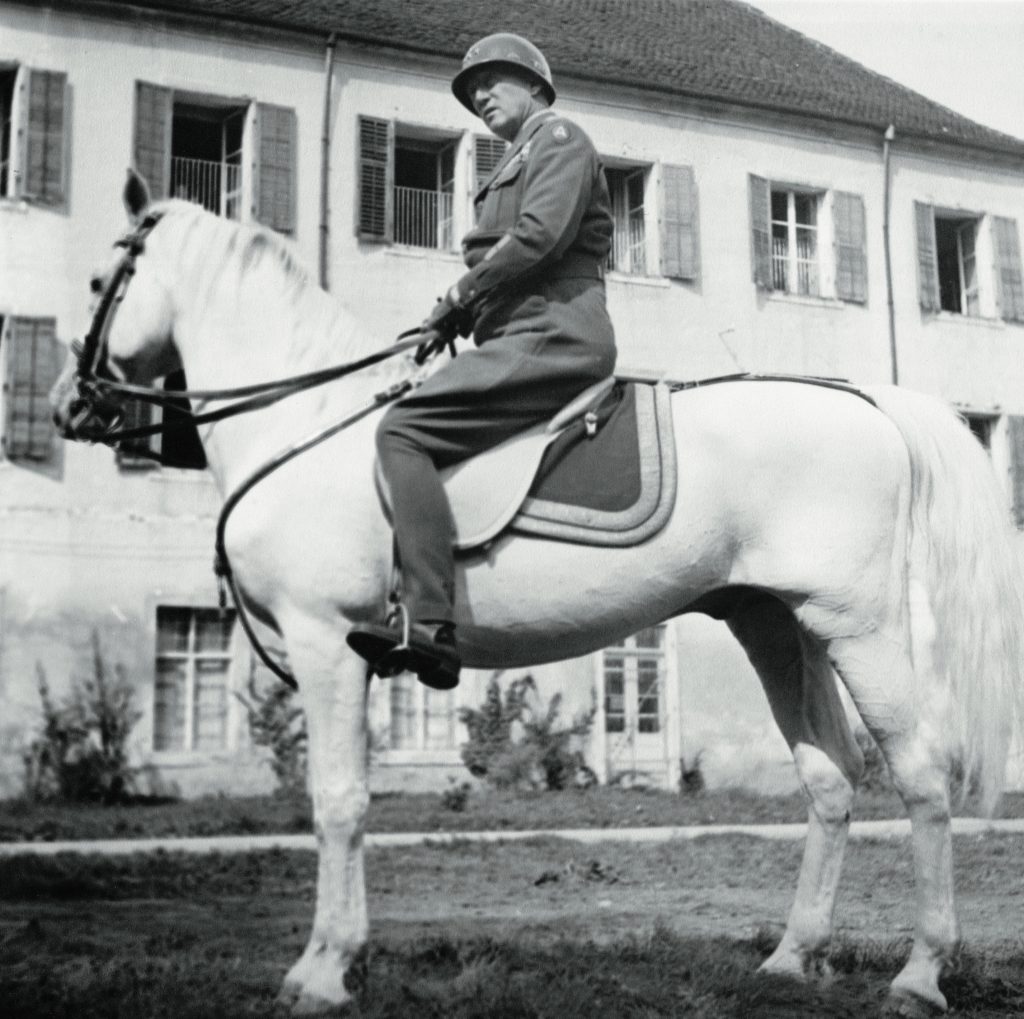
None of this was on the mind of Col. Alois Podhajsky as he prepared for what he regarded as the most important day of his life. Podhajsky, a tall, aristocratic Austrian of extraordinary single-mindedness, was looking for a way to guarantee the safety of the riding school and horses he supervised as the Third Reich collapsed around him. And on that sunny Monday morning, as a preoccupied General Patton strode into his exhibition arena, he thought he’d found it.
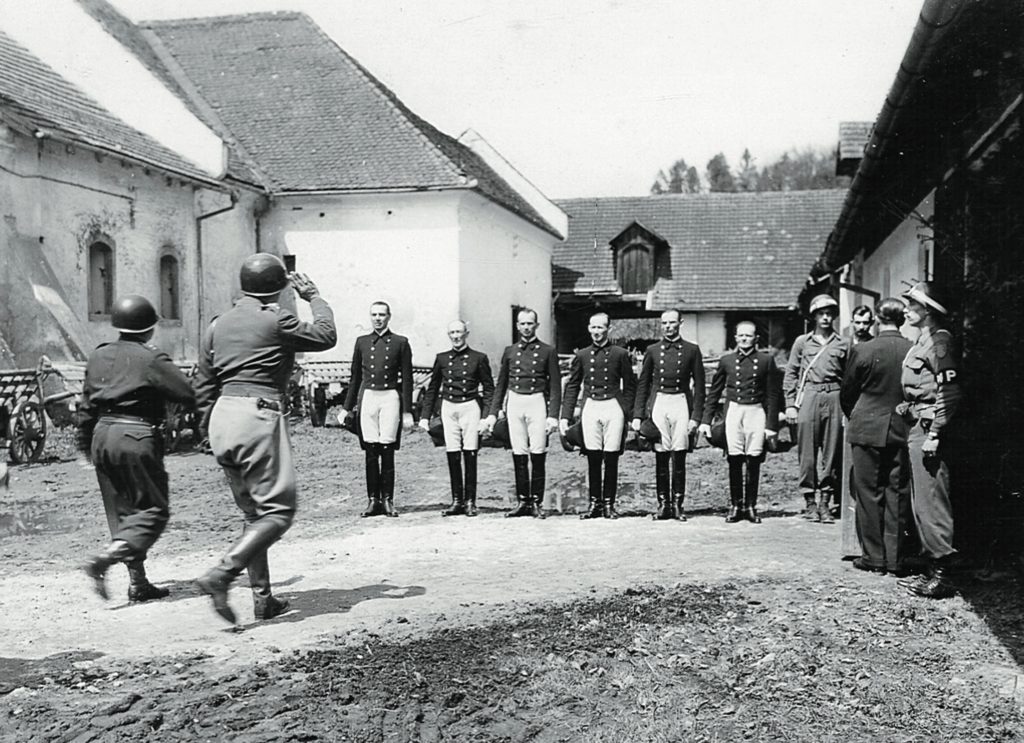
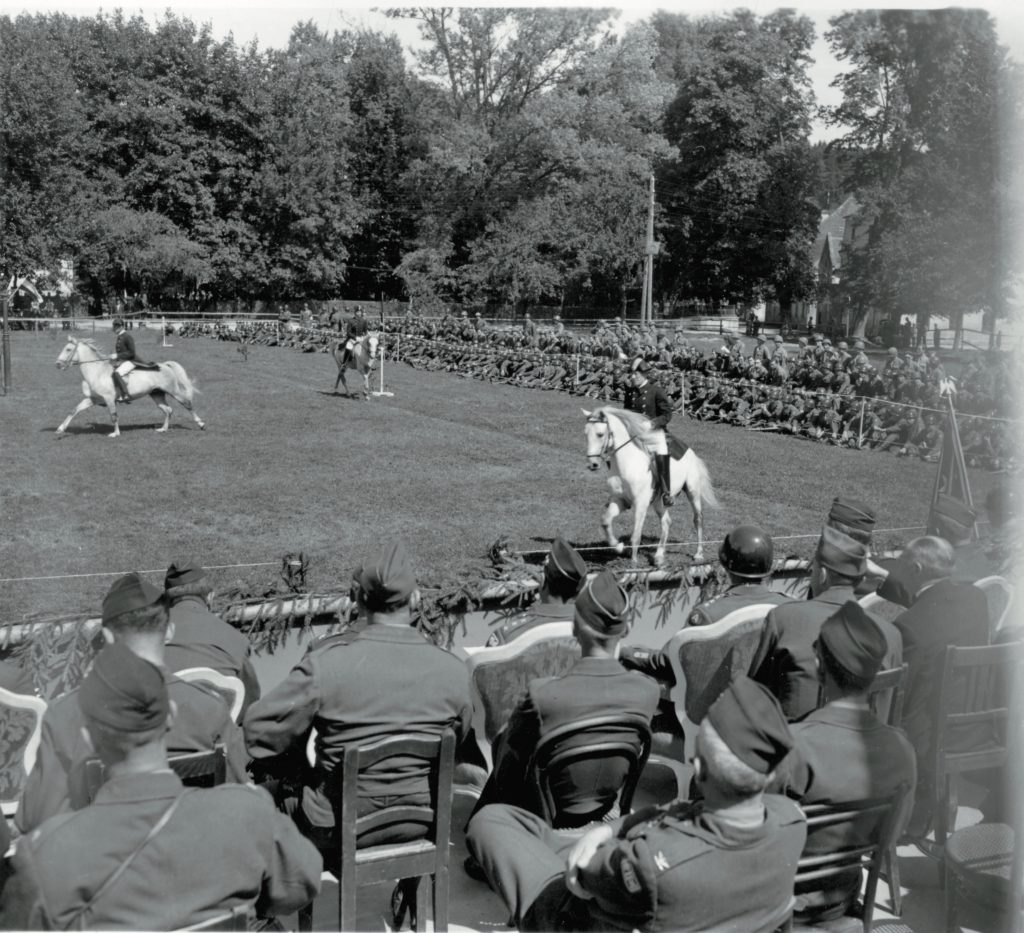
Lt. Gen. Walton H. Walker’s XX Corps had captured the renowned Spanish Riding School of Vienna several days earlier at its temporary quarters in St. Martin im Innkreis, a small town in Upper Austria, and Walker, a protégé of Patton’s, requested a performance of its white Lipizzaner stallions especially for him. As Patton watched, the horses and riders went through the precise, ballet-like maneuvers they were famous for: a demonstration of controlled power and ritualized elegance, set to music, that was beautiful to watch and incredibly difficult to execute.
When it was over, Podhajsky halted his horse before Patton and removed his hat in a traditional salute. “In a little Austrian village in a decisive hour two men faced each other,” he wrote in his memoir, My Dancing White Horses, the basis for the 1963 Disney film Miracle of the White Stallions, “the one as triumphant conqueror in a war waged with such bitterness, the other as a member of a defeated nation.” He asked Patton for protection for the centuries-old school during the uncertain postwar period and for help in retrieving its breeding herd from Czechoslovakia, where the Germans had sent the horses to a Wehrmacht-controlled stud farm.
Patton, an expert horseman himself, described the exhibition in his diary that day, calling it “extremely interesting and magnificently performed.” Ever the soldier, he added, “It struck me as rather strange that, in the midst of a world at war, some twenty young and middle-aged men in great physical condition…had spent their entire time teaching a group of horses to wiggle their butts and raise their feet in consonance with certain signals from the heels and reins.” More telling for Podhajsky, though, was what Patton noted next: “On the other hand, it is probably wrong to permit any highly developed art, no matter how fatuous, to perish from the earth—and which arts are fatuous depends on the point of view. To me the high-schooling of horses is certainly more interesting than either painting or music.”
Standing to address the man on horseback before him, Patton replied that he was putting the Spanish Riding School under the special protection of the U.S. Army; he later told Podhajsky he would do what he could about the horses in Czechoslovakia.
“This official declaration was far more than I had dreamed,” Podhajsky exulted. What he didn’t know, however, was that something far more dangerous and extravagant was already well under way: a top-secret mission involving not only Podhajsky’s horses, but hundreds more, as well as hundreds of Allied POWs, which would twine together Patton, Reed, and Podhajsky and leave Patton forever associated with the dancing white horses. It began 11 days earlier—with some captured secret documents.
off to the rACES
The contents of any intelligence officer’s papers are an obvious source of intrigue, especially when that officer is a general. But those that belonged to the commander of the German intelligence unit that surrendered to the 2nd Cavalry Group at a hunting lodge near the Czech border on April 26, 1945, were unexpectedly interesting. They included photos of horses—beautiful horses: Arabs, Thoroughbreds, and Lipizzaners.
The general, a celebrated spy known only as Walter H., invited Colonel Reed to join him for breakfast while they waited for trucks to arrive to haul off the captured documents. They looked at the photos together, and the general told Reed that the horses were among hundreds the Germans had collected from among the finest breeding stock in Europe and sent to a large stud farm in the nearby Czech town of Hostau, where they were under the care of Czech and Polish POWs who had surrendered to the Germans.
The problem was that the ruthless and ravenous Red Army was approaching; both men were concerned the animals might become army rations. But, as spelled out at the Yalta Conference that divided up postwar Europe, Czechoslovakia fell within the Soviet zone of occupation. “We mutually agreed that these fine animals should not fall into Communist hands and the prisoners should be rescued,” Reed recalled. He sent a message to Patton at Third Army headquarters requesting permission for the operation. Patton’s swift response: “Get them. Make it fast!”
By then Red Army troops were about 60 miles east of Hostau; the Americans were about 35 miles away. And although the Germans in Czechoslovakia were being rapidly overpowered, there were still die-hard Nazi snipers everywhere. Working in conjunction with the German, Reed formulated a daring plan.
He dispatched the general’s courier with a message asking the Germans at the stud farm to send an officer through the lines that night to arrange terms. At about 8 p.m., his request was answered when a lean man in a Wehrmacht officer’s uniform strode out of the woods near a 2nd Cavalry outpost. The officer was Capt. Rudolf Lessing, a staff veterinarian at Hostau. Over dinner he presented Reed with a counterproposal: send an officer back with him to Hostau to confer with the local Wehrmacht commander and they could arrange a surrender.
An intelligence officer with the 2nd Cavalry’s 42nd Reconnaissance Squadron, Capt. Thomas M. Stewart, was out in the field when his commanding officer relayed a message: “Colonel Reed wants to borrow you for a special assignment.” The 30-year-old captain—son of a U.S. senator from Tennessee—reported to Reed’s headquarters, where he found an assortment of American officers gathered in conversation around Lessing. Reed had just concluded a telephone conversation with General Patton, and told Stewart he was to accompany the German captain through the lines and attempt to arrange the release of the horses and prisoners. Reed sent him off bearing a letter written in German and English designating him as an emissary under Lessing’s protection and granting him the authority to negotiate.
The two men left on foot and walked together in the darkness for about a half-mile before coming upon the motorcycle that Lessing had secreted in some bushes. They drove it several miles to the barn of a friendly Czech forester, where they exchanged the motorcycle for a pair of horses the veterinarian had hidden there to take them on the rest of the journey.
Their destination lay about 18 miles ahead, through a forbiddingly dense forest. It had been around midnight when the pair set off, and the moon finally emerged from behind some clouds. Still, “the forest was so thick through there you felt like you were riding through two walls of darkness,” Stewart recalled in an interview in 2009.
Although riding through the dark countryside in the sole company of an enemy officer seems an intimidating experience, Stewart reveled in it. An experienced rider, he delighted in his horse, a Lipizzaner stallion said to have been the favorite mount of Peter II, King of Yugoslavia. When he encountered a roadblock about three feet wide and three feet high built of logs and branches, a steep cliff on one side, a ravine on the other, the American did the only thing he thought he could do: he gathered his horse and took off for the obstacle. Too late, he heard Lessing—who knew a route around the roadblock—call out, “He doesn’t jump!” No matter; the horse took off, light as a feather. “The perfect jump,” Stewart said. “It was the highlight of the trip for me.”
IN THE RIDER’S SEAT
A more significant obstacle emerged at the stud farm. As the men made their way in darkness to Lessing’s living quarters, they found Lessing’s friend and fellow veterinarian, Capt. Wolfgang Kroll, cradling what looked like a submachine gun. “We’re in trouble,” he told Lessing. The manager of the farm, Lt. Col. Hubert Rudofsky, had initially given his blessing to the plan, but had had a change of heart after Lessing left. Rudofsky was a Czech national and decided he could cut a better deal with the Russians than with the Americans. He told Kroll that if he and Lessing brought in an American, Rudofsky would have the three of them shot as spies.
Stewart spent the rest of the night crouched in a chair, while Lessing reconnoitered. A few hours later, on the morning of April 27, he summoned Stewart and Kroll; Rudofsky had left the farm, possibly to visit the local army commander, a General Schulze. Lessing’s plan was to find one of Schulze’s officers and have the three of them taken to see him as well—something they managed under tense circumstances later that morning.
Stewart was able to understand a little German, so he could make out a smattering of what was going on. And at first it didn’t look good. The general, a small man, sat behind a bare table, surrounded by officers—including, Stewart later learned, a silent Lieutenant Colonel Rudofsky. A staff colonel, a big blond man, said something in anger to Lessing and Lessing replied, “Sir, I am no spy! I am a German officer. I am no spy.”
General Schulze gestured, and Captain Stewart presented his credentials. Lessing explained their presence. As the German veterinarian recounted to the Austrian magazine Zyklus in 1982, he told the general that their primary responsibility was to the horses. “It is our duty to do everything to save them,” he argued. “It is unimportant for us to win the war here at Hostau on April 27 or 28, 1945. This we should have done four years ago. To do it now is too late.”
Stewart heard someone in the background say, “Adolf ist kaputt.” The general finally turned to the American captain and asked, in English, “How many panzers can you bring?” Stewart understood that the general didn’t want to surrender to a lone American captain and assured him the 2nd Cavalry would return with a sizeable number of tanks and other vehicles. “He looked at me for what seemed like a long time,” Stewart recalled, “and then he took out this pad and scribbled something.” It was a note of safe passage for Stewart. “There will be no difficulties when your people come in,” the general told him.
When Stewart finally set off toward his squadron later that evening, he wasn’t alone. Wolfgang Kroll, whom Lessing called “a man with an inclination to adventure and bravado,” wanted to be a part of the American advance on the farm and stayed in the jeep after Lessing departed. A German driver took Stewart and the veterinarian to the edge of the forest, but would go no further, so the two walked the last half-mile or so to Stewart’s squadron themselves. As soon as they arrived, Stewart briefed Reed via radio on the day’s events, and Reed immediately put his plans into action.
By daybreak the next day, April 28, a rapidly formed task force of approximately 70 men from the 42nd Reconnaissance Squadron’s A Troop—along with two light tanks and two assault guns—was on its way. As General Schulze had promised, the task force encountered no resistance on the way to the stud farm, and the surrender was peaceful.
PRISONERS NO MORE
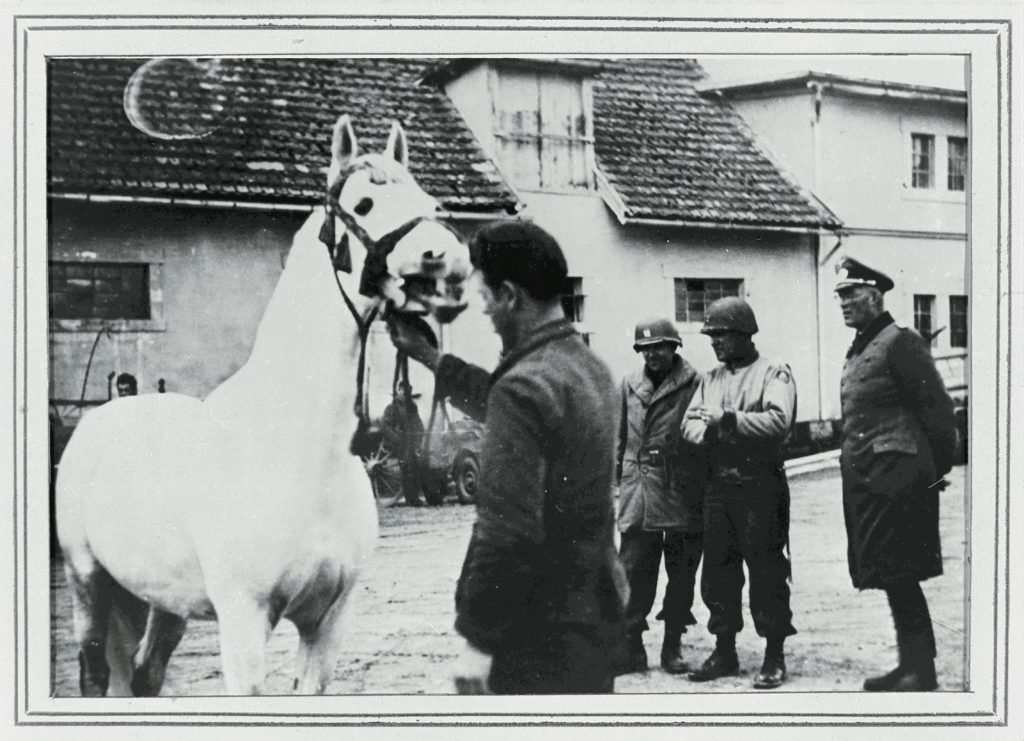
As soon as the facility was secured, the American troops hurried off to look at the source of all the commotion: the captured horses. It was truly a treasure trove of horseflesh. Among them were about 100 of the best Arabs in Europe, top Thoroughbred racehorses and trotters, hundreds of Russian Cossack horses, and some 250 Lipizzaners from breeding farms across Europe—primarily the Yugoslavian royal stud and the Piber stud in Austria, which supplied the horses for the Spanish Riding School.
There were also the prisoners: not only the several hundred grooms they had expected to find at the farm, but about 300 Americans and as many British troops, who had been encountered with their German guards in the vicinity. Steps were quickly taken to free and safeguard them.
While the rest of the 2nd Cavalry Group prepared for an advance toward Pilsen, the task force organized its own small army to defend the farm in the event of a counterattack. In addition to the Americans and their tanks and assault guns were Lessing, Kroll, and the other Germans; some Cossack cavalrymen; and an assortment of now-former POWs who chose to stay. That proved a wise move. For five hours on April 30, the small international force held off an attack from German troops: mostly older men and boys who knew nothing of what had transpired at the farm. The defenders took hundreds of German prisoners; the rest retreated back into the woods. “The Germans did a lot of shooting, but not a lot of damage,” Stewart remembered. Two men of A Troop ultimately lost their lives during the mission in isolated incidents elsewhere, however.
As the war wound down in the next few days, dramatic events continued to come hard and fast. Colonel Reed arrived at the farm on May 1 to inspect the horses. Before leaving, he cautioned Stewart that the massive German 11th Panzer Division would soon be headed in their direction. “Don’t engage them,” he warned. On May 4 the reason became evident, as the division and its more than 9,000 men surrendered, an event Reed had been instrumental in negotiating. Two days later, the Third Army liberated Pilsen. Germany surrendered the next day, and Reed, who shared Patton’s antipathy toward the Russians, established new headquarters at an estate near Pilsen. He was determined to hold his ground in Czechoslovakia until the U.S. Army—not the Russians or Czechs—told him to leave.
He was there on May 9 when he received word from Third Army headquarters that General Patton had been in touch with Col. Alois Podhajsky, the director of the Spanish Riding School, and that Podhajsky would be flown to Reed’s headquarters as soon as possible to inspect the captured Lipizzaners.
RIDE OF A LIFETIME
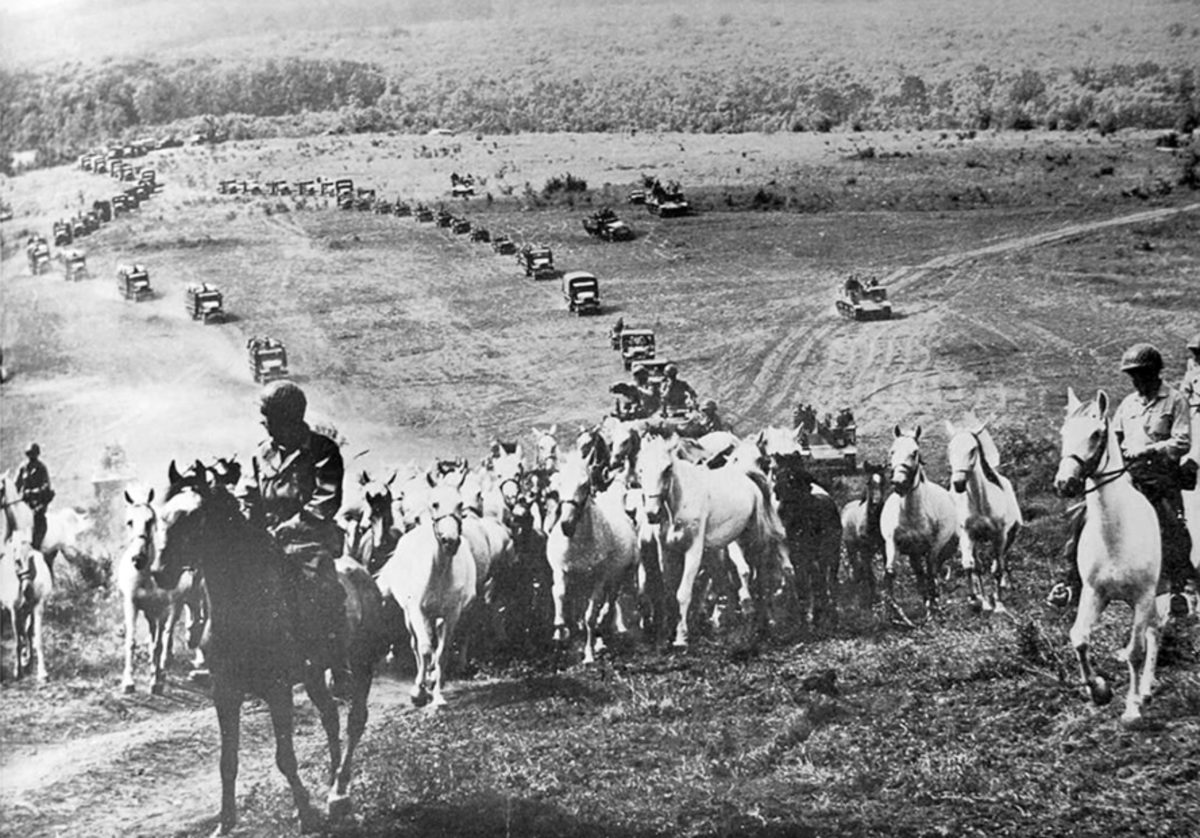
Although the horses were now in American hands, they were still in Czechoslovakia and Reed knew something had to be done to get them out of the path of the Red Army—and soon. “A day or so after the German surrender it became evident to me that the Czech and Russian Communists were showing a great interest in the captured horses,” he recalled. Word was that they’d made several stealthy trips to the stud farm; he transmitted this information to Patton’s headquarters, along with the recommendation that the Arabs and Lipizzaners be transferred as soon as possible to a large facility in Mannsbach in central Germany. The Third Army swiftly gave its assent, along with a guarantee to give the movement of the horses priority along the required roads.
At dawn on May 12, the remarkable procession began. About 350 horses were herded in small groups, with American vehicles positioned before and after them and with a band of Polish, Czech, and Cossack horsemen as outriders, along with a smattering of Americans—making the name of the mission, Operation Cowboy, especially apt. Despite the prevailing chaos of the time, the evacuation was an organizational masterpiece; the Americans had closed off all major intersections and the group covered the roughly 130 miles to Mannsbach safely. The fastest groups made the journey in two days; the slower groups, those that included mares and foals, arrived a day later. (Lieutenant Colonel Rudofsky had materialized at the border as the horses passed, marking off the departing animals on a checklist. Czech and Russian officials later filed a protest, but nothing ever came of it.)
At about the same time—on the afternoon of May 14—the U.S. Army flew Podhajsky to Colonel Reed’s headquarters. He was introduced to Reed over dinner. “Our conversation soon showed how full life is of interesting coincidences,” Podhajsky recalled. Reed, as it turned out, knew Podhajsky’s name well. When the captain of the U.S. Army riding team, of which Reed was a member, saw Podhajsky ride in the 1936 Olympics in Berlin, he had been so impressed he named one of the cavalry school horses after him.
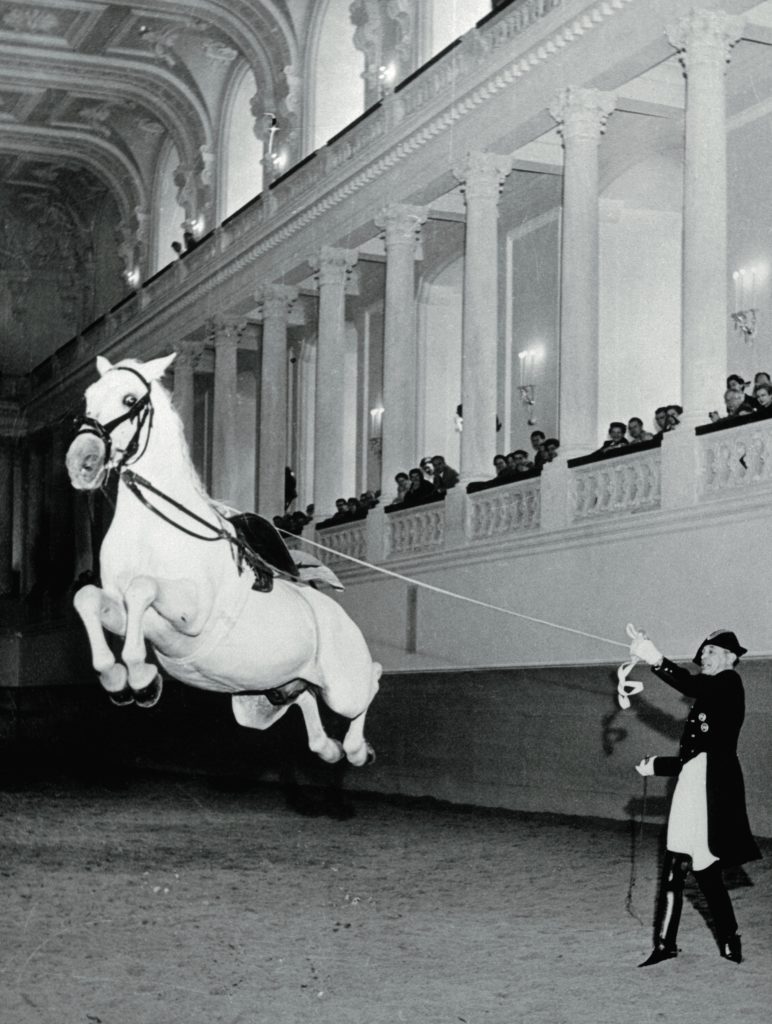
The next morning Reed drove his Austrian counterpart to Mannsbach in a jeep. Podhajsky easily identified the Lipizzaners belonging to the Austrian herd and Reed assured him they would be sent to St. Martin. “Before I flew off I tried to thank Colonel Reed for his help and great understanding,” the Austrian horseman said. “I have only acted as a fellow rider should,” Reed replied. “And I am convinced that you would have done the same if the positions were reversed.”
A little over a week later, Reed proved good to his word. Just before midnight on or about May 25, the sound of engines broke the quiet at an abandoned airfield outside St. Martin as the first of some 60 trucks pulled into view. The journey this time had been too great a distance to make on foot, so Reed had amassed as many captured German vehicles as possible and had them outfitted to carry the horses. Although two mares were injured in the chaos of unloading at the airfield and had to be put down, a total of 244 Lipizzaners were successfully returned to Austria.
Podhajsky was so grateful to have this segment of culture and tradition preserved for his country and the world that he staged performances for American soldiers stationed in occupied Austria over the next few months: a second for Patton on August 21, 1945, and several more for “ordinary mortals”—one or two thousand American GIs at a time. “The success of the Lipizzaner with the American Army General was repeated also with the ordinary soldiers,” Podhajsky noted with his characteristic pride. “They were all captivated.”
But why—when there was so much destruction, so much loss and pain, so much left to be done—devote limited resources to this particular mission? A simple explanation lies with the diverse individuals central to the rescue, who had all one trait in common: they loved horses.
Alois Podhajsky, the son of a cavalry officer, was one of the youngest lieutenants in the Austro-Hungarian cavalry in World War I, and won a bronze in dressage in the 1936 Olympics. Podhajsky devoted his life to horses, and they were rarely far from his thoughts. “I am bound to admit that I have always been what is commonly called ‘horse-mad,’” he said.
Charles Hancock Reed, also a former officer in the mounted cavalry, was a superb horseman: an instructor at the Cavalry School and a member of the 1930–1931 U.S. Army horse show team. After retiring from the army, Reed purchased the offspring of one of the horses he rescued, and rode her every day for nearly 30 years.
George S. Patton spent a lifetime with horses. While stationed at Fort Myer, Virginia, after his graduation from West Point, he played polo, fox-hunted, and competed in mounted steeplechases. He was a participant in the first modern pentathlon at the 1912 Olympics in Stockholm, Sweden, placing sixth out of 23 in the equestrian phase. As a major in the cavalry in 1921, he wrote that a cavalry leader “must have a passion—not simply a liking—for horses.” And when he sought to assess his condition after the automobile accident that ultimately took his life in December 1945, Patton chose one question to ask his doctor: “What chance have I to ride a horse again?”
But the rescue came at a cost—and a simple fondness for horses can’t explain the many instances of risk, bravery, and personal sacrifice that arose during its execution. For that, it was Colonel Reed, fittingly, who provided the answer: “We were so tired of death and destruction,” he said, “we wanted to do something beautiful.”
this article first appeared in world war II magazine