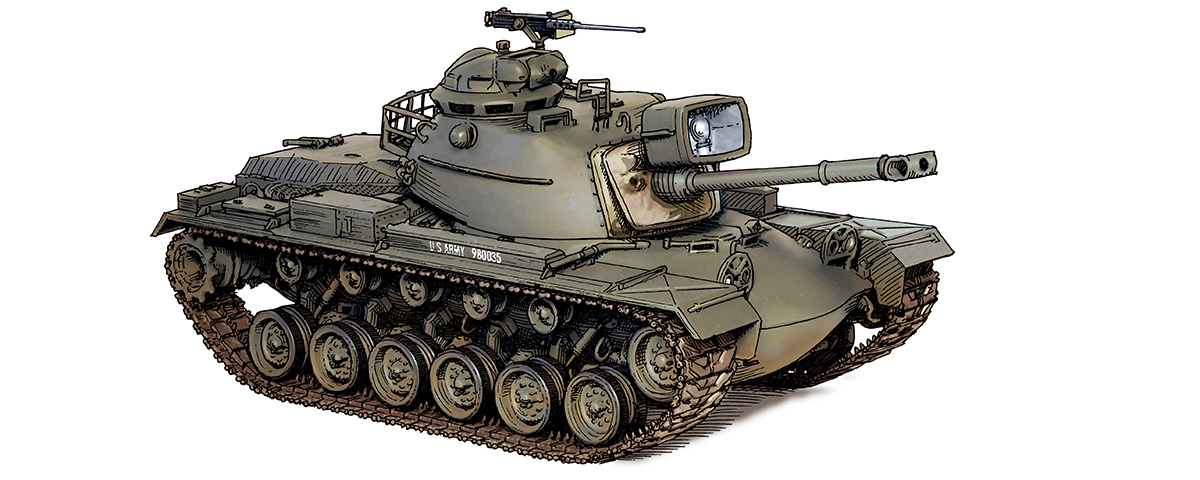
Many believed armor had little utility in Vietnam, but Marine and Army combat experience proved that there was no substitute for the shock and firepower tanks brought to the battlefield. Used primarily in the infantry support role, the M48A3 tank was America’s main battle tank in Vietnam from the earliest combat action, and in South Vietnamese service almost to its last.
The M48 was the final version of the Patton series, named after General George S. Patton. The first M48s were produced from 1952 to 1959, but the Vietnam-era A3 was a modernized and refurbished variant that first rolled out in February 1963. It had a supercharged diesel instead of a gasoline engine and an enhanced fire control system. The turret and hull were made from cast homogenous steel and enjoyed a 60-degree frontal slope. The turret had 4.5 inches of frontal armor, 3 inches of side armor and 2 inches in the rear. The hull’s front armor was 4.3 inches, and side armor was 3 inches forward and 2 inches at the rear. Inch-thick floor plating gave good protection against enemy mines.
The M48’s 90mm M41 cannon fired a 24.16-pound shell with a muzzle velocity of 2,800 feet per second out to a maximum range of 4,500 meters, but the fire control system had a 2,500-meter limit. The gunner used an M17A1 coincidence rangefinder, and the fire control system included a repeater that displayed the gunner’s sight picture to the commander. A coaxial .30-caliber machine gun and a .50-caliber gun in, or mounted on, the commander’s cupola rounded out the tank’s armament.
The M48A3’s wide tracks gave it good off-road mobility, but Vietnam’s exceptionally soft, deep mud frequently bogged it down. Its shallow fording depth (4 feet) and weight could limit its employment. A kit was available that enabled the tank to ford rivers up to 14 feet deep, but it was rarely used.
Patton tanks were in most of the war’s major actions, serving with the Marines and three U.S. Army tank battalions and with Army armored cavalry squadrons until replaced by M551 Sheridan light tanks. As U.S. forces began to depart in 1970, they turned their M48s over to the South Vietnamese.
Although designed to combat massed Soviet armored formations, the Patton was an invaluable weapon for infantry support and defending firebases. It is generally considered superior to the T-54/55 and T-59 tanks the NVA deployed south in 1972 and later. The newer M60 replaced the Patton in regular U.S. Army and Marine units after the war, but the M48 remained in service with most American allies and its reserve units well into the 1990s.
Crew: Four
Height: 10 ft. 9.3 in
Weight: 53.3 tons
Engine: 700 shp/diesel
Fuel capacity: 385 gal.
Max range: 300 miles
Main gun: 90mm M-41 cannon
Machine guns: One .50 cal M2 Browning machine gun; one .30 cal M73 machine gun
Originally from the February 2011 issue of Vietnam magazine. Subscribe here!