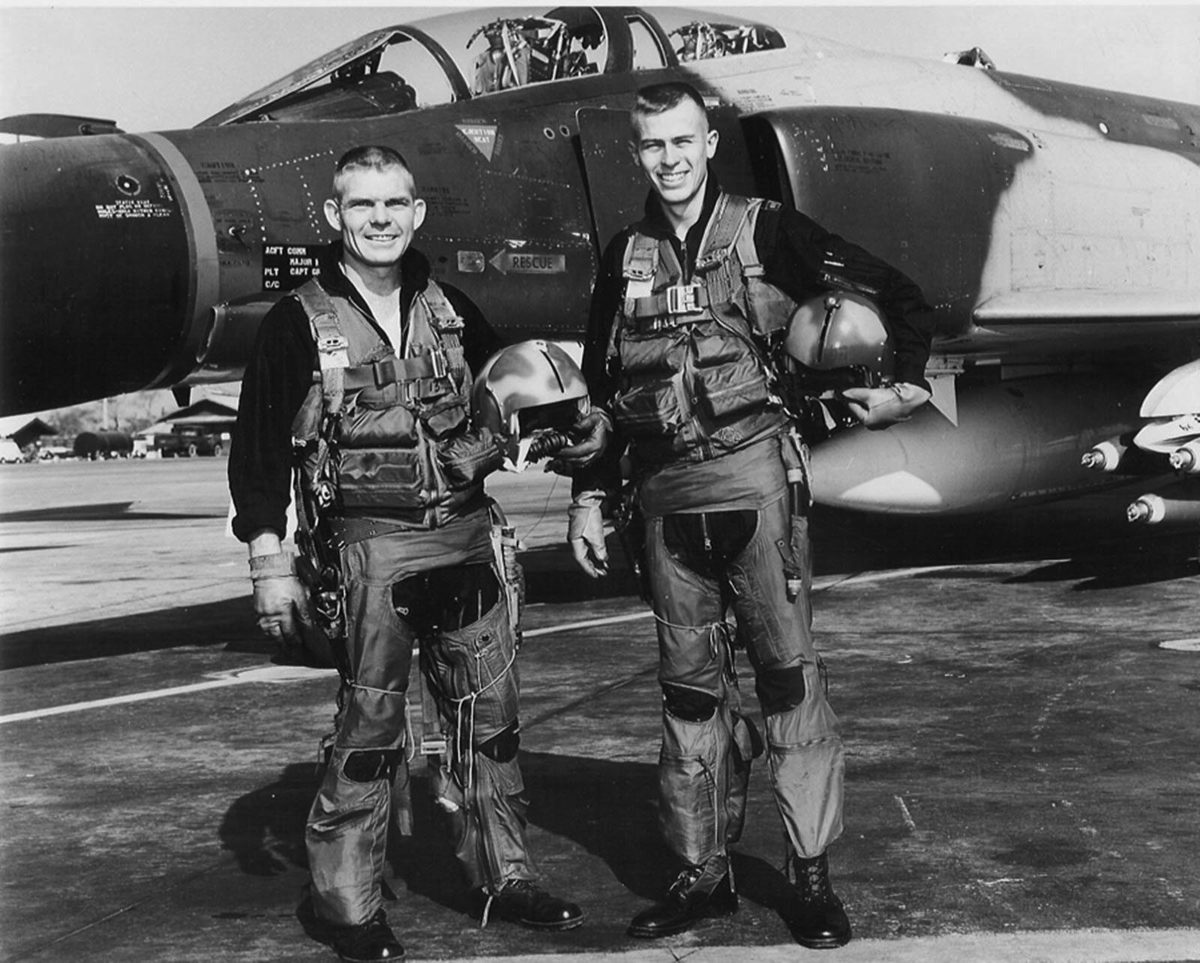
Sitting in two F-4 Phantoms, the four American airmen awaited their takeoff orders. It was March 10, 1967, and their mission to bomb a strategic target in Thai Nguyen, 30 miles north of Hanoi, was now a reality. It was also more dangerous than any mission they had yet flown in Vietnam. The target was the enemy’s only steel mill for the production of essential war materiel, and was therefore well protected.
The attack order included two tasks for the airmen. First, with their missiles, they were to screen the main strike force of F-4s and F-105s against North Vietnamese MiGs. Second, if the enemy MiGs did not try to intercept the main strike force, the two escort aircraft were also to attack the steel mill. The airmen were assigned to the 433rd Tactical Fighter Squadron at Ubon Royal Thai Air Force Base in Thailand. Each escort F-4 carried six 750-pound bombs and four missiles, as well as an electronic countermeasures (ECM) pod on the right outboard station.
For nine days the mission had been postponed because of heavy monsoons and low clouds over the clustered hills that surrounded the target. On the previous two days, bad weather had forced the entire strike force to turn back from the main target and attack secondary targets–transportation facilities and supply points in Laos and North Vietnam. Today, however, the skies were clear; this time, there would be no turning back.
First Lieutenant Robert Houghton and Captain Earl Aman in one aircraft, and 1st Lt. Steve Wayne and Captain Robert Pardo in the other, had carefully preflighted their planes. While waiting to take off, Aman thought about the intelligence estimate that Thai Nguyen would be defended by both MiGs and extra anti-aircraft guns. He adjusted his helmet with one hand, reached to Houghton’s shoulder with the other, and quietly said, ‘Hey, Bob, this job is going to be tougher than any we’ve yet faced.
Houghton nodded, and confessed that this was the first mission in which he was worried about getting shot down even before they took off. But the steel mill would be the most important target of any they had attacked so far.
The takeoff order finally came, and the strike force was airborne. Before they even got close to the main target, anti-aircraft fire blackened the sky, filling it with deadly flak. When Aman and Houghton were still 75 miles from Thai Nguyen, a close burst from a North Vietnamese anti-aircraft shell sent flak smashing into their plane, shaking it violently. Aman immediately called over the intercom to see if Houghton had been wounded. Fortunately, they both had escaped injury. They then hurriedly checked their gauges and discussed whether or not to return to Thailand or proceed on to the target.
On the initial check, the Phantom appeared flyable. Rather than jettison their payload and turn back, they decided to try to complete their mission, and held their damaged plane on course toward the Thai Nguyen steel mill. No enemy MiGs appeared, but the anti-aircraft fire remained heavy.
Aman and Houghton nosed their plane down through the enemy fire and dropped their bombs on the target, as did the other F-4s and the F-105s. Several American aircraft were shot down near the steel mill. Aman and Houghton felt their plane take two more hits and saw Pardo and Wayne’s F-4 under heavy fire directly over the steel mill. The first hit had badly damaged Aman and Houghton’s plane, and it was now losing fuel fast. They radioed their situation to their element leader, who then set a course for them south of Hanoi, back toward the in-flight refueling point where they were supposed to rendezvous with the tanker aircraft. The wounded F-4 was losing fuel so fast, however, that it could not possibly reach the tanker or even make it back to the Laotian border. Aman and Houghton saw they had no alternative–they had to eject. Still over enemy territory north of Hanoi, they prepared to bail out.
Pardo and Wayne’s plane also had been hit when they made their own run on the steel mill. As they came off the target, their Phantom was hit again, by a 37mm round in the fuselage aft of the pilot’s seat. Bright warning lights flashed on Pardo’s instrument panel, alerting him that the plane was severely damaged. It lost electrical power and began losing fuel. Miraculously, though, the F-4 was still handling normally.
Knowing their planes were badly damaged, both crews climbed their crippled F-4s to 30,000 feet to preserve fuel and to enable them to glide as far as possible after they ran out. The remaining aircraft in the strike force had no alternative but to continue heading back to Ubon. Pardo could see the fuel leaking from the other F-4, and he radioed to Aman: Earl, you’ve been hit badly; you’re losing fuel.
Aman answered him: We know; we’re getting ready to bail out.
Pardo and Wayne knew that if that happened, their comrades would face certain capture or death. Pardo yelled into his radio: Don’t jump! We’re going to do our damnedest to help you fly out of here!
Pardo never mentioned that his own plane also had been hit. Both aircraft were over a danger zone southwest of Hanoi, between North Vietnam’s Red and Black rivers, and the skies were filled with patrolling enemy MiGs. Despite the fact that his own crippled plane was wavering, Pardo again called over the radio: Aman, I think we can help you. Jettison your drag chute, and we’ll do our damnedest to get you out of here.
Pardo then struggled to position the nose of his aircraft into the empty drag chute receptacle of Aman’s F-4. The front of Pardo’s plane wobbled up to the tail of Aman’s, but the attempt failed because there was too much jet wash coming off the engines of the lead plane. Refusing to give up, Pardo next attempted to position the top of his plane’s fuselage against the belly of the other F-4, while Aman and Houghton did their best to steady their plane. That effort, however, also failed because of the excessive jet wash.
Although his comrades in the front fighter were now convinced there was no choice but to bail out in enemy territory, Pardo would not give up. He radioed seemingly impossible instructions to Aman: Drop your tailhook, and we’ll push you out of here!
The suggestion was mind blowing. The steel tailhook was designed to be used only for emergency landings to snag barrier cables and break the plane’s forward momentum–as in the U.S. Navy procedure for landing on an aircraft carrier. But to use the tailhook to push a crippled aircraft while still in the air? What Pardo was planning to do had never been tried.
this article first appeared in vietnam magazine


As the tailhook of the lead F-4 dropped and automatically locked into position, the plane’s slipstream made its tail sway. This in turn made it very difficult for Pardo to establish contact between the tailhook and the glass windscreen of his own aircraft. Houghton and Aman’s plane was now down to only 400 pounds of fuel, and that was rapidly draining out as it descended at the rate of 3,000 feet per minute.
Flying at 300 miles per hour, Pardo carefully brought his plane’s nose up under the rear end of the other plane to nudge his inch-thick glass windscreen against the tailhook. Any pushing had to be done with utmost care. If the glass broke, the tailhook would smash into Pardo’s face. Pardo cautiously began to push his windscreen against Aman’s tailhook for a few seconds at a time, in each instance just until the force of turbulence thrust his plane aside. Nonetheless, Aman’s rate of descent began to slow.
Suddenly, cracks started to zigzag through Pardo’s windscreen. Pardo immediately backed his fighter off and tried a different approach. This time he positioned the tailhook against the square of metal at the junction of his windscreen and his radome. Carefully, Pardo continued to push the other fighter a few seconds at a time, until turbulence would once again brush Pardo’s plane aside. But the tactic was working. The rate of descent of Aman’s F-4 was cut from 3,000 to 1,500 feet per minute.
While Aman’s engines were still running, their jet blast complicated the task of maintaining contact with the tailhook.
Aman yelled to Houghton, Bob, their nose keeps slipping off our tailhook!
Houghton yelled back, Right, and our engines are now flamed out!
With the lead plane’s engines off, however, the jet wash was significantly less and Pardo kept pushing the doomed plane. Both F-4s were now flying on only one pair of engines. Although they were still over enemy territory, the desperate maneuver had tripled Aman’s glide range and decreased his rate of descent to 1,000 feet per minute. As Pardo battled the forward plane’s slipstream, Aman and Houghton desperately fought to hold their aircraft steady and to maintain a heading southwest toward Laos.
GET HISTORY’S GREATEST TALES—RIGHT IN YOUR INBOX
Subscribe to our HistoryNet Now! newsletter for the best of the past, delivered every Monday and Thursday.
Then Pardo and Wayne’s own F-4 began to show the effects of the hits it had taken. A fire warning light indicated an internal fire in the left engine. Its temperature had increased from the normal 600 degrees Celsius to 1,000 degrees. That meant that the flame holders or burner cans inside the engine had ruptured and there was an uncontrolled internal flame that might detonate the engine and quite possibly the entire aircraft. Pardo glanced around, saw the scary gauge reading and shut off the left engine.
By now the rate of descent was up to 2,000 feet per minute again. With only one live engine for both planes, there was no way they could possibly make it to safety. In desperation, Pardo turned on the left engine switch again. But in less than a minute, the engine warning light flashed again. Wayne told Pardo, Our left engine is on fire; we’ve got to shut it off and keep it off or risk a hell of an explosion!
Pardo shut down the engine again. Although they were now well out of range of enemy anti-aircraft guns, they were still in extreme danger from a MiG attack. Miraculously, both planes kept flying southwest. For another 10 minutes Pardo’s plane managed to fly and push Aman with only the one remaining engine. Wayne made a desperate radio call for a pair of aerial tankers, hoping that both F-4s could link up with them and be pulled to safety. He quickly realized, however, that there was no way the tankers would be able to reach them in time.
Pardo and Wayne’s aircraft had managed to push Aman and Houghton’s about 58 miles to the southwest, but now Pardo’s plane was also running out of fuel. The four American airmen knew they would have to bail out. Across the Black River, near the Laotian border, they radioed their position to the air search-and-rescue crews. As they started to lose altitude rapidly, Aman and Houghton ejected and landed on a flat, bushy area, with hills to the west.
Meanwhile, several A-1E Sandys and two HH-43 Jolly Green Giants had been scrambled from Thailand toward the area in Laos where the four crewmen were expected to hit the ground. Houghton suffered a painful compression fracture of a vertebra from the high-G ejection. As he was floating down in his parachute harness over a small village, he could see a band of armed men with dogs, running, shouting and shooting at him.
Landing in a small tree, Houghton lost no time in unbuckling his parachute harness, desperately trying to avoid his hunters. Despite his terrible back pain, his sense of self-preservation propelled his legs and feet as he ran, pistol in hand, through the elephant grass to a small stream. There, he began painfully scrambling upstream.
After 40 minutes, Houghton lay hidden and hurting in the brush near a hilltop with his radio in one hand and his .38-caliber revolver in the other, hoping that U.S. helicopters would find him before his pursuers did. As the dogs picked up his scent and the armed guerrillas closed in, Houghton, in excruciating pain, started running up the hill. He finally stopped in exhaustion and hid quietly in a thicket, pistol still in hand, waiting for a fight. He radioed to the rescue aircraft, reporting his and Aman’s location just west of the village and also the enemy situation.
Aman found himself in a helpless quandary below a slippery cliff. Every time he tried to climb up the rock wall with his slick-soled boots, he would slip down onto his back, which was also injured. He couldn’t get out of that location, but fortunately the armed troops had not spotted him.
Pardo and Wayne, meanwhile, continued to fly south as fast as their one engine could go for about a minute more. Then they turned northwest toward a U.S. Special Forces camp in Laos to avoid ejecting near a North Vietnamese Army base camp. Their fuel lasted only about two more minutes, after which their engine flamed out. Wayne was first to eject, landing a little northwest of Aman and Houghton. He hid in the brush, holding his pistol and radio, ready in case the enemy got to him but hoping an Air Force rescue helicopter would reach him first.
Houghton radioed to the Sandys and reported that they were being pursued along the hillside by armed troops. As the A-1Es arrived on station, they came in low, driving off the attackers without having to fire a shot. Houghton again signaled the overhead aircraft, and shortly one of the Jolly Greens came in and winched him up by cable. Then they flew up to the cliff and retrieved Aman the same way. A little farther to the northwest they also rescued Wayne.
After Wayne had punched out, Pardo had glided the battered fighter a little farther to the northwest before he, too, ejected. As he landed, he was knocked unconscious and sustained two fractured vertebrae in his neck. When he came to he heard shouting and gunfire coming in his direction. Hurriedly, he grabbed his pistol and radioed to the Sandys to strafe the hillside near his position, as he painfully ran about half a mile up the hill. The A-1Es came roaring in over the mountains, strafing the enemy troops and dispersing them. About 45 minutes later the second helicopter finally located Pardo on the hillside, where he lay badly injured.
The Jolly Green Giant rescued Pardo and then flew northwest to a remote outpost in Laos to refuel. There, Pardo, Wayne, Aman and Houghton were all placed on one helicopter for transfer back to Udon and medical treatment.
Ironically, the U.S. Air Force leadership in Southeast Asia was so sensitive to combat losses during the war that Pardo was actually reprimanded for the loss of his F-4. By 1989, however, the Air Force had re-evaluated the matter, and the four airmen received long overdue recognition. Earl Aman and Robert Houghton received the Silver Star for continuing to press the attack even though their aircraft had sustained severe battle damage. Robert Pardo and Steve Wayne also received Silver Stars for their heroic actions to save their comrades. The courage in the sky demonstrated by these four American airmen, in what became known as Pardo’s Push, had made possible one of the most incredible feats of airmanship during the Vietnam War.