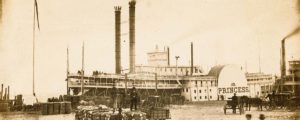
In early winter 1852, some Yuma Indians took one look at the strange craft on the Colorado River and ran away in fear. ‘The devil is coming!’ they cried. One of them might even have suggested that this devil was ‘blowing fire and smoke out of his nose and kicking water back with his feet.’ These Yumas, or Quechans, had seen various boats on the river before, but never a paddle-wheeler, with its smokestack belching smoke and sparks and its paddle wheel tossing the water into the air.
For years, the river steamboats had performed enormous service in the development of the West. In 1809 Robert Fulton, inventor of the first successful steamboat, founded the Mississippi Steamboat Company and began commercial river transportation from Pittsburgh to New Orleans. By 1814 steamboats had entered the Red River, followed by the Arkansas and the Minnesota. But the longest and by far most important river for opening the Western frontier was the Missouri, along with its tributaries. More than 3,000 miles of water connected St. Louis with the head of navigation of the Missouri at Fort Benton, in what is now Montana. Much of the trade on the Missouri in the first half of the 19th century was beaver pelts and buffalo skins headed back to civilization. Return trips found the holds filled with manufactured goods directed at upriver Army forts and frontier settlements.
The paddle-wheeler California first entered San Francisco Bay on February 28, 1849, steaming from New York around the tip of South America. Paddle-wheelers transported gold seekers and mail to California, both around Cape Horn and from the Panamanian overland route, and carried ore and gold bricks back to the East Coast. Paddle-wheelers could navigate the Sacramento and San Joaquin rivers from San Francisco Bay, and passengers booked transport to Sacramento and Stockton for closer jumping-off points to the gold fields.
Further gold discoveries meant a large increase in overland treks, and Indians preying on westbound wagon trains meant Army forts needed to be established to protect travelers. The first paddle-wheeler on the Colorado River came as a direct result of the founding of Fort Yuma late in 1849. Provisions for the California fort, located on the west bank of the Colorado across from the mouth of the Gila River, were hard to get. Wagon and pack-mule trains across the mountains and deserts from San Diego to Fort Yuma were slow and costly at $500 to $800 per ton.
In an attempt to determine the feasibility of using steamboats to supply the fort, Lieutenant George H. Derby received orders from Maj. Gen. Persifor F. Smith, commander of the Division of the Pacific, to test the navigability of the Colorado. In the fall of 1850, Derby, a topographical engineer by training, sailed his 120-ton schooner Invincible from San Francisco around Baja California and up the Gulf of California (also known as the Sea of Cortez) to a point about 30 miles above the mouth of the Colorado. The water was too shallow to proceed, so from there the supplies for Fort Yuma were carried on barges for the rest of the trip, nearly 90 miles more. The garrison appreciated the goods, but even more valuable was the information Derby provided — stating that the Colorado River could be navigated. He recommended stern paddle-wheelers that drew less than 3 feet of water, so they could go over the many sandbars that impeded the progress of deeper vessels.
In 1852 a contract awarded to Captain James Turnbull established the beginning of riverboat trade. Turnbull purchased a small steam tug, broke it down and shipped it, along with his first load of supplies, on the schooner Capacity from San Francisco to the mouth of the Colorado. It took two months to reassemble the tug, but in November, Turnbull’s 65-foot side-wheeler, renamed Uncle Sam, started upriver with 32 tons of freight and generated enough steam to appear devillike and scare off some Yuma Indians. Not all. In fact, on board with the captain were three Indian passengers — one Yuma and two Cocopahs. One of the soldiers at the fort, Lieutenant Thomas W. Sweeny, described the arrival in his diary: ‘The steamer Uncle Sam, so long expected from below, arrived at the post on the 3rd [of December] with about twenty tons of commissary stores. She was fifteen days coming up the river.’
Turnbull’s river commerce flourished, and he soon improved on the time it took to make the trip, regularly completing the round trip in 12 days. But at that rate, it took more than four months to unload Capacity, anchored at the mouth of the Colorado, and transport the goods to Fort Yuma. Turnbull continued the effort until Uncle Sam sank in May 1853. At that point, he decided to give up the Colorado River trade.
For the rest of 1853, the fort again was supplied overland by mule train from San Diego until Captain George A. Johnson picked up the challenge. He dismantled a steamboat in San Francisco and transported the parts to the mouth of the Colorado. By January 1854, the 104-foot side-wheeler General Jesup was ready to start upriver, propelled by a powerful 70-horsepower engine. General Jesup carried 50 tons of goods with a mere 30-inch draw. Johnson’s steamer made the trip from the Gulf of California to Fort Yuma and back in four to five days. At $75 a ton, Johnson saw a gross of around $4,000 per trip, proving that river trade could be highly profitable.
In addition to using a more powerful boat, another thing helped the speed of the trip — the improved availability of fuel. The Cocopah Indians, longtime enemies of the Yumas, were not intimidated by the noisy paddle-wheelers. In fact, they saw the river traffic as an opportunity and worked at wood yards spaced at a day’s voyage, about 30 miles. The Indians cut and hauled wood from nearby mountains to the river’s edge. The first ‘yard’ above the mouth of the Colorado was called Port Famine, but it and the other landings proved profitable for the Americans and Cocopahs involved in their operation. In the years to come, Cocopah men would find employment as river pilots and navigators. The Cocopahs called themselves Xawil Kunyavaei (‘Those who live on the river’).
General Jesup proved to be so profitable that Johnson added another ship to the fleet, Colorado, a 120-foot stern-wheeler with an 80-hp engine. By December 1855, Colorado began operations on the river for which it was named. Because of its powerful engine, Colorado was able to pull two large barges, more than doubling the payload. In another way, it clearly demonstrated the effectiveness of the stern paddle wheel. When faced with a sandbar too high to steam over, Colorado merely turned around and used the paddle wheel to chew its way across the obstacle.
With two boats on the river, Johnson began to look for ways to expand his business. He heard rumors that an old French trapper, Antoine Leroux, had rafted down the Colorado all the way from the mouth of the Virgin River (not far from present-day Las Vegas) and claimed that steamboats could reach that point, too. Johnson decided it was worth investigating. The forts in the interior of what would become Arizona and the Mormon settlements of Utah Territory needed mail and supplies — and water routes would theoretically get them their things more quickly.
In 1856 Johnson persuaded the California Legislature to pass a resolution supporting an expedition up the river. Using that resolution, he talked Secretary of War Jefferson Davis into asking Congress for funding. The $70,000 appropriation passed, and the new administration elected in November asked for bids. Johnson offered General Jesup for $3,500 per month or Colorado for $4,500, but new Secretary of War John B. Floyd named one of his relatives to the job, young topographical engineer Lieutenant Joseph Christmas Ives.
Ives ordered the construction of a stern-wheeler, the 54-foot Explorer. The little iron-hulled boat, built in Philadelphia, was tested on the Delaware River to mixed reviews at best. Undaunted, Ives had Explorer dismantled and shipped by way of Panama to the mouth of the Colorado during the summer of 1857. It had a peculiar profile with a howitzer on one end and a cabin on the other. Its oversized boiler took up a full third of the deck, but its engine was underpowered for the task of navigating the powerful Colorado. The expedition’s artist, Balduin Möllhausen, described the craft as a ‘water-borne wheelbarrow,’ and the Cocopahs and Yumas laughed at the diminutive size, calling it a ‘chiquito boat.’
On December 31, 1857, Ives and Explorer left the Gulf of California to find the limit to navigation. Unknown to Ives, George Johnson left Fort Yuma on the same day with the same goal. Annoyed by the rejection of his commercial bid, Johnson had decided he wanted the glory of the discovery. Adding impetus to his resolve was the deteriorating situation between the Mormons and the federal government. The War Department felt it was possible that the U.S. Army would need to transport troops up the Colorado to Utah, so the acting commander at Fort Yuma ordered Lieutenant James L. White and 14 other soldiers to go along on the voyage. The optimistic Johnson took only 25 days’ worth of rations. Also aboard were trapper Paulino Weaver, Yuma Chief Kae-as-no-com (sometimes called Pascual) and a dozen other civilians.
The Colorado River above Yuma looked much the way it did below the fort. Meandering along through miles of banks dotted with cottonwood trees and mesquite bushes, the voyagers spotted occasional fields of corn and beans cultivated by the Mohave (or Mojave) Indians. It surprised Johnson that problems arose from shallow sandbars that were difficult for the side-wheeler General Jesup to navigate, not from the rapids he’d expected. The river was lower than usual, increasing the sandbar hazards. Furthermore, wood was not readily available for fuel.
By January 21, 1858, the boat had reached the first rapids on the river at the head of Pyramid Canyon. The rapids could be easily navigated, but it would take time. With few rations left, Johnson decided against General Jesup continuing upriver. Instead, he and Lieutenant White took a skiff a few miles up into Cottonwood Valley to a spot with a good view of another 40 miles of unobstructed river ahead. They estimated the distance to the mouth of the Virgin River at about 75 miles and decided that the Colorado was navigable for 400 miles above Fort Yuma. Because of their shortage of supplies, they couldn’t test that theory, but they felt sure the Mormon settlements were within easy reach of trade boats or troop-carrying boats if needed.
Two days later, Johnson turned General Jesup around and headed south, pleased to have beaten Ives this far upriver. On their first stop for wood, the crew and passengers were startled to look up and see the profiles of camels on the bluff overlooking the river. Camels? In the high desert of what was then western New Mexico Territory?
The camels were no mirage. Lieutenant Edward F. Beale had successfully lobbied for $30,000 in funding from Congress to try out the famous ships of the desert. He felt their strength and stamina, coupled with a lower need for water, made them ideal for this terrain. With the support of Secretary of War Jefferson Davis, funding for the Camel Military Corps was approved in December 1853. It took several years to acquire camels and drivers from Egypt, transport them to Texas and train local men to handle the smelly and opinionated beasts. Beale’s camel caravan strode across the territory from Camp Verde, Texas, up the Rio Grande and across the 35th parallel to reach the point where the present states of Arizona, California and Nevada come together.
Beale was just as surprised to see the steamboat as her passengers were to see his camels. After all, General Jesup was the first such craft to reach this far north on the Colorado. In his written report, Beale said, ‘Here, in a wild, almost unknown country, inhabited only by savages, the great river of the West, hitherto declared unnavigable, had for the first time borne upon its bosom that emblem of civilization, a steamer.’ Beale was delighted to see the boat for another reason. Camels could not ford a river the size of the Colorado if they were fully loaded. An amused Johnson agreed to ferry the personnel and cargo across the river into California while the camels and mules swam the chilly water unhampered by packs.
About a week later, on January 30, 1858, General Jesup met the chagrined crew of the Explorer heading north. So far, Joseph Ives’ trip had been embarrassing. Explorer had made poor progress, since it was underpowered, overloaded and had a propensity for getting hung up on sandbars. Amid much fanfare, it had pulled away from Fort Yuma only to run hard aground in full view of well-wishers. The Indians along the river had found much amusement in Explorer‘s sandbar troubles. The captain, David C. Robinson, claimed to be able to recognize problems ahead by the crowds of Indians along the bank, gathered wherever they anticipated yet another grounding. The meeting of the two boats was friendly enough, and the crews swapped tobacco and information before Explorer continued upriver.
Explorer worked slowly north until March 6. At the entrance to Black Canyon, nearly 500 miles above the mouth of the Colorado, it struck a rock. The collision threw crew members to the deck and knocked the boiler off its foundation. Ives decided that this spot, 40 miles above the point reached by Johnson, and which he named Explorer Rock, was the practical head of navigation. While the boat was being repaired, Ives and Robinson explored farther upriver in a small skiff. They concluded that at periods of higher water a steamboat might reach the Virgin River.
Tired of the confining quarters on Explorer, Ives and most members of his expedition decided to disembark at Beale’s Crossing rather than go home in the steamboat. Robinson took Explorer back to Fort Yuma and sent a pack train back to pick up the rest of the party. Mormon spies spotted the pack train and, mistaking it for an invading army, took to the hills looking for defensive positions. For a time, Ives feared a Mohave uprising incited by Mormon alarmists, but it didn’t materialize. Ives and his party explored the territory east of the Grand Canyon and then headed back to Fort Yuma. In writing his official report, Ives neglected to mention Johnson and the General Jesup expedition, but did stress the importance of opening the Colorado to further river travel. Now that Explorer‘s job was complete, the steamboat was offered at auction and purchased for a mere $1,000 by none other than George Johnson. He put the boat to work hauling firewood on the Gila River.
Beale’s camel caravan opened a major wagon route across the territory, but it proved to be vulnerable to attack by Indians. Nine emigrants were killed by Indians at Beale’s Crossing in August 1858. When the secretary of war learned of the attack, he ordered the establishment of a military post at the crossing. The first party scouting for a suitable site skirmished with Mohave Indians, making a defensive base even more imperative. Johnson’s fleet was hired to transport supplies and men to the Fort Mohave site at a rate of $200 a day for General Jesup and $300 a day for Colorado. He personally expressed the opinion that the Mohaves were not warlike, but the fees he received persuaded him to be quiet. The Indians left the builders alone, and Fort Mohave was completed in the summer of 1859.
By the end of 1859, George Johnson had found increased demand for his river fleet’s services. Gold and silver discoveries were being made all along the Colorado River. Starting with Jacob Snively’s placer gold find in arroyos bordering the Gila River, just above its confluence with the Colorado, pockets of rich ore called out to miners, and these gold-hungry fellows booked passage on one of Johnson’s boats. It was not until 1862, following strikes in Eldorado Canyon and Laguna de la Paz, however, that the great rush to the Colorado River began in earnest. Johnny Moss, Paulino Weaver and Joseph Walker, beaver trappers turned miners, played key roles in opening mines all along the river. In April 1861, Moss and his party discovered rich silver lodes on the west side of the river, about 65 miles above Fort Mohave. After staking his claims at what would be called Eldorado Canyon, Moss made a fortune by selling the claims to San Fran-cisco buyers. Soon more than 700 claims had been staked, and the rush was on. Before long, news came of placer gold strikes farther south. In January 1862, Weaver discovered gold on the east side of Colorado at La Paz, about 130 miles above Fort Yuma. Within a year, there were nearly 2,000 miners at those diggings. When Arizona became a separate territory in 1863, La Paz was its largest town.
Despite the large increase in business, George Johnson still ran two steamboats, no more. He was paying more attention to his large cattle ranch near San Diego. Consequently, by the fall of 1863, more than 1,200 tons of freight had stacked up, awaiting transport upriver, at the south end of the river — most of it at Arizona City (later called Yuma, Ariz.), near the confluence of the Gila and Colorado rivers and opposite Fort Yuma. The situation was ripe for a competitor, and in stepped ‘Steamboat Sam’ Adams.
With backers in San Francisco, Adams hired Thomas Trueworthy to pilot a new line of paddle-wheelers on the Colorado. The men transported a 93-foot stern-wheeler, Esmeralda, and the barge Victoria, both originally built for trade on the Sacramento River, to the mouth of the Colorado instead. Smaller than Johnson’s boats, Esmeralda was more powerful and could tow a barge with a payload of 100 tons. Even with a barge in tow, Trueworthy’s first trip to Fort Yuma in early May 1864, took only three days and eight hours. Johnson, sensing the end of his monopoly on river trade, came up with a new 135-foot steamer, Mohave, the most powerful boat on the river. Mohave set a record time of 10 days and two hours for the 365-mile run to Eldorado Canyon.
The increase in competitive paddle-wheelers meant the owners had to look farther afield for business. Bids for a lucrative trade with Utah Territory settlers beckoned. In fall 1864, both Johnson and Adams contacted Mormon businessmen from Salt Lake City who were disgusted with the high cost of overland freighting. In December 1864, Brigham Young authorized Anson Call to negotiate with the riverboat companies for cheaper rates. A warehouse was built at Callville, about 75 miles above what Joseph Ives had named Explorer Rock. Johnson was unsure about the profitability of such a venture, so he rejected Call’s first offer. Steamboat Sam Adams, however, was determined to give it a try. Captain Trueworthy, skipper of Adams’ Esmeralda, was game, but the insurers were not. They informed Trueworthy that a policy increase of 70 percent could be expected if he tried such a foolhardy task. Adams canceled the policy. Esmeralda headed north. When she reached Hardyville, just above Fort Mohave, the crewmen were told that the river was navigable for only seven miles more. ‘Just watch me,’ Trueworthy replied. Bull Head Rock, supposedly the end of the line, proved to be no problem. Explorer Rock, which had ended the expedition of Joseph Ives, was easily avoided. Once past that point, Esmeralda passed through high canyon walls. The most difficult spot was expected to be Roaring Rapids, but they safely traversed it in seven minutes.
Then disaster hit. The boat was fine, but the rumor mill nearly sank them. Adams and Trueworthy met a group of Mormons traveling downriver who told them that word had been sent to Anson Call that Esmeralda had sunk, and he had returned to Salt Lake City. Steamboat Sam Adams and his captain were stunned. Why go on to Callville with the lumber and manufactured goods they carried if there was no one there to receive it? They turned the boat around and tied it up at Eldorado Canyon. Then they traveled overland to Salt Lake City to declare their success and to blame their troubles on George Johnson. Their complaints against Johnson included attempted sabotage of the boiler, logs floated downriver to scuttle the boat, and, of course, the false rumor that they had sunk.
Johnson gave the run a try in the 140-foot-long stern-wheeler Cocopah, but he was stopped by low water at Hardyville in March 1865. That same year, seagoing vessels started anchoring at Port Isabel, a few miles east of the mouth of the Colorado, for safe transfer of their freight to barges. Adams, determined to prove his point, took Esmeralda and a barge, carrying a combined 100 tons of cargo, all the way to Callville in October 1866. Steamboat Sam triumphantly stood on the dock of the Mormon settlement more than 600 miles above the Gulf of California while Esmeralda blew its whistle long and loud. The triumph rang hollow because Adams was deeply in debt, and the sheriff seized his boat when it returned to Fort Yuma.
The competition had forced Johnson to lower his rates, much to the delight of his shippers. He faced no further threat to his monopoly for more than a decade. Steamers left Yuma every few days for upriver landings, booked up with passengers and towing a barge of freight. The fare was $15 to the growing town of Ehrenberg and $35 to Fort Mohave. Ehrenberg, 125 miles above Yuma, was the second largest town on the river, and the shipping point for central Arizona. Passengers bound for Ehrenberg included Army troops and sometimes their families.
One such family consisted of William H. Corbusier, Army surgeon, his wife, Fanny, and their young son. First assigned to Fort McDermit, Nev., Corbusier received a transfer to Prescott, Arizona Territory, in November 1872. The trip consisted of a wagon ride to Winnemucca, then a train trip to San Francisco, and on around the tip of Baja California by way of the steamer Newbern. From the mouth of the Colorado, Fanny describes the journey:
A stern-wheel steamboat took us up the Colorado River, and we had a very comfortable stateroom. We towed a flatboat or barge, which held the recruits. At night, we tied up and the men went ashore to cook their meals and sleep on the banks of the river. There were many sandbars in the river, and as we approached one of them, we listened to the man at the bow of the boat call out the depth of the water. We were three days reaching Yuma and had to wait there for about 2 weeks for the ‘Cocopah’ and Captain Polhemus to take us up to Ehrenberg….From Yuma to Ehrenberg the navigation was easier.
In spite of the heat and general discomfort, passengers continued to ride the paddle-wheelers up the Colorado. Johnson expanded his fleet to four steamers and incorporated, forming the Colorado Steam Navigation Company with two partners in December 1869. By the mid-1870s, his company did over a quarter million dollars worth of business, carrying 7,000 tons of freight and about 1,000 passengers annually. But in 1877, the railroad reached the river. In 1878, George Johnson sold out to the Southern Pacific Railroad. For a time, the paddle-wheelers continued to act as feeders to the east-west routes of the railroad. The construction of Laguna Dam in 1908, which closed the Colorado River 14 miles above Fort Yuma, meant that the colorful era of steamboats on the Colorado had ended.
This article was written by Kay Muther and originally appeared in the August 2004 issue of Wild West. For more great articles be sure to subscribe to Wild West magazine today!