In the spring of 1843, the first ripple of a coming tide of would-be settlers piled everything they owned into canvas-covered wagons, handcarts and any other vehicle that could move, and set out along a dim trace called ‘the Emigrant Road.’ They went by way of a route that was a broad ribbon of threads, sometimes intertwining, sometimes splitting off into frayed digressions. It ran beside waterways, stretched across tall-grass and short-grass prairies, wound through mountain passes, and then spanned the Pacific Slope to the promised lands of Oregon and California. One in 17 never made it. This road to the Far West soon became known by another name–the Oregon Trail.
Even today, ruts from the wagon wheels remain etched indelibly in the fragile topsoil of the Western landscape. The Oregon Trail opened at a time when the westward settlement and development of the trans-Mississippi West had stalled at the Missouri River; Mexico still claimed all of California, and Alaska remained Russian territory. Everything from California to Alaska and between the Rocky Mountains and the Pacific Ocean was a British-held territory called Oregon. The trail pointed the way for the United States to expand westward to achieve what politicians of the day called its ‘Manifest Destiny’ to reach ‘from sea to shining sea.’
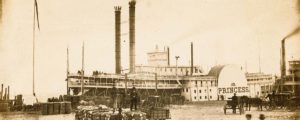
In 1843, the trickle of emigrants into Independence, Mo., began to swell. They came from all directions, by steamboat and over primitive roads that a day or two of heavy rain turned into quagmires. For the most part they were farmers–family men, with wives and children–who had a common goal of seeking a promised land of milk and honey in far-off Oregon, about which they knew as little as they did about how to get there. They did know that the back country of Iowa, Missouri and Arkansas had not proved to be a shining paradise. The doldrums that followed the depression of 1837 shriveled the value of land and the price of crops, and malaria ravaged the bottomlands that once had promised so much.
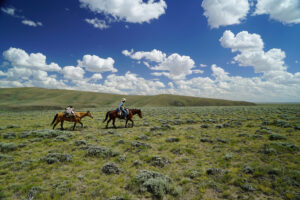
It was said that snow did not exist in California’s golden valleys, that the black soil of Oregon was bottomless, that vast rivers afforded easy transportation, and that no forests barred the way to migrating wagons. Ignorance allowed travelers to advance where fuller knowledge might have rooted them with apprehension. But they were farm folk and had pioneered before. They were adept with wagons, livestock, rifles and axes. The women were used to walking beside the men as wilderness equals. Above all, they were restless–once a farm had been tamed, the narrow horizons of the backwoods communities closed around them. Vast and unclaimed riches far to the west, across the Great Plains, beckoned. It was as if the land itself were pulling the people westward. ‘As I looked about me I felt that the grass was the country, as the water is the sea,’ wrote novelist Willa Cather in My Antonia. ‘And there was so much motion in it; the whole country seemed, somehow, to be running.’
Many of these restless souls had heard of the success of Joe Meek and his friend Bob Newell, who had made it to Oregon in 1840. These two mountain men rigged up some wobbly wagons and trained’squaw ponies’ to pull them. Meek and Newell managed to get the first wheeled vehicles over the Blue Mountains. The wagon trip ended at Fort Walla Walla, after which they took boats down the Columbia River to the Willamette River valley. The next year, John Bidwell and John Bartleson traveled what would later be christened the Oregon Trail on the first planned overland emigration west to California. At Soda Springs (in what is now southwest Idaho) one contingent split off for Oregon. In his Journal, Bidwell described the famous landmarks that would impress almost all Oregon Trail travelers–Courthouse Rock, Chimney Rock, Scotts Bluff, Fort Laramie and Independence Rock. In 1842, Dr. Elijah White, the newly appointed Indian agent in Oregon, successfully led 125 men, women and children there. But the real thrust westward came the following year, when the Oregon Trail took on a new significance thanks to the so-called Great Emigration.
By May 13, 1843, more than 900 emigrants bound for Oregon were encamped on the prairie at Fitzhugh’s Mill, several miles from Independence, preparing for embarkment, dividing into companies, electing wagon masters and engaging veteran and self-proclaimed frontiersmen who professed to know the country to guide them. Peter Burnett was chosen captain, and a so-called cow column for slower wagons and herds of livestock was formed with Jesse Applegate as its leader. Applegate would later provide descriptions of life on the Oregon Trail in his memoir, A Day with the Cow Column in 1843. Mountain man John Gant was to be chief guide as far as Fort Hall. They would follow the trail left by Meek and Newell.
Marcus Whitman, a Protestant missionary and physician who had established a mission in Oregon in 1836, would join the Applegate train on his return west after an eastern visit. Doctors came to be a welcome rarity along the trail. Applegate called Whitman ‘that good angel’ of the emigrants. ‘It is no disparagement to others to say that to no other individual are the emigrants of 1843 so indebted for their successful conclusion of their journey as to Dr. Marcus Whitman,’ he added.
Among the travelers was Jesse Applegate’s young nephew and namesake. The 7-year-old boy’s full name was Jesse Applegate Applegate to distinquish between them; he was called Jesse A. or just Jess. Along with his uncle, Jess traveled with his parents, four brothers, one sister and numerous other relatives. Years later, when he was in his 70s, he wrote Recollections of My Boyhood, in which he largely succeeds in portraying events and personalities from the 1843 western crossing through the eyes of a young boy. As the Applegate party journeyed across the prairies and over the Rockies, the trek had mostly seemed like grand fun to the boy. At first his recollections bubble with the thrill of adventure. The ‘gay and savage looking’ Plains Indians had awed but not scared him. He had traded nails and bits of metal with Indian children and thrown buffalo chips at other white children. Later, though, the recollections become more somber. Jesse A. Applegate had also experiened the suffering that almost no early traveler on the Oregon Trail could avoid.
Food supplies would inevitably become low and water scarce. A bone-wrenching weariness would set in as the miseries mounted. Propaganda about Oregon and early accounts of travel west flourished in newspapers, pamphlets and emigrants’ guidebooks, creating an Oregon fever. Oregon’s image was that of a place of renewal, where everything was bigger and better and people could better themselves. The U.S. government made the new land seem even more appealing by offering Oregon settlers a square mile of land for almost nothing. But as the emigrants pushed overland, many lost sight of the vision that had set them going. That wasn’t so surprising because, as Hiram Crittenden remembered, ‘the Trail was strewn with abandoned property, the skeletons of horses and oxen, and with freshly made mounds and headboards that told a pitiful tale.’
The weight of hardship piled on hardship was enough, on occasion, to make men and women break down and cry, and perhaps even turn back. Yet most travelers summoned up reserves of courage and kept going. They endured every hardship from a mule kick in the shins to cholera. The ones who got through usually did so because of sheer determination.
The Applegate train began to assemble in late April, the best time to get rolling. The date of departure had to be selected with care. If they began the more than 2,000-mile journey too early in the spring, there would not be enough grass on the prairie to keep the livestock strong enough to travel. Animals would begin to sicken, slowing up the train. Such slowdowns would often throw off the schedule and sometimes cause major problems down the road. If they waited too long they might later be trapped in the mountains by early winter storms.
Over the years, other wagon trains used Westport, Leavenworth and St. Joseph as jumping-off points. The Applegate train used Independence, pre-eminent since 1827 as an outfitting center. Since the majority of emigrants were farmers with families, they often chose Murphy farm wagons as their chief means of transport. Conestoga wagons, which weighed 1 1/2 tons empty, were too heavy for travel where there were no roads. The heavier the wagon, the more likely it would bog down in mud or cause the team to break down. Oregon-bound travelers were advised to keep their wagons weighing less than 11Ž2 tons fully loaded. A new wagon and spare parts, which were almost always needed, would cost a family close to $100.
The wagons had 10-by-3 1/2-foot bodies, and their covers were made of canvas or a waterproofed sheeting called osnaburg. Frames of hickory bows supported the cloth tops, which protected pioneers from rain and sun. The rear wheels were 5 or 6 feet in diameter, but the front wheels were 4 feet or less so that they would not jam against the wagon body on sharp turns. Metal parts were kept to a minimum because of the weight, but the tires were made of iron to hold the wheels together and to protect the wooden rims. The rims and spokes would still sometimes crack and split, of course, and in the dry air of the Great Plains, they were also likely to shrink, which eventually caused the iron tires to slip off.
These early American mobile homes were called ‘prairie schooners’ because they resembled a fleet of ships sailing across a sea of grass. In fact, when rivers were too deep to be forded and there was no timber to build rafts, the travelers would remove the wheels and float the wagons across.
Once he had selected a wagon or two, the pioneer next had to decide on his draft animals. Most emigrants, including Captain Burnett, swore by oxen. ‘The ox is the most noble animal, patient, thrifty, durable, and gentle,’ he said. ‘Unfortunately, they also had their drawbacks. Their cloven hoofs tended to splinter on mountain rocks, and oxen could only do about 15 miles a day, while mules did 20. ‘They don’t walk,’ said one exasperated emigrant. ‘They plod.’
Prosperous families usually took two or more wagons because the typical wagon did not have a large carrying capacity. After flour sacks, food, furniture, clothes and farm equipment were piled on, not much space remained. Space was so limited that, except in terrible weather, most travelers cooked, ate and slept outside. A.J. McCall wrote of his fellow travelers, ‘They laid in an over-supply of bacon, flour and beans, and in addition thereto every conceivable jimcrack and useless article that the wildest fancy could devise or human ingenuity could invent–pins and needles, brooms and brushes, ox shoes and horse shoes, lasts and leather, glass beads and hawk-bells, jumping jacks and jews-harps, rings and bracelets, pocket mirrors and pocket books, calico vests and boiled shirts.’ A passerby was reminded of birds building a nest while watching one family load its wagon. The members of the Applegate train often killed buffalo and antelope, but a more dependable supply of meat was the herd of cattle led behind the wagons.
Once the wagons were loaded, the animals gathered and the emigrants reasonably organized, Captain Peter Burnett finally gave the signal for the Applegates and the others to move out. The train included nearly 1,000 persons of both sexes, more than 200 wagons, 700 oxen and nearly 800 loose cattle. The Great Emigration of 1843 had begun. ‘The migration of a large body of men, women and children across the continent to Oregon was, in the year 1843, strictly an experiment,’ Jesse Applegate, the leader of the cow column, wrote.
Out on the plains in the middle of May, the grass was luxuriant and the wildflowers out in force. The spring storms were often startling in their power. The thunderstorms of eastern Kansas, wrote one traveler, ‘rolled the whole circle of the firmament with a peculiar and awful vibration.’ Another diarist reported a gale that covered the ground with a foot of water, drove rain through the wagon covers ‘like as though they had been paper,’ and scattered cattle ‘to the ends of the earth.’
The first miles were a hubbub. Ill-broken oxen and reluctant mules either bolted or sulked in harness, entangled themselves in picket ropes or escaped entirely and sped back to the starting point. When not busy rounding up livestock, the exuberant males of the party quarreled over firewood and water holes and raced for preferred positions in line.
Still, for the most part, the travelers had it relatively easy during the first few weeks on the trail as they headed northwest toward Nebraska and the Platte River. Despite the occasional thunderstorm, the weather was usually pleasant. It was a good time to learn to handle a prairie schooner. Jesse Applegate wrote about the workings of a typical day on the trail: ‘Sentinels fired their rifles at four o’clock in the morning to wake the camp. Fires were lighted and the herders drove the oxen into the circle of wagons to be yoked for the day’s journey. This corral of the plains was made the night before by parking the wagons in a circle. The rear wagon was connected with the wagon in front by its tongue and ox chains. It was strong enough to keep the oxen from breaking out, and also served as a barricade in case of Indian attack.
‘Five to seven o’clock were busy hours, with breakfast to be eaten, teams yoked, tents folded and wagons loaded. Promptly at seven the bugle sounded, and the wagon train was on its way. Women and children often walked beside the trail, gathering wild flowers and odd-looking stones. Boys and young men on horseback kept the loose stock from straying too far, as they trailed along behind the wagons.
‘At noon we stopped to eat. Oxen were turned loose with their yokes on, so they might graze and rest. Sometimes the officers of the train got together at noon to consider the case of someone who had violated the rules or had committed a crime. He was given a fair trial and, if found guilty, was sentenced according to the nature of his offense.
‘At one o’clock the bugle sounded, and the wagons were once more on their way. All through the afternoon the oxen plodded, and when the wagons arrived at the spot chosen by the guide as a camping place, preparations were made to spend the night. Livestock were driven out to pasture, tents were pitched, fires built, and supper was on its way. Perhaps hunters came in with choice parts of buffalo or antelope, and everyone enjoyed a feast.
‘After supper, the children played their favorite games, the elders gathered in groups and talked, perhaps making plans for the new homes to be built at the end of the Oregon Trail. Some of the young folk danced to the music of the fiddle or accordion, while those more serious minded sang their favorite songs, some religious, some sentimental. ‘Old Hundredth’ was a favorite, and as the music and words of the grand old hymn floated on the evening breeze, many paused to listen and ponder. But youth was not to be denied, the trek was a great adventure, and life stretched far ahead. Many a troth was plighted at the impromptu gatherings along the trail, beside a dim campfire.
‘Guard duty commenced at eight o’clock at night and continued until four o’clock in the morning. Various companies took turns at guard duty, one night out of three. Fires were dimmed at an early hour, and everyone retired to rest for tomorrow’s march. Some slept in tents, some in wagons, some on the ground, under the stars. Usually their sleep was undisturbed save perhaps by the sharp yelp of a coyote on a nearby hill, and the challenging bark of the camp dogs.’
The prairie schooners crossed the Big Blue, a tributary of the Kansas River, about two weeks out of Independence. The trail then swung up into Nebraska, where it ran along the south bank of the Platte River. The silty Platte was so flat and broad that a woman named Martha Missouri Moore commented, ‘The river ran near the top of the ground.’ It often was said that the Platte was ‘a mile wide and an inch deep.’
The emigrants marveled at the Great Plains. Sarah Cummins described them as being ‘like the wild regions of Africa.’ They marveled, too, at the prairie wildlife–antelope, black bears, grizzlies, coyotes, buffalo and, of course, prairie dogs. Buffalo were so plentiful that one traveler wrote, ‘Some are grazing quietly and others are marching, moving and bellowing, and the great herds making a roaring noise as they trample along.’ Cows would sometimes stray off with a buffalo herd, and the buffalo could befoul a stream. Still, few travelers found reason to complain about the buffalo. The animals were a source of meat, and buffalo chips were a valuable source of fuel on the treeless plains.
Trouble with the Indians was rare, especially in the 1840s, when Indians usually provided information about the trail ahead and were sometimes even hired as guides. Indians on their pinto ponies, some of these dragging laden travois, trailed by, gazing curiously at the ox-drawn wagons. They often stopped to swap buffalo robes and buckskin moccasins, fringed shirts and leggings for tobacco, ironware and worn-out clothing. Precautions were still taken. At each stop, the wagons were drawn up into a corral. This also served as an enclosure for the livestock. Almost never did an Indian war party descend upon a circle of wagons. Such a strategy would have assured heavy casualties among the Indians.
Stragglers or small groups, however, were attacked on occasion by Indians, who were mostly interested in the horses and supplies. It is estimated that prior to the 1849 California gold rush, only 34 whites and 25 Indians were killed in fighting on the Oregon Trail. Relations between white travelers and Indians did sour in the 1850s. In September 1860, the small Utter wagon train was attacked by Bannock Indians and only 14 of 44 travelers made it to Oregon. Indian danger would be such a problem in the summer of 1867 that the U.S. Army would forbid travel by single wagons in western Kansas.
But far more prevalent on the trail than Indian attacks were the everyday trail hazards of accident and disease. Little was known about health and sanitation, and no vaccines were available. The sick lay on pallets in the hot, debilitating confines of their wagons, with only the wagon cover to protect them from the direct rays of the sun. The emigrants were prone to dose themselves with great quantities of medicine at the first sign of illness–the theory being that the larger the dose, the quicker the recovery. Many died of overdoses, especially of laudanum. However, the most frequent epitaph was, ‘Died: Of Cholera.’ Because there was no wood for coffins, bodies were wrapped in cloths and buried under mounds of earth and rocks. One of the first deaths in the Applegate train was that of 6-year-old Joel Hembree. ‘A very bad road,’ wrote William Newby. ‘Joel Hembree sone [son] Joel fell off the waggeon tung and both wheels run over him.’
After a month on the road, the emigrants arrived at the confluence of the Platte’s north and south forks. They were now 460 miles west of the Missouri River. Marcus Whitman and his nephew Perrin Whitman proved to be excellent guides as the wagons crossed into more challenging terrain. Dr. Whitman’s first practical counsel was: ‘Keep traveling! If it is only a few miles a day. Keep moving.’ Dr. Whitman’s medical skill, freely given, was also of vital worth to the men, women and children who fell ill. Death was inevitable for some, but babies were born, bringing new courage to the travelers. The trail followed the north fork, but first the travelers had to cross the south fork. It was at least a half-mile wide and the water was high. The wagon wheels were taken off, and the wagon bodies, by then long bereft of their caulking, were covered with buffalo skins to waterproof them. The prairie schooners thus lived up to their nicknames. William Newby noted in his diary: ‘Hunted buffalo and killed 2. We wonted thare hides for to make bots to craws the river.’
The flat Platte River valley had been left behind. After traversing a 22-mile tableland, the emigrants had to lower their wagons down a dangerously steep drop to what seemed an oasis to them–Ash Hollow, a woodsy glen that provided sweet spring water and shade. After leaving Ash Hollow, the wagon train continued on up the sandy banks of the North Platte. The snow-crested Laramie Mountains rose in the distance. Closer by, a series of strange rock formations captured the pioneers’ attention. The first of these were the multi-tiered, 400-foot-high mound of volcanic ash and clay that became known as the Courthouse and its smaller rock companion, the Jail House–so dubbed because of their resemblance to municipal buildings in St. Louis.
Just 14 miles to the west came the more stunning Chimney Rock. Surrounded at its base by mounds of debris, the 500-foot-high slim stone shaft was likened not only to a chimney but also to a minaret, a church steeple and a tunnel turned upside down. It was in the emigrants’ view for days, and their fascination with it was so great they even went so far as to measure its dimensions. One vigorous fellow took 10,040 steps to walk around its base.
Scotts Bluff, a weathered contortion of towers and parapets that someone called a Nebraska Gibraltar, was another 20 miles down the trail. If on schedule, a wagon train reached the bluff in late June. From there, it was another two days to Fort Laramie, a frontier outpost in present-day southeast Wyoming. Women turned to washing clothes, the men to refitting iron tires to wheels shrunken by the dry air. Sore-footed oxen were thrown onto their backs in trenches and shod while their hooves waved helplessly. Though the emigrants were 640 miles from Independence, they were only one-third of the way to Oregon.
More than a third of the emigrants’ supplies was likely to have been used up by this time. The oxen and mules would be exhausted–as would the patience of their owners. Even worse, the road beyond Fort Laramie began the climb into the Rocky Mountains, which meant extra hardships for both man and beast. To keep the animals moving, it often became necessary to lighten their loads. The road beyond Fort Laramie became littered with castoffs–sheet-iron stoves, clothes trunks, tools, claw-footed tables, massive oak bureaus, cooking pots and even food. Things that had seemed like treasures in Missouri were now often impossible to keep.
The land ahead was challenging. From a distance, the mountainsides looked like green meadows, but up close they revealed mostly dry sand and rock. By the time travelers reached the Sweetwater River–named, it was said, in relief from the bitter and occasionally poisonous springs that mocked their thirst– alkali dust had stung their eyelids and rasped their throats, and alkali water had griped their bowels.
The most popular campsite along the Sweetwater was next to Independence Rock, so called because the schedules of many wagon trains brought them to the granite monument around the Fourth of July. Few emigrants passed by the rock without leaving their names or initials chiseled into its surface. In 1841, Father Pierre DeSmet, a Jesuit missionary, had spotted some names carved there by fur traders and called it ‘The Great Record of the Desert.’
Even in July in this part of the country, emigrants shivered in early morning and night. At the Ice Slough, not quite 80 miles west of Independence Rock, a bed of ice lay about a foot beneath the sod even in the heat of the day. Travelers would chop out big chunks for their water casks, and some even made ice cream. The presence of ice in midsummer indicated that they had reached the highest point on the trail–the Continental Divide at South Pass.
The emigrants were sometimes disappointed with South Pass, for this passageway in the Wind River mountains was nothing like the deep gorge they had envisioned. Instead, the trail arched over a wide grassy meadow before dipping toward the Pacific Ocean. They celebrated their arrival in Oregon Territory with cheers and gunfire at nearby Pacific Springs, but most had no idea that hundreds of miles lay between them and their final goal.
After a night’s rest at Pacific Springs the traveling parties would move on to Fort Bridger, a primitive trading post set up in 1843 by mountain man Jim Bridger, commonly known as Old Gabe. Since the fur trade was dwindling, he had built his fort to settle down and make a dollar or two selling fresh supplies and fresh oxen to emigrants. Many emigrants elected not to visit the fort, however, because it was shorter to follow a path across a grassless tableland–Sublette’s Cutoff. On this barren 50-mile stretch, there was no water available until the Green River, on the far western side. Where the cutoff rejoined the main trail, the travelers headed northwest.
After traveling 70 miles in seven days, they would arrive at Soda Springs, where the naturally carbonated water was a treat for the travelers. Some said it tasted like beer. Others mixed it with sugar and citrus syrup to make lemonade. It was at Soda Springs in 1843 that young Jesse A. Applegate and the others met a group led by famed western explorer and cartographer John Charles Fremont. ‘There was a soda spring or pool between the camps, and Fremont’s men were having a high time drinking soda water,’ recalled Jess. ‘They were so noisy that I suspected they had liquor mixed with the water.’
Fifty-five miles beyond Soda Springs, at Fort Hall, another supply depot operated by the Hudson’s Bay Company, the wagon trains split up, one part going to California and the other to Oregon. Those who took the California Trail veered southwest through an arid, rocky landscape and eventually, after 525 miles and a month’s travel time, reached the Sierra Nevada. But first they had to get through the Great Basin around the Great Salt Lake. In the stark, arid land west of the Humboldt River, more than one traveler was ‘obliged to swallow dust all day in place of water,’ as one woman put it.
The Hudson’s Bay Company agents at Fort Hall encouraged the emigrants to take the California route. Being of British descent and still trying to protect the fur business, they wanted to forestall the influx of settlers into Oregon country for as many more years as possible. Even so, their warnings about the road to Oregon–described as a deplorable succession of dangerous rivers, hostile Indians, famine and winter storms–were not far from reality.
The trail stretched out loosely for 300 miles along the south rims of the black lava canyons of the Snake River. The wagons struggled along paths strewn with boulders and knotted sage. Twice they risked deep crossings of the Snake River, fatal to some. The more dangerous of the two was the Three Island ford near the present-day town of Glenns Ferry, Idaho. William Newby wrote: ‘First we drove over a part of the river one hundred yards wide on to a island, then over a northern branch 75 yards wide on a second island; then we tide a string of waggons to gether by a chance in the ring of the lead carrles yoak and made fast to the waggon of all a horse & before & himn led. We carried as many as fifteen waggeons at one time. We had to up stream. The water was ten inches up the waggeon beds in the deep plaices. It was about 900 yards acraws.’
Eventually, the wagons would be dragged up Burnt Canyon into present-day Oregon, skirt the treacherous swamps of the lovely Grande Ronde River valley, and finally climb slowly among the cold evergreens of the Blue Mountains. Far ahead, glinting in the sunlight, the weary travelers saw the curving sweep of the Columbia River, breaking a gateway through the tawny mesas that guarded the approach to the Cascade Range. Once past the Blue Mountains, the emigrants still faced a tough haul either by land (250 miles over the Cascades to the Willamette Valley) or by water (230 miles down the Columbia River).
Crossing the Blue Mountains in 1843 was particularly slow-going for the Oregon emigrants because of the forests and poor weather. Jesse A. Applegate recalled: ‘The timber had to be cut and removed to make way for the wagons. The trees were cut just near enough to the ground to allow the wagons to pass over the stumps, and the road through the forest was only cleared out wide enough for a wagon to pass along….We were overtaken by a snowstorm which made the passage very dismal. I remember wading through mud and snow and suffering from the cold and wet.’ Once out of the Blue Mountains, Jesse’s spirits picked up briefly when he reached a stream lined with black hawthorns. ‘They were black and near the size of buckshot with a single seed, very sweet and otherwise pleasant to the taste…,’ he later wrote. ‘Our party ate large quantities of this fruit. It was told for a fact in camp that a woman died during the night we stayed there from the effects of a gorge of black haws. I ate about all I could get my hands on but experienced no bad results–they were ripe and mellow.’
In late October, the Applegate train finally reached Fort Walla Walla. The Cascades still lay between the emigrants and their destination, the Willamette Valley. For the most part, the range rose a mile above sea level, with its most prominent peak, the white-capped Mount Hood, standing nearly a mile higher. Since they were unable to drive wagons through the Columbia’s steep-walled, heavily timbered gorge, the men in the Applegate party spent aboout two weeks at Fort Walla Walla sawing lumber and building skiffs. Wagons, cattle and horses had to be left behind. By early November, a small fleet of boats was heading down the Columbia River toward the Willamette Valley. ‘I well remember our start down the river, and how I enjoyed riding in the boat, the movement of which was like a grapevine swing,’ recalled Jesse.
But the Columbia could be turbulent, and this final leg of the journey proved to be the worst ordeal of all. By the time the 1843 party started the river run they had been on the trail nearly five months. Four more weeks of travel, no less challenging for being on water, still remained. After they had been floating downstream for several days, the Applegates encountered approached the first set of rapids. Jesse rode in one boat with his parents, his Uncle Jesse, Aunt Cynthia and an Indian pilot. Another boat held Jesse’s brothers Elisha and Warren and a cousin, Edward Applegate, all under 12, as well as two men in their early 20s, and 70-year-old Alexander McClellan. As the two boats approached a river bend, young Jesse heard ‘the sound of rapids, and presently the boat began to rise and fall and rock from side to side….I could see breakers ahead extending in broken lines across the river, and the boat began to sweep along at a rapid rate.’
Jesse saw the other boat across the river and ‘presently there was a wail of anguish, a shriek, and scene of confusion in our boat that no language can describe. The boat we were watching disappeared and we saw the men and boys struggling in the water.’ Jesse’s father and uncle wanted to leap into the water and try to save their drowning children, but they went back to manning the oars at the urging of Jesse’s mother and aunt. ‘The men returned to the oars just in time to avoid, by great exertion, a rock against which the current dashed with such fury that the foam and froth upon its apex was as white as milk,’ Jesse later wrote.
The other boat was swept to the bottom by a whirlpool. Jesse’s brother Elisha and the two men in their 20s made it safely to shore. Old McClellan had placed 9-year-old Edward on a pair of oars and tried to swim the boy to shore. But McClellan’s strength soon gave out, and they both disappeared under the water. ‘The brave old soldier could have saved himself by abandoning the boy,’ wrote Jesse, ‘but this he would not do.’ The other person who had been on the skiff that capsized, Jesse’s brother Warren, also drowned.
Jesse, who would turn 8 on November 14, and the other battered survivors regrouped and continued downriver. They were able to negotiate the other rapids without mishap. In late November 1843, they reached trail’s end, Fort Vancouver, which had been built by the Hudson’s Bay Company in 1825. The food and rest they found there was welcome, but soon it was time to face new tasks and challenges–building homes and dreams in Oregon’s Willamette Valley.
The Applegates spent their first winter in log cabins at the ‘Old Mission’ (where the small town of Gervais, Ore., now stands). Jesse A. Applegate, who would die at age 88 in 1919, wrote: ‘Oh, how we could have enjoyed our hospitable shelter if we could have looked around the family circle and beheld all the bright faces that had accompanied us on our toilsome journey almost to the end. Alas, they were not there!’
In 1844, there were 1,475 Oregon-bound emigrants; in 1845, 2,500 emigrants. Starting with the gold rush in 1849, more of the overland travelers chose California as their final destination, but Oregon still got its share. Between 1841 and 1866 about 350,000 people used what had become the most famous wagon route across America. It was no wonder that, in places, ruts along the Oregon Trail are still visible today.
This article was written by Bob Brooke and originally appeared in the April 2000 issue of Wild West.
For more great articles be sure to subscribe to Wild West magazine today!