The morning of June 25, 1948, in Berlin was unseasonably warm, and a low ceiling of dark clouds hung ominously over the divided city. During the night, news editors in West Berlin had been busy remaking the front pages of their morning papers because of a flash from the Soviet-sponsored ADN news agency in East Berlin: “The transport division of the Soviet military administration is compelled to halt all passenger and freight traffic to and from Berlin tomorrow at 0600 hours because of technical difficulties. West Berlin will receive electricity only between 11 p.m. and 1 a.m….”
West Berliners quickly learned what the “technical difficulties” would mean. For weeks, the Soviets had been harassing the French, British and American authorities to try to force them to withdraw from the city. To this end, various restrictions, controls and slowdowns had been imposed on military and civilian traffic between West Germany and Berlin, and there had been many frustrating discussions during which neither side would give in.
The Western Allies had had to resort to airlifting military supplies to the city for 11 days, beginning on April 1, 1948, when U.S. authorities had refused to submit to Soviet inspection of military rail shipments. Land traffic resumed after much haggling, but on June 15 the Communists closed the autobahn “for repairs.” Six days later, they halted all barge traffic into the city. At this impasse, Douglas C-47 Skytrains from the 60th and 61st Troop Carrier Groups at Kaufbeuren and Rhein Main made an average of 38 trips daily for five days to West Berlin with needed military supplies. British Royal Air Force (RAF) aircraft also flew in supplies for British nationals in the city. It was on June 26 that the so-called Berlin Airlift officially began and the first scheduled airlift brought supplies to the three Allied sectors of West Berlin.
Deep inside Soviet-held East Germany, West Berlin was an island of democracy in an ocean of communism. At the end of World War II, the Allied powers had agreed upon free access by military traffic to the occupied zones of Berlin within the Soviet sector of Germany. The Soviets later decided that this was no longer acceptable and that they would force the British, French and American military out in order to rid the city of democracy’s influence. They hoped to starve, freeze and scare the West Berliners into accepting communism by the simple expedient of cutting off all resupply of life’s essentials. The three 20-mile-wide air corridors remained open, however. The Allied occupation forces had been reduced drastically over the previous two years, and the Soviets didn’t believe there was a sufficient cargo force left in West Germany to mount a successful airlift.
The blockade of the sprawling city began promptly at 6 a.m. on June 26, 1948. All land, river and rail traffic was halted between the three Allied sectors of West Germany and West Berlin. The ultimatum was clear: The Western powers must withdraw their military occupation forces from the city. The Soviets believed they would soon win their point by leaving West Berlin without food, fuel and other necessities.
As soon as word of the Soviet action reached General Lucius D. Clay, the
highest ranking American officer in West Germany, he immediately called Lt. Gen. Curtis E. LeMay, then commander of the U.S. Air Force in Europe. Clay asked LeMay if his planes could airlift emergency supplies into the isolated city. With the “can do” spirit that made him famous–and feared by the Soviets–LeMay replied characteristically, “Sir, the Air Force can deliver anything.”
One of the first flights into Berlin after the land embargo began was a Douglas DC-4 piloted by Captain Jack Bennett of American Overseas Airlines. Within hours, a small fleet of battered, war-weary, twin-engine Douglas C-47s–the Air Force’s famous “Gooney Birds”–began to arrive from various West German bases with priority cargo at Tempelhof Air Force Base in the American zone of West Berlin. By nightfall, 80 tons of flour, milk and medicines had been delivered to the blacked-out western half of the city.
General LeMay put his logistics staff to work to figure out what it would take to build an air bridge to the city with the aircraft available in the theater. Logistics experts quickly calculated that it would require 2,000 tons of coal and 1,439 tons of food per day to meet the minimum basic needs of the 2 million inhabitants. The normal total tonnage requirement for the city was 13,500 tons daily. But even 3,439 tons flown in each day with the few available C-47s appeared an impossible task.
In spite of the heroic efforts of a few hastily rounded-up pilots and ground personnel, the Western three sectors of the city seemed doomed to capitulate. Berlin’s Lord Mayor-Elect Ernst Reuter told Clay that his people were grateful for the efforts being made for them, but that they knew the city did not have a chance with the entire armed might of the Soviet Union backing up the blockade.
There was also understandable pessimism among the Allied nations. No city had ever been kept alive solely by airlift. The tonnage requirements were simply too great, especially in winter. Why try to hold Berlin anyway? Why not withdraw all Allied claims to Berlin and let the Soviets have it?
The world’s press debated these questions while the U.S. Air Force went to work in concert with the British. The French were eliminated from participating in any airlift because of language difficulties. By prior agreement, the Americans and British would fulfill the French military requirements. As an interim measure to continue the flow of critical supplies before larger aircraft could be assigned, the C-47s, capable of hauling 3 tons each, were ordered to report from all over Europe to Wiesbaden and Frankfurt, site of the two large American bases closest to the East German border.
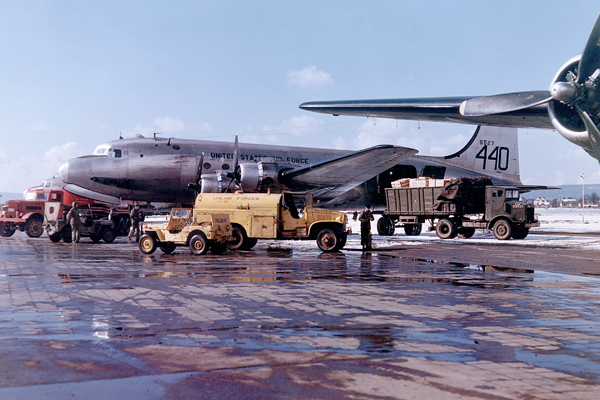
Meanwhile, four-engine Douglas C-54 transports that could carry 10 tons each were ordered from Panama, Guam, Hawaii, Alaska, Japan and the United States. While they were winging their way to Central Europe with flight crews and ground personnel, the faithful Gooney Birds flew round-the-clock missions from the two U.S. bases to Berlin and back. Ground crews, mostly German civilians, were hurriedly hired at both ends of the airlift to load and unload the vital supplies. The RAF marshaled some of its Douglas C-47 Dakota, Handley Page Hastings and Avro York aircraft and also began to fly the air corridors to Gatow, an airfield in the British sector of Berlin. During the summer months, the British also occasionally used amphibious aircraft that landed on the waterways in the city.
Within four days, a C-47 was landing at Tempelhof every eight minutes to discharge 2 1/2 tons of cargo–well over 150 planeloads a day. The supplies were immediately trucked to warehouses strategically located throughout the western sectors of the city. However, this was only about one-thirtieth of the food, fuel and medicines that would be required.
The Communist press in East Berlin ridiculed the efforts being made to counter Soviet demands. It derisively referred to “the futile attempts of the Americans to save face and to maintain their untenable position in Berlin.”
Those first few days were brutal for the pilots and ground crews. The aircrews flew eight hours, did eight hours of ground duty, then, if they were lucky, could sleep six or seven hours. The weather did not cooperate, although it was midsummer. They sometimes ran into rain, fog, hail and even snow flurries, all on one flight.
The daily tonnage increased. Within the first 10 days, more than 1,000 tons of cargo had been carried to Berlin, including the first shipment of coal loaded in GI duffel bags. By mid-July, 1,500 tons a day were being flown in by American planes, while the British were flying in 500 tons daily with smaller transports from their bases at Celle and Fassberg. By this time, the world news media had focused on the effort. The press delighted in describing how pilots formerly assigned to desks were now flying around the clock to keep the city alive in what was quickly dubbed Operation Vittles.
More airlift capability was needed, and larger Douglas C-54s began to arrive on June 30 to replace the C-47s, all of which were relieved by October 1. Tonnage figures rose, and within 28 days the planes were flying 3,028 tons of food, clothing, coal, medicine and petroleum products into the city each day.
The Allied planes carried nearly 121,000 tons in August, and the West Berliners were gradually getting enough supplies for a bare subsistence. In September, seeing that the two airfields could not handle the rising demand for coal shipments, Clay ordered several large steamrollers to build a new airfield, Tegel, in the French sector. Too big to be carried by C-54s, the steamrollers were cut into sections with acetylene torches, flown to Berlin and welded together again. A Douglas C-74 Globemaster and a Boeing YC-97A Stratofreighter were each flown experimentally for a short period, as were five Fairchild C-82 Flying Boxcars.
The Air Force had a few Republic P-47 Thunderbolt fighters in West Germany in case the Soviets started a shooting war. To back them up, the 36th Fighter Group pilots and mechanics, with P-80 Shooting Star jet fighters, were ordered from the Panama Canal Zone. Arriving in Scotland on a U.S. Navy carrier, they were flown to Furstenfeldbruck, near Munich, to patrol the border with East Germany.
The approach of fall brought freezing conditions that caused delays. To get rid of ice that formed on aircraft wings while planes were on the ground, a de-icing unit using a jet engine was constructed. Master Sgt. Paul G. LeBeau conceived the idea of mounting an engine from a P-80 on a truck and maneuvering it into position in front of a plane so that the hot air blast would melt the ice. It not only melted ice but also blew the wing dry. Six similar de-icers were ordered for the airlift.
It appeared that the operation would continue indefinitely. So the Air Force called on Maj. Gen. William H. Tunner, a World War II veteran who had led transport operations from India across the Himalayan “Hump” to China. With British assent, he was named commander of the Combined Airlift Task Force. He brought experienced members of his staff from the Military Air Transport Service (MATS) with him. Their first major concern was aircraft maintenance. All planes had to be inspected after 25 hours of flight, then taken out of service after 200 hours for a more thorough check. Those inspections were conducted at Oberpfaffenhofen, near Munich. Later, a base at Burtonwood, England, handled this requirement.
Aircraft were returned to the United States for 1,000-hour checks. Engines were overhauled by the Navy machine shops at Alameda Naval Air Station, Calif. Two Navy squadrons furnished 24 Douglas R5Ds, the Navy equivalent of the C-54s, which also participated in the airlift effort. The British furnished 58 Dakotas at first, then 40 Yorks for the effort. DC-4s from various civilian air carriers participated in the auxiliary transatlantic lift in support of Operation Vittles.
It soon became obvious that the sod runway with pierced steel mats at Tempelhof would be unsafe after much usage by the heavier four-engine aircraft. The runway was strengthened while construction of two cement runways began next to the steel strip. Other needed bases were obtained by Tunner with the British at Celle and Fassberg.
Much coal would be required in the bitter Berlin winter, and Air Force Colonel William Wuest spent hours flying over Berlin looking for a suitable place to drop it in burlap bags from low-flying bombers. A military firing range seemed appropriate. Its abutments could be used to stop the rolling lumps. But the experiment was discontinued when the coal was consistently smashed into dust.
“What I found was badly needed was better timing of the flying operation,” Tunner said in an interview at his Virginia home in 1969. “Valuable time was wasted in Berlin as crews landed, parked, shut off engines, took off for the snack bar and then strolled over to Operations to make out their return clearances. I laid down an order: No crew member was to leave the side of his aircraft while the Germans unloaded it. Each plane would be met by an operations officer who would hand the pilot his return clearance all filled out, and a weather officer would give him the latest weather back at his home base. Mobile snack bars tended by some of the most beautiful girls in Berlin would move to the side of each plane. Turn-around time was cut in half to 30 minutes.”
General Tunner had an experience on his first trip to Berlin in a C-54, soon after he arrived, that led to a new rule. It was August 13, 1948, a day he referred to as “Black Friday.” The weather was fair when he departed from Wiesbaden, but the plane was soon in the clouds as it entered the corridor. “We were not alone in the sky,” he said. “As the pilot followed the prescribed flight path to Tempelhof, radioing the exact moment he passed over the Fulda low-frequency beacon and turning to the heading of 057 degrees, we knew there were C-54s behind and ahead of us, each precisely three minutes apart, and each flying at a speed of 180 miles per hour. I felt that the operation was going smoothly.”
But when they arrived over Berlin, there was a heavy rainstorm and visibility was zero. The rain also impaired the radar screen returns, and the situation became serious when two C-54s had landing accidents that tied up the Tempelhof runway. Air traffic controllers began to stack the C-54s at different altitudes as they continued to arrive steadily. “And here I was, flying around in circles over their heads,” Tunner said in his memoirs. “It was damned embarrassing. The commander of the Berlin Airlift couldn’t even get himself into Berlin.”
Tunner grabbed the mike, identified himself and called the Tempelhof tower. “Tell everyone in the stack above and below me to go back home,” he ordered. “Then tell me when it’s OK to land.” They returned to their bases, and he landed.
“I believe the real success of the Airlift stems from that day,” Tunner recalled. “It was that day that the rule book for instrument flying was rewritten.” He ordered that all flights, regardless of the weather, would follow instrument flight rules (IFR), and any pilot who missed an approach for any reason would immediately bring his load back to his base. No one would be given another chance to try an approach and hold up other aircraft.
Once this rule was put into effect, the tonnage to Berlin rose steadily in good weather or bad as Air Force crews flew the 120 miles in and out, round-the-clock through the three air corridors. The flights became a steady routine. Each pilot was given a precise takeoff time. At that exact moment, he would push the throttle forward and climb out on the prescribed flight path to the first beacon at Darmstadt and level off at his assigned altitude. The next beacon would be tuned in and followed on the radio compass to others along the corridor until the final one near Tempelhof. At that point, a ground controlled approach (GCA) radar operator would take over and give precise heading and altitude instructions until touchdown.
The operational questions resolved, Tunner turned to “people problems.” Most of the men assigned to the airlift were on temporary duty away from their bases and thought they would be returning home after 30 to 60 days in the theater. But their orders were extended when the Soviets showed no indication of lifting the blockade. Housing was in short supply, so tents were erected and old Quonset huts were unboarded and outfitted with the bare essentials. Meal hours at the dining halls were lengthened so that crews could eat at almost any hour. Still, morale began to sag.
“Things like poor mail service, no curtains on the windows so crews could sleep in the daytime, and poor washing facilities took on huge proportions,” Tunner said. He decided that a spirit of competition and accomplishment had to be established in each unit. He initiated the Task Force Times, an airlift newspaper that contained the airlift’s statistics “for all to see, compare, and try to beat.” It also contained cartoons by Sergeant John H. “Jake” Schuffert, who drew humorous scenes of the airlift, reminiscent of famous World War II cartoonist Bill Mauldin’s irreverent drawings.
The Times worked its communications magic. The tonnage increased, and even the German workers loading and unloading the planes caught the fever of competition. A C-54 loading record was established that was never beaten: 20,000 pounds by one 12-man crew in five minutes and 45 seconds.
Another serious problem was a shortage of mechanics. Nonfraternization with the Germans was still the rule, and they could be given only menial jobs with little responsibility. To solve this dilemma, Tunner received permission from Clay to find a former German Luftwaffe aircraft maintenance officer who could speak excellent English. He located Maj. Gen. Hans Detlev von Rohden, who translated aircraft maintenance manuals into German, recruited top German mechanics and started a mechanics school to train them on the C-54.
Concurrently, an aircrew replacement center was opened at Great Falls Air Force Base in Montana, where 29 pilots were turned out weekly to replace those flying the lift. The air corridors, the approach to Tempelhof, the instrument letdown and GCA procedures were duplicated down to the last detail. The C-54s were loaded with sand to a gross weight of 64,000 pounds during practice flights, although at least three landings were required at 70,000 pounds gross weight before a pilot was considered qualified.
All of the C-47s were withdrawn by the end of September, and 225 C-54s were devoted to the lift. Five thousand tons a day were now being unloaded. An East German spy, stationed in an apartment house and noting the unloading of every plane at Tempelhof, was reportedly fired by his supervisor for reporting what the supervisor thought were exaggerated totals.
November and December 1948 proved to be the worst months of the airlift operation. One of the longest-lasting fogs ever experienced blanketed the entire Continent for weeks. Temperatures dropped below freezing, yet the planes flew whenever there was the slightest chance of getting through. Too often, however, they would make the entire flight and then be unable to land in Berlin. The weather seemed to put a death grip on the city as deliveries dropped off. On November 20, 42 planes departed for Berlin but only one landed there. At one point, the whole city had only a week’s supply of coal.
As if the weather was not enough to discourage the Allies, Soviet fighters continually harassed the unarmed cargo planes by making diving passes at them as they lumbered through the corridors. Barrage balloons were cut loose in their flight paths, and gunnery targets were towed in front of the airlift planes. A Soviet anti-aircraft artillery unit moved in front of the RAF field at Gatow and fired incendiary bullets between planes as they flew their traffic patterns just inside the border of the British zone.
Soviet-built Yakovlev fighters loosed rockets near one C-54, narrowly missing it. Three Soviet bombers dropped a string of bombs and almost hit an airlift plane flying in the corridor below. One Soviet fighter buzzed a British passenger plane too closely, and both planes crashed to earth in flames, with a loss of 35 lives.
A statistical summary revealed a total of 733 recorded harassment incidents, including air-to-air and ground-to-air fire, radio interference, flares, ground explosions, use of chemicals, flak, and strong searchlights aimed at the cockpits.
In spite of the hazards, the Luftbrucke (air bridge) continued. The weather improved with the turn of the year, and the rate of deliveries resumed an upward trend. But success led to another problem. Neither Tempelhof nor Gatow airfields could be expanded, and they were being saturated with air traffic. A third Berlin airport was needed at Tegel in the French zone, where construction had already begun on a large tract of land where Hermann Göring’s anti-aircraft artillery had trained. But there was a 200-foot radio tower sticking up at the edge of the field that was actually owned by the Soviets. Tunner asked the Germans to take it down, but possibly fearing retaliation, they did nothing. General Jean Ganeval, the commandant of the French contingent, solved the problem. There was a “mysterious” explosion one day, and the tower disappeared.
“Tonnage for Tunner” became the watchword. More than 171,000 tons were delivered in January, but the figure fell to 152,000 tons in February. In March, the tonnage leaped to 196,223 and in April rose to 234,476.
“I thought things were going too well at this time,” Tunner confided, “so I decided the command should have a little shaking up. They needed some kind of all-out goal that was attainable, yet still required the utmost effort from every man.”
Tunner and his staff decided to shoot for a one-day grand total of 10,000 tons–3,000 more than had been hauled previously. The cargo would be coal, which was stockpiled in advance at the airports. Maintenance schedules were arranged so the maximum number of aircraft would be on hand, plus spares. The day decided upon was Easter Sunday, April 16, 1949.
“I flew back and forth to Berlin several times that day,” Tunner said, “so I was able to touch down at all of our bases to see what was going on. I could see that the spirit of competition was running high but I thought it could be raised even more. At Fassberg, the base commander Colonel Jack Coulter told me that he was 10 percent ahead of his quota. I said, ‘That’s nice, but the guys at Celle are running 12 percent above theirs.’ Coulter quickly disappeared to spread the word to his units.”
On the appointed day, a record 1,398 flights carrying 12,940 tons were made by the U.S. Air Force and RAF combined. That was the equivalent of 600 cars of coal delivered on an average of one round trip for each of the 1,440 minutes in the 24-hour period. And the record was set without a single accident or incident. “The worldwide headlines the next day made me the happiest commander that ever wore a uniform,” Tunner said.
Perhaps that day made the Soviet authorities realize that the Allies weredetermined to stay in Berlin and that a further blockade was useless. The four powers began serious negotiations, and a settlement was made on Allied terms. On May 12, 1949, at one minute past midnight, the barricades were lifted. An American military train left for Berlin, the first truck departed Berlin for Hannover, a private automobile headed for Berlin from Helmstedt, and soon the first freighter arrived in Berlin’s West Harbor.
The airlift didn’t stop until September 30, as supplies continued to be stockpiled just in case. The last airlift flight–the 276,926th–was made by Captain Perry Immel. The tallies for 321 days of operation were a total of 227,655 passengers flown either in or out of Berlin; 2,323,067 tons of mostly food and coal delivered at a cost of $345 million to Americans, 17 million pounds to the English, and 150 million Deutschmarks to the Germans. There was a greater price, however. Seventy-five American and British lives were lost in the operation.
The Berlin Airlift was costly, but valuable lessons were learned. It was a proving ground for air transport, showing the feasibility of sustained, round-the-clock mass movement of cargo by air. It gave aircrews and ground personnel invaluable experience in bad weather flying, air traffic control, aircraft maintenance, overhaul methods and operational techniques. It also showed that the United States and the rest of the Free World had a potent enemy to face in the years ahead. Only nine months later, hundreds of miles east of Berlin, Korea would become another battleground. Again, America’s airlift capability would be tested.
Contributing editor C.V. Glines served with the 36th Fighter Group at Furstenfeldbruck during the Berlin Airlift and flew several support missions in C-47s. For further reading, he recommends: Over the Hump, by William H. Tunner; and Bridge in the Sky: The Story of the Berlin Airlift, by Frank Donovan.