
I first read about Operation Market Garden as a nine-year-old school-boy in England and was immediately entranced by the remarkable airborne effort to liberate the Netherlands in September 1944 and hasten the end of the war. I gulped down books on the subject, demanded that my parents take me to see Richard Attenborough’s film A Bridge Too Far, and asked for the soundtrack for my birthday. It wasn’t just the images of vast air armadas droning through the morning sky, or the scenes of tenacious airborne forces deep behind enemy lines awaiting relief by advancing ground forces; I was in awe of the operation’s ambition and its massive scale.
And because everything I had been told was summed up by the words of the author who described the operation as “an unmitigated disaster both absolute and terrible,” I also wanted to understand why Market Garden had failed. I lapped up the conclusion of British military historian Ronald Lewin: “Naked courage lacked the bodyguard of competent planning, competent intelligence, competent technology,” and then went on to offer this searing indictment: “War’s objective is victory, not only the Victoria Cross, and it was shameful that by the autumn of 1944 we could still be so amateur.” This was the conventional wisdom and, I, too, became a fervent detractor of Market Garden.
But as I went on to become a serious student of military history and learned to be more critical, to understand strategy and its relation to the operational level, to work ever more closely with the military and to explore the old battlefield itself, I found myself questioning some of the more glib criticisms made of the operation. Although I am criticisms made of the operation. Although I am well aware of the numerous errors made in all of the operation’s phases, I have become a defender of Market Garden. It was a bold but justifiable gamble made in a heady atmosphere in which a quick end to the war with Germany seemed tantalizingly possible. And even in its undeniable failure it reaped tangible but largely unrecognized successes, weakening the German forces in Holland at a time when they could ill afford major combat losses and paving the way for the ultimately successful invasion of western Germany.
It is ludicrous—and disrespectful—to believe that Allied commanders in the autumn of 1944 needed to be reminded that “war’s objective is victory, not only the Victoria Cross.” Operation Market Garden did not take place in the strategic vacuum such words imply, for Field Marshal Bernard Montgomery’s scheme had to fit into the grand design dictated by his boss, Gen. Dwight D. Eisenhower, the supreme commander of the Allied Expeditionary Force. Indeed, Ike approved Market Garden because he believed it held great strategic merit and had the potential to solve several problems the Allies had created for themselves owing to the speed of their advance after the Battle of Normandy.
During the last week in August, German forces in the west were disintegrating, and the Allied armored spearheads streamed eastward. “We raced along,” Capt. Robert Boscawen of the Coldstream Guards tank troop noted in his diary on August 31. “We charged down all the hills at a tremendous speed.…In front the Grenadiers had practically no opposition except shooting up an occasional convoy.…A wonderful day. We had advanced nearly sixty miles.”
After the grind of Normandy, this bracing progress engendered a rush of optimism. The Combined Allied Intelligence Committee in London believed that “organized resistance under the control of the German High Command is unlikely to continue beyond 1 December 1944.” But with supply lines for the advancing Allied troops now stretching 350 miles back to Normandy, neither the rate of advance nor the unbounded confidence could last. A great military opportunity remained for the Allies to exploit, but there was sharp disagreement over just how to do it.
The strategic debate centered on the views proffered by the ever-patient and politically astute Eisenhower against those of the arrogant and battle-experienced Montgomery, commander of the British 21st Army Group. Ike was committed to his “broad front” strategy: a slow but sure way of advancing his ground forces in a coordinated manner to put the enemy under constant pressure over a wide area. Monty, however, did not rate this strategy—or Eisenhower—very highly: “His ignorance as to how to run the war is absolute and complete.” Monty argued fiercely for a concentrated “narrow front”; one that, needless to say, would be under his own command. The massing of divisions together, he argued, would create a force “which would be so strong that it need fear nothing” and would successfully “secure bridgeheads over the Rhine before winter began and seize the Ruhr quickly.” Beyond the Ruhr—Germany’s industrial heartland—Montgomery’s eyes were firmly set on Berlin.
Montgomery frequently articulated these aims to Eisenhower during the late summer, and his vehemence only increased as the Allied offensive ground to a halt in the days after the liberation of Brussels on September 3. The British general believed fervently that Allied strategy was becoming “unstitched” and had no doubt that a narrow front would stitch it back together. After Eisenhower rejected his suggestion for a reorientation in strategy several times, Montgomery decided to subtly change his tack. As a prelude to something grander, he offered the supreme commander a plan likely to be looked on with favor. Knowing that his boss wanted to test his “sky soldiers” and was eyeing the last great obstacle protecting the heart of Germany, he proposed an airborne operation behind German lines in Holland to capture a crossing over the Rhine.
Ike gave this operation, codenamed Market Garden, his approval on September 10 but was careful to point out that he was not agreeing to a narrow front, merely a temporary boost to the left wing of his broad front. If it worked, he thought, the Allies would have gained an extremely valuable crossing over the Rhine. But if it failed, then at least Montgomery would have been able to put his preferred strategy to the test. The First Allied Airborne Army, the new and only Allied strategic reserve, would have been tested as well, and the Germans further weakened. Indeed, Eisenhower later said, “I not only approved Market Garden, I insisted upon it.”
Montgomery confirmed that the operation would take place on September 17. The short lead time was necessary in order to take advantage of the German disorganization the rapid Allied advance had created. Reports from the front were acknowledging increasing enemy resistance, however, so there was precious little time for planning such a complex undertaking.
Market Garden’s main aim was to seize a Rhine crossing at the Dutch city of Arnhem and open a gateway to the Ruhr by outflanking the German Siegfried Line. The spearhead of the British Second Army, Lt. Gen. Brian Horrocks’s XXX Corps, would accomplish this by pushing up a narrow road to Arnhem, supported by a corps on either flank. The First Allied Airborne Army—under the command of the tenacious American lieutenant general Lewis H. Brereton, a pilot in World War I—was to provide three and a half divisions. It was to be the largest airborne operation ever mounted.
These 35,000 men from three nations would be commanded by Brereton’s British deputy, Lt. Gen. Frederick “Boy” Browning. Maj. Gen. Maxwell Taylor’s 101st Airborne Division would be dropped north of Eindhoven; Maj. Gen. Jim Gavin’s 82nd Airborne Division would be inserted south of Nijmegen; and Maj. Gen. Roy Urquhart’s British 1st Airborne Division, along with Maj. Gen. Stanislaw Sosabowski’s 1st Independent Polish Parachute Brigade, were to land around Arnhem.
“I told my staff that General Eisenhower wants the airborne army used in mass,” Brereton later said. “He believes that if it is used that way the effect on morale of the Germans would be devastating.” But that vision proved impossible to fulfill. Although fifteen hundred transports and five hundred tug-glider combinations were available, that was less than half the number required to move all the troops in one operation. Maj. Gen. Paul Williams, head of the American IX Troop Carrier Command, quickly determined that the airborne divisions would have to be inserted in three lifts spread over three days.
This decision had massive ramifications for Browning’s lightly armed troops because it meant it would dilute the attacking forces, a situation exacerbated by the need for some of the first arriving troops to defend the drop zones and landing zones for subsequent lifts. To make matters worse, with so much air traffic rumbling over the battlefield on both resupply missions and ongoing airlifts, no ground-attack missions could be flown during these times for fear of aerial collision. Williams also vetoed any drop zones or landing zones that he believed would put his aircraft in “unnecessary” danger of being engaged by enemy antiaircraft fire. This led, in the worst case, to the British 1st Airborne Division’s being forced to land between six and eight miles from its main objective.
The unintended net result of the air plan, therefore, was the destruction of the primary advantage of speed and surprise an airborne operation offered, while giving the Germans and the weather greater opportunity to undermine it. (Indeed, the situation would worsen two days into the operation, when inclement weather spread the airlifts from three days to five.)
“They used to make a beautiful airborne plan,” Brigadier John “Shan” Hackett, commander of the British 4th Parachute Brigade, sardonically observed after the war, “and then add the fighting-the-Germans bit afterwards.”
Browning’s divisional commanders had concerns about the plan from the outset. But they recognized that airborne warfare was inherently risky and felt confident their superiors would not let them down. Even so, they could not help ruminating on the potential for a strong German reaction to the landings. The bridge at Arnhem spanned what was to Germany a psychological as well as a physical barrier—the Rhine. Sosabowski in particular feared a flexible, speedy, and strong response, saying, “The British are not only grossly underestimating German strength in the Arnhem area, but they seem ignorant of the significance Arnhem has for the Fatherland.”
The mission planners consistently put the best possible interpretation on disturbing intelligence coming from both the Dutch underground and Ultra decrypts of German communications. When Maj. Brian Urquhart, chief intelligence officer at Browning’s headquarters, presented photographic evidence of enemy armor in the Arnhem area, Browning reassured Urquhart that he “should not worry unduly, that the reports were probably wrong, and that in any case the Germans troops were refitting and not up to much fighting.”
Even so, divisional commanders were aware of the quantity of German troops and armored vehicles they were likely to face on landing, contrary to conventional historical views. But they were not told vital details about the quality of those troops, nor were they told to expect their rapid reinforcement. Maj. Gen. Roy Urquhart, for example, was accurately told that in his sector it was unlikely that “any [enemy] mobile force larger than a brigade group with very few tanks and guns could be concentrated against the airborne troops before relief by the ground forces.” But because he was not entitled to receive detailed Ultra intelligence, he was not told what his superiors did know: that a significant part of this force was from Lt. Gen. Willi Bittrich’s professional and experienced II SS Panzer Corps.
Obviously the planners did not pay sufficient respect to the enemy; this was what made men like Sosabowski and Urquhart question the wisdom of the operation. Yet, with heavy hitters such as Churchill, Gen. George C. Marshall (the U.S. Army chief of staff), Eisenhower, Montgomery, Brereton, and Browning all behind Market Garden, it attained unstoppable momentum.
In fact, the Germans were increasingly capable of undermining the Allied plan. One reason for this was the presence of so many extremely able senior commanders in and around the Market Garden area. These included Field Marshal Walther Model, commander of Army Group B, who had recently sited his headquarters in Oosterbeek alongside one of the British 1st Airborne Division’s intended routes to Arnhem. Model had helped to create growing order out of the chaos of early September and was in the process of reinforcing his front. One of his new formations was the First Parachute Army, commanded by the skillful Gen. Kurt Student, which had its headquarters just off the main Eindhoven–Nijmegen highway. Bittrich’s panzer corps was located just twenty-five miles from Arnhem. All three men had developed contingency plans for an Allied attack and ensured that they could counter quickly.
The Allied operation began the morning of September 17, with spectacularly successful daylight insertions of the airborne troops accurately hitting their drop zones and landing zones that afternoon.
Yet their very success actually assisted the German response from the start. Because the troops weren’t scattered, the Germans could easily pinpoint where they had hit the ground and make a quick deduction of the likely objectives of the Allied operation. Troops from some SS units that were about to board a train back to Germany for reorganization were summarily stopped and turned around.
“Now we immediately received weapons,” SS Cpl. Paul Müller remembers. “Everyone got a rifle and ninety rounds of ammunition which was stuffed into our pockets or haversacks, because we no longer had our ammunition pouches, steel helmets, or entrenching tools.”
Meanwhile, local field commanders did what they could to stall the Allied airborne forces. SS Maj. Sepp Krafft sent his under-strength SS Panzer Grenadier Training and Reserve Battalion, which had been exercising in the woods near the British drop and landing zones, to immediately block routes into Arnhem. One of the British units they stopped was the reconnaissance squadron, which had sped off by jeep to capture the bridge at Arnhem ahead of the rest of the 1st Parachute Brigade, approaching on foot.
Trooper Arthur Barlow recalled what happened when his vehicle came under German machine gun fire: “[We] ran to the road verge on the right hand side of the jeep.…The heavy machine gun fire continued. Minns, being more exposed, had his hip shattered and other wounds, and lay in the road bleeding profusely, calling for help. Thomas was hit in the foot, whilst Hasler was hit in both legs and unable to move.…[McGregor] raised himself up on his hands to have a look around and died immediately, falling flat on his face without making a sound, killed by a burst of machine-gun fire in the face and chest.”
The success of Krafft’s defensive enterprise meant that only a small force of 720 airborne soldiers managed to get through to Arnhem bridge (see related story,“They Stood to Their Guns,” p. 62). Urquhart’s prospects never recovered from this early blow, and the majority of his division eventually became isolated and surrounded miles from the bridge.
One of the most obvious weaknesses in the Market Garden plan was XXX Corps’s reliance on a single road—“Hell’s Highway,” as the American 101st Airborne Division called it. Indeed, Maj. Freddie Hennessy, the operations officer of the Guards Armoured Division, which was in the vanguard of the push up the road, compared advancing sixty-four miles on a narrow highway over several major water crossings to “threading seven needles with one piece of cotton, and we only have to miss one to be in trouble.”
Numerous ad hoc German battle groups immediately saw the advantage in severing this crucial artery and converged on it in attempts to destroy its bridges. “German machine gun and rifle fire cut through us,” recalled Donald R. Burgett of the American Company A, 1st Battalion, 506th Parachute Infantry Regiment, which took part in the storming of the Wilhelmina Canal crossing at Son soon after landing. “Several men were hit but we continued on. We covered the ground quickly. Just a few yards to go and the bridge would be ours.…I was staring at the bridge when it suddenly erupted in a flash of flame and black smoke. The air was shattered by one hell of an explosion and the shock scattered those of us who were close to it like rag dolls.”
XXX Corps had found it difficult to gain any momentum from the outset, and the destruction of the bridge at Son slowed them even further. German pressure on the highway increased as the days passed, undeterred by the British flanking corps, which was struggling to make progress. As one American rifleman from the 101st Airborne who had been wounded trying to keep the corridor open wrote to his parents: “Our combat experience started out very easy, but got worse and worse as it went along, until finally on the day I was hit, the Germans counterattacked with vicious artillery support and raised six kinds of hell with us. I was wounded just in time to escape the worst of it.”
These attacks stretched the airborne forces dangerously thin at times but they failed to permanently cut the highway. “Apparently the enemy had insufficient troops to force a decisive action,” Capt. Robert H. Evans, a company commander in the 327th Glider Infantry, later wrote. “With many small forces, he hit the corridor at several points almost simultaneously. If an action was not almost immediately successful, the units were withdrawn to strike again at another point.” This gave the airborne troops some respite, and XXX Corps staggered on toward Arnhem. British armor eventually crossed the Wilhelmina Canal on the morning of September 19 after a Bailey bridge had been constructed, only to find that the American 82nd Airborne Division had been unable at the same time as intended to seize the road and railroad bridges at the town of Nijmegen from men of the 10th SS Panzer Division.
The 82nd Airborne had been asked to achieve too much with too little. Its commander, General Gavin, had wanted to storm across the wide Waal River in strength on the opening day, but with other objectives pressing, his one “spare” battalion instead conducted the abortive attack. “I was deeply troubled by the possibility of failing to accomplish some of my objectives,” Gavin later admitted. “The perimeter of our endeavors would extend beyond twenty-five miles with the likelihood of major battles being fought at several different points simultaneously.”
On the afternoon of the next day, September 20, the 3rd Battalion of the 504th Parachute Infantry Regiment finally stormed across the Waal and seized the Nijmegen bridges. It was a perilous endeavor. As the Guards Armoured Division aimed a barrage of artillery and mortar fire against the Waal’s opposite shore, twenty-six heavily laden small boats took to the river. “German small-arms fire began to intercept the fragile flotilla,” Gavin recalled. “Never having rowed together, the troopers sometimes worked against each other, and the boats were spinning in the river. The German firing steadily increased, heavy artillery fire joining the machine-gun and mortar-fire.…There were many individual acts of courage, many casualties.”
The Anglo-American forces’ success that afternoon concluded with the tanks of the Grenadier Guards rolling across the road bridge. However, with night falling, unreconnoitered ground ahead, and a serious lack of fuel and ammunition, the armor was forced to halt—just eight miles from the Lower Rhine. The attack was resumed at dawn, but for the dwindling band of British airborne troops at Arnhem bridge who had gallantly been holding on since September 17, it was too late: within a few hours, German forces overran them.
The remainder of the British 1st Airborne Division continued to fight from slit trenches and burning buildings outside Arnhem. Here the battle was not only ferocious but often at close quarters. “We heard a great deal of shouting and prepared ourselves for yet another attempt by the enemy to dislodge us from our house,” Staff Sgt. Les Frater said of one German attack. “Over they came, screaming and yelling, and this time they made it to the house. I could see them through the iron grille on the front door and fired up the hallway at point-blank range, working the bolt of my rifle as fast as I could, dodging back behind the wall to reload hastily, and then firing again.”
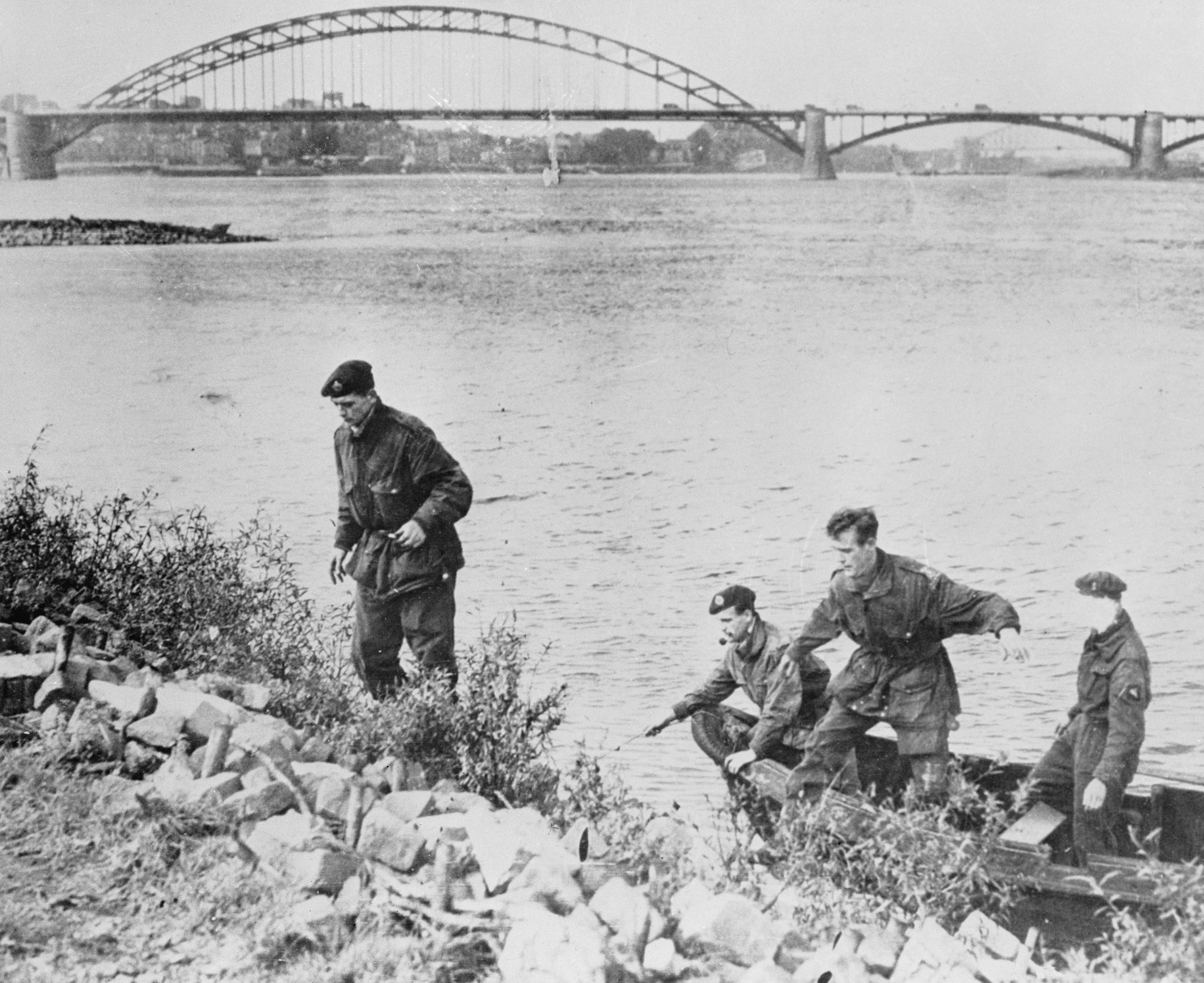
Although there were attempts to reinforce the division with units from the Polish Brigade and XXX Corps, they largely failed. Thus, high on casualties and low on everything required to sustain themselves, some four thousand British and Polish troops were evacuated across the Lower Rhine the night of September 25–26. Market Garden had come to an end.
There is no doubt that Operation Market Garden failed. No matter how close XXX Corps got to Arnhem, the British Second Army did not cross its bridge over the Rhine, and the war in Europe continued into 1945. There were some remarkably courageous acts by units and individuals: indeed, five Victoria Crosses and two Medals of Honor were later awarded. But many argued then and since that all that courage was in vain. When one equates the ground taken (a vulnerable finger pointing toward the Lower Rhine) to the cost (nearly eleven thousand airborne casualties and more than five thousand ground casualties), the outcome of Market Garden looks abject.
“Through inappropriate risk-taking, underestimation of the enemy, the neglect of unpalatable information and a failure of technology,” British author Norman Dixon wrote, “military decisions by able brains, at high levels of command, brought down misery and chaos.”
Such words raise the question of whether the operation should ever have been mounted. But the majority of the military hierarchy, as well as the airborne troops themselves, were willing and ready to take bold operational risks. With the Germans in retreat, September 1944 was just the time for a daring operation to bring down the final curtain. Gavin, for one, later reflected, “We knew that the risks were great, but we believed that the battle we were about to fight would lead to the battle that would bring the war to an end.” The British prime minister went further in the immediate aftermath of the operation: “The battle was a decided victory.…I have not been afflicted by any feelings of disappointment over this and am glad our commanders are capable of running this kind of risk.”
Churchill’s thoughts would be less cogent if the potential gains that a successful Market Garden offered had not been so great and the operation had not come so close to succeeding. Delays notwithstanding, XXX Corps was within just a few hours of linking up with the small airborne force holding out at Arnhem bridge. With a little more luck—better weather for example—the operation could have worked despite its planning weaknesses. In other words, the risk became “inappropriate” only in hindsight because Market Garden failed. However, neither Montgomery—who suggested that the operation was “90 per cent successful”—nor the British Official History viewed the operation as a disaster. The latter argued, “Operation Market Garden accomplished much of what it had been designed to accomplish. Nevertheless, by the merciless logic of war, Market Garden was a failure.”
Although these two sources are not without obvious bias, the venture did yield some tangible gains: the Germans, already severely weakened by the Soviets pushing in from the east, were in no position to absorb the eight thousand casualties and equipment losses they suffered as a result of the operation. Field Marshal Gerd von Rundstedt, the German commander in chief West, was prevented from using his forces to strengthen the defenses of their homeland against the Allies. Furthermore, the Germans never reclaimed the proportion of the Netherlands liberated up to the Waal, and that area subsequently became the springboard from which the final western offensive into Germany was launched.
Unfortunately, while Market Garden was a sensibly conceived scheme, the plan was ultimately flawed in too many ways. Warfare is an unforgiving business where mistakes can be cruelly punished; airborne warfare is particularly vulnerable to failure. Nevertheless, it is worth remembering the words of one veteran, Len Wright, who fought at Arnhem bridge: “We wanted and needed Market Garden in 1944. We knew that there were risks and were willing to take them. Now I know that there were more risks than we were told about back then—but we would have taken them nonetheless.”
This article was written by Lloyd Clark and originally published in the October 2007 issue of World War II Magazine. For more great articles, subscribe to World War II magazine today!