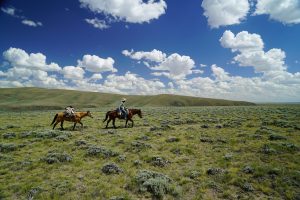

‘God’s Land, But No Man’s’ — that’s what the New York Sun called it, and for once an Eastern newspaperman got something right about the West. The writer was describing an ancient, hard, unforgiving land, domain of the terrible Comanche time out of mind. In winter, murderous northers howled down out of Kansas and Colorado to freeze men and animals. For the rest of the year the winds were generally southerly, ranging all the way from gentle breezes to shrieking gales that drove great clouds of dust before them.
The Santa Fe Trail passed through part of it, winding down out of Kansas, bound southwest for old Santa Fe. After statehood in 1907, the region began to be called the Oklahoma Panhandle. Today, it comprises the three busy agricultural counties of Cimarron, Beaver and Texas, but during the 1850s, ’60s, ’70s and ’80s, it had no government at all.
It formed a long, narrow rectangle, altogether about 5,700 square miles. Once this emptiness had been Spanish, split up into three massive land grants, and then it had been, in name at least, part of the Mexican province of Texas (Tejas). When the United States annexed Texas, prior to statehood, this northern strip was cut off to comply with the Slave State–Free State balance mandated by the Missouri Compromise.
The 37th parallel had been established as the southern boundary of Kansas and Colorado, but the northern frontier of Texas officially stopped at 36 degrees 30 seconds latitude. In between the two borders lay about 34 miles of space unassigned to anybody at all. To the east, the western line of the Cherokee Outlet was drawn at the 100th meridian, leaving a gap of just under 170 miles before you reached the New Mexico Territory line. In time, Congress officially referred to the area as the ‘Public Land Strip.’ Out West, though, men seldom called it anything but No Man’s Land.
The first Anglo occupiers were mostly cattlemen, tough, adventurous types willing to fight anybody for free grass and water. After the Civil War, they could push their herds northward into Kansas for shipment, and more cattle were driven north out of Texas, up the Jones-Plummer Trail from Tascosa and Mobeetie way. Where the trail crossed Beaver Creek (also called Beaver River), a man named Lane opened a ‘road ranch’ — a sort of store-saloon-campground — to service the great drives north. But the cattlemen soon had rivals for this big, empty country. After passage of the Homestead Act in 1862, No Man’s Land was surveyed and laid off into townships: The boundaries were marked with little domes of zinc, called ‘pot lines.’ Kansas newspapers published rhapsodic stories of new towns and free land; the embryonic town of Beaver City (which would become just Beaver) would be called the ‘new metropolis of the plains.’ Most of this stuff was pure moonshine, but it sounded good.
Settlement followed, land-hungry families looking for their own little place in the sun. Most of those places were not much to start with, either. Most folks lived in sod houses, for wood was hard to find on those wind-swept plains. The typical’soddie’ had turf walls about 2 feet thick, with a sod roof laid across timber rafters and a mat of green branches. There was a door, of course, or maybe two, and perhaps even a couple of inside walls to create separate rooms. There might or might not be windows, and if there were, their closures were likely to be wooden shutters, since glass was scarce and expensive. All around these isolated soddies lay the empty prairie. One settler built a tower, from which his wife could hang a lantern to guide him home across the emptiness.
At first there was much hard feeling between cattlemen and settlers. The range, once clear and open, was no longer so, and there was a good deal of fence-cutting and crops eaten and trampled by stock. On the other hand, many ‘nesters’ were not above supplementing their meager diet with beef, which often belonged to somebody else. Sometimes it came to shooting — nesters shooting intruding cows, cowboys shooting back, nesters returning the fire, and so on. In time, many ranchers would kill a beef on Saturday and share it with their nearest granger neighbors. A little at a time, most men found a way to live together.
Any collection of more than two buildings qualified as a town in No Man’s Land. ‘Most towns,’ according to one account, ‘were made up of three or four sod houses grouped around a larger sod structure housing a country stock of merchandise. [Only Beaver City] reached the dignity of a village…no more than six hundred … . Beaver was the only town in the Territory big enough to take sides in a controversy.’
Beaver was also a major collection point for much of the riffraff of the area. The same reporter, who had a certain gift for description, described the little town’s ‘floating’ population: ‘Floating is scarcely the word to describe the population temporarily there … . If they floated it was on a sea of alcohol. If they sailed or flew the breeze that wafted them on was heavy with the fumes of tobacco and the smoke of gunpowder. If they drifted they were stranded at the shortest of intervals on bars not built of sand.’
Most of the other hamlets were little more than wide spots in the road. Gate City, for example, boasted two stores, a blacksmith shop and a post office. Neutral City was about the same size, except for a bumper crop of saloons, and so was Hardesty. Many ‘cities,’ such as Optima, Grand Valley and Paladora, consisted of a post office and not much else. Carrizo was three saloons and a lunch counter. In the 1860s, William ‘Bud’ Coe’s gang of thieves was surprised there, taken while sleeping in an abandoned adobe. Eleven of them were supposedly hanged from the big cottonwoods along the riverbank behind Carrizo. Coe himself got away or wasn’t there; he got his cottonwood limb later, outside Pueblo, Colo., in 1868. Perhaps it was best that Carrizo’s first postmaster, George W. Hubbard, changed the town’s name in 1890 to Florence, in honor of his daughter. A nephew of P.T. Barnum, Fairchild B. Drew, then became postmaster, moved the post office to the east a bit and changed the name to Kenton.
Probably the worst of No Man’s Land’s towns was a woebegone settlement called ‘Old Sod Town,’ a refuse-littered dump of about a dozen sod buildings. It’s gone now — today, only the wind remains. But in its heyday it was a center for the moonshine trade and exported — illegally — a considerable amount of firewater across the line into the area of Indian Territory known as the Cherokee Outlet, or Cherokee Strip. Old Sod Town was also the center of operations for an outfit of horse thieves called the Chitwood Gang, who stole anything with four legs until a citizen blew a hole in one of the gang members and vigilantes ran the others out of the area.
Some ‘towns,’ announced with considerable fanfare, were chimeras, nothing more than a land speculator’s illusion. Such a place was Nevada, down on Duck Pond Creek, which turned out to be only a lot of fine words and a set of stakes laying out the town. A minister, reaching Nevada in 1886, found ‘not a living creature’ there.
Anything that passed for a settlement generally had at least one saloon. If it didn’t, you could get a drink at the store. The only exception, according to an old-time cowboy, was a one-horse place commonly called Slapout, so named because the storekeeper there was forever saying, ‘I’m sorry, but we’re slap out of that.’ On these rude oases the cowboys descended on payday, itching for excitement and sport. That sport generally took the form of filling up on tarantula juice and shooting up the town, not necessarily in that order.
Considering the uneven quality of some of the whiskey, peculiar results were not at all unusual. One ranch foreman, for example, became so spiflicated that his loyal crew tucked him away in a storeroom above the saloon to sleep it off. He appeared next morning a changed man, for he had awakened to find himself in a room full of coffins and was convinced that he had died and been resurrected.
Sometimes the merriment got a little grimmer, like the night long-haired Dick Davis arrived in Beaver from Tascosa, Texas, with a couple of dance hall queens. Davis took his stand at the bar to regale everybody with tales of his own magnificence. His bombast wore very thin very quickly. Somebody shouted, ‘Shoot the jaw!’ or something that sounded like that, and somebody did. A .45 slug broke Davis’ jawbones into dozens of pieces and blew out all his teeth but one. Mumbling ‘God, I’m shot!’ — a massive understatement — Dick Davis collapsed. A local doctor picked out all the fragments he could find — about 70 of them — and Davis survived to carry on a distinguished career as a claim jumper and horse thief.
The law didn’t care about Dick Davis getting shot, of course, because there wasn’t any law. Criminals simply went unpunished, unless an irate citizenry could organize in time to deal with them. One agonized parent, petitioning the U.S. Department of Justice, bitterly alleged, ‘My boy was killed in June, 1886, at Neutral City,’ and then went on to list seven more men killed and three badly wounded between that time and February 1887.
Neutral City was the scene of one young teamster’s startling introduction to No Man’s Land. Stopped in front of Bly’s general store after his long trip, the young man’s oxen promptly lay down, and the youngster himself was half asleep. Abruptly, Bly emerged from his emporium brandishing two shotguns and shouting: ‘Drive that team up a little! Drive that team up!’ And before the teamster could get his tired team on its feet and out of the way, Bly, safely barricaded behind slabs of dry-salted meat, began blazing away at some target across the street.
The storekeeper’s target was a cowboy called Boone, who was preparing to open a saloon on the other side of the street, an undertaking to which Bly objected. Boone, unpersuaded, returned the fire with his Winchester, while the teamster hugged the earth and wondered why he’d come to this benighted place. About a hundred rounds later, as the teamster told it, what passed for silence returned to Neutral City…with nobody hurt.
Some forms of relaxation were more civilized. Dances were held as often as anybody could find a reason, and people came from as far as 50 miles to attend. They were orderly affairs, mostly, in part because the only person allowed to carry a gun was the cloakroom attendant, whose job it was to collect everybody else’s hardware at the door. And, there being always more men than women, each man was issued a number as he came in the door. For each dance, the male dancers’ numbers were called off in strict rotation. That way, nobody got to dance more often than anybody else, removing another ground for potential trouble.
For all the growing pains, by the end of 1885 settlement was well-advanced, especially along the creeks flowing into Beaver Creek. Many of the settlers lived from hand to mouth and earned what ready cash they had by collecting buffalo bones from the thousands of carcasses left over from the great hunts. When the first settlers reached No Man’s Land, buffalo skeletons lay as thickly as 50 to a 100 within a few hundred yards. Mingled with them were acres of beef bones, a legacy from the terrible blizzard of 1886, which decimated the great cattle herds scattered across No Man’s Land. A ton of bones brought $8 to $10 in Dodge City, Kan., and horns brought even more money, since they were a favorite material for knife handles. Many a poor nester bought crucial groceries by harvesting bones and driving the long haul to Dodge.
Along with the hard-working nesters and cattlemen, large and small, came the grifters, the bullies and the thieves. In the northeast corner of No Man’s Land a couple of counterfeiters turned out bags of phony coins, most of which they circulated up in Kansas. If the law got too close north of the border, it was easy enough to find sanctuary down in No Man’s Land, where the writ of Kansas law did not run.
A persistent pest was a highly specialized breed of con man called the ‘road-trotter.’ These lowlifes filled their bellies by making specious claims on other people’s land, either occupying the claim in the owner’s absence or producing a forged instrument of title. They would generally go away if the owner bought them off, and they departed anyhow in most cases in which the owner cocked his shotgun.
Because No Man’s Land belonged to no governmental entity, there could be no law enforcement save what the people managed for themselves. In 1885 the United States Supreme Court ruled that the area was not part of the Cherokee Outlet to the east, as many had thought. The secretary of the interior opined only that the area was public domain, and therefore open to anybody to settle. And so the citizens handled their own law enforcement, either personally or by forming vigilante groups. In Beaver City, for example, when a drunk started to shoot up the town, endangering the families there, the citizens simply filled the offender full of holes and buried him without ceremony. There was no formal inquest, both because there was no formal authority to hold one and because nobody cared. The ancient Western defense of ‘he had it coming’ ran strong in this pioneer country.
People felt the same way about the case of a settler named Broadhurst whose wife was insulted by a neighbor. Once he heard of his neighbor’s transgression, Broadhurst saddled up, rode to his neighbor’s house and shot him down. His fellow citizens thought some formal gesture ought to be made, so they convened a home-grown court, presided over by a man who had once been a judge somewhere else. The verdict, predictably, was ‘not guilty.’ You did not insult a respectable woman; it was that simple. If you did, whatever you got you deserved.
In another case, a hoodlum saloonkeeper took umbrage at the town’s opposition to his watering hole and passed his time taking potshots at the soddies of those who opposed him. A storm of return fire extinguished the bully permanently, and an ad hoc court promptly exonerated the man who fired the fatal shot. Such summary justice had a couple of real virtues: It was dealt out by the people directly affected, and it was simple to administer. As one resident of No Man’s Land put it, ‘There were no court expenses, no long drawn-out trials; no delays; no appeals; no dockets; no paroles; no pardons.’ All that surely had its advantages, depending on which end of the law you were on.
The same rough justice was applied to a small group of men organized to jump as many claims as possible. Two of the gang came in second in a gunfight with some 100 citizens, who then loaded the surviving families into their wagons, complete with all their belongings. Git, said the citizens, the family members got, and justice was done again in No Man’s Land. Some of the area’s leading citizens also created an entity called the Respective Claims Board, in an effort to adjudicate disputed land titles and abate the nuisance of the road-trotters. The board’s authority depended mostly on the Winchesters of its own members, but in most cases that power sufficed.
It worked perfectly with another gang of road-trotters who got their comeuppance in Beaver in 1887. The worst of the bunch, a man named Thompson, had already tried to kill the locally elected marshal, Addison Mundell, and now was ordered by the Respective Claims Board to vacate a disputed claim. When Thompson arrogantly refused, Mundell and a posse set out for his dugout on the claim.
Spotting them from a boardinghouse window, Thompson shouted: ‘You thus-and-such, are you going to that claim? I’ll stop you now!’ He raised his Winchester, but Mundell was quicker, putting a bullet through Thompson’s knee. ‘I throwed my gun down,’ Mundell later said, ‘and pulled as a man would shoot a bow and arrow.’
Taking Thompson to his dugout, where the local sawbones amputated his ravaged leg, the posse now searched for Thompson’s confederates, Tracy and Bennett. Tracy had wisely departed the area at a high lope, but Bennett had stuck around too long. He was duly apprehended and led to the dugout. As he confronted his wounded cohort, the last sound he heard on earth was the cocking of many hammers. Bennett departed this life forthwith, and the posse immediately sent Thompson to join him. The matter was then closed with a coroner’s inquest, which opined as follows: ‘We the jury appointed to view the remains…find that they came to their death from gunshot wounds received at the hands of many law-abiding citizens, there inflicting, as nearly as possible, the extreme penalty of the law as it should be in such cases…their untimely end is but the result of their many wrongs.’
At least a couple of locals suggested that Mundell had dry-gulched Thompson, but the jury either didn’t believe them or didn’t care or both. It was sufficient to be rid of this arrogant pest. And that was that, except for the burying, at which the Rev. Overstreet preached appropriately: ‘Ye fools, when will ye be wise? And He shall bring upon them their own iniquity, and shall cut them off in their own wickedness … . ‘
Bennett and Thompson were not the only iniquitous residents to be cut off in their own wickedness. A hoodlum called Billy Olive — who lived, as the saying went, ‘with slight labor’ as a rustler — became much wroth when his paramour left him. He promptly shot up a saloon in Beaver, working on the false premise that Henderson, the bartender, had induced the lady’s departure. Olive and a partner, one ‘Lengthy’ Halford, pursued the bartender out the saloon door and into the street. Escaping when Olive’s rifle misfired, Henderson lay in wait for his tormentor behind a sod wall and drilled him dead center. Lengthy wisely departed in haste for safer climes, and public opinion exonerated Henderson without a hearing of any kind. And then there was the celebrated case of Doc Linley’s hat. Linley was a shady sort of feller with more than one wife, but he was a sartorial triumph, regularly sporting a Prince Albert coat and a shiny top hat. One evening in a saloon, a man called Brusher placed Doc’s fine hat on his own head. ‘Let me see how I will look with that thing on,’ he said. And he looked wonderful indeed, or at least he did until Clark, another celebrant, decided to demonstrate his keen eye by shooting the hat off Brusher’s head. Being somewhat pie-eyed, Clark sadly shot a trifle low, puncturing Brusher’s forehead instead of the hat.
The town mayor, all the law there was, fined Clark $25 for ‘criminal carelessness’ in handling his pistol. And that was an end to the matter, or it was until Brusher’s brother came to town. After hearing the evidence, the brother graciously announced that his sibling’s death was clearly accidental, and even had a drink with Clark. One drink followed another, merry as a wedding bell, until Brusher politely excused himself, went outside, then stuck his pistol through the saloon window and permanently ventilated Clark.
Similar rough justice pursued a No Man’s Land ruffian called Bill Bridgford. Riding along a road one day, Bridgford, from either malice or a warped sense of sport, fired a couple of shots over the head of a woman and her child traveling in a buggy. The lady’s vehicle upset, and she fled in terror with her child, much to Bridgford’s amusement.
He shouldn’t have laughed. That night in Neutral City, nemesis came looking for Bill Bridgford, in the person of the local vigilance committee. As Bridgford partook of strong spirits in a local saloon, the local enforcers summoned him to come forth and answer for his mistreatment of a lady. This failing, according to one account, ‘Some parties on the outside opened fire on the house, firing through the side on which there were no windows, thus placing the parties on the inside at a disadvantage.’
Bridgford was mortally wounded, an innocent cowboy patron got a slug in the arm, and Rockhold (or Rockford), the bartender, was hit twice. Boone, one of Bridgford’s disreputable partners, outside on the other side of the saloon, took flight and galloped into a barbed-wire fence, killing his horse and badly cutting himself.
The vigilantes burned down the ‘offending’ saloon, then ordered the surviving occupants of the bar to leave town, on the general ground of being found in noxious company. All obeyed but Rockhold, who not only stayed but also jumped another man’s claim. When his victim objected, Rockhold shot him, and that night the vigilantes saddled up again. They surrounded Rockhold’s soddy, but the bartender refused to emerge and killed one citizen who had just finished pouring kerosene on the building. In the ensuing fire and confusion, Rockhold escaped with only minor wounds, and he was never brought to justice this side of the pearly gates.
In time, most of the badmen went the way of Bridgford or Rockhold: dead or fled. One pair, who incautiously bragged that they intended to rob the big distillery on Hog Creek, were hanged by a vigilance committee before they could commit their crime, a sort of preventive medicine.
Others were summarily dealt with by people they tried to bully, to the satisfaction of the general citizenry. One such fellow was Bill Williams, the ‘Bad Man of Gate City’ (every little village had one). Williams had won a measure of dubious fame when he emerged from his shack, drunk, forgetting he had tied his half-broken horse to the building. As he tried to gallop off into the sunset, his horse remained attached to the shack and went berserk. The shack disintegrated, and Bill ended up south end first in a prickly-pear cactus. This disaster called for urgent surgery of the roughest frontier kind. Williams was stretched face down on the saloon bar, while the spines of the prickly pear were extracted from his posterior. He swore horribly as the citizens pulled slowly, pretending not to want to hurt him.
Not long after that, Williams, perhaps still smarting from prickly pear, decided to drink up most of Neutral City. For entertainment, he began firing over the heads of an inoffensive man and woman chopping wood. ‘Just watch how fast settlers can run,’ he said to a companion, and the terrified couple did indeed run. The man ran, however, even faster than Williams thought possible, collecting his shotgun and cutting through his cornfield to confront the Bad Man of Gate City farther down the trail. Astonished at finding the settler armed and angry, Williams reached for his pistol. He was too slow.
Another badman, returning drunk from Neutral City in the middle of the night, took a notion to shoot up a settler’s soddy. He and a companion galloped around the terrified granger’s shack, firing into the walls and windows. The granger was alone, and had only a muzzleloading shotgun and no shot, but he primed his ancient weapon and broke up a cast-iron teakettle into pieces small enough to cram down the bore. Then he turned loose both barrels, and when the smoke cleared, the local bully had ceased to breathe. His companion, bleeding, departed into the night, never to return. Like the demise of Bill Williams, the bully’s death seemed to follow from his sins like a rainbow from the rain.
For a while, a big-time criminal or two operated in No Man’s Land. Thomas ‘Black Jack’ Ketchum, the story goes, three times held up the railroad over in New Mexico Territory, then fled with his cohorts to the safety of Tug Toland’s ranch in No Man’s Land. Twice he and his men escaped unscathed, but the third holdup, on August 16, 1899, was a mistake. For this time the stalwart conductor, Frank E. Harrington, badly maimed Black Jack’s arm with a load of buckshot. As the engineer put it: ‘You said you were tired of having your train robbed. Now I believe you.’
Ketchum, tried in New Mexico Territory, departed this earth in memorable fashion. Facing the gallows, he called out: ‘I’ll be in hell before you start breakfast, boys! Let her rip!’ And they did, for somebody had miscalculated weights and measures, and the drop tore off the outlaw’s head. No Man’s Land would know him no more.
In addition to the general run of no-goods, No Man’s Land was amply supplied with liquor sellers and whores. There were a good many of the former, thanks in large measure to ax-wielding Carry Nation and her Anti-Saloon League. Carry’s depredations up in Kansas had pretty well dried up the Sunflower State, and the nearest place to get a legal drink for many Kansans was No Man’s Land. While moonshine did get imported into Kansas, much of it from No Man’s Land, drinking in the bunkhouse wasn’t nearly the same as pouring ’em down in a real saloon.
Liberal, just across the Kansas line, was an especially thirsty town. The Rock Island railhead reached Liberal in the spring of 1888, a stockyard appeared, and the cattlemen and cowboys followed. These men were given to celebrating in style, and to accommodate their taste for booze and other more intimate indoor sports, a little town popped up just over the border in No Man’s Land. It called itself Beer City.
Beer City actually bore the more respectable name of White City at first, since it was roofed mostly in canvas, but Beer City was obviously a more appropriate title, and the name stuck. There was nothing much in Beer City but saloons and dance halls. It never had a church or a school or even a post office. During the cattle-shipping season, itinerant prostitutes traveled to Beer City from Dodge City and Wichita. Many of the girls who staffed Beer City’s houses commuted from Liberal, traveling between the two towns in the daily horse-drawn hack.
Predictably known as the ‘Sodom and Gomorrah of the Plains,’ Beer City knew no holidays, for its business was constant merriment. The entrepreneurs who ran the Elephant, the Yellow Snake and the other saloons advertised their town as the only place ‘in the civilized world where there is absolutely no law.’ They staged dances, horse races, boxing and wrestling matches, and Wild West shows to keep their customers amused between drinks. Some of them even furnished ‘drunk pens,’ wire enclosures in which a sodden cowboy could sleep it off without getting rolled for any money he had left.
The town had other kinds of entertainment, too, much of it unplanned and violent. There was, for example, the day on which Pussy Cat Nell, madam of the house above the Yellow Snake Saloon, ushered town marshal Lew Bush into the next world with her shotgun. The cause of their falling out is not recorded, but there is no evidence that Pussy Cat Nell’s impulsive act was regarded as worthy of censure. Besides, she ran an essential service, and Marshal Bush had been rustling on the side.
Since Beer City and its competitors were a very long way from any kind of real distillery, and since cowboys seldom cared much what sort of booze they drank, the liquor supply, such as it was, tended to come from local sources. Thus the making of white lightning became a favorite — and semirespectable — occupation for a good many residents of No Man’s Land.
In addition to the little stills, producing more or less poisonous rotgut, there were several serious distilleries. One was run out of a cave covered by a lean-to soddy on Hog Creek, near Gate City, and operated night and day. Another, down on Clearwater Creek south of Beaver, produced a couple of barrels of ‘good whiskey’ each week. The best-known still was run by the man who would appear in 1888 as the first attorney general of an illusory Cimarron Territory. This still even boasted an expert distiller, imported from Kentucky, where folks were supposed to know about these things. Another artist boiled dried peaches and added the juice to his moonshine, producing what was described as ‘a beautiful, amber-colored and fancy-flavored drink.’
In time, enthusiastic residents of No Man’s Land formed a provisional government, as they called it. They had a great seal made and used it to fire off petitions to Washington, D.C., for territorial status. They grandly called their new land Cimarron Territory, in fact, in the forlorn hope that the name and their activity would move the Congress to favorably consider their ambitions. They sent a couple of competing representatives to Washington, too, and even found some allies in Congress, but the area would remain an orphan until the Oklahoma Organic Act of 1890 made it part of brand-new Oklahoma Territory.
That great day came too late for many residents of No Man’s Land, for the living was lonely and farming was a hardscrabble life. Wheat prices were not high enough to make much money, and the nearest railheads were still up in Kansas. There was a severe drought in 1888, and as a last straw the supply of beef and buffalo bones was nearly exhausted, and so too were buffalo and cow chips, the staple fuel. A mournful nester jingle went:
Pickin’ up bones to keep from starving, Pickin’ up chips to keep from freezing, Pickin’ up courage to keep from leaving, Way out West in No Man’s Land.
With most of the bones and chips gone, the courage of many citizens ran out. One family recalled planting 50 acres of corn and harvesting only enough roasting ears for a single meal. For a lot of hard-working settlers, the time had come to seek greener pastures. Some of the criminals drifted away, too; few people had any money, so crime didn’t pay at all well. Even the provisional government folded up. And so, when the Oklahoma lands to the east opened for settlement in 1889, many people pulled up stakes and joined the land rush. The population dropped from about 12,000 to under 3,000, and, as an old-timer put it, ‘We had to count in some prairie dogs and jack rabbits to get that number.’
Things began to look brighter once No Man’s Land became part of Oklahoma Territory. More people began to move in, and the strip got some real law. In addition to locally elected lawmen, the hard cases now had to contend with federal judges and tough deputy marshals. One of these marshals was the formidable Dane, Chris Madsen.
In Beaver City, district court was held in a room above a saloon, and on occasion the uproar downstairs interfered with the dignity of the proceedings upstairs. On one such day the judge turned quietly to Madsen, who was traveling with the court, and ordered him to abate the noise beneath. Downstairs, Madsen encountered three would-be badmen, who paid no attention to the Dane’s reasonable requests for a little peace and quiet. So Madsen turned to direct action, shooting one man through the hand and pistol-whipping the other two. ‘Jedge,’ said Madsen, returning to the courtroom, ‘Yo rebellion is oveh now. What disposition shall I make of the prisoners?’
Real law had come to No Man’s Land.
For more great articles be sure to subscribe to Wild West magazine today!