HistoryNet mastheadHistoryNetShop Summer Catalog

Oil War 1942

By Robert M. Citino | Front & Center  | Single Page  | 9 comments  | Print This Post  | Email This Post

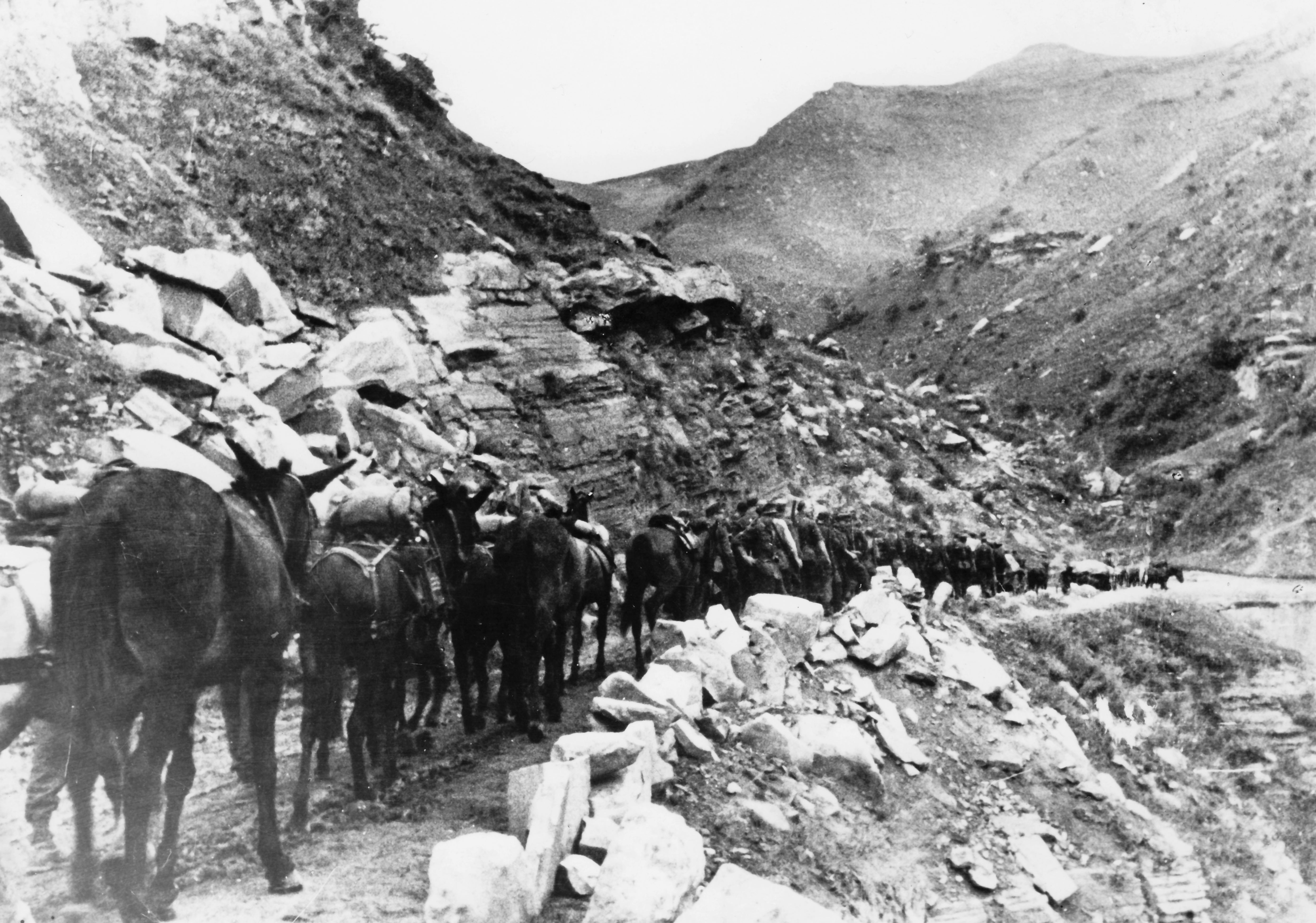
Sixty-seven years ago this month, two German spearheads were heading towards their respective rendezvous with destiny.  One, made up of the 6th Army, was driving on the key industrial city of Stalingrad against what was already some pretty stiff opposition.  It was slow going, made even slower by 6th Army's precarious supply situation and the caution of its commander, General Friedrich von Paulus.  The other, however, was a multi-army extravaganza–including the 1st and 4th Panzer Armies, the 17th Army, and the Romanian 3rd Army–that was hurtling forward at top speed, lunging deep into the Caucasus mountains.  Operation Edelweiss had already conquered one of the Soviet Union's three principal oil cities, Maikop, and the other two, Grozny and Baku, glittered on the far horizon.  The Soviets had done a pretty good job of wrecking Maikop before they left, true.  As distressing as that must have been to its new overlords, however, getting Maikop pumping again was an engineering problem, not some sort of mystery, and engineering had always been a German specialty.  Already the Panzers were concentrating on the Terek river, less than 100 miles from Grozny.

Subscribe Today

Subscribe to World War II magazine

The Germans still had a long way to go, but then again, they had already come pretty damn far.  The Wehrmacht had opened the campaign by crossing the Manych river and driving into Asia.  It was now campaigning on no fewer than three continents at the same time.  The Soviet defenders had not yet coalesced into any sort of coherent line, and the roads in the Caucasus were filled with columns moving south:  German Panzers, retreating Soviet columns, and the poignant site of 100,000s of civilian refugees crowding the roads, heading south and east.  Moreover, one entire German army had not yet even made its appearance in the theater.  Field Marshal Erich von Manstein's 11th Army was still in the Crimea, preparing to cross the Straits of Kerch.  A concentric drive by five armies would put immense pressure on the Soviet defenses in this isolated region, and might even overload them altogether.  The stakes were tremendous.  The Wehrmacht was always tough on the operational and tactical levels.  Seizure of some of the world's greatest oilfields might have been a solution to its principal strategic weakness:  supply and logistics.

Most historians have tended to treat the Caucasus operation as an inevitable failure, and have relegated it to the status of a footnote, a sideshow to Stalingrad.  It would be interesting to go back in time to mid-August 1942 and sample Soviet opinion on that point.

Tags: , , , ,

HistoryNet.com Subject Locator
  1. 9 Comments to “Oil War 1942”

  2. The supplies number were clearly tipped in favor of the Allies, between the British Empire, the U.S., and the Soviet Union. If Hitler focuses on the Caucasus, he gains resources, while removing the Soviets from the argument, thus being able to provide more support to the Japanese against the U.S.

    Of course hindsight is 20/20, and the only thing Stalin would want to keep more than the city that was his namesake, is the lifeblood that would keep it that way.

    By Tamahome Jenkins on Aug 18, 2009 at 10:44 am

  3. If Germany had focused on North Africa by way of Libya and Turkey, the oil fields of the mid-east would have been available; Egpyt and India out of the war and a link with Japan through Pakistan built. All of this without a Soviet invasion. Liebensarum was such a short sighted policy.

    By Sam Rankin on Aug 25, 2009 at 5:45 pm

  4. Yes, the last observator poses some reason!

    I inclusive aded why German strategist planified three moves related with this,but not implemented during 1941-42:

    *first German planing to reinforzed Italian Lybia
    *no named operation departed from Bulgaria for entering in Turkey and Palestina
    *no named plan from supposed conquest Egypt to Palestina
    *some anex operation from South Caucassus to Turkey and Persia

    among the German moves from Syria,Irak and secret operations in Persia and Afganistan.joining at this the German planning not only extended to Afganistan or East British India,inclusive are planned the total ocupation of West French Africa for reinforzed the future atlantic operations joining with Fall Felix,the occupation of Canary islands,Madeira,Azores and Cape Green archipielago.

    Proper Italy between your plannings projected the occupation of French Tunisia,Algeria and Morocco,Egypt,Anglo-Egyptian Sudan,british somalia and parts of british Kenia also

    Particulary the Adm.Raeder as favoured the North African and Middle East future moves and some Wehrmatch Luftwaffe and Schutz Staffel leaders also (in last case theirs organized the "Aegypt unit" for opered in recent ocupied Egypt)

    In same way some German diplomats and SS officers as meeting with some muslim leaders in area also.

    If certain why the Dessert Fox,Gen.Erwin Rommel can to seized Egyptian soil,from this land,no poses any heavy allied oposition in route to Middle East.your site are very similar toGreek Alexandros Ho Megas (Alexander the Great) in your conquest of Persian Achemenid Empire or the conquest dreams of Roman General Marcus Licinius Crasus and X legion,but equiped with tanks,moblie infantry,aviation and artillery.

    By Wladimir on Aug 27, 2009 at 12:40 pm

  5. I'll probably ask this question later this semester as well, but I'd like your thoughts on the caution of the German General von Paulus.

    Do you think that if a more aggressive commander, such as Erwin Rommel, could have taken Stalingrad at the same time with the same resources?

    It's good to hear a fresh perspective about this, as in my experience the only time we ever here about the importance of oil during WW2 is the effect it had on Japan, and the stunning last-gasp German attack in the Battle of the Bulge.

    Call it Western-centric history, but the Eastern Front is all too easily forgotten and stereotyped. Time to bring it back to the conversation and round out the views of WW2 with it in the frame.

    By Andrew Morris on Sep 11, 2009 at 3:56 pm

  6. Andrew–

    Tough call! The problems of 6th Army were not all due to Paulus. In fact, by July 26, 6th Army was dead in the water on the path to Stalingrad because of lack of fuel, not a lack of command aggressiveness. Now, I'll admit: once battle had been joined in the city itself, sure, it's possible to see a more aggressive German commander making more raid progress than Paulus did! But who really knows?

    By Rob Citino on Sep 11, 2009 at 6:12 pm

  7. It would also be interesting to know whether the Stalingrad/Caucasus operations would have succeeded, if the Germans had sent their reserves to that region, instead of wasting them in an attempt to defend Tunisia. At the end, approximately a quarter million troops were in Tunisia, and they were largely supplied by the Luftwaffe. Could that same force have been used to win the battle of Stalingrad?

    By Adam Rinkleff on Sep 13, 2009 at 1:15 pm

  8. Adam–

    A quarter of a million Germans? I was under the impression that was the total of ALL Axis forces in Tunisia: Germans and Italians together.

    But you're right in the general sense: you're fighting for your life along the Volga and you desperately need air transport, and you're wasting those transport assets in temporarily keeping alive an untenable bridgehead in Tunisia. It's hard to justify. Whether those transport aircraft would have helped the Germans "win the battle of Stalingrad" is still problematic to me.

    By Robert M. Citino on Sep 13, 2009 at 5:34 pm

  9. The Werhmacht’s need for oil is heavily discussed in the literature, and often sited for the failure of Operation Blue under the guise of further spreading scarce resources and stretching the Axis supply lines to the point of snapping, as well as a large player in the demise of the Axis overall. But have you considered the possibility that the German need for oil happened to be an ancillary goal/benefit of the drive on the Caucasus?
    Prima facie: a simple question. But turn the kaleidoscope slightly, and view it with an eye on the potential impact on the Soviet war machine. It becomes feasible that the Germans were not after the oil reserves of Maikop, Baku, etc as much as they were of trying to choke off the Soviet oil supply.
    The Soviets were cognizant that the German High Command had their cross hairs trained on the Caucasus for months. The refinery workers diaries detail the feverish pace demanded of them by the Red Army, drilling new wells and developing equivalent oil sources more interior, at times working the clock full round. They also detail that the Soviets practiced the strategic policy of “Scorched Earth” on the Baku, Grozny and Maikop wells. The Germans discovered this and expected more of the same as they penetrated farther. With this in mind, is it not possible that the Germans held to a strategic plan of depriving the Soviets of the lubricant of modern warfare, rather than seeking more oil for their own consumption? The deprivation would serve to grind the Soviet war machines to a halt, thus helping 6th Army in the taking of Stalingrad, and eventually ensuring a German victory.
    The German High Command did not all of the sudden become mindless with Operation Blue. The concurrent attack on the Soviet Oil fields and Stalingrad seem strategically sound when viewed without hindsight as our interpreter of the eventual outcome– without oil the Soviets could not fight.
    Hitler and the Generals were all steeped in the lessons of Napoleon's misstep in underestimating the tenacity and resolve of the Soviet people. Successful, the drive on the Caucasus would have functioned as a tidy tourniquet on the Soviet oil flow, and go a great distance to counterbalance Scorched Earth, national pride/honor, and Stalin's willingness to toss his own mother under an on coming tank.
    It is important to note that the Soviet’s were fully aware that the Romanian’s functioned as the major supplier in oiling Bewegungskrieg; there are dozens of mentions in period documents traversing the Stalin/Hitler diplomatic pipeline during the late 1930’s. Additionally, there is substantial documentary evidence that strongly argues that the Soviet’s could have captured Germany’s Romanian oil supply line on 22-26 June 1941, during the massive air and coastal bombings of Constanta, the Danube Delta, Bucharest, and yes, Ploiesti. The Soviets held reign, just as they did during Operation 60,000 (Apr-May 1944), never pressing their advantage, why is a question that perplexed both the German and Romanian High Commands.
    It should also be noted that once the Axis combined forces secured the Crimea and forced the Soviet’s back the German oil supply was secure: Ploiesti. Infrequent and small raids did occur on Ploiesti, but nothing that caused significant hindrance in quenching the thirst for oil by the beast of Blitzkrieg, until 1944. The point being, blaming the German thirst for oil as the reasoning for the failure of Blue and Stalingrad can be over simplification and selling the German High Command strategically short for the wrong reasons.

    By Lee on Sep 25, 2009 at 10:49 pm

  10. Lest we forget, the conflagration occurring on the other side of the world at the same time was provoked by another belligerent's fixation and desire for that ol' light sweet crude.

    By paul penrod on Feb 1, 2010 at 4:43 pm

Post a Comment

Please note that HistoryNet Staff cannot respond to requests for research of any type. Please visit our research forum to post research questions. If you have a question about our magazines, please use the contact us form.

Related Articles


SPONSORED SITES


HistoryNet Article Archives Historynet Spacer

HISTORYNET READERS' POLL

Given cultural differences and expanding populations, could European settlers and America’s native tribes poossibly have co-existed peacefully?

View Results | See previous polls

Loading ... Loading ...
STAY CONNECTED WITH US 
RSS Feed Daily Email Update
HistoryNet on Twitter HistoryNet RSS Feed

What is HistoryNet?

The HistoryNet.com is brought to you by the Weider History Group, the world's largest publisher of history magazines. HistoryNet.com contains daily features, photo galleries and over 5,000 articles originally published in our various magazines.

If you are interested in a specific history subject, try searching our archives, you are bound to find something to pique your interest.

 Get our RSS!
 Newsletter Signup

From Our Magazines

Weider History Group

Weider History Network:  HistoryNet | Armchair General | Great History | Achtung Panzer!
Today in History | Picture of the Day | Daily Quiz | Daily History Question

Copyright © 2010 Weider History Group. All rights reserved. Reproduction in whole or in part without permission is prohibited.
Contact Us | Advertise With Us | Subscription Help