
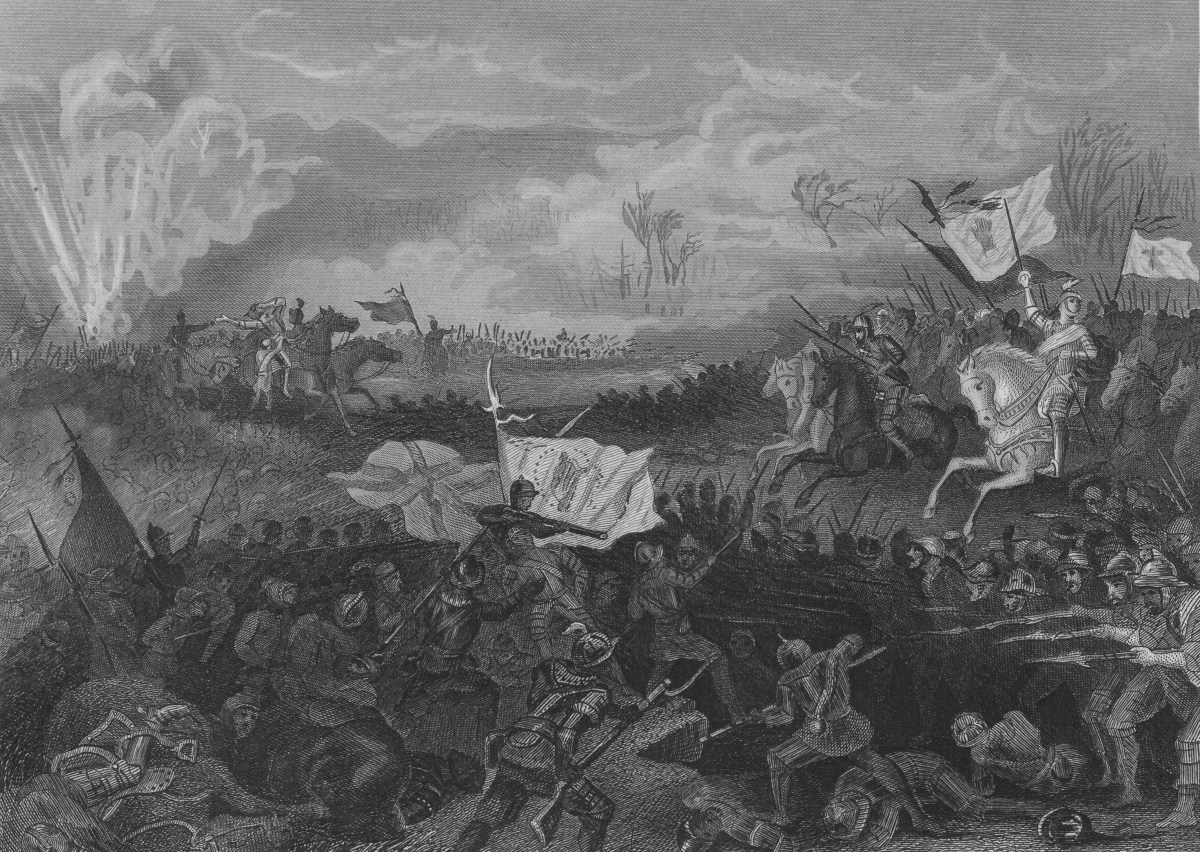
It was a shaken and demoralized English column that returned to its northern Irish base at Newry on the evening of May 28, 1595. On May 25, the 1,750-man force, under the command of Marshal Sir Henry Bagenal, had set out to resupply the besieged garrison at Monaghan castle some 20 miles to the west. Nominally, the Irish rebels investing the castle were led by Hugh Roe (or Red Hugh) O’Donnell, but rumor had it that they were actually being commanded by the Anglicized Irish lord on whom the English had counted to assist them against O’Donnell–Hugh O’Neill, the second Earl of Tyrone.
As early as February 16, O’Neill was reported to have aided the rebel followers of his bastard brother, Art MacBaron, in their successful storming of the English fort at the Blackwater River northwest of Newry. Bagenal’s suspicions about O’Neill were confirmed on May 25 when O’Neill rode up with a small troop of horsemen and began surveying the English camp at Ballymoyer, where Bagenal’s men were resting for the evening. Sir Edward York rode out of camp to parley with him, then returned to report that O’Neill had stated that by 10 the next morning, ‘it should be seen whether the Queen or they should be masters of the field and owners of Ulster.’
The English resumed their march toward Monaghan on the morning of May 26, but at Crossdall, just four miles from their destination, their vanguard came under attack by a large Irish force. Expecting the Irish to attack the rearmost division of his column, Bagenal had stayed at the back. Consequently, the officers in the vanguard did not know what to do until Captain Richard Cuney, commanding one of the two Staffordshire companies present, engaged the enemy with 150 musketeers and pikemen. In previous rebellions, such a show of force would have sufficed to scatter any Irish assault, but this time the 300 musket-armed Irishmen who lined up against the English were equally proficient in the use of their weapons. The Irish did not press their advantage, however, and Bagenal was able push on to Monaghan’s garrison, which he provided with supplies and a company of fresh troops.
When Bagenal’s force marched back to Newry on May 27, O’Neill ambushed it at Clontibret, near the border of Monaghan and Armagh counties. During the next seven or eight hours, the English were engaged in a running fight over 14 miles, but they ultimately managed to break out of the trap. Bagenal reported that the expedition had cost him a total of 43 men dead and 139 wounded, including Captain Cuney. Hugh O’Neill’s open defiance against the English at Clontibret escalated the rebellion in the province of Ulster into what the Irish would call the Nine Years’ War, a conflict that would engulf all of Ireland and affect its political and social structure to the present day.
Although England had long claimed Ireland for its own, actual control at the end of the 15th century was limited to the ‘Pale,’ an area not more than 20 miles in diameter around the city of Dublin in the eastern province of Leinster. For the English, only anarchy and barbarism lay beyond the Pale (thus the origin of the phrase). The majority of Ireland consisted of a patchwork of lordships ruled by a collection of Gaelic-Irish and Anglo-Irish dynasties, the latter being descendants of the original 12th-century Anglo-Norman invaders who had adopted Gaelic culture. Although they paid lip service to the government in Dublin and to the crown, the lords collected their own taxes, maintained their own courts of law and waged private wars with their own armies.
That state of affairs was not tolerated after 1485, when the Tudors ascended the English throne and sought unchallenged control over the British Isles. England’s adoption of Protestantism under King Henry VIII caused further alienation with the Gaelic-Irish and Anglo-Irish, who remained Catholic. The loss of England’s continental possessions after the Hundred Years’ War, combined with the discovery of America, shifted English attention westward, renewing interest in the acquisition of land in Ireland as well as the New World. English landlords made little distinction between native Irish and native Americans–both were regarded as’savages’ and a threat to be eliminated, either by being ‘civilized’ with English culture and Protestant religion, or by destruction. Both approaches were resisted by the Irish lords.
In Ulster, the Lord of Tyrone, Shane O’Neill, declared his open defiance of the English in 1561. In order to compete with the growing might of the government forces, Shane expanded the privilege of military service to include the peasantry, whom he equipped with firearms. It was not the English, however, but Hugh O’Donnell, a rival lord of neighboring Tyrconnell, who toppled Shane at the Battle of Farsetmore on May 8, 1567. Shane was subsequently killed on June 2 by the MacDonalds of Antrim, with whom he had hoped to find sanctuary, and his pickled head was delivered to the English viceroy, Sir Henry Sidney, in Dublin.
In Munster and the western province of Connacht, the Anglo-Irish Geraldine League declared their opposition to the government in 1569. Fighting continued until 1583, resulting in the devastation of most of southern Ireland. Hugh O’Neill served with the English army during those campaigns.
Born about 1545, Hugh Con O’Neill was the son of Matthew and grandson of Conn O’Neill. After his father was murdered by his uncle Shane O’Neill, Hugh was adopted by Giles Hovenden, an Englishman who farmed the property granted to Conn O’Neill’s sons at Balgriffen, near Dublin. Having been taught the English language and ‘civility’ by his foster parents, Hugh showed a preference for English dress and customs, and came to be regarded as a valuable ally by the officials in Dublin, who rewarded his loyalty by making him Earl of Tyrone. O’Neill, however, preferred the independence of an Irish lord to the limited power of an English puppet. In 1593, to the consternation of the English government in Dublin, Hugh accepted the traditional Gaelic title of The O’Neill from the people of Tyrone.
Sir Henry Bagenal was one of the earliest and most persistent doubters of O’Neill’s loyalty to the crown, so one can imagine his reaction upon learning that his sister, Mabel, had fallen for the Earl of Tyrone’s considerable charm. In August 1591, Mabel suddenly eloped with O’Neill, who had already had two wives–one he had divorced and the other had died. They were wed by Thomas Jones, Bishop of Meath, who later claimed to have performed the ceremony for the sake of the lady’s honor. One historian’s reference to Mabel as ‘the Helen of the Elizabethan wars’ may be excessive, but her brother made no secret of his distaste at being related through her marriage ‘with so traitorous a stock and kindred.’ By the time Mabel died in 1596, relations between Bagenal and O’Neill had developed into a full-fledged blood feud.
The two brothers-in-law had occasion to fight side by side on October 10, 1593, when their combined forces of 200 horse and 1,000 foot encountered 1,200 Irishmen, led by Hugh Maguire, holding a salient south of the Erne near Belleek. Using musketeers to cover their flanks, they mounted a well-coordinated assault across two fords and put Maguire to rout, with 300 Irish and only three Englishmen killed. Among the dozen English wounded was O’Neill, who took a spear in the thigh, but Bagenal tellingly omitted his brother-in-law’s contribution to victory in his report.
O’Neill’s loyalty was again put to the test when his son-in-law, Red Hugh O’Donnell, Lord of Tyrconnell, joined Maguire in the investment of Enniskillen castle in June 1594. Hugh O’Neill’s brother, Cormac MacBaron O’Neill, joined the rebels, along with 100 horsemen and 300 musketeers, but Hugh did not–most likely because he believed that O’Donnell was acting too soon. Nevertheless, on August 7, Maguire and Cormac O’Neill routed an English force that was marching to relieve Enniskillen’s garrison at the Arney Ford, which came to be known as the Ford of the Biscuits because of the English supplies that were scattered about after the fight.
The English ordered O’Neill to lead a punitive expedition against O’Donnell. He complied at a snail’s pace, while clandestinely continuing to build up his forces. As Queen Elizabeth I’s most loyal representative in Ulster, O’Neill had been granted the right to maintain 600 troops, trained by English officers in the most up-to-date military methods, including the use of the pike and matchlock firearms–lightweight calivers and heavier but more accurate muskets. By rotating trained men out of the group and raw recruits into it, O’Neill was able to train far more men than the 600 he had been allowed. With the soldiers organized into companies of 100 and armed with the latest weapons imported from Scotland or Spain–or smuggled from English ports–there was little to distinguish O’Neill’s troops from the English, aside from the bagpipes that accompanied them into battle.
By May 1595, O’Neill had recruited and trained some 1,000 cavalrymen, 1,000 pikemen and 4,000 musketeers, along with other troops armed with the more traditional weapons of sword, javelin, battle-ax and bow. At the Battle of Clontibret he finally declared his commitment to the Irish cause, and in June he was proclaimed a traitor. During the battle, O’Neill employed a strategy that he would soon use with greater success. By laying siege to English outposts beyond the Pale, he would compel the enemy to send relief columns to the isolated forts, and he could then am-bush those soldiers. Such guerrilla tactics were perfectly suited to 16th-century Ireland, a land that was still covered by thick forests and numerous bogs.
O’Neill’s strategy was based on lessons learned from previous Irish rebellions. There were essentially only three routes by land into Ulster–along the east coast through Moyry Pass (beyond which lay the English base at Newry), in the center at Enniskillen and along the west coast at the Ford of Ballyshannon. Mindful of the internecine divisions that had led to Shane O’Neill’s downfall, Hugh employed considerable dip-lomatic skill to form a strong coalition of Irish leaders in Ulster and beyond. O’Neill hoped that by exhausting England’s resolve he could gain a negotiated settlement that would leave his power in Ulster intact.
In the early summer of 1595, the O’Donnells captured Sligo, securing the southwest approach to Ulster. The English garrisoned the ruins of Armagh Cathedral, northwest of Newry. O’Neill tore down his castle at Dungannon, thereby eliminating it as a worthwhile objective for the English, and distributed its contents among Tyrone’s crannogs–small, fortified artificial islands. In June, the English lord deputy of Ireland, Sir William Russell, and Sir John Norris, the new commander in Ulster, led a large force to the Blackwater River but then thought better of trying to cross it. The English failed to subdue southwest Ulster and Connacht and had to accept the loss of Sligo.
Russell was only too glad when the Irish agreed to a truce in southeast Ulster, which lasted until the summer of 1597. During that time, however, the English were alarmed to learn that a priest named Piers O’Cullen of Clogher had sailed to Spain, bearing a letter dated September 19 and signed by O’Neill and O’Donnell. The letter beseeched the Spanish king to send 2,000 to 3,000 men, along with arms and money, to Ireland ‘to restore the faith of the [Catholic] Church and so secure you a kingdom.’ By seeking aid from England’s principal rival, the Irish coalition was raising the stakes of the war.
Russell led a lightning raid into Wicklow in the spring of 1597 and returned with the head of Feagh McHugh O’Byrne, a prominent rebel leader. In May, however, Russell was replaced as deputy by Thomas Lord Burgh, who proposed a somewhat grandiose plan in which his forces would converge with those of Sir Conyers Clifford, the governor of Connacht, deep inside Ulster at Lough Foyle. Marching swiftly from Newry, Burgh’s 3,500-man column reached the Blackwater and overran an earthwork on the north bank on July 14. O’Neill’s main forces blocked any further English advance, and Burgh settled on building a new Blackwater fort to replace one that O’Neill had destroyed in 1595.
Meanwhile, Clifford and about 1,200 troops had retaken Sligo, forced their way across the Erne River and reached Ashroe Abbey on July 30. Three miles away lay Ballyshannon Castle, but before Clifford could assault it, he learned on August 1 that Burgh, contrary to his original plan to meet Clifford at Lough Foyle, was retiring to Newry. Furthermore, Cormac O’Neill was leading 1,000 Irishmen to relieve O’Donnell while Hugh Maguire and Brian O’Rourke were crossing the Erne to cut off the English. Clifford prudently retired, but not without enduring a reprise of the running battle of Clontibret, in which his column moved eight miles in six hours, fighting all the way. The English gunpowder ran out, but Clifford’s pikemen managed to fend off attacks from both sides and reach Connacht on August 2. In a chivalrous salute to their opponents, the Irish dubbed the part of the Erne that Clifford’s men crossed Casan-na-gCuradh–the Ford of Heroes.
Burgh’s success had been strictly temporary, but he held high hopes that the resurrected Blackwater fort, with its 150-man garrison under the command of Welsh Captain Thomas Williams, would be the linchpin of ultimate victory. On October 2, O’Neill’s men assaulted the earthworks with scaling ladders, only to be repulsed by the defenders, whose arsenal included two robinets (light field guns) and two arquebuses-à-croc. Then on October 13 Burgh died of the ‘Irish ague’ (typhus), as had so many of England’s troops stationed in Ireland. O’Neill, who later admitted to Williams that he had lost 400 men in his attempts to storm the fort, made no further assaults but kept it under a close blockade. The garrison had to fight to obtain firewood or water from the surrounding area, and by November its supplies of beef and biscuit were running dangerously short.
After Burgh’s death, command of the English forces fell to Thomas Butler, Earl of Ormonde. Believing that time was on his side, O’Neill negotiated another truce, during which Ormonde expressed regret that ‘the scurvey fort at Blackwater’ had ever been built. Isolated and requiring an army for its maintenance, the outpost that the late Lord Burgh had conceived as ‘an eyesore in the heart of Tyrone’s country’ was proving to be only an expensive liability.
As the truce reached its end in June 1598, Queen Elizabeth’s Irish Council considered abandoning the fort but was concerned that the consequent loss of face would encourage O’Neill, who reportedly was preparing to threaten the Pale itself. On August 2, 1,400 reinforcements landed in Dublin, and Bagenal offered to command any column that was sent to the Blackwater. After debating the matter, the government decided in favor of a relief expedition.
Bagenal was an experienced, courageous soldier who had considerable knowledge of the area. His principal weakness, already demonstrated at Clontibret, was a tendency to let his divisions become too widely separated and thus lose overall control, which Ormonde later stated was a danger ‘whereof I often warned the Marshal to take special care before he went hence.’
Bagenal’s relief force amounted to a large army for the time and place in which it was mustered–3,901 foot soldiers, as well as 320 horse, who were ‘old’ (experienced) troops. About a quarter of his 40 infantry companies had seen combat, including four that had campaigned in Picardy before arriving at Waterford in March. As many as half of his men were Irish–indeed, roughly three-quarters of the queen’s troops in Ireland in June 1598 were said to be Irish. The rest were levies or conscripts from the English shires, and some 1,500 were recruits who had landed late in July, only partly trained and poorly disciplined. The force had four cannons, the largest of which was a saker, smaller than a 6-pounder.
After assembling at Ardee on August 7, Bagenal’s force marched through Armagh on the 13th and camped on the right bank of the Callan River. When the advance was resumed the next morning, the troops were only about 41/2 miles from the Blackwater. Bagenal was aware that O’Neill would be waiting for him somewhere along the way and sought to avoid the most likely ambush points by plotting his route of march away from the highway. The country beyond Armagh was an area of small, wooded hills, falling away gradually toward the Blackwater in the north. There were boggy areas, but Bagenal expected his troops to lay down boughs and sticks to render those spots passable for artillery, horses and pack transport as they advanced. Charles Montague, then a captain in the column, described the route as ‘hard and hilly ground, within a caliver shot of wood and bog on both sides, which was wholly possessed by the enemy continually playing upon us.’
The column traveled above the Callan for a stretch, then crossed the stream and went over what survivors described as the first hill, continuing on to boggy ground and the Yellow Ford. After that, the route ascended to the second hill, then down to a field of green corn surrounded by more bogs and finally up to higher ground, the third hill, where the Irish had constructed a breastwork. The dangerous places were the Yellow Ford itself (which at that time probably crossed a brackish, discolored stream that oozed from the Callan) and the cornfield and bogs between the second and third hills.
Bagenal had broken his infantry down into 500-man regiments, with the cavalry, guns and supply transports moving between those units. The whole column stretched about a mile from front to rear in the standard arrangement for an army on the march–vanguard, main battle and rear guard. Unlike at the Battle of Clontibret, the marshal commanded the vanguard units himself. In front of them, two wings of musketeers were detached from the vanguard’s first regiment to form an advance guard, or ‘forlorn hope’ as it was called at the time, commanded by Sir Richard Percy, the Earl of Northumberland’s brother.
O’Neill’s and O’Donnell’s combined forces totaled about 4,050 foot soldiers and 600 horsemen, who, while not as well-equipped as the English, had greater mobility. O’Neill also possessed an even greater advantage–the initiative. While Bagenal had to place priority on reaching and relieving the Blackwater fort, the Earl of Tyrone could attack when and where he pleased. Anticipating the enemy’s most likely route, he had also prepared the ground in advance, having his men weave undergrowth and brushwood to form living fences and dig pits to impede the cavalry. The boggy land between the second and third hills was linked by a trench, about 5 feet deep and 4 feet wide, with a thorny hedge on the far side.
Half a mile from his camp, at about 8:30 a.m., Bagenal’s vanguard came under attack on both sides by a force led by O’Neill’s nephew, Brian McArt, and Randal MacSorley MacDonald of Antrim. The Irish used the same tactics they had at Clontibret, but by now they had perfected them. O’Neill’s musketeers and horsemen, generally keeping a stretch of boggy ground between themselves and the English to hinder their cavalry, alternately pursued and attacked the left flanks of Bagenal’s units as they advanced. At the same time, O’Donnell led a force around the right of the column, his gunners finding some shelter in a forest and thickets as his men, too, harassed the English.
Bagenal’s troops had a shorter distance to cover than at Clontibret, but their hopes of quickly reaching the fort’s relative safety were frustrated by the marshy ground and delays caused by a seemingly unceasing series of hit-and-run assaults by the Irish. A more dangerous result of the harassing attacks was that intervals between the regiments widened, making it difficult for them to support each other. Soon the battle developed into three separate conflicts.
Although compelled to stop several times to fight off Irish attacks, Percy’s advance guard eventually reached the second hill. There, he waited for the marshal’s vanguard to come up–until continuing pressure from O’Neill’s skirmishers and exposure to Irish musket fire compelled him to push on. Although one of his captains and many of his troops were killed, Percy managed to cross the trench and reached the third hill, where he again halted to ‘maintain skirmish.’
From there, the English could see the Blackwater fort. Upon spotting Percy’s colors, Williams’ troops reportedly ‘threw up their caps for joy, hoping to have a better supper than the dinner they had had that day.’ Some of the garrison marched out to meet the relief force, but at least 500 Irishmen were ready to bar their progress, and thousands more were no doubt concealed in the woods.
After a long interval, Bagenal’s part of the vanguard, with some cavalrymen, fought its way to the second hill. Colonel Henry Cosby–commanding the first regiment of the main battle–followed, but the terrain prevented Bagenal from seeing him. Even farther back, the second regiment, under Sir Thomas Maria Wingfield, was hindered by the saker, which kept sinking in the boggy ground. At the ford itself, the gun became stuck fast, and it seemed as if the men and oxen would be unable to extricate it.
At that point, Wingfield heard heavy firing behind him and became increasingly anxious. The rear of the column, under Colonel Richard Billings, was engaged, but all that Wingfield could see behind him were O’Neill’s and O’Donnell’s troops. Riding up to join Bagenal, he proposed that Bagenal withdraw the vanguard to hold the ford, while Wingfield himself went back ‘to fetch off the rear.’ Such a move, if still possible, would concentrate the marshal’s forces for a major effort to reach the fort. Before approving the plan, however, Bagenal wanted to see things for himself. After dispatching an order to Percy to retire to the second hill, Bagenal rode back with Wingfield and found that his troops, through a seemingly superhuman effort, had succeeded in pulling the saker out of the ford. There was still no sign of the rearmost regiment, however, and the two senior officers rode back to the second hill to find out whether Percy had obeyed his orders and was coming back. He was not.
Wingfield then left Bagenal to rejoin his regiment at the ford. He found his troops pinned down but was relieved to see Billings’ rear guard coming up. Meanwhile, Percy was trying to disengage and join Bagenal. ‘Our retreat,’ Percy later said, ‘was more in disorder than our going on, because our loose wings, having spent their powder coming in, gave way to the enemy, being both horse and foot, to charge us in the rear, which our new men quitted, and threw away their arms.’
In the meantime, Bagenal’s vanguard had thrown back its Irish assailants, and determined to press on, the marshal ordered his men to advance down the second hill toward the trench. As his troops moved forward, Bagenal raised his visor to get a better view of the situation. At that instant, a musket ball shattered his face, killing him instantly.
The exclamations of Bagenal’s horrified troops could be heard by Percy’s men just as they were fighting their way back to the trench. Upon hearing the news, Percy said, the soldiers were’so dismayed that from retiring they began to fall into a rout.’ Percy himself was stunned when a ball struck his breastplate, but his Irish horse boy pulled him to his feet and led him to safety. Few others of his detachment were so fortunate. Percy’s Welsh ensign, Evan Owen, broke his flag staff in two, wrapped Percy’s silver crescent-decked banner around his body and defended it until hacked to pieces by the Irish.
Other than its effect on English and Irish morale, Bagenal’s death made little difference at that point–he had lost control of the battle long before. Upon learning of the marshal’s demise, Wingfield assumed command, and he and Colonel Richard Cuney, the next in rank, decided to return to Armagh. The infantry lines were starting to break up and the horse, Wingfield noted, could find ‘no going where the rebels stood, by reason of a main bog.’ The saker had again become stuck; a wheel of its carriage had broken, and Irish musket fire had cut down the oxen that towed it. On top of all that, a careless English musketeer, who was replenishing his flask of powder from an open barrel, touched it with his lighted match. Not only was that barrel blown up but also a second, which, as a report later noted,’spoiled many men and disordered the battle.’
By then Wingfield’s regiment had advanced toward the second hill and Cuney’s and Billings’ men had passed the Yellow Ford, but the situation was critical. Billings reported that ‘the enemy charged us with horse and foot, to the number of two thousand foot and four hundred horse, having long entertained skirmish and by reason of the great number of the enemy’s shot and horse coming so near and fast upon us, we were forced four or five several times to charge with our colours in the head of the pikes.’ His musket and caliver men had used up almost all of their ammunition, and the newer recruits were panicking.
While Cuney and Billings prepared to retire toward Armagh, Wingfield rode up to Cosby’s regiment and ordered him to ‘maintain the rear’–that is, gather whatever remained of the forlorn hope and the vanguard, then join the retreat. After Bagenal’s death, the vanguard, led by Captain Evans, continued to advance beyond the trench but was ultimately beaten back. Cosby, who by then had reached the top of the second hill, led his men forward–whether to rescue the survivors of the former vanguard or because Blackwater fort was closer than Armagh is not known. In any event, he did not get far before his men, too, broke under the fury of the Irish onslaught. Evans was killed and Cosby taken prisoner. Percy and the survivors of his detachment escaped with the help of English cavalry, commanded by Colonel Calisthenes Brooke.
It was now early afternoon. Four hours after the fighting had begun, Cuney and Billings were retiring, joined by fugitives from the van who carried their wounded and the body of their slain marshal while cavalry screened the withdrawal. As they neared the ford, the troops saw O’Neill’s horsemen and infantrymen brandishing the banners they had taken from the routed vanguard and rushing to cut them off. Billings’ troops, however, won the race to the ford and held it.
Wingfield, meanwhile, had learned of Cosby’s disobedience to orders and went back after him, accompanied by some of Cuney’s infantry and a squadron of horse, now led by Captain Montague because Brooke had been wounded. In a spirited action, Wingfield’s scratch force managed to recover another 500 men and a number of colors from the routed vanguard. He then joined Cuney and resumed the retreat, with Montague’s cavalry providing flank protection. The saker had to be abandoned, along with large quantities of supplies, arms and ammunition, but Billings’ regiment saved the three smaller guns and used them to scatter a group of O’Neill’s horsemen who tried to cut them off from Armagh. That skirmish brought the Battle of the Yellow Ford to an end, as O’Neill and O’Donnell called off any further attacks.
In the course of the afternoon, some 2,000 exhausted English soldiers marched or straggled into Armagh and did what they could to fortify themselves in the cathedral and amid the surrounding ruins. Half of the cavalrymen subsequently rode to Dublin. They were expecting the Irish to follow up their success with more attacks, but none came.
As it was, Hugh O’Neill had inflicted the worst defeat ever suffered by an English army at Irish hands on Irish soil. The English had lost 25 to 30 officers, more than 800 men killed and about 400 wounded. More than 300 of Bagenal’s Irish troops deserted to O’Neill–including two Englishmen, who later stated that O’Neill paid them a 20-shilling bounty for switching sides–and many others fled and were written off as missing. Eleven colors were lost during the battle. The Irish estimated their casualties at about 200 killed and 600 wounded.
Ormonde, whom the queen chided for not having led the expedition himself, condemned Bagenal and his officers for ‘marching so far asunder.’ The recruits, he added, ‘came away most cowardly, casting from them their armour and weapons as soon as the rebels charged them.’ In all fairness, the regular English troops and cavalry had fought well as a whole–if they had not, there might not have been any survivors at all. But O’Neill and O’Donnell had dominated the battlefield, and their well-handled warriors had responded to their leadership with unprecedented precision. As one English officer grudgingly acknowledged, ‘The Irish are most ready, well disciplined, and as good marksmen as France, Flanders or Spain can show.’
The most direct result of the costly Battle of the Yellow Ford–which had come about from the English insistence on saving face and maintaining their untenable Blackwater fort–was the loss of face and the fort. Captain Williams’ position was hopeless, but his stout defense of the fort against earlier assaults may explain the remarkably generous terms offered by O’Neill, who was evidently eager to conclude the siege as quickly as possible. The fort’s garrison would be able march out unmolested, leaving behind their colors, drums and ammunition, to join the English army at Armagh. The whole force would then march southeast to Dundalk with all it could carry.
The English accepted those terms immediately, although their army stopped at Newry instead, probably because they were uneasy about marching through narrow Moyry Pass en route to Dundalk. O’Neill did not press the matter, in spite of his followers’ insistence that the English be cut off and destroyed. For one thing, he was eager to march on to Lough Foyle, where he expected the English to land a new army. He was correct in believing that the English had been planning such a landing, but unaware that his victory at the Yellow Ford had led to its cancellation.
Along with ensuring the Irish coalition’s control over Ulster, O’Donnell was able to extend his control to the province of Connacht. Further afield, Owen MacRory O’Moore and Richard Tyrrell, O’Neill’s best field commander, led 2,000 men into Munster, torturing and killing any loyalists they could catch.
The ultimate result of the Battle of the Yellow Ford was the expansion of the Nine Years’ War from a conflict fought largely in Ulster to a struggle against English control throughout Ireland as a whole. Although O’Neill seldom offered a pitched battle when faced by veteran campaigners like Ormonde, his guerrilla tactics wore down the English expeditions sent after him. Among the most humiliating defeats was when the queen’s current favorite, Robert Devereux, Earl of Essex, led more than 12,000 troops against O’Neill on July 25, 1599, and ended up negotiating a private six-week truce with him on September 7.
The English finally found a commander capable of subduing the Irish in Charles Blount, Lord Mountjoy, but on September 21, 1601, Spain belatedly entered the struggle when 3,800 infantrymen under Don Juan del Aguila landed at Kinsale. Moving swiftly, Mountjoy laid siege to Kinsale, which in turn drew O’Neill and O’Donnell out as they moved to link up with their Spanish allies. The result, on December 24, was the decisive battle for which the English had yearned for so long, with O’Neill–perhaps a bit overconfidently–deploying his troops in Spanish-style tercio formations of pike and shot. The Irishmen were far from familiar with both the territory and the tactics, however, and in the end Mountjoy’s veterans routed them, inflicting 2,000 casualties. Red Hugh O’Donnell fled Ireland to solicit further help in Spain, only to die there soon after.
The Spanish at Kinsale capitulated on January 2, 1602, and were allowed to depart with their colors and guns. They had never effectively supported the Irish. O’Neill fought on until he was finally compelled to surrender on March 30, 1603. Queen Elizabeth had died six days earlier, bringing the Tudor dynasty to an end, but her Stuart successor, King James I (James VI of Scotland), continued to enforce English control over Ireland.
Nominally, O’Neill and the other Irish leaders were allowed to retain their positions in Ulster, but on September 4, 1607, they took ship for the continent when threatened by an English plot, an event known as ‘The Flight of the Earls.’ Hugh O’Neill died in Rome in 1616. His lands and those of his fellow exiles were confiscated and divided into plantations for Scottish and English Protestants. Tragically, the ultimate legacy of O’Neill’s defeat would be centuries of violent struggle in Northern Ireland between the descendants of his native Catholic followers and the descendants of the Protestant settlers–a state of affairs for which only in recent months, nearly 400 years later, ongoing peace negotiations offer some prospect of a peaceful end.
This article was written by Jon Guttman and originally published in the August 1998 issue of Military History magazine. For more great articles be sure to subscribe to Military History magazine today!