
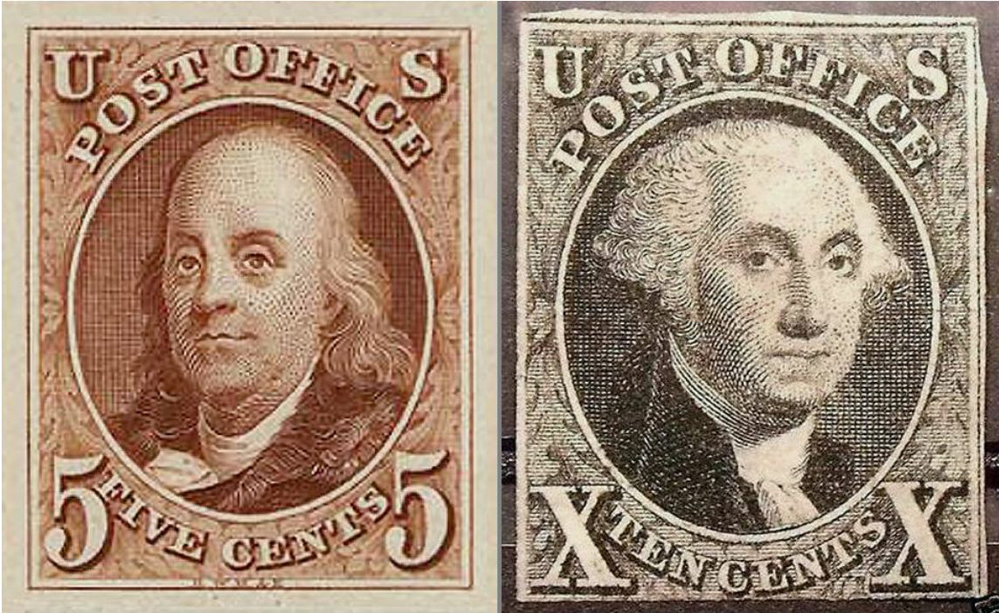
The hobby that attracts more Americans with a collector’s instinct than any other owes a debt of gratitude to Postmaster General Cave Johnson, who urged Congress to authorize the use of stamps as a system of postage prepayment, as the British had been doing since 1840. On March 3, 1847, President James K. Polk signed into law a bill that authorized the printing of stamps, which, “when attached to any letter or packet,” would indicate that the sender had paid the necessary postal charges. The first two U. S. stamps printed were a five-cent version bearing the likeness of Benjamin Franklin and one for 10 cents with George Washington’s image.
Americans did not immediately take to the new postage stamps, the use of which was not compulsory. Some postmasters resisted the new system. They had been content with the hand-stamping that had been customary since 1772 or with stamps–known as “postmaster provisionals”–that were paid for out of individual postmasters’ budgets. This resistance continued for almost a decade after the first stamps were issued, until the federal government finally decreed that mandatory prepayment and the use of postage stamps for mailing would take effect on January 1, 1856.
The federal government’s Bureau of Engraving and Printing took over the printing of stamps in 1894, at a great savings over the previous system of private printing. Until then, stamps were considered strictly utilitarian and featured the likenesses of presidents or the Founding Fathers. But when someone realized that the stamps could be used as promotional tools, the Post Office Department issued the first commemorative stamps, mostly to call attention to international fairs and exhibitions. Gradually, public interest in such stamps grew, resulting in the wide variety of commemoratives, such as the new series on the history of aviation, that now provide the U.S. Postal Service with an important source of revenue.