They flew their rickety aircraft within a few feet of the ground, looped them again and again in dangerous maneuvers and roared earthward in seemingly suicidal dives, pulling out at the very last minute. Some clambered out onto the wings thousands of feet above the ground to do handstands, swung from ropes to transfer from one plane to another, or hung suspended from the struts of their aircraft and dropped onto other vehicles — planes, speeding boats or automobiles. These were the danger-loving fliers of aviation’s early days, widely known as barnstormers.
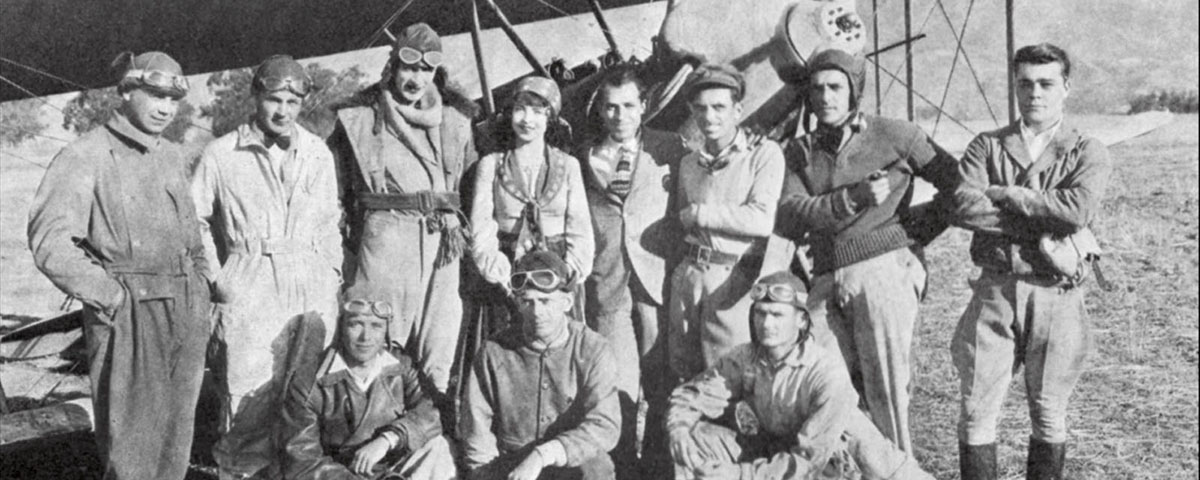
In the aftermath of World War I, a select group of these daredevils found new audiences, performing their stunts in the silent feature films and serials that proliferated throughout the 1920s. The novelty of flying was highly appealing to film producers, and audiences of the day were fascinated by this new technology and its ever-present dangers. An elite group of pilots would gain fame from their cinematic exploits. Dick Kerwood, Al Wilson, Frank Tomick, Ormer Locklear and Dick Grace all started out performing their stunts on the county fair circuit — until the movie industry made them famous. Sadly, the breathtaking stunts that wowed movie audiences also claimed the lives of many skilled aviators during those heady years. It was no wonder that stunt pilots became known as the ‘Squadron of Death.’
Efforts to make the stunts appear more realistic onscreen often led to some unintended consequences. Joe Bonomo, who did many parachute jumps in his career, described one scene that almost resulted in his drowning when he bailed out of a plane over water. He and another performer were supposed to leap from an aircraft with only one parachute, but when no other stunter would agree to jump with him, he decided to use a dummy — which proved to be a wise decision.
When Bonomo hit the water after the jump, the wind was blowing violently and his parachute was pulled through the water like a sail at a rapid clip. Using the dummy as both life preserver and shield (to block the water hitting his face), Bonomo managed to stay conscious. It was almost half an hour before a speedboat finally arrived to pick him up. Bonomo later quipped, ‘I’m probably the only man in the world who owes his life to a dummy.’
Such quick thinking under pressure was common among stunt pilots — and many would owe their lives to it. Ormer Locklear had built a reputation as a fearless flier long before he started stunt-flying, while he was serving as an instructor for the U.S. Army Air Service. When the radiator cap blew off his aircraft during a training flight, for example, he casually climbed out and stuffed a rag in the opening to prevent boiling water from blowing back into the cockpit. In 1919, while performing at a carnival, he made what may have been the first public transfer from one plane to another in midair. It was at such carnivals and fairs that Locklear pioneered many of the eye-popping stunts other wing-walkers would copy in the years to come.
Locklear eventually made his way to Hollywood. One of his first films was The Great Air Robbery, which enabled him to perform many of his signature moves. In one scene he changed planes in midair, and in a later sequence he climbed down from a plane to a speeding car, fought with the villain, then grabbed the undercarriage of the plane above him and climbed back into it just as the car overturned and crashed.
In 1920 Locklear and his friend and pilot Milton ‘Skeets’ Elliott were hired by producer William Fox to do aerial scenes for the film The Skywayman. Locklear performed a variety of hair-raising stunts for that movie, including a train-to-plane transfer and wing-walking. He even performed at night — rare at the time — illuminated by searchlights.
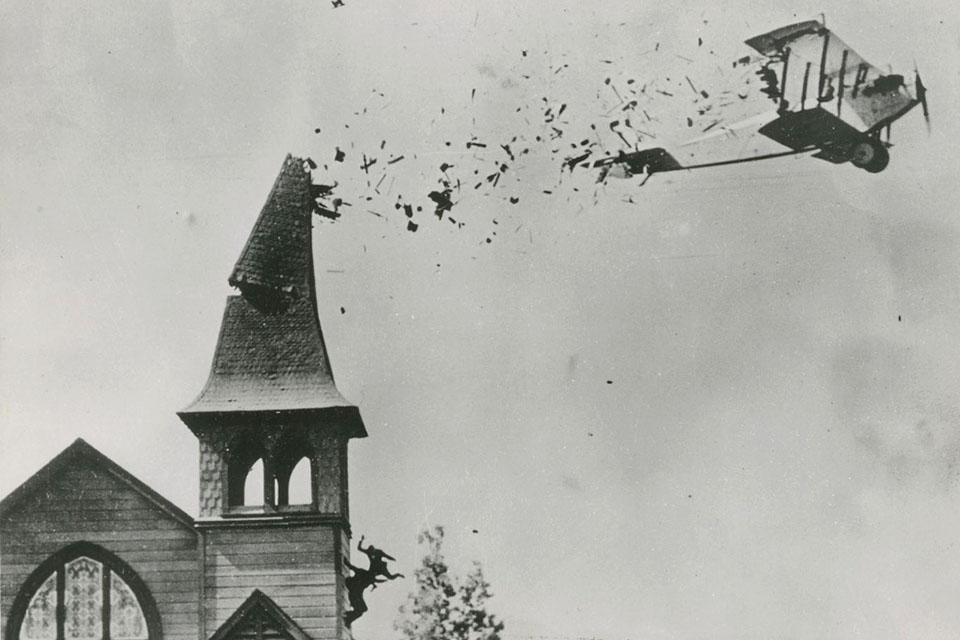
On August 2, 1920, he and Elliot were to execute the film’s final aerial stunt, a spiraling dive at night over oil fields near Los Angeles from 5,000 feet with phosphorus flares glowing on the wings to give the impression the plane was on fire. Locklear had told the director to kill the searchlights illuminating the dive to signal when it was time for the pilot to pull out. But for some reason the lights were never turned off, and when Locklear and Elliot finally realized how low they had fallen, it was too late. The plane crashed into the pool of an oil well, killing both occupants.
Not one to sacrifice exciting film footage, producer Fox took advantage of the publicity and rushed the film into release — including the final, fatal plunge. To his credit, however, the moviemaker did earmark 10 percent of the film’s profits for the families of the men who had died.
Clearly, safety precautions were seldom uppermost in the minds of early stunt fliers. Few used parachutes, and often the only safety device involved in stunt sequences was a rope tied to the plane’s strut and the ankle of the performer. In a way, stuntmen seemed eager to tempt fate.
Earl Burgess, who had also served as a flying instructor during World War I, became a barnstormer at the war’s end. Hired as the stuntman in a film that was eventually dubbed Sky Eye, he executed plane-to-plane transfers, a leap from a plane to a speeding train, and a fight on the wings of an aircraft in flight.
On February 6, 1920, Burgess was doing a scene in a film for comedian Chester Conklin and accompanied by flier Walter Hawkins. Like too many stunt fliers, Burgess had refused to wear a parachute. According to some reports, he was also out of condition and overweight. He was apparently supposed to climb out on a wing, simulate a fight with a dummy, knock the dummy (the ‘villain’) off the plane, then climb back into the cockpit.
After the scene was filmed the first time, they flew back to the airfield to give Burgess a rest. However, the scene had to be reshot — either because they needed another copy for foreign release or because the director was unhappy with the first take (accounts differ). Burgess insisted on doing the second take right away rather than wait until the next day.This time, after he threw the dummy from the aircraft, Burgess began to work his way back to the cockpit. But when he reached the wing skid, the two men in the camera plane flying nearby could tell the stuntman was close to exhaustion. A.C. Mann, the pilot of the camera craft, tried to maneuver below the plane where Burgess hung, so that he could get his top wing under the tired performer. But the stuntman looked across at the other plane, shook his head hopelessly and let go. He fell 500 feet onto some high-tension wires and died shortly thereafter.
Dick Kerwood, another noted stuntman and aerial performer, is credited with creating a host of dangerous stunts. Like so many others, he suffered numerous injuries in his work. In a serial called The Eleventh Hour, for example, Kerwood was supposed to be in a plane that was hit by gunfire from a submarine below him. His aircraft was rigged with an explosive charge that had a 10-second delay, to enable him to bail out just before the plane blew up. But the delay device did not work, and before he could climb out, the explosion knocked him unconscious and threw him out of the plane.
Fortunately, a piece of shattered wing hit Kerwood, jarring him awake. He was wearing a parachute, and when he saw that most of the debris had cleared around him, he pulled the ripcord and was relieved to see the chute open. But gasoline had sprayed his chute, and he could see that it was burning in several places. He quickly realized that unless he could extinguish the flames he would be a goner. With great coolness, he pulled hard on the shroud lines on one side to partially collapse the chute, then as he fell, let the air back in. By repeating that maneuver several times, he succeeded in subduing the flames enough so that he did not end up plummeting uncontrollably into the water. He was later picked up by a Navy seaplane.
But even the coolheaded Kerwood’s luck ran out in 1924, when he died in a fall from a rope ladder dangling from an aircraft. He became another in the growing list of fatalities among the stunt fliers of the early days of the movies. It was estimated that by the early 1930s, of the top 23 aerial performers, 18 had been killed and four were unable to fly after suffering major accidents.
As the 1920s came to a close, flying sequences in films were becoming more common, but the productions were also becoming more spectacular. Two such lavishly made films are still revered today by film historians.
Wings (1927) was directed by William Wellman, himself a veteran of the Lafayette Flying Corps, a group of American pilots who flew for France during World War I. The film starred Buddy Rogers, Richard Arlen and Clara Bow and included the first brief appearance of a young Gary Cooper. Considered by many the last great silent epic, it was chosen as the winner of the very first Academy Award for best picture.
Wings is highlighted by aerial dogfights, bombing raids, spectacular crashes and a massive re-creation of the September 1918 Battle of Saint-Mihiel that involved 3,500 infantrymen and five dozen planes. Despite the impressive numbers of aircraft and performers involved, Wings was a relatively safe film, resulting in few accidents. There were, however, several major stunts that had to be done, and the always-in-demand Dick Grace was hired to execute them.
One of the top stunt fliers of his day, Grace had earned a reputation for skillful aerial work that spanned many years. When Grace saw the deteriorated World War I-era planes that were going to be used in the film, he had a skilled engineer work with him to rebuild the aging aircraft (Spads and German Fokkers). Once the repairs were complete, Grace expertly weakened the ones he would use so they would come apart on impact to heighten the drama of the crashes.
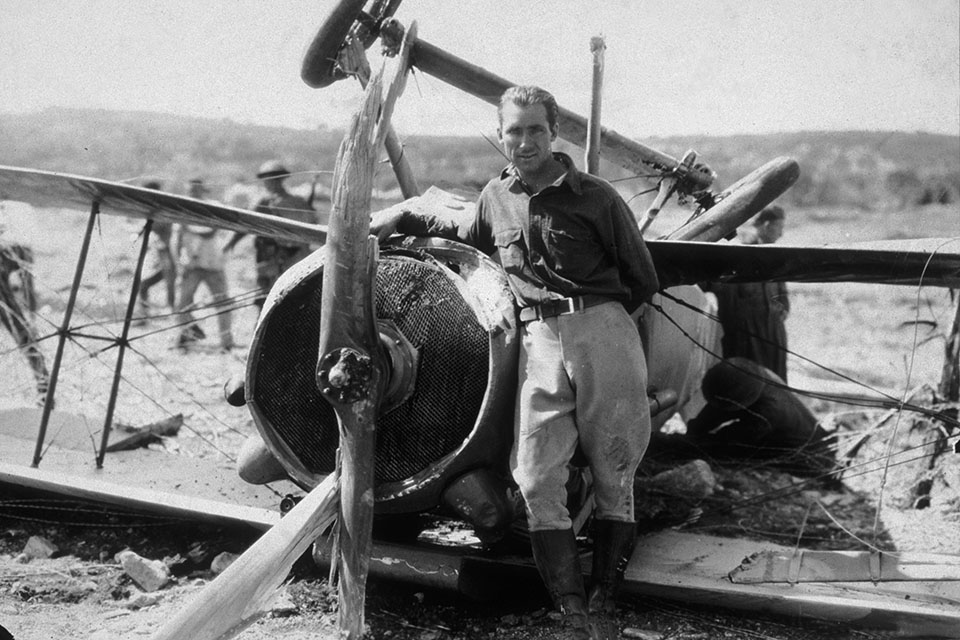
For one scene the field he was to crash into had been set up with barbed wire, 6-foot cedar posts, trenches and shell craters — some as much as 12 feet deep. The terrain was meant to resemble no man’s land. Director Wellman assured Grace that a 25-foot section would be rigged with flimsy balsa-wood posts and yarn instead of wire — in case his crash landing went awry. But the stunt flier would have to hit his mark traveling at almost 100 miles per hour — and also avoid hitting several cameramen on the field.
Grace had an entire emergency crew ready with an ambulance, tools to extricate him from the wreck and another plane ready to rush him to a hospital if he was injured. In late September 1926, all was ready for the scene, and he executed the first crash in a Spad with consummate skill, hitting the ground just 17 feet from the closest camera. Grace himself later described the moment of collision as he roared in at 90 miles per hour: ‘I jerked the stick over to the right, giving just a slight left rudder. The wing dipped and the fuselage swayed to the left. In this position I knew the ship would be a cinch to go on its back, but that’s what Bill [Wellman] wanted.
‘With a dull thud the wing hit and crumpled, then the landing carriage crashed. The poor ship tottered over to the other wing and broke that, and the thing started over on its back. As it did I ducked my head forward. It was my one measure of protection, but it happened to be just the right one. With a terrific crash something wedged between my flying coat and the back of the seat.’
When he examined the wreckage, Grace realized that he had missed the flimsy balsa posts and had hit the hardwood ones. As the plane turned over, two jagged pieces of cedar fencepost had come through the fuselage, and one was just inches from where his head had been. Ducking his head had probably saved his life.
When Grace performed a second crash — with a Fokker D.VII — he was not so fortunate. As he hit the ground at 110 mph, the impact caused the straps holding him to snap, and his head went into the instrument panel. When Grace was pulled from the wreckage, he seemed unhurt. But he later collapsed, and an examination revealed a broken neck: Four cervical vertebrae were crushed, and a fifth was dislocated. Told by doctors that he would be in a cast for a year, Grace refused to follow their advice. After 11 weeks he took off the neck harness and jumped out of his second-floor hospital room to spend an evening with his girlfriend. Unfortunately his appearance (a slight paralysis on the right side of his face, which caused his features to be twisted out of shape) shocked the young lady. According to his own explanation, the next day she decided to become engaged to someone else.
Realizing he should finish his therapy before he ruined any more relationships, Grace completed the prescribed 17-week hospital stay. Even though he was advised by doctors not to continue with stunt flying, he was back at work in 1928, organizing a squadron called ‘the Buzzards’ to perform in a minor film, Lilac Time. He managed to break several ribs in one of the crashes he did for this film, but again his luck held and he survived. Several other Buzzards, however, were not so fortunate. Three of them would die shortly after Lilac Time — though not in film-related accidents.
Another noted aerial movie produced in the latter days of the 1920s was the brainchild of eccentric billionaire Howard Hughes. Eager to make an aerial film, Hughes had been furious when the script for Wings (written by his friend John Monk Saunders) was bought by Paramount. The resolute Hughes decided to make his own epic — one that would outdo Wings. It would be called Hell’s Angels.
Then just 23, Hughes hired star actors and spent more than half a million dollars buying and renovating 89 airplanes. He put well-known flier Frank Tomick, who had worked on Wings, in charge of obtaining all the aircraft he could for the film — on an open budget. Because Hell’s Angels took place in England, the planes for the film had to look British and German, so many of the aircraft Hughes acquired had to be repainted and redesigned to simulate unobtainable foreign aircraft.
He also needed airfields, so he bought a cow pasture near Van Nuys — just north of Los Angeles — and dubbed it Caddo Field. There he built hangars and other buildings, personally supervising construction. He also bought land in Inglewood, south and west of Los Angeles (in an area that would later become the site of Los Angeles International Airport) and property in Chatsworth, in the far west part of the San Fernando Valley, which would be used to simulate a German base.
One of the final dramatic scenes in the film was the diving, spinning crash of a Sikorsky S-29A bomber — repainted to represent a German Gotha. Both Dick Grace and Frank Clarke had refused to do the stunt for less than $10,000, but Al Wilson agreed to perform the dangerous dive. Smoke effects would be created by using lamp black, with a mechanical blower system blasting the black ‘smoke’ from the diving plane. A young mechanic, Phil Jones, volunteered to ride along and operate the smoke machine.
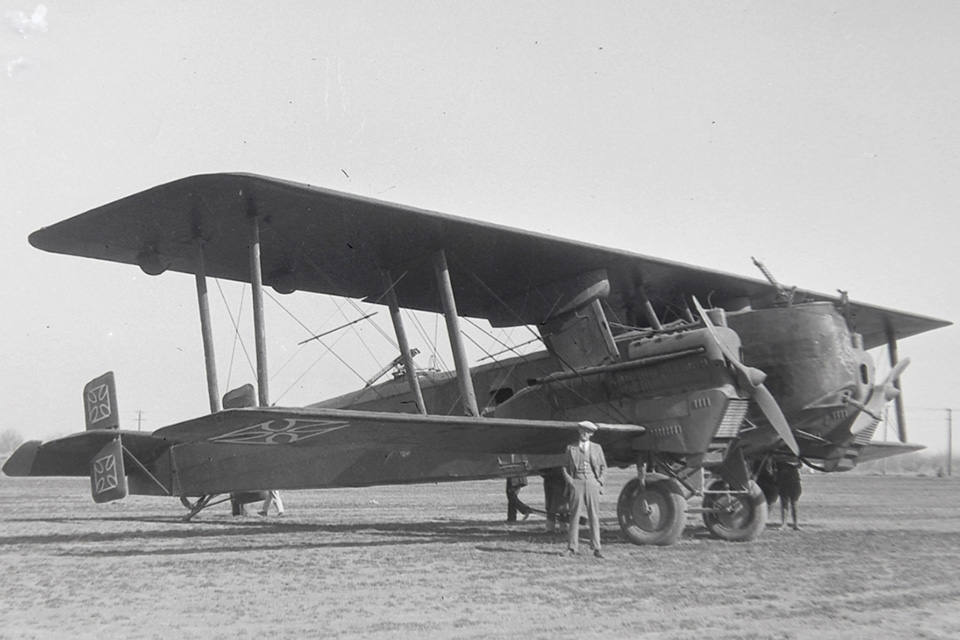
On March 22, 1929, with three camera planes in the air to record the stunt, Wilson took the Sikorsky up to 7,500 feet. As he started the downward spin, the other pilots noticed the fabric tearing away from the left wing, and then pieces of cowling from the left engine began to break away. Wilson realized he was in trouble, and he climbed from the cockpit and opened his parachute.
The three cameras recorded the plunge of the plane as they waited for a second parachute to appear. But it never did. The plane crashed with Phil Jones’ body inside, his parachute still strapped to him.
Al Wilson was shattered when he learned of the mechanic’s death. He swore he had twice yelled to him to jump, but whether Jones heard him or not, Wilson had no way of knowing. He received a great deal of criticism after the accident, but an investigation found him not guilty of negligence. His pilot’s license was suspended briefly as a result of the incident.
Hell’s Angels was not completed until 1930, by which time sound had been introduced and audiences were shunning silent films. Hughes decided to reshoot many scenes to make what had started as a silent film into a sound film. The production ended up costing him $4 million — one of the most expensive pictures made up to that time — but it was to prove a success, mainly because of its spectacular aerial scenes.
To highlight the film’s premiere on May 27, 1930, planes flew low over Hollywood Boulevard, dropping flares and parachutes. Veteran racer Roscoe Turner also participated in the gala event, completing a flight from New York to Los Angeles in a record 24 hours and 20 minutes.
Hollywood Boulevard was blocked off in one direction before the movie’s initial screening, but the crowd, eager to see the stars arrive, was immense, and traffic soon came to a standstill. The film went on to play to packed houses worldwide. Whether or not it eventually made a profit is hard to gauge. Hughes always claimed it did, but others were not so sure.The project had certainly drained a vast amount of money from his other enterprises. He had shot almost 300 times the amount of film that was eventually used and lavished time and effort on the project. In an interview some years later, Hughes admitted, ‘Making Hell’s Angels by myself was my biggest mistake….Trying to do the work of twelve men was just dumbness on my part. I learned by bitter experience that no one man can know everything.’
Demand for stunt fliers began to wane as the newly evolving airline industry grew eager to provide filmmakers with opportunities to photograph their own planes taking off and landing and even made available mock-ups of their interiors — which they had built to train airline staff. Then, as now, product promotion was becoming a fact of life for the movie industry. The military also began cooperating with the industry by providing film companies with both planes and personnel. They saw this as an effective way to recruit young men for the Army Air Corps.
But a more important reason why there were few accidents in those later days involved the evolution of more sophisticated special effects. Miniatures, rear projection and matte shot techniques were being developed to a point where many dangerous scenes could be faked.
Thus the era of the Squadron of Death, which had claimed the lives of so many talented fliers, came to an end. It had provided audiences — and the stunt pilots who survived — with some of the greatest thrills ever captured on film.
This article was written by Gerald A. Schiller and originally published in the March 2005 issue of Aviation History. Schiller is the writer/director of numerous educational films and documentaries. Additional reading: The Motion Picture Pilots and Hollywood’s Classic Aviation Movies, by H. Hugh Wynne; and Broken Wings: Hollywood’s Air Crashes, by James H. Farmer.
For more great articles subscribe to Aviation History magazine today!