The Khalkha River winds from north to south near the tip of a flat, grassy salient of Mongolia that juts about 100 miles eastward into Manchuria. In the 1930s, Manchuria’s Japanese overlords regarded the river as an international boundary line: Manchuria to its east, and Outer Mongolia—then a protectorate of the Soviet Union known as the Mongolian People’s Republic—to the west. Those on the Mongolian side of the border claimed that line ran some 10 miles east of the river, near the tiny hamlet of Nomonhan. While the precise location of the border meant little to the nomadic Mongols who had followed their herds back and forth across the river for centuries, the Kwantung Army, the elite Japanese force that controlled Manchuria, took a different view.
In April 1939, Maj. Masanobu Tsuji, the notorious and sometimes brilliant senior officer of the army’s operations staff, drafted an inflammatory set of principles for dealing with the border skirmishes that had been troubling the desolate region since Japan seized Manchuria in 1931 and 1932 and renamed it Manchukuo. Worded to provoke rather than settle such disputes, Tsuji’s principles declared that “where boundaries are not clearly defined, area commanders will establish boundaries on their own”; that in the event of an armed clash the army will “fight until victory is won, regardless of…the location of boundaries”; and, finally, that “it is permissible to enter Soviet territory, or to trap or lure Soviet troops into Manchukuoan territory.”
The following month, the Kwantung Army general responsible for the disputed territory, Lt. Gen. Michitaro Komat-subara, commander of the 23rd Division, was meeting with his staff to discuss the new border principles when he received word of incursions by Mongolian mounted cavalry across the Khalkha River near Nomonhan. In keeping with the new orders, as a participant in the meeting later recalled, the usually cautious, bookish Komatsubara made a firm plan. Weary of the skirmishes and hoping a tough response would get the Soviets to back off, Komatsubara “decided in a minute to destroy the invading Outer Mongolian forces.”
That snap decision would turn out to be one of the most important of World War II.
The conflict it ignited was no mere border clash. More than 100,000 men and hundreds of tanks and aircraft fought for four months in the battle known in Japan as the Nomonhan Incident and in the Soviet Union and Mongolia as the Battle of Khalkhin Gol. Two commanders in the conflict, Major Tsuji and Soviet general Georgi Zhukov, would go on to play critical roles in the Second World War, one helping to set Japan on the path to Pearl Harbor, the other fending off the Nazi blitzkrieg against Russia in 1941 and ultimately leading the Soviet Union to victory in that titanic struggle.
Even more astonishing, this little-known battle, fought in remote inner Asia, helped pave the way for the Nazi invasion of Poland—and all that followed. Indeed, the height of the battle at Nomonhan coincided precisely with the August 1939 conclusion of the German-Soviet Nonaggression Pact, which gave Hitler the green light to invade Poland, triggering another world war. That was no coincidence. The pact was part of a simultaneous military and diplomatic offensive by Stalin to neutralize the German threat and stun the Japanese. It assured Hitler he would not have to fight Britain, France, and Russia, so he felt safe in attacking Poland; it kept Stalin out of the intracapitalist war in Europe; and, in isolating Japan from Germany, it gave Stalin a free hand to unleash his fury against the Japanese at Nomonhan.
At dawn on May 28, General Komat-subara backed his decision with action. Following a series of indecisive small-unit skirmishes in mid-May, he dispatched a 2,082-man force under Col. Takemitsu Yamagata to crush the Mongolian “intruders.” Yamagata’s detachment was built around a battalion of the 23rd Infantry Division; a regimental artillery unit of 75mm guns and smaller caliber rapid-fire guns; and a 220-man reconnaissance unit conveyed by trucks and armored cars, under Lt. Col. Yaozo Azuma.
Yamagata found that the enemy had constructed a sturdy pontoon bridge across the Khalkha River and had taken up positions less than a mile west of Nomonhan. He decided to trap the enemy east of the river and destroy them there. He ordered Azuma’s recon unit to push south along the east bank of the river to the bridge, cutting off their escape route. Yamagata’s infantry, with artillery support, would attack frontally, driving the enemy toward the river and Azuma’s waiting unit. There they would be trapped between the two Japanese forces and destroyed.
Faulty intelligence, however, would plague Japanese operations throughout the conflict, and Yamagata mistakenly believed that the bridgehead was held only by Mongolian border troops and light cavalry—a staple of both Mongolian and Manchukuoan forces on the grassy steppe. In fact, the Mongolian forces had been reinforced by Soviet infantry, combat engineers, armored car “tankettes,” and artillery, including a battery of self-propelled 76mm guns. The combined force totaled about 1,000 men.
That morning Yamagata’s main force attacked the Soviet and Mongolian units near Nomonhan with some initial success, pushing them back toward the bridge. But Yamagata’s advance was checked by Soviet artillery and armor. Meanwhile, Azuma’s recon unit was startled as it approached the bridge to find its objective held by Soviet infantry with artillery and armored car support. These armored cars were true fighting vehicles with the turret and 45mm gun of a medium tank. Azuma had no artillery or antitank weapons and was wholly incapable of dislodging the Soviet force. When Yamagata’s assault bogged down, Azuma found himself caught between two superior enemy forces. The would-be encirclers had become encircled.
As the day wore on, the Soviet 149th Infantry Regiment, which had recently been sent to the area as a pre-cautionary measure, was trucked to the combat zone and thrown against Azuma. Yamagata, pinned down several miles to the east, was unable to relieve him. The outcome was inevitable: Azuma’s unit was annihilated. Only four men managed to escape that night; the rest, including Azuma, were killed or captured. It was an unmitigated disaster, and, in the words of Kwantung Army records, “remorse ate at the heart of General Komatsubara.”
On June 19, a Soviet air raid on a Japanese logistical base some 12 miles from the border accelerated the determination of Komatsubara and the Kwantung Army to avenge this defeat. At the army headquarters, Tsuji quickly drew up plans for a much larger offensive.
Tsuji, who was to become a notorious character in Japanese wartime and postwar history, was then 37 years old. Despite his unimpressive five-foot-two stature and the round, black-rimmed spectacles that dominated his face, he was a charismatic leader who routinely impressed his views on his superiors by dint of his forceful personality, intellect, and supreme self-confidence. He could be idealistic and even heroic, but also fanatical and brutal. He was a man of ideas and action, a gifted and imaginative operational planner who also strove to be in the thick of the fighting.
 Tsuji and his colleagues in operations wanted to entrust this mission to the 7th Division, one of Kwantung Army’s finest, rather than to Komatsubara’s 23rd Division. The 23rd, which had just been organized in 1938, was a green outfit with little combat experience. And though the 52-year-old Komat-subara was one of Kwantung Army’s leading Soviet experts—he had served as the military attaché in Moscow and as head of the Soviet section of Kwantung Army intelligence—he too lacked combat experience.
Gen. Kenkichi Ueda, Kwantung Army commander, approved Tsuji’s basic plan—with one caveat. He insisted that the 23rd Division be given the lead. He agreed with his staff’s assessment of the “unreliable combat effectiveness” of the 23rd Division, but reminded them that the Nomonhan area was Komatsubara’s direct responsibility. “To assign another division commander to handle the incident…would imply a loss of confidence in the 23rd Division Commander. If I were in Komatsubara’s place,” Ueda told his staff, “I would commit suicide.” The staff officers could not budge their commanding general on this point.
Tsuji’s attack plan called for reinforcing the 23rd Division with a powerful strike force commanded by Lt. Gen. Masaomi Yasuoka, built around two tank regiments, a motorized artillery regiment, and the 7th Division’s outstanding 26th Infantry Regiment. With the addition of the 2nd Air Group, the total attack force consisted of approximately 15,000 men, 116 artillery and antitank guns, 87 tanks, and 180 aircraft. Having estimated enemy strength in the area at one to two infantry regiments, two small armored units, and two to three air squadrons, plus Mongolian cavalry, Kwantung Army headquarters was confident their attack force would strike the enemy “like a butcher’s cleaver dismembering a chicken.”
Their main concern was that their preparations might tip off the enemy to the impending attack. Consequently, they curtailed air reconnaissance west of the Khalkha so as not to alarm or alert the enemy. That was a deadly error. The forces the Japanese would soon encounter were far more powerful than they had envisioned. And they were commanded by a dangerous new foe, Gen. Georgi Zhukov.
On June 1, the burly 42-year-old Zhukov, then deputy commander of the Belorussian military district, received an urgent phone call to hurry to Moscow. With Stalin’s bloody purge of the Soviet officer corps a very fresh memory, such a summons was most unwelcome. But the rising cavalry and tank commander was not destined for a bullet in a secret police execution cellar. Instead, he was briefed on the recent fighting at Nomonhan. He was instructed to fly there immediately, assess the situation, and if he deemed it necessary, take command. “Please,” the deputy chief of the general staff urged him. “The moment you arrive, see what’s going on out there and report to us, without pulling any punches.”
On June 5, Zhukov arrived in Tamsag Bulak, the Soviet 57th Corps’ headquarters in Mongolia, about 100 miles west of Nomonhan. He quickly concluded that corps commander N. V. Feklenko and most of his staff were out of touch with the situation. Only one senior staff officer had visited the combat zone; Zhukov took that officer with him on a tour of the front. Zhukov reported to Moscow that the battle at Nomonhan did not appear to be a mere border clash, that the Japanese were likely to escalate their aggression soon, and that 57th Corps and its leadership would not be adequate to stop the aggression. Zhukov recommended a temporary holding action to safeguard the bridgehead east of the Khalkha River until major reinforcements could be brought up for a counteroffensive.
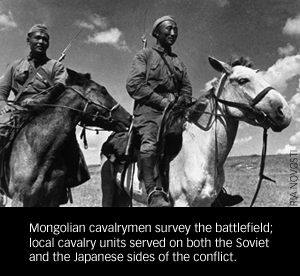
Feklenko was promptly relieved of his command and Zhukov named to replace him. Zhukov’s force was strengthened with powerful reinforcements—the 36th Mechanized Infantry Division; the 7th, 8th, and 9th Mechanized Infantry Brigades; the 11th Tank Brigade; a heavy artillery unit equipped with 150mm guns; the 8th Mongolian People’s Republic Cavalry Division; and a tactical air wing with more than 100 aircraft—and designated 1st Army Group.
Major Tsuji’s plan for the next offensive was essentially a more ambitious version of the battle plan Colonel Yamagata had employed on May 28. It called for the main body of the 23rd Division to seize a group of hills called Fui Heights on the east bank of the river, about 11 miles north of the Soviet bridge. This force would then cross the Khalkha River and strike southward along its west bank toward the bridge. General Yasuoka’s detachment, also concentrated near Fui Heights, would simultaneously loop southward on the east side of the river. Komatsubara and Yasuoka would trap the enemy between them near the bridge and destroy them.
Tsuji personally conducted a deep air reconnaissance mission and discovered the Soviet air force buildup. He concluded that a preemptive air strike was necessary. Kwantung Army command quickly adopted the proposal, and the Japanese launched an air raid on June 27. One hundred thirty attacking planes caught the newly arrived Soviet squadrons on the ground. Tsuji, in one of the bombers, estimated 25 Soviet planes destroyed on the ground and nearly 100 more shot down as they tried to take off and give combat. Even allowing for considerable exaggeration, the Japanese fliers had won temporary air superiority.
The Kwantung Army successes continued. On the night of July 1, the 23rd Division occupied Fui Heights without a fight. The next night, July 2, Komatsubara made a brilliant tactical gain. A battalion of his 71st Regiment rowed across the Khalkha and landed unopposed on the west bank. Combat engineers constructed a pontoon bridge across the river in darkness. By dawn, the main strength of the 23rd Division—led by Komatsubara, and accompanied by Tsuji—had crossed the river undetected. Although the pontoon bridge could not support the weight of tanks, the troops were able to cross with their full complement of artillery.
The first inkling the Soviets had that a major Japanese assault was under way came in the predawn hours when General Yasu-oka attacked southward from Fui Heights on the east bank of the river. Lightning from a passing thunderstorm lit the sky just as Yasuoka’s 87 tanks, their guns blazing, descended on the Soviet 149th Infantry Regiment. The stunned defenders scattered. When Zhukov got word of Yasuoka’s tank attack, he ordered his 11th Tank Brigade, 7th Mechanized Brigade, 24th Mechanized Infantry Regiment, and elements of the 6th Mongolian Cavalry Division to a hill called Bain Tsagan on the west bank of the Khalkha, roughly opposite Fui Heights. But Komatsubara’s troops had already taken Bain Tsagan, and were still on the move. In the faint early morning light, lead elements of the 23rd Division advancing southward from Bain Tsagan ran directly into the vanguard of the 11th Tank Brigade moving north. The encounter surprised both sides. The Soviet tanks immediately went on the attack, but their deployment was awkward and Japanese antitank gunners mauled them.
When Zhukov finally realized that a large Japanese force had crossed the river and threatened his entire position, he hurled the remainder of his forces against Komatsubara’s infantry to prevent them from capturing the Soviet bridge. The result was a series of uncoordinated attacks which the Japanese infantry, with artillery and some air support, was able to beat off while inflicting heavy casualties on the enemy. Japanese infantry discovered that the gasoline engines of the Soviet tanks and armored cars could be easily ignited by shellfire or handmade gasoline bombs, a precursor to the Molotov cocktail.
“Dozens of chunks of iron from tanks were strewn around the area and smoke from blazing vehicles clouded the sun,” a Japanese infantryman recalled. Komatsubara’s offensive, however, was checked. Soviet counterattacks forced the 23rd Division to dig defensive positions in the loose sand west of the Khalkha, not far south of Bain Tsagan.
With his attack stalled, Komatsubara’s best hope rode with Yasuoka’s detachment. If Yasuoka could seize the Soviet bridge and link up with Komatsubara, the offensive might yet succeed. The west bank of the Khalkha River is about 200 feet higher than the east side, which gave the men of the 23rd Division a fine view of the progress of Yasuoka’s men on the far shore. It was not a heartening sight.
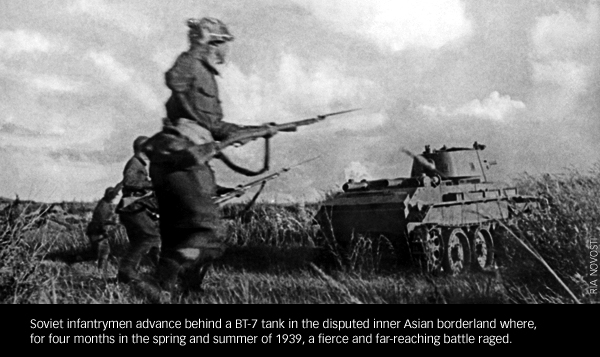
After his initial success, Yasuoka encountered ferocious resistance from Soviet artillery, tanks, and infantry. The Type 89 Japanese medium tank had a high profile and thin armor skin, which the high-velocity Soviet 45mm tank gun could easily penetrate. The Type 89’s short-barreled, low-velocity cannon, in contrast, proved almost utterly ineffective against the sloping armor of the Soviet BT-7 tank—a precursor to the famed T-34. In one short engagement, the Soviet 9th Mechanized Brigade destroyed 20 Type 89 tanks. The more agile but even more poorly armored Japanese light tanks had to be withdrawn from the vanguard. By late afternoon, Yasuoka’s advance had been halted and his force also resorted to digging in for protection against Soviet bombardment.
The Japanese now found themselves in the potentially disastrous position of having their force divided on opposite sides of a river, with a powerful enemy separating them. The 23rd Division had to cross back over the river as soon as possible. Fortunately for the Japanese, Zhukov had been caught off-guard by the daring river crossing and did not immediately recognize Komatsubara’s vulnerability. On the night of July 3, Zhukov was still thinking in terms of repulsing the enemy, rather than encircling and destroying him. That allowed the 23rd Division to slip away to the relative safety of the east side of the river.
Both sides had been bloodied, but again Kwantung Army had failed to achieve its objective. And again, much of the cause for the failure lay in poor intelligence work. The enemy’s strength had been badly underestimated. Perhaps even more disturbing, the intelligence failure was not merely quantitative, but qualitative. The Soviet forces were not only larger but more powerful than anticipated. While the Japanese attackers enjoyed a slight numerical advantage, as well as tactical surprise at the outset, the weight of Soviet firepower proved decisive. As Zhukov later noted, “Our trump cards were the armored formations.” This was an alarming lesson, one the Japanese were loath to accept. For if Bushido, the presumed spiritual superiority of the Japanese warrior, could not prevail against crude material force, Japan’s military prospects were grim.
Even as the battle at Nomonhan was escalating beyond the border clash it first appeared to be, Stalin was weaving the diplomatic design that would connect it to a far larger conflict: World War II.
By the summer of 1939, it was clear that Europe was sliding toward war. Hitler was determined to move east, against Poland. Stalin’s nightmare, to be avoided at all costs, was fighting a two-front war against Germany and Japan. His ideal would be a war between capitalist countries: the fascist-militarist capitalists (Germany, Italy, and Japan) fighting the bourgeois-democratic capitalists (Britain, France, and perhaps the United States)—leaving the Soviet Union free to weigh in on either side after the capitalists had exhausted themselves.
Hitler’s annexation of Czechoslovakia in March 1939—in violation of the six-month-old Munich Agreement—gave Stalin the opening he was hoping for. In response to Hitler’s land grab, Britain and France pledged to fight Germany if it attacked Poland, and then openly sought to enlist Moscow in an anti-Nazi alliance. This offer gave Stalin the leverage to open secret negotiations with Germany. Stalin correctly calculated that if Hitler went to war over Poland, he would want to avoid the 1914 mistake of fighting England, France, and Russia. Stalin was maneuvering into a position in which the Anglo-French powers and Germany were competing for an agreement with him. The choice would be his. Meanwhile, the fighting continued at Nomonhan. The Japanese piece of the puzzle would be part of Stalin’s grand design.
In the weeks that followed the early July battle, the Japanese attempted to even the score by bringing almost all the heavy artillery in Manchukuo to the Nomonhan front for a major artillery duel, and, later, by launching a series of large-scale nighttime attacks. But in both cases the Soviets proved stronger, with bigger guns and strong defensive lines.
And they were growing stronger still. While Stalin continued public negotiations with Britain and France and secret negotiations with Germany, he reinforced his army at Nomonhan. In July, Zhukov’s 1st Army Group was strengthened by the addition of the 57th and 82nd Infantry Divisions, the 6th Tank Brigade, the 212th Airborne Brigade, two Mongolian cavalry divisions, and numerous smaller infantry, armor, and artillery units. By mid-August, when the buildup was complete, Zhukov commanded a force equivalent to four infantry divisions, supported by two cavalry divisions, 216 artillery pieces, 498 armored vehicles, and 581 aircraft.
To bring this force and the equipment and supplies necessary for a large-scale offensive to the combat zone, the Trans-Baikal military district in eastern Siberia amassed a fleet of more than 4,200 trucks, which transported some 55,000 tons of materiel 400 miles from the closest railhead to the combat zone.
Japan’s intelligence, while weak, was not blind. The Japanese knew reinforcements were moving east along the Trans-Siberian Railroad. But they had no idea of the volume. They were also lulled by the assumption, gospel in the Japanese Imperial Army, that the maximum range for large-scale military operations was 125 to 175 miles from a rail line. Anything beyond 200 miles was considered logistically impossible. Kwantung Army had only 800 trucks in all of Manchukuo, so a logistical operation the size of the Soviets’ was almost unimaginable. No major attack was expected.
Also, because the Kwantung Army’s 7th Division was based on a main rail line, it could be transported to any trouble spot in a few days. Some at Kwantung Army headquarters wanted to deploy the 7th Division to Nomonhan in case the Soviets did attack, but it was the army’s sole strategic reserve and the operations section was reluctant to commit it to the far western frontier. Instead, the division’s 28th Regiment was dispatched to Nomonhan, as was a battalion from the distant Mukden garrison in eastern Manchukuo. These reinforcements did little more than make up the losses already suffered by Komatsubara’s forces, however. As Zhukov’s 1st Army Group prepared to strike, the effective Japanese strength at Nomonhan was only slightly more than one division.
Zhukov needed detailed information on Komatsubara’s deployment, but the latter’s tight perimeter security, and the lack of Japanese deserters, made that difficult. Finally, Maj. I. M. Remizov, commander of a regiment that had been in the thick of the fighting since May 28, succeeded in penetrating Japanese lines and brought back the information Zhukov needed (for which Remizov was later decorated a Hero of the Soviet Union): The Japanese 23rd Division’s main strength was concentrated a few miles east of the Khalkha River. The infantry lacked mobility and strong armor support. And the Manchukuoan cavalry held their northern and southern flanks.
Zhukov devised an uncomplicated attack plan. He would divide his 1st Army Group into three strike forces. The central group, under his personal command, would launch a frontal assault behind maximum artillery and air support and tie down Komatsubara’s main strength there. The northern and southern strike forces, which were allotted the bulk of the armor, were to turn in the Japanese flanks and force them into a pocket that the three combined forces would then reduce and destroy.
To ensure tactical surprise, Zhukov and his staff devised an elaborate deception program intended to reduce Japanese expectation of an attack, with dummy radio and field telephone messages about constructing defensive fortifications, leaflets ostensibly for Soviet troops titled “What the Infantryman Should Know About Defense,” and huge loudspeakers blaring the sounds of tanks and aircraft engines each night. At first, Japanese frontline troops mistook the sound effects for an attack and fired toward the loudspeakers, but after a few days they became accustomed to the nightly “serenade” and tried to ignore it. On the night of the attack, the sounds of Soviet troop concentration and preattack staging drew little attention from the Japanese.

On August 19, when Stalin was confident he had an agreement with Hitler in the bag, he gave Zhukov the final green light to launch his offensive. At 5:45 a.m. on August 20, as German foreign minister Joachim von Ribbentrop was preparing to fly to Moscow to sign the Nonaggression Pact, 200 Soviet bombers appeared over the Khalkha and began pounding the Japanese positions. When the bombers withdrew, a thunderous artillery barrage began that lasted for 2 hours and 45 minutes—precisely the time the bombers needed to rearm, refuel, and return for a second run. Finally, all the Soviet artillery hurled an intensive 15-minute barrage at the Japanese forward positions.
Komatsubara’s men huddled in their trenches under the heaviest bombardment to which they or any other Japanese unit had ever been subjected. The effect, physically and psychologically, was shattering. A Japanese artillery commander described the incessant bombardment as reverberating like “the gongs of hell.”
At 9 a.m., Soviet armor and infantry moved out all along the line. A dense morning fog near the river shrouded their approach at some points, allowing them to get within small-arms range of the defenders. The surprise and disarray on the Japanese side was so great that Japanese artillery did not begin firing in support of their frontline troops until about 10:15. By then, some of the frontline positions were already overrun. Japanese resistance soon stiffened, however, and fierce combat raged along the front some 40 miles from end to end.
In the first day’s fighting, the tank-heavy Soviet southern force under Col. M. I. Potapov routed the Manchukuoan cavalry holding General Komatsubara’s southern flank, and bent that segment of the line inward about eight miles. Zhukov’s central force advanced only about half a mile against furious resistance, but his frontal assault fixed Komatsubara’s infantry in place, preventing him from reinforcing his flanks. Col. I. P. Alekseenko’s northern force easily overran the Manchukuoan cavalry on the northern flank, about two miles north of Fui Heights. But the heights themselves were a natural strongpoint and became the northern anchor of the Japanese line. Kwantung Army headquarters did not at first realize the scope of Zhukov’s offensive and believed Komatsubara’s defensive position was stable. The 7th Division remained held in reserve.
Over August 21 and 22, Potapov’s southern force pushed ahead, bending the Japanese southern flank further in toward the center. Elements of Potapov’s force disengaged and took up a blocking position some 11 miles east of the river, athwart the likely escape route of the Japanese units in the south. The Japanese center grudgingly gave up a little more ground. The northern flank remained anchored at the key strongpoint of Fui Heights—having, Zhukov acknowledged, “put up more obstinate resistance than we thought it could.”
On August 23, Kwantung Army headquarters became alarmed enough to order the 7th Division to Nomonhan. But the order came too late. That day, Komatsubara ordered a counterattack by his 72nd Regiment and the 7th Division’s 28th Regiment. Heavy morning fog obscured visibility as the troops moved forward the next morning. When the fog cleared, the 72nd Regiment discovered that it had moved into the path of a powerful Soviet tank attack. The Japanese infantry took a terrible beating. Nearly every company and battalion commander was killed, as well as the regiment’s commanding general and most of his staff.
The 28th Regiment fared little better. Intense artillery fire had pinned it down 500 yards from the Soviet lines. Unable to advance but unauthorized to retreat, the troops dug in against the withering bombardment. A postwar Japanese army history recounts that when Komatsubara received combat reports from his two regiments, he “evinced deep anxiety,” while his divisional chief of staff “appeared bewildered.” After sunset, the attack force was ordered to withdraw—but by then both Japanese regi-ments had been shattered.
At about the same time, news of the German-Soviet Nonaggression Pact reached Tokyo, and Japan’s hope of a military alliance with Germany was shattered as well. Japan realized it would face the Soviets alone. The army leadership in Tokyo, which had been pressing for a German alliance, was humiliated. Their forces at Nomonhan faced a cruel fate.
Colonel Alekseenko’s northern force had been hammering the Japanese at Fui Heights for three days without success. Although the attacking forces were much more powerful than the relatively small force of 800 men—under the command of Lt. Col. Eiichi Ioki—that held the heights, the strongpoint had defensive fortifications on all sides and barbed wire overlaying deep bunkers connected by trenches. The Japanese defenders inflicted heavy casualties on the attackers.
Zhukov became exasperated and summoned Alekseenko to the phone. When the latter expressed doubt about his ability to storm the heights immediately, Zhukov relieved him of command on the spot and ordered the man’s deputy to attack. A few hours later, Zhukov called again and, finding that the heights still had not been stormed, he dismissed the second officer as well and sent over one of his own staff to take charge. He also reinforced the northern force with the 212th Airborne Brigade, more artillery, and a detachment of flamethrowing tanks.
The Japanese defenders were now hopelessly overmatched. Artillery came pouring in at two to three rounds per second. Earth and sky throbbed, reminding one defender of the incessant pounding of Buddhist monks’ koto drums. With their own artillery knocked out, they had no effective defense against the flamethrowing tanks, which a Japanese officer saw “spitting red darts like the tongues of snakes.” Lieutenant Colonel Ioki and 200 survivors, most wounded, abandoned Fui Heights without orders and retreated east, beyond the combat zone.
After taking Fui Heights, the northern force began to roll up and envelop the entire Japanese northern flank in a wide sweeping movement south and east from the heights toward Nomonhan. The next day, elements of the northern force’s 11th Tank Brigade linked up with the southern force’s 8th Tank Brigade near Nomonhan. The steel ring was closed.
As the Japanese northern and southern flanks dissolved, Komatsubara’s command as an integrated unit ceased to exist. Japanese lines were cut in several places and organized resistance continued only in three pockets. Their only hope lay in a powerful relief force that could break through the Soviet encirclement from the outside. But the Kwantung Army was spread thin and lacked sufficient trucks to get even the 7th Division to the combat zone quickly enough. On August 27, the 7th Division finally reached the northeastern segment of the ring Zhukov had forged around Komatsubara’s force. One day’s hard fighting showed that it lacked the strength to break through the Soviet armor. The 7th Division was withdrawn.
The sun beat down on the surrounded Japanese defenders and the temperature rose to 100 degrees. Water canteens ran dry. Enemy positions could barely be discerned through the heat shimmers, sweat, and fatigue. With his men unable to reach the river to refill their canteens, the commander of the easternmost Japanese enclave ordered them to drain the water from the radiators of their vehicles. Drinking that foul liquid at the expense of immobilizing their vehicles was a sure sign the defenders knew their situation was hopeless.
Throughout August 27 and 28, Soviet aircraft, artillery, armor, and infantry relentlessly attacked the three Japanese strongpoints, compressing them into ever-smaller pockets and gradually grinding them to pieces. The surrounded Japanese fought valiantly and continued to inflict heavy casualties on Soviet infantry, but the issue was no longer in doubt. The 23rd Division and its associated units were wiped out. Few surrendered.
Shortly before midnight on August 30, the bulk of the Soviet armor withdrew briefly to refuel and some of the infantry that had been in continuous action for 10 days pulled back as well. General Komatsubara and about 400 survivors of his command managed to slip through the Soviet lines. Major Tsuji was among them. After four months of fighting, over 50,000 men on both sides were dead or wounded.
In the days and years ahead, events set in motion at Nomonhan continued to play out. To begin with, the German-Soviet Nonaggression Pact called for the Soviet Union to join Germany in subduing and occupying Poland. After the German blitzkrieg struck on September 1, the main strength of the Polish army was broken within days. As early as September 3, Ribbentrop invited the Soviets to move into their agreed-upon occupation zone in eastern Poland. But for two and a half weeks the Soviet divisions that were poised on the Polish frontier did not move. Meanwhile, sporadic ground and air combat continued in the Nomonhan area. A formal cease-fire went into effect there on September 16. The next morning, the Red Army burst across the Polish border into a country that had lain open before it for days. Stalin apparently wanted the fighting in the east resolved before committing himself in the west.
Fast-forward two years. Japan is still fighting in China, which has vast strategic resources. The oil embargo that Franklin Roosevelt imposed on Japan in July 1941 is threatening to bring the Japanese war machine to a halt and Japan to its knees. Meanwhile, Germany controls most of western and central Europe and has invaded the Soviet Union. In three months, German armies plunge more deeply into the heart of Russia than in the four years from 1914 to 1918. Whole Soviet armies are destroyed or captured en masse. Ukraine lies open. Leningrad is besieged. German armies are on the road to Moscow. Many experts predict the collapse of Soviet military resistance in a matter of weeks. It’s decision time in Tokyo.
Hitler is urging Japan to join in the war against the Soviet Union: Avenge the defeat at Nomonhan and seize the Soviet Far East. But do it now. If you wait until after I’ve defeated Stalin, I won’t need you. Top Japanese army leaders favor this idea—the northern course. The navy strongly disagrees, preferring a southern course: seizing the Dutch, French, and British colonies in Asia. The Dutch East Indies (present-day Indonesia) is Japan’s only possible source of oil. The Dutch and French colonies are defenseless; Britain is fighting for its life. The only real obstacle to the southern course is the United States Pacific Fleet. The southern course means war with the United States.
At a series of Imperial Conferences in Tokyo in mid- to late 1941, these issues were debated and decided. Tsuji, then a lieutenant colonel and a key member of the operations staff at Imperial General Headquarters, was in the thick of it. A senior officer in the Japanese army ministry at the time testified at the Tokyo war crimes trials that Tsuji was “the most determined single protagonist in favor of war with the United States.” The decision, of course, led directly to the attack on Pearl Harbor and the Pacific war.
Gen. Eugene Ott, German ambassador to Japan, cabled this explanation to Berlin of Japan’s decision: “In my reports I have repeatedly pointed out that after the experiences at Nomonhan and in view of the Russian resistance to an army such as the German Army, the [army] activists consider participation in the war against the Soviet Union too risky and too unprofitable.”
When Japan made the decision to strike south, the Soviet Union’s top spy in Tokyo, Richard Sorge, signaled Moscow that Japan would not attack the Soviet Union. Only after learning this did Stalin make the crucial decision to transfer his Far Eastern forces westward. Fifteen infantry divisions, three cavalry divisions, 1,700 tanks, and 1,500 aircraft moved from the Soviet Far East to the European front. It was these powerful reinforcements, commanded by Zhukov, that turned the tide in the Battle of Moscow in the first week of December—at the same time Japan attacked Pearl Harbor. That was the most decisive week of the war, the week that ultimately doomed the Axis.
Zhukov won his spurs at Nomonhan—and won Stalin’s confidence to entrust him with overall command in late 1941 when the war hung in the balance. Zhukov led the Red Army to victory after victory, all the way to Berlin; the much-decorated Hero of the Soviet Union would survive Stalin and be appointed defense minister in 1955.
The main architect of Japan’s defeat at Nomonhan fared differently. When war came, Tsuji again was in the thick of it. He masterminded Japan’s brilliant Malay-Singapore campaign—and the slaughter of thousands of pro-British Chinese in Singapore. In the Philippines, he helped instigate the Bataan Death March. He fought—and lost badly—at Guadalcanal. After Japan surrendered, he went into hiding in Thailand, disguised as a Buddhist monk, to avoid prosecution as a war criminal. He later returned home, wrote many books about his exploits, and was elected to Japan’s parliament, where he served for 10 years—until disappearing mysteriously into the jungles of Laos in 1961, just as the American military involvement in Southeast Asia was getting started.
Not all of the key players at Nomonhan went on to shape world history. Lieutenant General Komatsubara was a broken man after Nomonhan. He was relieved of command of the 23rd Division in November 1939 and forced into retirement early the next year. He died of cancer 10 months later, at age 54. And Lieutenant Colonel Ioki, who retreated without orders from Fui Heights, was still in the hospital recovering from wounds he sustained in the battle when he received orders from the Kwantung Army to commit suicide. Ioki protested the order as unfair, but obeyed and shot himself.