Ichiro Miyato, of the 27th Radar Squad (Southern Kyushu), returned to his radar screen after helping carry material for the new construction, which, when completed, would provide a more powerful and well-camouflaged radar installation intended to detect, at a great distance, the anticipated invasion by American forces.
Miyato, his tour scheduled to begin at 11 a.m., noticed the wall clock showing 10:45. He initialed the logbook under the date August 9, 1945. No sooner seated, he spotted a blip moving southward. He watched the radar make two more sweeps; still only the one blip appeared. Scanning frequencies, he found interference indicating the blip was using its own radar.
‘Looks like a lone B-San running radar…I’d guess it’s mapping,’ he advised his command headquarters. ‘Altitude…probably 10,000 meters…out of triple A and fighter range.’ After a couple more sweeps he plotted the vector and reported, ‘Their course will take them over Nagasaki…if you want to alert Civil Defense.’ Nagasaki lay 25 kilometers south of the radar station.
Miyato poured himself a cup of green tea. He knew Japanese fighter planes would not scramble. The Boeing B-29 was too high, and they couldn’t afford to waste the fuel in a futile attempt to bring down the bomber.
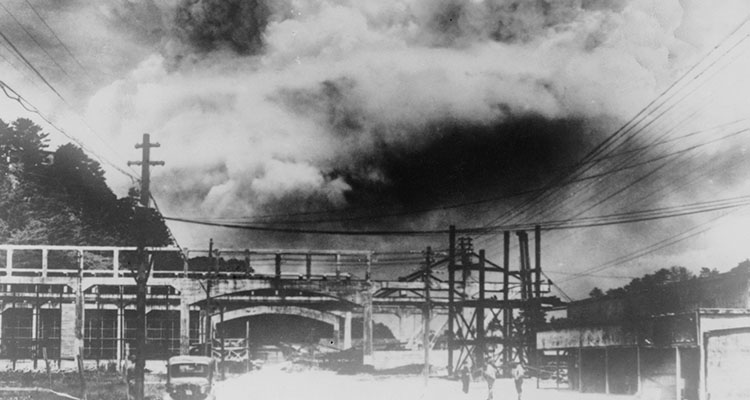
Back on the line to headquarters 10 minutes later, he had just gotten the words out: ‘They should be over Nagasaki now…,’ when his screen went blank. A distant flash filled the room with light, and the walls of the radar shack shuddered.
Michie Hattori Bernstein was a 15-year-old schoolgirl when the bomb was dropped on Nagasaki. She never forgot that day.
I may not have been the brightest student in high school, but I was probably the most obedient. When the city sounded the air raid warning, I ran as fast as I could to the cave the government had dug into the side of a hill for us students. I always made it to the shelter ahead of the rest of my class. I say always because Nagasaki had been bombed five times before that day. Out at our school we heard the explosions or saw the sparklers coming down, but they never came near us. Even the sounds were muffled by the hills around our location.
We thought the warning on August 9 would be like the others. That’s why a lot of the girls just hung around the school. At that point, the government had not announced the atomic bombing of Hiroshima three days before. The teachers made us all leave the classrooms, telling us to run to the shelter. I did, but most of the others just stood around talking in the schoolyard. It was not that unusual to see B-San [‘Mr. B’] flying over. That’s what most of us called a B-29. A single B-San had never caused trouble — just checking the weather or taking pictures of the coast, we assumed.
When the bomb exploded, it caught me standing in the entrance to the shelter, motioning for the pokey girls to come in. First came the light — the brightest light I have ever seen. It was an overcast day, and in an instant every object lost all color and blanched a brilliant white. My eyes couldn’t cope, and for a little while I went blind.
A searing hot flash accompanied the light that blasted me. For a second I dimly saw it burn the girls standing in front of the cave. They appeared as bowling pins, falling in all directions, screaming and slapping at their burning school uniforms. I saw nothing for a while after that.
Immediately, a powerful wind struck me. It propelled me farther into the cave; then in an instant it threw me out the front entrance. I guess the shockwave hit the back of the cavern and bounced. It took me with it and others who had sought refuge in the shelter. We came tumbling out onto the ground.
What a terrible feeling! I could see nothing. My hands and face singed, intense pain gripped my body. I tried to walk a little and stumbled over a fallen tree. I lay there, not knowing for sure where I was or whether something else might happen to me.
When my senses, including my sight, began returning, I heard crying from the girls in front of the shelter. All, except one, were now standing and blowing on their skin. Looking at the one lying down, I saw her leg twisted at a crazy angle. To this day, we don’t know how it became broken. The face and hands of the other girls quickly turned bright red. I guess my being partially inside the cave provided some protection because my stinging began to disappear before long.
We told Haruko, the girl with the broken leg, to lie still; we would go for help. Fires started all around us. Flames leaped from paper and wood scraps, some from collapsed structures. Thick smoke and dust filled the air. The fires gave the only real illumination. Even the noontime sunlight, filtering through the clouds, darkened. The word I kept hearing the girls say, jigoku, means hell. That’s the closest I ever want to come to jigoku.
‘Let’s go back to the school. It’s only a couple hundred meters,’ one of the classmates suggested. We traveled slowly because each step caused pain. Our thoughts were that a bomb must have gone off near the shelter and burned a short distance around us. We didn’t even dream what devastation covered our entire city.
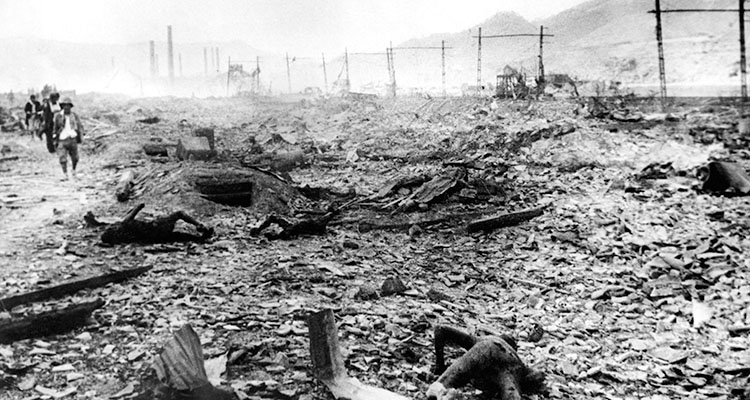
The route to the school seemed strangely flat and empty. Someone asked, ‘Weren’t there houses here when we came to the shelter?’ The whole world appeared so surreal we just accepted that structures could disappear off the face of the earth. We were living a terrible nightmare.
My classmate Fumiko scampered about 50 meters ahead of us. When I looked up to see why she was calling, I saw her pointing to a large form on the ground.
‘Look over there,’ she shouted. ‘It has escaped from the zoo. It’s an alligator.’ It lay in our path to the school, so we approached with caution. Fumiko found a rock.
She drew back the rock above her head as she approached the creature. Then, Fumiko froze in her tracks, screaming hysterically. I ran to her side. The face looking up at us from the crawling creature was human. The shrieking in my ear kept me from hearing what the face was trying to say. I could just see it pleading for something — probably water. No clothes or hair were visible, just large, gray scalelike burns covering its head and body. The skin around its eyes had burned away, leaving the eyeballs, huge and terrifying. Whether male or female I never found out.
The head fell forward — face in the dirt. It didn’t move after that. Fumiko crumbled to the ground and I dropped beside her.
We were both 15. The wartime schedule of year-round attendance would allow us to graduate in another month. We were lucky. At the end of spring, the Student Mobilization Order closed many of the other girls schools and moved the students to Yawata. It’s a steel-mill town near Kokura where the girls worked all summer. The boys schools also closed. Those boys who had not enlisted in the military ended up working in the Nagasaki shipyard.
When we felt like standing up, we plodded on toward the schoolhouse. Fumiko and I encountered two or three groups of people. They appeared numbed, standing around victims who were on the ground. We saw nothing we could do to help, and we moved on.
Because of the dust and debris, we couldn’t see the school building until we were almost upon it. It appeared to have remained sound, except the windows were blown out. We soon saw the other students who had stayed in the schoolyard. Fortunately for them, most were on the opposite side of the building from the blast.
Two girls wore makeshift bandages on their arms. Flying glass from the windows had caused their lacerations. Many of them displayed the bright red faces and hands, which I have come to know as characteristic of second-degree burns. The reinforced concrete-block building offered protection in case of additional explosions, we thought. So, we remained with the group for about half an hour.
It seems a little petty to me now, but I wanted to go into the building to retrieve my books and belongings. A student in our group said, ‘I think one of the teachers is dead.’ It’s funny how my books seemed so important, but my parents had purchased them from their meager income. I was determined to enter.
The blast knocked out our electricity, which added to my dread as I made my way along the hall. Only the dimmest light filtered through the thick dust and smoke. Though a little disoriented, I found room 1-Kumi, my homeroom. Glass littered the floor and lay on the desks, but my books were intact. I tucked them under my arm and retrieved my hat, pulling it tightly to my ears.
Once again in the hallway, I heard a person’s voice. The door to 3-Kumi, the room next to mine, stood ajar. The voice from inside called, ‘mizu, mizu‘ — water, water. The door seemed stuck with his body lodged against it, so I pushed with all my might to get in. He screamed in agony when the door moved his body. I recognized Sakamoto Sensei — Teacher Sakamoto. He had wrapped his shirt around his bloody leg. Blood also oozed from the side of his neck. Lifting the crimson-soaked shirt, he motioned to his thigh by nodding his head.
The only sounds he made were gurgling grunts. I saw the wide, gaping slice in his leg. His thighbone showed white in the bloody pool. He looked up at me and mouthed the word mizu. I ran to my homeroom because I knew where cups and a full teapot sat. Returning, I held the cup for him to drink.
He emptied it and motioned with his head toward a pile of overturned desks. I missed the word he whispered. Holding my ear closer I barely heard him say, ‘Tani.’
‘Tani Sensei?’ He nodded. I walked behind the pile of desks and saw on the floor a woman’s body with a slab of broken window glass on her chest. I wrapped one of my books around the edge of the glass and attempted to move it. I probably screamed when I saw her head; I don’t remember. The head had been virtually severed, but her eyes remained open. The sight of the inside of her windpipe haunts me to this day.
I filled Mr. Sakamoto’s teacup with more tea and left it for him. I could do nothing more for him or for Miss Tani.
Almost out the back door, I was nearly crushed by my classmates rushing into the building. ‘Look at my arm,’ one said, showing it to me. I saw large dark wet spots. ‘The rain is black…large drops and they hurt when they hit you.’
Before I returned to the school from the shelter, four of the students who suffered the most painful burns had departed for the river. They planned to bathe their wounds in the cooling water. The explosion apparently knocked over the city’s water towers, bringing the pressure to zero at our school. The Urakami River runs through the middle of the town and drains into Nagasaki Harbor. Our school was located a couple hundred meters from the river.
In such a state of shock I don’t know if I made sense, but I attempted to tell the group about the fate of the teachers. I continued trying to get my story out when the four girls returned from the Urakami. All were crying. Two girls could only be described as hysterical. The others attempted to hug us and then quickly pulled away in pain from their burns.
They told us how they reached the river where hundreds of severely burned people were trying to cool their injuries in the water. The girls described many as looking like dead trees with their bark peeling off — skin hanging from their faces and hands. Along the shoreline floated bodies, some stacked two or three deep. A few still moved, lacking the strength to pull themselves out onto the bank.
The parents of several of the girls came to the school and escorted their daughters away. Mine did not. I fretted considerably about that fact. Had they been killed or injured? Trying to brace myself for whatever tragedy I might find at home I set out walking. Two classmates departed with a crutch made from a tree branch to help Haruko with her injured leg.I dutifully strapped my schoolbooks on my back and headed off from the others. On two occasions I found myself lost. The streets were covered with debris and most landmark structures had been demolished by the blast. A ridge of land, some 30 meters high, formed a wall between the river delta of our school and the district containing my home. Guiding on a saddleback in the ridge, I found the path that led to my neighborhood.
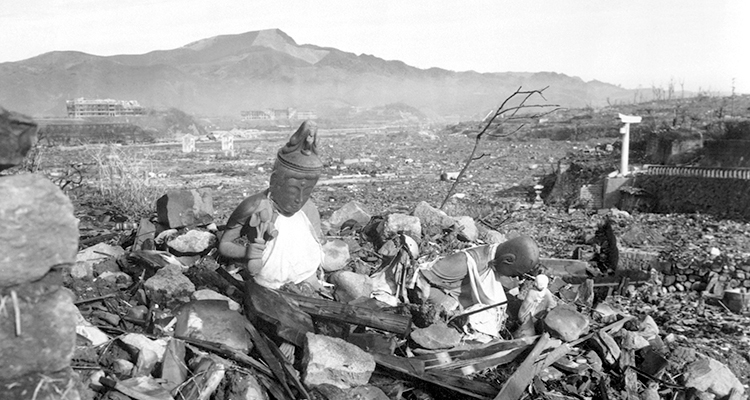
Coming off the ridge, however, a completely different world greeted me. No damage met my eyes, grass appeared green, a truck moved along a street. I stopped and asked myself if the past two hours had just been a terrible nightmare or were they real.
As I walked through my neighborhood I saw a number of people in the streets. Most knew something terrible had happened — they didn’t know what. I didn’t either. After relating to them a few of the scenes I had witnessed, I hurried on.Turning onto my street I saw my mother and dad coming out of the house. On their way to look for me, they had reached home only a few minutes before me. Both my parents worked at a small neighborhood factory assembling airplane parts. Those in the factory saw the flash and felt their building shake, but they put it down to an earthquake. Eventually the factory manager realized something more serious had occurred and released all of the employees.
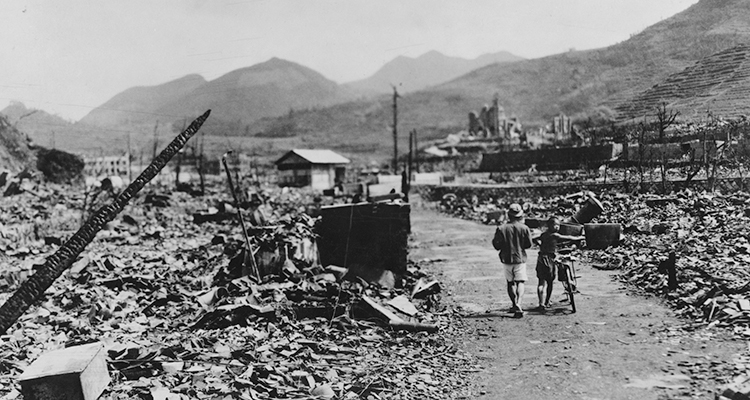
That evening our civil defense block captain roused everyone in the area and formed rescue squads. We walked to the damaged sections. Initially, seeing the extent of the devastation stunned those in my group, but we all pitched in. That first evening chaos reigned, but over the next week we helped set up a makeshift morgue and treatment center.
I thought, only a week ago I would have been horrified at a paper cut on my finger. Now I found myself helping carry dead people whose skin was tearing off in my hands. I saw bodies where the blast had tattooed the pattern of their kimonos onto their skin.
I was assigned the task of keeping flies off of the injured. From nowhere, it seemed, a huge contingency of flies arrived. They swarmed around the wounded, attempting to lay their maggot eggs in the open wounds. Flies crawled under my makeshift bandages. At nightfall my parents would send me home to rest while they worked on.
People were telling us the war had ended — an event for which we had waited years, and yet it seemed insignificant in light of the efforts we were engaged in. By the end of August, victims were still dying of radiation sickness. We didn’t know at the time what was killing them. Civilian groups and returning soldiers cleared most of the debris from the streets.
About that time we saw our first Americans. The citizens of Nagasaki didn’t welcome them as I am told occurred in other cities. The universal horror experienced by those living in the atom-bombed areas could not be shaken off by even the promise of peace. We knew war is appalling and has few rules, but what the enemy did to our innocent civilians on a mass scale we felt to be outside the purview of a civilized nation’s warfare.
Was it the unseen hand of some providential power that directed the bomb’s ground zero squarely over the largest Christian church in Asia and its surrounding Christian neighborhood? Did that same hand spare the great Shinto shrine Suwa-jinja in the center of town? Are we to be pariahs the rest of our lives, disfigured and frightening others because of our radiation ailments? These were among the questions I heard my parents discussing with their friends.
Over the next few years such dark thoughts eroded away as America’s help rebuilt schools and encouraged businesses. I completed my education, majoring in English. When around Americans, I listened carefully to their pronunciation, trying to imitate each word. It worked out well for me. General [Douglas] MacArthur’s headquarters hired me, and I moved to Tokyo.
I became quite fluent in English, working closely with American officers, translating documents and explaining Japanese customs and mores. My early life in Nagasaki, however, I kept to myself. For many years after the war no one understood radiation sickness and many feared those exposed might somehow transmit it to others around them. In addition, I couldn’t bring myself to dredge up those awful memories people were sure to ask about. After all, Japan was becoming a different country.
Many months passed before I revealed the secrets even to my future husband, Raymond Bernstein. Serving as a civilian attorney employed by the War Crimes Commission, he frequently called on me to help with his cases. More than 500 war criminals stood trial, and lawyers called up close to 1,000 witnesses.
When we started dating, life became quite heady for this young girl. He escorted me to diplomatic functions, and we met with high-ranking judges and lawyers from many countries. More than once, newsreel cameras caught me standing by his side as he gave an interview.
Of course, I said yes when he asked me to marry him and move to America. However, I readied myself for months — maybe years — of red tape before we would actually say our vows. Ray just said, ‘I’ll pull a few strings,’ and in a short time we were on a plane headed to the United States. After living in Washington for two years, he took a job with the federal prosecutor’s office in Dallas.
His work took him all over Texas and to surrounding states. I found myself more and more left at home when he traveled. His circle of American friends seldom included me.
One day, after seven years of matrimony, he presented me with divorce papers, saying our marriage had been a mistake. He offered to pay my expenses back to Japan, but I felt this country offered better opportunities for a single woman.
A Japanese friend living in Fort Worth arranged a job for me with a loan company. Ray had converted me to his Jewish faith, but I guess you could say I reconverted to Christianity. The Baptist Church keeps me active. I remained with the loan company through a buyout by a mortgage business from which I retired in 1994. My plans call for my moving to Mississippi, where I understand the climate resembles that of southern Kyushu.
I have undergone an operation for cancer, but no one can determine if it is related to my ordeal in Nagasaki.
I have been reluctant to talk in any detail about my experience as a youth during the war. Now I believe the Lord has left the memories so vivid in my mind so that I may pass them on to other generations, instead of taking them to my grave.
Michie Hattori Bernstein moved to Mississippi and died in 2003. William L. Leary was trained in Japanese by the U.S. Army. After the war, he conducted interviews with civilians in Japan for the U.S. Strategic Bombing Survey and continues to interview Japanese expatriates living in America. For further reading, see The Atomic Bomb: Voices from Hiroshima and Nagasaki, by Kyoko Seldon.
This article originally appeared in the July/August 2005 issue of World War II magazine. For more great articles subscribe to World War II magazine today!