THE INTRIGUING NOTION that he might personally lead an armed uprising against the viceregal government of New Spain apparently struck Father Miguel Hidalgo y Costilla sometime in 1809 as he was attending a meeting of a provincial literary club. What began as romantic fancy became the call of destiny, however, transforming this obscure country priest into a revolutionary sworn to the cause of Mexican independence.
For 300 years, New Spain had been the most loyal and stable of all of Spain’s American colonies. But once the French Emperor Napoleon’s military juggernaut rolled across the Iberian Peninsula, and Spain’s North American colonists learned that a Bonaparte—Napoleon’s brother Joseph—sat on the Spanish throne, everything changed. Clandestine literary clubs sprang up, attracting restless or openly rebellious men. Flying every ideological flag, they hatched countless conspiracies, from liberating New Spain from Napoleon, to saving it for Ferdinand VII (the “rightful” Spanish king), to demanding outright independence. One near-miss revolt was scotched by Spanish Royalists, but a dozen more were floating on the wind, especially in the Bajío, where Hidalgo’s conspiratorial clique gathered.
Located a four-day horseback ride north from Mexico City, the Bajío was a fertile alluvial plain, called the breadbasket of New Spain. Abounding with thriving towns and flourishing haciendas, the Bajío was further enriched by the presence of Guanajuato in the central sierra. In addition to splendid stone palaces, churches and public buildings, Guanajuato boasted some of the richest silver mines in the world. First discovered in 1548, by 1810 they were producing 64 percent of all the silver in the world, giving employment to large numbers of Indian and mulatto laborers.
Having grown up on a hacienda where his father acted as superintendent in place of the absentee owner, Miguel Hidalgo had always had sympathy for the illiterate and unskilled Indian workers who provided the field labor. His father, a poor Creole in a society of poorer Indians and mestizos, worked to ensure his three sons would rise above his own modest station in life. All attended college. Miguel and an older brother entered the ranks of the clergy, and a third brother studied law.
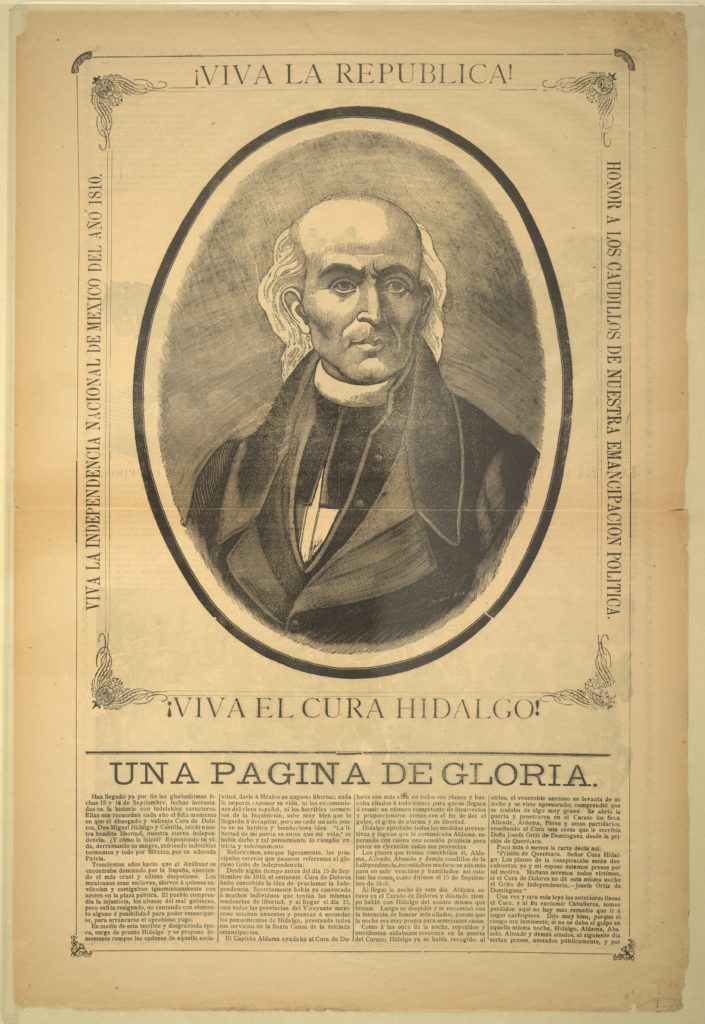
At age 55, Hidalgo was a tall, gaunt man with a high, domelike forehead and a long, narrow face. He carried his head habitually bent forward, giving him the appearance of a true contemplative. But looks were deceiving. He had a restless, willful nature, and his expressive green eyes shot fire when he argued politics. In his student days, he had won debates and honors; as a theologian he enjoyed considerable local renown. He was a visionary, resentful of authority and with a touch of the crusader about him. When first sent by Church authorities to Dolores, near Guanajuato, he took an avid interest in raising silkworms and cultivating grapes for wine, intending to provide self-supporting cottage industries for his Indian parishioners. With the same laudable intentions, he set up a pottery works and a leather-tanning shop beside his parish house. As his fascination with politics grew, his interest in other projects waned. Still, he did not entirely forget his poorest parishioners. Instead, taking them into his confidence, he set potters and tanners to the secret military task of making lances, slings and wooden swords against the day when he and other rebels would move to overthrow their Royalist oppressors.
Hidalgo was joined in his enthusiasm for revolt by Ignacio Allende, a fiery, multitalented young regimental captain from the nearby Bajío town of San Miguel. With a dashing military figure and Michelangelesque nose—broken during a village bullfight—he was a superb horseman, exemplary soldier, amateur matador, gambler and womanizer. Allende’s Spanish-born father had immigrated to New Spain, married into a prominent family of Creole or Spanish descent, and had become a wealthy merchant.
In New Spain, the social rank of people born in Europe was considered higher than those of European descent who had been born in the New World, though intermarriage between these two groups was a common pattern in the colony. Nevertheless, it was a pattern that created a bitter split in the social elite. The rift was doubly dangerous, since New Spain was already a divided society, in which Indians and persons of mixed blood outnumbered whites 10 to 1. When the ruling class of New Spain—Creoles and Spaniards—planned to square off against one another in full view of the natives, they did so at their own peril.
It was the established policy of the Spanish Crown to entrust the most powerful posts in the colonies to Spanish-born officials. Thus viceroys, treasurers, bishops and generals–who occupied the highest paying and most desirable posts—were sent out from Spain. However “pure” their own European blood, Creole men were barred from these influential positions. Immigrant Spaniards who benefited from the policy reinforced the myth that men born and reared in the tropical climate of the Americas lacked the physical and mental stamina of Europeans. As a consequence, the maligned Creoles (often the sons of influential Spanish fathers) had to seek careers in the lower ranks of the government, military and clergy.
Creoles such as Captain Allende, yearning for advancement in an army top-heavy with Spanish brass, faced this frustration daily. The feud had plagued the white upper class for years, but by 1810, with the once-powerful Spanish monarch now a craven captive in a Bayonne jail, it had reached a flash point. For the first time in three centuries, a power vacuum existed in New Spain, and ambitious, resentful Creole aristocrats meant to fill it.
Allende’s vision of the revolt was that of himself riding at the head of a triumphant rebel army of trained Royalist soldiers—defectors all—drawn from proud provincial regiments. Upper-class Creoles would flock to join an openly anti-Spanish crusade. Hidalgo, however, imagined machete-wielding Indians overthrowing the Spaniards–blind to the fact that formation of such an Indian army would likely drive propertied Creoles straight into the arms of conservative Royalists.
Abad y Quiepo, the 55-year-old bishop-elect of the Diocese of Michoacán, was a Spanish-born prelate who had spent years in New Spain and loved the country and its people. Gifted with a keen mind, a fighting spirit and an eloquent tongue, he was also an ardent advocate of ideas associated with the European Enlightenment and social reform. The racial inequities in America disturbed him deeply. Working tirelessly for the economic and social advancement of the same poor Indians with whom Hidalgo sympathized, Quiepo routinely fired off letters to the viceroy in Mexico City and the king in Madrid, advising drastic changes in oppressive policies. He also expressed grave concern over the social breach between the two white camps and urged lifting the onerous tribute to the Crown that the Indians despised.
This liberal, thoughtful prelate was Hidalgo’s ecclesiastical superior from the early years of his career and had detected in him, as a young man, a disinterest in his priestly role that was alarming. As a result, Quiepo had early on tactfully persuaded Hidalgo to resign a position as college rector (rather than arrange for him to be dismissed from the post), citing long-unpaid debts he owed the school. Reassigned to a village curacy, Hidalgo was later exposed as living a scandalous life of partying, gambling and living openly with a mistress. Mindful of Hidalgo’s sincere charity toward his poorest parishioners, however, Quiepo quietly had him transferred to Dolores. Now, in September 1810, the prelate planned to visit him there, unaware that Hidalgo’s parish house had become a powder keg.
In that same fateful month, Spanish-born Brig. Gen. Don Félix María Calleja del Rey, who had also just turned 55, began eyeing retirement. A career officer, he had come to New Spain 20 years earlier after soldiering in North Africa and Gibraltar, then teaching nine years at a military college in Spain. Appointed viceroy of New Spain, he felt his qualifications were ideal for the post—the army required a firm, experienced hand, for the colony had had no serious need for a military presence since the 16th century.
Calleja proved a dynamic and popular leader. He worked hard at reorganizing the colony’s vulnerable northern frontier defenses and at training the fledgling army. Reflecting the French influence on Spain’s Bourbon kings, he implemented military reforms. He replaced the old brigade structure with regimental and corps units, like those employed by the French; pushed for reductions in the excessive number of generals; and supported the founding of military academies, like the one in Spain where he had taught.
In 1810, Calleja commanded the Army of the Center based in San Luis Potosí, to the north of Bajío. Another Spaniard, General Manuel Flon, was his counterpart in the south. Both armies were well trained, but small. Along with provincial regiments, the Royalists numbered scarcely 30,000 men, but Calleja saw no cause for concern. On the contrary, the colony was peaceful and prospering as never before. As for his own future, he had married into a prominent Creole family and was looking forward to enjoying a comfortable old age on his country estate. His awakening to the political realities in the fall of 1810 would be a rude one.
A fifth man whose personal destiny would be changed by Hidalgo’s revolutionary dream was Don Antonio Riaño, governor of the silver-rich province of Guanajuato. A close friend of Bishop Abad y Quiepo and of General Calleja, he had come to the Americas as a Spanish officer in the mid-1770s, and between 1779 and 1781 he had fought the British in Louisiana and Alabama as an ally of the North American colonists in their war for independence.
Riaño’s charm won the hand of a beautiful Louisiana-French Creole bride, and his signal victories over British troops netted him appointment to a provincial governorship in New Spain. As Riaño was both a military leader and an intellectual, his Guanajuato mansion became a magnet for educational and cultural gatherings in the province. Among the guests who had attended Riaño’s soirees was Father Miguel Hidalgo, who seemed to him to be a mild-mannered country priest who took delight in arguing the fine points of theology.
In the early morning hours of September 16, 1810, a courier who had ridden all night brought Hidalgo and Allende the dismaying news that their planned revolt had become known. On the previous day, one of their co-conspirators had panicked and divulged the arrangements they were making for a December uprising to Riaño. The messenger advised them to flee before the governor could order them hanged for treason. Father Hidalgo, so legend has it, then buckled on a sword and dramatically declared in ringing tones: All may seem lost, but in action, all can still be saved! We now have no choice but to go out and seize the Spaniards!”
When his parishioners, mostly farmers and workers from the countryside around Dolores, gathered for the early Sunday Mass, Hidalgo addressed them. According to witnesses, his Grito, or call to arms, which was to become famous, was: “I ask you to join my Reconquísta, to fight at the side of our legitimate ruler, King Ferdinand VII of Spain! I cannot speak longer, for all is being done in great haste and I must go!” Then, his eyes flashing, he cried, “Death to the Gauchupines! Long live the Virgin of Guadalupe! Down with bad government! Now let us go and seize the Gauchupines!”
Adopting Hidalgo’s derogatory reference to their Spanish-born overlords, the crowd took up the popular cry. At the same time, his Indian factory workers came racing through the plaza bearing torches and brandishing machetes. Within minutes, the town regiment defected en masse to Captain Allende. The jail was emptied of potential rebel recruits, and shops and businesses owned by Spaniards were broken into and plundered. Bewildered Spaniards were dragged from their beds as the mob rushed in to loot their homes. Creole wives and children looked on helplessly as husbands and fathers were taken hostage, roped together and driven to the next destination, Allende’s home town of San Miguel. There, the crowd, now out of control, enacted similar horrific scenes, often over Captain Allende’s vehement protests. Hidalgo’s rampaging Indian horde had swelled to several thousand.
Continuing his march across Bajío, Hidalgo and his followers took town after town without firing a shot. They merely threatened to slit the throats of the 100 or more Spanish hostages if city gates were not opened to him. Everywhere, Spaniards were jailed or taken hostage, their money and properties seized to fund the burgeoning rebel war chest. In the process, Hidalgo dropped his false posture of loyalty to Ferdinand VII, instead declaring openly for an independent Mexico. He also sent a message to Governor Riaño that he was marching on Guanajuato.
As governor, Hidalgo’s former host had constructed an imposing stone building to serve as the city’s alhóndiga, or granary. Located in the center of town, the two-story rectangular structure was built, fortresslike, around a central patio with a water well. The exterior was plain, except for three horizontal rows of small square windows evenly spaced about three yards apart. Each window marked the head of a grain bin, 50 of which opened off the lower and upper loggias in the courtyard. To facilitate making a stand against the rebel forces, Riaño fortified the alhóndiga, his regiment digging moats and erecting barricades in surrounding streets. With food stores sent in and the convenient well, he hoped to withstand a lengthy siege.
Very worried, he sent a fast courier to General Calleja in San Luis Potosí. “My Most Esteemed Friend and Commander: I write you in an hour of dire necessity…Spies inform me Hidalgo’s forces are now twenty-thousand strong….I am prepared to resist as best I can because I am an honorable man. [But] I beg you, my friend, in the name of God, to hasten to my aid: we can hope for no other succor short of a miracle!”
The governor ordered all the city’s tax monies and administrative records stored safely inside the granary. Mine owners lugged in heavy bars of silver, then hastily buried costly heirlooms, family jewels and silver service deep in the golden grain of the bins. Both Riaño and Calleja knew the city itself was not defendable, since it was situated in bowl-shaped terrain with treeless hills ringing it on every side. Citizens boarded up windows and barred their doors, locking themselves inside to pray for deliverance. Above the town, the mines lay idle and abandoned. Mine workers watched from the hilltops. They knew the city’s wealth exceeded 20 kings’ ransoms, and if the rebels took it, the workers wanted first crack at the plunder.
As September 28 dawned, the town braced itself for the dreaded invasion, all eyes on the alhóndiga. Inside was the town regiment and all the civilian volunteers Riaño could muster and arm–a courageous but hopelessly outnumbered force of less than 500 men against an expected 20,000. In the early morning, final word came to Riaño from Hidalgo, now at the edge of town: “Your Honor will be pleased to tell the Spaniards…with you in the alhóndiga that…if they do not obey my demand to surrender, I shall use every means to destroy them, leaving no hope of mercy or quarter.’ When the governor relayed this message to his men, Spaniards and Creoles shouted as one, “Victory or death, long live the king!” Back inside his command post, Riaño turned to an aide, tears in his eyes, and asked, ‘Whatever is to become of my poor, dear child of Guanajuato?”
At noon, Allende’s regimental cavalry appeared and charged the alhóndiga. Repelled by a withering volley from the barricades, they broke down the doors of nearby homes whose flat rooftops overlooked the granary. Riaño hurried out to rally those manning the barricades, then raced back to reenter the granary by a side door. A rooftop sharpshooter cut him down with a single bullet to the brain.
Inside the granary, their leader’s death caused horror, but the defenders maintained a murderous fire and rained down deadly homemade grenades on the leaderless tide of Indians now engulfing the outer walls. Those in the forefront who tried to escape by turning back were driven forward by pressure from those behind. Rebel trod on rebel, dead or alive, but there were thousands more to replace those who fell. A group of Indians, farther away, released a blizzard of stones with slingshots, driving defenders on the granary roof inside. Meanwhile, Allende’s men occupied a strategic hill above the alhóndiga and the riverbed below, supplying the slingers with stones. Hidalgo, having commandeered Royalist barracks, sipped hot chocolate while the battle raged.
From their windows, civilians saw the Indian horde torch the granary’s wooden doors, smash them in and then, howling in triumph, race inside. The few defenders who survived the ensuing bloodbath were stripped and paraded through the streets. Riaño’s naked body was hoisted up on a flagpole and exposed to public view for two days. At nightfall the sack of the city began, a drunken orgy of rape and looting, lasting well into the next day. Some women escaped by fleeing from rooftop to rooftop, many with infants in their arms. Mines and costly mining machinery were systematically wrecked, some so extensively that they remained inoperable for years. Horrified by the chaos, Allende denounced Hidalgo publicly for indulging his unruly, rampaging Indian rebels. Hidalgo retorted in front of his men—a slight Allende would not forget.
In mid-October, after having feverishly hammered groups of inexperienced recruits into a semblance of disciplined fighting units, General Félix Calleja marched this army out of San Luis Potosí–3,000 cavalry, 600 infantry and four cannons. When Calleja had first received Riaño’s eleventh hour plea, he had to face the incontrovertible fact that his own small existing force would have been cut to pieces, along with Riaño’s 500. He had had to swallow the grief and bitterness of abandoning his trusted friend to his fate, then set himself to the daunting task of building a military machine capable of destroying Hidalgo.
Meanwhile, flushed with victory, Hidalgo led his Indian horde toward Mexico City, many dressed in fine silks and velvets and lugging stolen carpets, wrought-iron window rejas (barred grillwork) and doors. Near the end of October, Allende positioned his small army in the mountain pass of Las Cruces, 30 miles west of the city. In the distance shone the bright, multitowered capital, the richest jewel in the Spanish colony’s crown. Magnificent stone mansions and public buildings, shops, the mint, the viceregal palace, 2,000 coaches and hundreds of richly adorned churches, monasteries, convents and libraries were all waiting to be plundered. With a horde of 80,000 at the city gates and only 2,500 troops to defend them, the people of Mexico City were in a state of panic.
At Las Cruces, the Royalist defenders of the city fought furiously. Among Hidalgo’s vast following, scarcely 1,000 had firearms, but weaponless and naïve Indians clambered fearlessly up steep hillsides to cover the mouths of cannons with their own straw sombreros, believing these would stop the deadly cannonballs from coming out. In two days and nights of savage combat, the carnage on both sides was horrible. Of the 2,500 Royalists, a mere 200 survivors straggled back to the capital to await the invasion.
Then, for some reason which neither Hidalgo nor Allende ever explained to anyone, no invasion followed. For two days they made an effort to negotiate with the commander of Mexico City’s defenders, but he refused to talk or surrender. Some believe Hidalgo panicked, thinking Calleja—whom he greatly feared and whose whereabouts were unknown–might catch up to him unexpectedly. For whatever reason, he ordered his forces out of Las Cruces and turned them west toward Valladolid (now Morelia) in Michoacán.
Valladolid was the cathedral city of Bishop-elect Abad y Quiepo. Enraged that the prelate, reacting to Hidalgo’s rebellion, had put him and his followers under an edict of excommunication, Hidalgo vowed to take him hostage, but Quiepo had already fled. An increasingly exasperated Allende panicked, and tried to assassinate Hidalgo by poisoning his wine, but the wily priest made his suspicions of Allende known by employing a taster.
The rebels moved on to Guadalajara, with Calleja in hot pursuit. Finally forced to make a stand, Allende dug in on the bank of the Calderón River with a steep bluff at his back and the river serving as a moat before him. The position was impregnable except by open attack across a grassy plain separating the armies. Spies informed Calleja that the rebels had 6,000 cavalry, but only 600 muskets, and 5,000 infantry-archers. The remaining members of Hidalgo’s 80,000-man army carried lances, machetes or slings. Against Allende’s military advice, Hidalgo deployed his infantry in cumbersome divisions of 1,000 men each. On the fateful morning of January 16, 1811, a puffed-up Hidalgo told his followers, ‘I’ll breakfast in Guadalajara, dine at the Bridge of Calderón and sup in Mexico City!’
Calleja divided his forces into three groups. General Flon would attack the rebels’ left flank while a crack cavalry troop engaged their right. Calleja positioned himself in the center, poised to support either wing. As the Royalists charged across the open plain, a naked assault on a nearly unassailable position, rebel cavalry drove back Flon’s attack against a strong enemy battery. Seeing Flon overwhelmed, Calleja hurled his reserves, supported by 10 artillery pieces, at the rebels’ countercharge.
At that moment, Royalist artillery fire struck a loaded rebel ammunition wagon. It went up in a stupendous explosion, igniting the dry winter grass of the plain. Panic-stricken Indians scattered in a universal rout. Seizing the fortunes of battle, Calleja stormed the cliffs behind the rebel entrenchment, driving the enemy from the field. At Calderón, Calleja finally broke the back of Hidalgo’s revolt.
With his sense of military honor outraged, Allende paused long enough in flight to strip Hidalgo of command, and the priest traveled on as his prisoner. The new commander hurried north to cross into the United States, convinced he could get financial aid, arms and diplomatic recognition from President James Madison, and bring 30,000 Yankee mercenaries back with him to Mexico. But there were rebel officers who bore professional grudges against Allende, believing he had denied them deserved promotions. One former Royalist regimental, a double turncoat, betrayed him.
On March 21, 1811, as the column of 14 coaches and 1,000 Allende followers neared the border, the traitor arranged for their ambush by telling Allende an ‘honor guard’ awaited him ahead at the Wells of Beltran. When Allende’s coach stopped to water his horses and his men, a Royalist pulled open the door, pistol in hand, and cried, ‘I order you to surrender in the name of the king!’ Hidalgo, riding in a different section of the procession, was also taken prisoner soon after.
Following a trial, the key conspirators were convicted and sentenced to death by firing squad. Hidalgo was the last to die. He said he regretted the ‘rivers of blood’ he had unleashed, and admitted, ‘None of us thought anything of sacrificing what others had legitimately earned or inherited.’ But remorse for widows and orphans was one thing–recanting his sacred cause of independence from Spain and freedom for the poorest in the colony was another. To his final breath he swore he was destined to do exactly what he had done.
Antonio Riaño died at the alhóndiga. Calleja became viceroy, but later, embittered and traumatized by the revolt, retired to Spain. Proud Allende, convicted as a traitorous soldier, suffered the indignity of being shot in the back by his executioners.
The prelate Abad y Quiepo endured perhaps the cruelest martyrdom. With Ferdinand VII restored to the Spanish throne, Quiepo traveled to Madrid to report details of the revolt–whereupon that vengeful monarch accused him of inciting the revolt with his support for radical social reforms and ordered him incarcerated for life in a remote convento in Spain. The Hidalgo revolt began as opéra bouffe, but for five of its principal figures, it ended as tragedy.
This article was written by Diana Serra Cary and originally published in the October 2000 issue of Military History magazine. For more great articles be sure to subscribe to Military History magazine today!