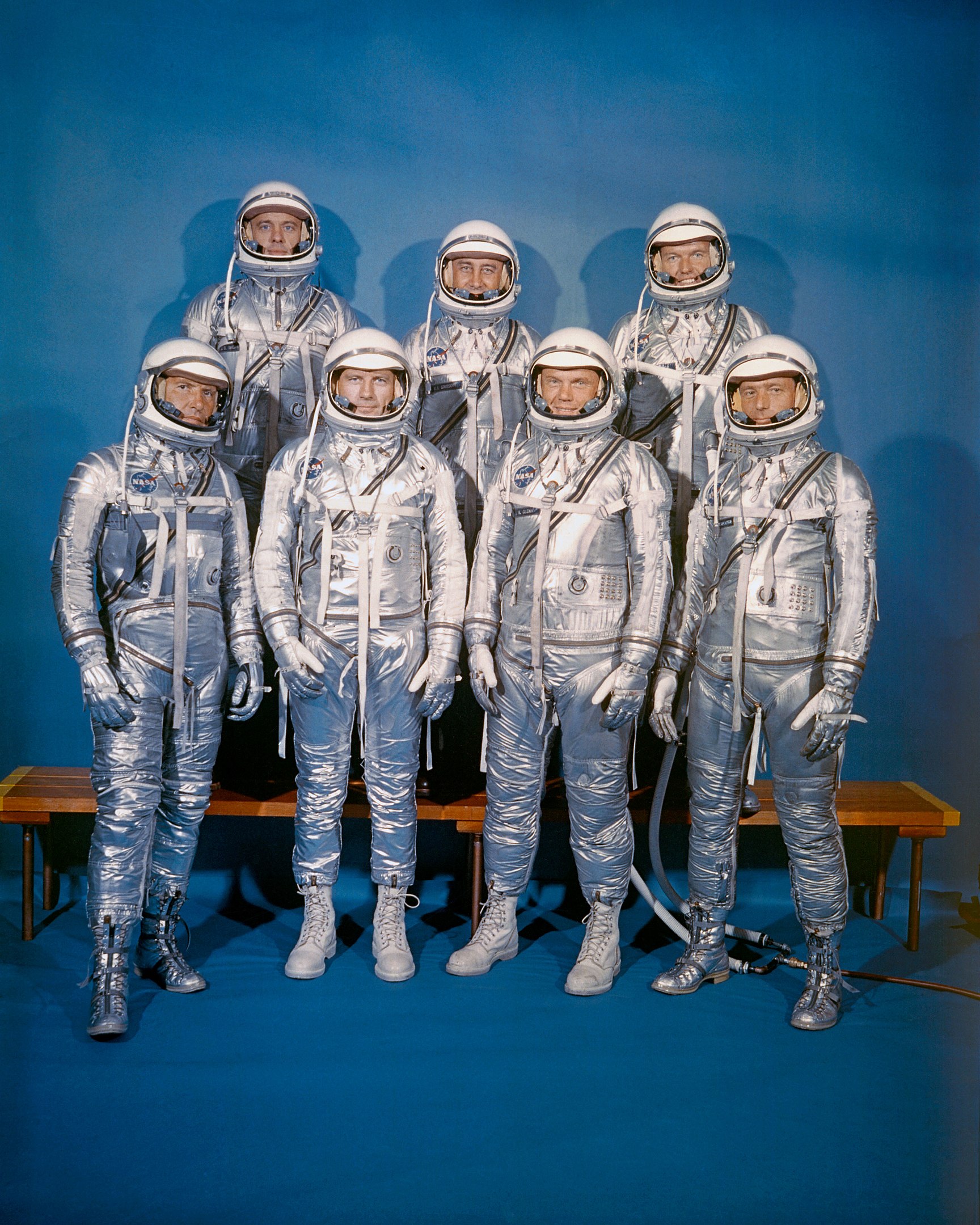
In February 1962—just nine months after President John F. Kennedy called for the U.S. to put a man on the moon before 1970—Mercury astronaut John Glenn became the first American to orbit the Earth.
On the morning of February 20, 1962, millions of Americans collectively held their breath as the world’s newest pioneer swept across the threshold of one of man’s last frontiers. Roughly a hundred miles above their heads, astronaut John Glenn sat comfortably in the weightless environment of a 9 1/2-by-6-foot space capsule he called Friendship 7. Within these close quarters, he worked through his flight plan and completed an array of technical and medical tests as he cruised through the heavens.
It offered the legroom of a Volkswagen Beetle and the aesthetics of a garbage can, but the small capsule commanded an extraordinary view of the planet Earth. Through the craft’s window, Glenn saw thick, puffy, white clouds blanketing much of southern Africa and the Indian Ocean. The Atlas Mountains of North Africa stood like proud, majestic statues on a planet that seemed as timeless as the stars that twinkled an eternity away. Dust storms blew across the deserts, and smoke from brush fires swirled into the atmosphere.
“Oh, that view is tremendous,” Glenn remarked over the radio to capsule communicator (Capcom) Alan Shepard, his fellow Mercury astronaut stationed back at mission control. As Friendship 7 passed over the Indian Ocean, Glenn witnessed his first sunset from space, a panorama of beautiful, brilliant colors. Before the conclusion of that historic day, he would witness a total of four sunsets—three while in earth orbit, and the fourth from the deck of his recovery ship.
For Glenn, the historic voyage of Friendship 7 remains as vivid today as if it had happened yesterday. People still ask him what it felt like to be the first American to orbit the earth. And often he thinks of his capsule’s breathtaking liftoff and those subtle, emotionally empowering sunrises and sunsets.
“Here on earth you see a sunrise, it’s golden, it’s orange,” Glenn recalled recently. “When you’re in space, and you’re coming around on a sunset or sunrise, where the light comes to you refracted through the earth’s atmosphere and back out into space, to the spacecraft that refraction has the same glowing color for all the colors of the spectrum . . . .”
There have been more than ten thousand sunsets since his orbital flight helped launch the United States deeper into a space race with the former Soviet Union. And although Glenn’s political career as a Democratic senator from Ohio has kept him in the public eye, he is remembered by many of his countrymen as the first American to circle the planet and as the affable spokesman for the seven Mercury astronauts.
Glenn marvels at how people all over the world still recall the heady days of the Mercury program. “It’s been heartwarming in some respects and it’s amazing in others,” he says. “I don’t go around all day, saying ‘Don’t you want to hear about my space experience?’ Quite the opposite. But if the kids come to the office here, or if I run into them on the subway and they want to stop a minute, I don’t hesitate to stop and talk. I think it’s good; I think that’s a duty we [former astronauts] have.”
By the time Glenn and Friendship 7 burst through the earth’s atmosphere, the United States was already a distant second in space technology, behind the Soviet Union. The race to begin to explore the universe had unofficially begun on October 4, 1957, when the Soviets launched Sputnik I, the world’s first artificial satellite.
“I think Sputnik sort of forced the hand,” explains Gene Kranz, who served as Project Mercury’s assistant flight director and section chief for flight control operations. “I think we found ourselves an embarrassing second in space and related technologies. We were second best, and Americans generally don’t like that kind of a role.”
President Dwight D. Eisenhower, however, was more concerned about the country’s security than its self-esteem. With the Soviets having the rocket power to propel a satellite into space, he wondered how long it would be before they were capable of launching a nuclear bomb toward the United States. In response to this perceived Soviet threat, Eisenhower signed the National Aeronautics and Space Administration (NASA) into being on July 29, 1958. One of the first assignments given to the new agency was to launch a man into space and return him safely to earth, and that fall, Project Mercury was created to fulfill that daunting task.
On April 9, 1959, NASA formally introduced to the world the seven test pilots who would, it was hoped, carry the U.S. banner to the heavens. Selected were: Lieutenant Commanders Malcolm Scott Carpenter, Walter Marty Schirra, and Alan B. Shepard of the Navy; Air Force captains Leroy Gordon Cooper, Virgil I. “Gus” Grissom, and Donald “Deke” Slayton; and Lieutenant Colonel John H. Glenn of the Marine Corps.
Born on July 18, 1921, Glenn was the oldest of the group, arguably the most celebrated, and an obvious candidate for Mercury from the beginning. A veteran of World War II and the Korean War, Glenn had flown 149 combat missions and been awarded the Distinguished Flying Cross five times. After completing test-pilot school in 1954, Glenn went to work testing the fastest jets America could produce. His career sparkled even more in 1957 after he set a transcontinental speed record for the first flight to average supersonic speed (700 miles per hour) from Los Angeles to New York.
From their first public appearance together, the Mercury 7 astronauts, as they came to be known, were celebrities and heroes. “We were at first extremely surprised when we were announced to the whole world, and how crazy everybody went over the whole thing,” laughs Cooper.
But enthusiasm for the project was one thing; making it a success was more difficult. There were countless variables and unknowns to conquer: weightlessness, a new capsule, an inconsistent booster in the Atlas rocket, and of course, the awesome specter of space. “To put it bluntly, we didn’t know what we were doing in many areas of the Mercury program and we were fortunate our country understood there was no achievement without risk,” admits Kranz.
As the Mercury project evolved and moved into the next decade, NASA found a crucial supporter in President John F. Kennedy. Just weeks into his term, however, the Soviets scored another technological coup. On April 2, 1961, Soviet Cosmonaut Yuri Gagarin became the first human to fly in space, orbiting the earth once during his one hour, 48-minute flight, which came just three months after a U.S. Redstone rocket had carried a chimp named Ham into space and brought him safely back.
On May 5, 1961, Alan Shepard made America’s first, manned suborbital voyage, flying for 15 minutes and reaching an altitude of 116 miles. Compared to Gagarin’s flight around the world, Shepard’s 302-mile mission was a mere stopover between ports of call. It was, however, a major boost to America’s pride. While Gagarin flew under a cloak of secrecy, Shepard’s flight was broadcast live on television.
The early success of the Mercury Program spurred President Kennedy to inspire NASA to reach for new heights. On May 25, he grabbed the world’s attention when he told Congress that the nation’s new goal was to complete a manned trip to the moon before the end of the decade. For the first time in its space duel with the Soviet Union, the United States, which had so far amassed just 15 minutes of manned space-flight time, had set the stakes. Gene Kranz recalls with a laugh that “. . . we thought he was crazy,” but the astronauts also felt energized to meet the new challenge.
NASA turned its efforts up a notch that summer. In July, Gus Grissom replicated Shepard’s short suborbital flight, and by the fall, NASA was ready to attempt putting a spacecraft in orbit. As a final test in preparation for a manned trip, a chimpanzee named Enos was launched into space in late November. The craft carrying Enos completed two orbits before landing safely back on earth, after which NASA announced that on December 20 of that year, John Glenn would make the first American orbital flight.
Before taking this next giant leap toward the moon, however, NASA had to ensure that an astronaut could function in a weightless environment for an extended period of time. Some scientists feared that without proper equipment and technology, a space traveler’s eyeballs would bulge out of their sockets and change shape. This, in turn, would distort his vision and preclude his flying the craft should any of the automatic controls fail. Also, scientists feared that fluid in the inner ear might float freely into the air and that Glenn would become so nauseated and disoriented that he would be unable to perform his tasks.
In addition to its concerns about Glenn’s adaptability to weightlessness, NASA worried about the inconsistent Atlas booster, the huge rocket designed to push Glenn’s ship into orbit. Two of the five unmanned test firings conducted on the 93-foot Atlas prior to Glenn’s mission had failed. The memory of one of those failures has remained vivid for Glenn. It was a night test, he remembers, “and it was very dramatic–searchlights and a beautiful starlit night. Not a cloud in the sky. They light this thing, and up she goes . . . . At about 27,000 feet it blew up right over our heads. It looked like an atom bomb went off right there.”
To add to the mounting tension, poor weather and mechanical problems with the rocket forced NASA to “scrub” Glenn’s scheduled mission nine times. Finally, on February 20, 1962, seven months after America’s last manned flight, John Glenn would don his bulky pressure suit for what would be the final time.
Rising out of bed in his “ready room” at NASA’s spacecraft center at Cape Canaveral, Florida, at 2:20 a.m., he checked the weather report, which indicated a fifty percent chance of rain. Glenn showered and shaved and had the customary astronaut’s breakfast of steak and eggs, before taking a pre-flight physical. If the many weeks of anticipation weighed on Glenn’s mind, his body did not reflect it.
Four hours later, Glenn made the short ride to the rocket’s launch site. When he emerged from the transfer van, Launch Pad 14 resembled a movie set as giant floodlights waved streams of milky white upon the rocket and the surrounding area. The huge Atlas was a glowing silver sword in the coal-black night. “My flight was–it was like you staged it,” recalls Glenn. “It was Hollywoodesque.”
Two hours before his scheduled liftoff, Glenn squeezed into the cramped cabin of Friendship 7, perched atop the Atlas rocket. The sky was clearing, and just before 8:00 a.m. technicians began the laborious task of bolting on the entry hatch of the craft. Sealed inside the capsule, Glenn felt truly alone. The minutes ticked by slowly as he calmly and methodically worked through his preflight checklist. Finally, Glenn heard the flight team give his mission an “A-OK” over the radio. With all systems functioning normally, Glenn acknowledged his preparedness with a firm “ready.” As the final countdown to liftoff began, backup pilot Scott Carpenter’s voice crackled over Glenn’s radio: “Godspeed, John Glenn.”
At 9:47 a.m. the rocket’s three engines ignited. Friendship 7 began to vibrate as the mighty Atlas built up 350,000 pounds of thrust, the force needed to lift Glenn and his craft into orbit. For a few interminable seconds, the massive rocket held steady. Finally, its hold-down clamps released, and the Atlas slowly, agonizingly clutched and pulled at the bright blue sky. “We are underway,” Glenn reported to Mercury Control.
Minutes later, Glenn was a hundred miles above the earth and traveling at more than 17,000 miles per hour. With all systems running smoothly during his initial orbit, Control advised him that he “had a go” for at least seven turns around the earth. Unlike Soviet Cosmonaut Gherman Titov, who had experienced nausea and dizziness during his recent 16-orbit flight, Glenn worked and ate without difficulty. As he gazed earthward through the capsule’s window, he noted how fragile the planet appeared, shielded from the unforgiving vacuum of space by a film of atmosphere that seemed no more dense than an eggshell.
Back at Mercury Control, the flight team, headed by Chris Kraft and Kranz, kept their focus on more practical considerations. After Glenn’s first orbit, Control had received a telemetry signal indicating that his capsule’s heat shield might be loose. If that signal was correct, Glenn and the spacecraft would disintegrate in the three-thousand-degree heat generated by reentry into Earth’s atmosphere. There seemed to be only one solution to this potentially tragic problem. If Glenn refrained from jettisoning the ship’s retro-rocket package, a normal procedure just before reentry, its titanium straps might hold the shield in place. Control advised Glenn of their decision to end his flight and ordered him to plan for reentry after his third orbit.
Unwilling to burden Glenn with concern over the possible heat-shield malfunction, Control offered no explanation for their decision until he was safely home. Glenn was suspicious, but all parts of Friendship 7 seemed to him to be working properly so he concerned himself only with what was within his control. Before long, the capsule splashed down safely in the Atlantic Ocean.
“When I started back in through the atmosphere, when the straps that held the retropack on burned off, one of them popped up in front of the window,” Glenn remembers. “I thought the retropack or the heat shield was breaking up. It was a real fireball. But the heat shield worked fine.”
Glenn’s flight was a public relations boon for the U.S. space program. He returned to a hero’s welcome and a wildly emotional New York City ticker-tape parade. The United States had made a significant step forward in its competition with the Soviet Union and its quest for the moon. Few people knew, however, that the nation’s most famous pilot would never again fly in space.
As Glenn recalls, “President Kennedy had passed word to NASA, and I didn’t know this for some years, that I was not to be used again on a flight, at least for a while. You can’t believe being the focal point of that kind of attention when we came back. I don’t know if he was concerned about political fallout, or what.” Glenn was disappointed that he never again traveled into space, but declares, “I don’t feel cheated because I had such a tremendous flight.”
Three years after the confetti and streamers had blown away, John Glenn left NASA and, relegating space flight to a vivid memory, moved into another public arena. Politics is a high-profile world in which Glenn’s clean-cut image and amiable personality easily endeared him to his constituents and to the public in general. In 1974, he was elected to the U.S. Senate by his home state of Ohio, an office he has held through three more terms.
Despite the passage of more than a quarter-century, Glenn easily recalls the innocent joy he found in those wondrous space sunsets. He has never lost the ability to draw inspiration from his experiences and to channel it into a positive outlook. “I think its an attitude,” he says, of maintaining his inner youth. “I think kids have an expectation of what’s going to happen tomorrow. I think some people are able to maintain that whole thing, this expectation about what they’re looking forward to.”
Not surprisingly, Senator Glenn can easily find his time consumed by the business of Capitol Hill. But when a red-headed, freckle-faced teenager with blue eyes ablaze asks Glenn to describe a launch or splashdown, the senator from Ohio again becomes one of America’s first astronauts, as he relives that historic day in 1962 when time stood still and three space sunsets blazed like campfires of a thousand sparkling colors.
Bryan Ethier is a freelance writer from Connecticut. After Mercury, his retrospective book on the effect the Mercury Space Program has had on the world, will be published in the spring by McGregor Hill.
This story was originally published in the October 1997 issue of American History Magazine. For more content, subscribe here.