“Suddenly, this story came in and took possession. It really seemed to write itself.”–L. Frank Baum
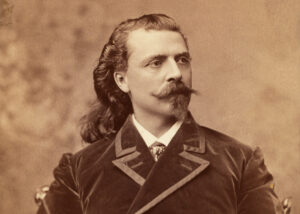
In 1881, L. Frank Baum was a tall, handsome bachelor with a rheumatic heart but an invariably sunny disposition who managed his uncle’s chain of opera houses in upstate New York and Pennsylvania. Young Baum’s most successful production was a musical melodrama, The Maid of Arran, which he wrote and starred in himself. Several women in the Baum clan fretted that the delicate 25-year-old, who seemed forever lost in the world of his imagination, had yet to settle down and begin raising a family. So when he returned home to the Syracuse area that Christmas, they conspired to fix him up at a holiday party with the dark-haired 20-year-old roommate of one his cousins at nearby Cornell, the first Ivy League college to admit female students.
“Frank Baum,” said his Aunt Josephine at the party, “I want you to know Maud Gage. I’m sure you will love her.”
“Consider yourself loved, Miss Gage,” quipped Frank.
“Thank you, Mr. Baum,” replied Maud. “That’s a promise. Please see that you live up to it.”
Frank and Maud were smitten with each other from the get-go—and that did not please Maud’s mother in the least. Matilda Joslyn Gage, the most radical leader of America’s woman’s rights movement, stood shoulder-to-shoulder with Susan B. Anthony and Elizabeth Cady Stanton as a co-founder of the National Woman Suffrage Association. Notoriously argumentative, she was known for her ability “to detect and register any masculine deficiencies with phenomenal accuracy.”
When Frank proposed to Maud in the front parlor of her Fayetteville, N.Y., home one evening in 1882, Matilda blew up. She lambasted Maud for wanting to drop out of college to become a housewife and said, “I will not have my daughter be a darned fool by marrying an actor who is on the road most of the time, jumping from town to town on one night stands, and with an uncertain future.”
The couple married anyway and Baum proceeded to fulfill Matilda Gage’s worst fears, proving a failure at a variety of other occupations as he constantly uprooted his wife and family in search of a better situation. Then, at age 44, Baum finally hit pay dirt by penning America’s most enduring tale of fantasy and adventure—The Wizard of Oz—which ultimately was transformed into the iconic 1939 film that has been seen by more people than any other motion picture in history.
.jpg) Some have speculated that Oz is an allegory, a veiled parable of the Populist movement that swept the country in the 1890s. But new research, including recently discovered newspaper writings by Baum as well as previously unpublished letters of Matilda Gage, reveal an unlikely source of inspiration for the fairy tale: Baum’s indomitable mother-in-law.
Some have speculated that Oz is an allegory, a veiled parable of the Populist movement that swept the country in the 1890s. But new research, including recently discovered newspaper writings by Baum as well as previously unpublished letters of Matilda Gage, reveal an unlikely source of inspiration for the fairy tale: Baum’s indomitable mother-in-law.
Shortly after Frank and Maud wed in November 1882, the new bride joined the theatrical troupe as it embarked on a multi-state tour of The Maid of Arran. But things began to unravel when the troupe arrived on the bleak, treeless plains of Kansas, which had recently become a prohibition state. Ticket sales were poor, and the trip that began with such excitement now turned tiresome, especially to Maud. “I don’t think much of Kansas,” she wrote. “The hotels are dreadful. It’s N.G. [her abbreviation for No Good.] I couldn’t be hired to live here.” Baum would never again return to Kansas, except in his future fables.
The tour ended as financial fiasco—and with Maud pregnant. The young couple returned home to Syracuse only to face debts and obligations. With a baby on the way and a disapproving mother-in-law, Baum was forced to abandon his childhood quest to become a great writer and find a more conventional line of work. One of the Baum theaters burned down, while the others were shuttered. So Frank joined a branch of the family oil business, Baum’s Castorine Co., selling cans of lubricant for machines and buggy axles. He wrote slogans for an oil that “Never Gums” in the heat and “Never Chills” in the cold and was “so smooth it makes horses laugh.” Years later, Baum’s oilcans would be mythologized by one of his many memorable characters, the Tin Woodman, who was in constant need of a few drops.
But when Baum’s real-life oil enterprise failed after five years of effort, he threw up his hands. “I see no future in it to warrant wasting any more years of my life,” he concluded.
In the meantime, Maud’s father, Henry Gage, died and Matilda Gage found cause to launch a new political campaign. She had grown disgusted that her two suffragist colleagues, Anthony and Stanton, were courting the support of the Woman’s Christian Temperance Union, whose main aim wasn’t to win rights for women but to take down the constitutional wall between church and state, enact prohibition nationally, and make the rest of America as dry and moral as Kansas.
In response, Gage formed her own group, the National Women’s Liberal Union. She spoke and wrote about how governments and churches have persecuted innocent women throughout the centuries by accusing them of heresy and witchcraft. “As soon as a system of religion was adopted which taught the greater sinfulness of women,” Gage wrote in Woman, Church and State in 1893, “the saying arose: One wizard for every 10,000 witches, and the persecution for witchcraft became chiefly directed at women.”
Baum the fantasist was haunted by his mother-in-law’s vivid descriptions of witch-hunting, a motif that would provide the climax in Oz when the Wizard commands Dorothy and her companions to hunt down the Wicked Witch of the West. At the same time, Baum the gentle-hearted family man sympathized with Matilda Gage as politicians and religious leaders denounced her activities as “satanic.” Instead of viewing her as a hectoring shrew, Baum came to regard her as a spiritual mentor.
The turnabout took place in the Dakota Territory, where the Baum family relocated in 1888. Enticed by the promise of fortune and adventure, Frank saw the West “as a place where a man can be somebody.” In the town of Aberdeen, he opened a variety store called Baum’s Bazaar, stocking it full of novelty items and toys, which naturally drew the town’s children. Gage came to spend the winters with the Baums and to campaign for suffrage there. When Frank would tell whimsical tales to his own sons or the kids in the store, she would insist that he put them to paper. “Frank,” she said, “you must write your stories down.” He resisted, in part because he was so busy running the store—until
it too went bust.
To help them get through the tough times, Gage imparted to her daughter and son-in-law a faith that she called “the crown blessing of my life.” The Theosophical Society, founded by the world-traveler Helena Petrovna Blavatsky in 1875, offered up a newfangled amalgam of Buddhism and Hinduism that spoke of following life’s golden path to enlightenment, a journey to find the wisdom, compassion and courage within. While Baum actually walked on a physical yellow brick road as a teenager on his way to boarding school, it was his reflections on Theosophy later in life that seemed to give the famous footpath in his story its higher meaning. Theosophy appealed to both Frank and Maud because it seemed to be a way to transcend the disappointments of ordinary life. Members of the Theosophical Society often discussed how to meditate so intensely that they could realize an out-of-body experience in a mystical dimension called the “Astral Plane.”
After his variety store failed, Baum began publishing a newspaper, the Aberdeen Saturday Pioneer, in which he chronicled the hard times on the Great Plains, a land of deadly droughts and terrifying tornados. In one article he described a twister that demolished a neighbor’s barn and launched a pig hiding in a buggy a distance of 300 feet. “The pig was quite uninjured,” he wrote, in what would turn out to be a preview of Dorothy and Toto’s safe landing in the Land of Oz.
When his newspaper failed in early 1891, Baum was broke and desperate and left his wife and four sons in South Dakota to look for work in Chicago, a place of hopes and dreams that would soon host the Columbian Exposition. Builders were busy erecting a glimmering White City for the World’s Fair that would one day inspire Baum’s Emerald City of Oz.
Newly uncovered writings from Baum’s short stint as a reporter for the Chicago Evening Post offer clues about his frame of mind at the time. His first piece for the newspaper was a front-page article on May 1, 1891, about the experience of relocating to a new home. “Many a proud man will sleep on the floor tonight,” he wrote, “for this is moving day. This is the day when man lives as it is written he shall, by the perspiration of his brow. Also is it the day when the wife…whispers in your ear the beauty of the poet’s tip that there is no place like home.” Baum’s declaration that “there’s no place like home” was ironic, since he wrote the piece on a day he was moving into a slum, the worst place he would ever live, and his family had yet to join him in Chicago. But the piece reflected his unfailing optimism and was accompanied by a telling illustration, depicting four traveling companions who carry their possessions down a road—accompanied by a little dog.
Baum’s next front-page story came a week later. The morning papers carried the news that Madame Blavatsky was dead at age 60. Instead of penning a serious piece about Blavatsky or Theosophy, Baum took a humorous slant. The headline read: “An Astral Vacation: Mme. Blavatsky Is Not Dead, but Taking a Rest.”
Baum’s wife and sons arrived soon after and, in addition to becoming deeply involved with Maud in the activities of the local Theosophical Society, he was swept up into the swirl of anticipation at the new technological marvels that would be unveiled at the World’s Fair. Baum reported on a visit to town by the inventor Thomas Alva Edison, who happened to be a Theosophist, and quoted the Wizard of Menlo Park’s description of the wonder he planned to showcase at the fair: “I hope to be able to throw upon a canvas a perfect picture of anybody and reproduce his words.” Baum also expressed awe at Edison’s appearance. “A massive head is his,” he wrote, foreshadowing his description in Oz of a wonderful wizard who first appears only as “an enormous Head, without a body to support it or any arms or legs whatever.”
The World’s Fair came and went and by 1895 Baum was still struggling to support his family—as a traveling salesman of fine china. Matilda Gage tried in vain to get her son-in-law to enter a contest in The Youth’s Companion that offered a prize of $500 for the best short story for young adults. Nonetheless, she planted a seed of inspiration. “Now you are a good writer and I advise you to try,” she suggested in a letter. “If you could get up a series of adventures or a Dakota blizzard…or maybe bring in a cyclone from North Dakota.”
Frank Baum’s mother-in-law was silenced by a stroke and died in March 1898, at the age of 72. But shortly before she passed on, she penned a prophesy that seems to portend Baum’s dual view of witches in Oz as mythic creatures seen by some as wicked yet embraced by others as good. “I am one of those that are set for redeeming the Earth. I am to live on the plane that shall be above all things that dishearten,” wrote Gage, a firm believer in the reincarnation of karma. “I shall have courage and gain force out of the Unseen to do the things I am asked to do…to the extent of my spirit light and potency.”
Shortly after Gage’s death, Baum was overwhelmed by a flood of images that converged during one transcendent moment in the entrance to his Chicago home. “Suddenly, this [one] story came in and took possession,” he later marveled. “The story really seemed to write itself….I grabbed a piece of paper that was lying there.” He began with an image of a Kansas cyclone. Yet in his early drafts, the girl in the story didn’t have a fixed name. Later that year, a family tragedy struck, when Frank and Maud’s niece, 5-month-old Dorothy Gage, died from a fever. Maud was so distressed that she had to seek medical treatment. Frank named his main character in his story Dorothy Gale as a way of honoring the child’s unrealized potential. As for the character who helps deliver Dorothy to redemption, Glinda, her name may have come from a contraction of good and Matilda.
Featuring lavish color pictures by newspaper illustrator W.W. Denslow, The Wonderful Wizard of Oz was published in 1900 and sold out one print run after another, and prompted Baum to write thirteen Land of Oz sequels. In 1919, while finishing his final book, Glinda of Oz, he learned just before his death that Congress finally put forward a constitutional amendment giving women the right to vote. The generation of Americans who had grown up reading Baum’s story of a determined girl who leads self-doubting men down a golden road would now be asked to ratify the change.
Somewhere, over the rainbow, Matilda Joslyn Gage’s dream was about to come true.
Evan I. Schwartz is the author of Finding Oz: How L. Frank Baum Discovered the Great American Story (Houghton Mifflin Harcourt).