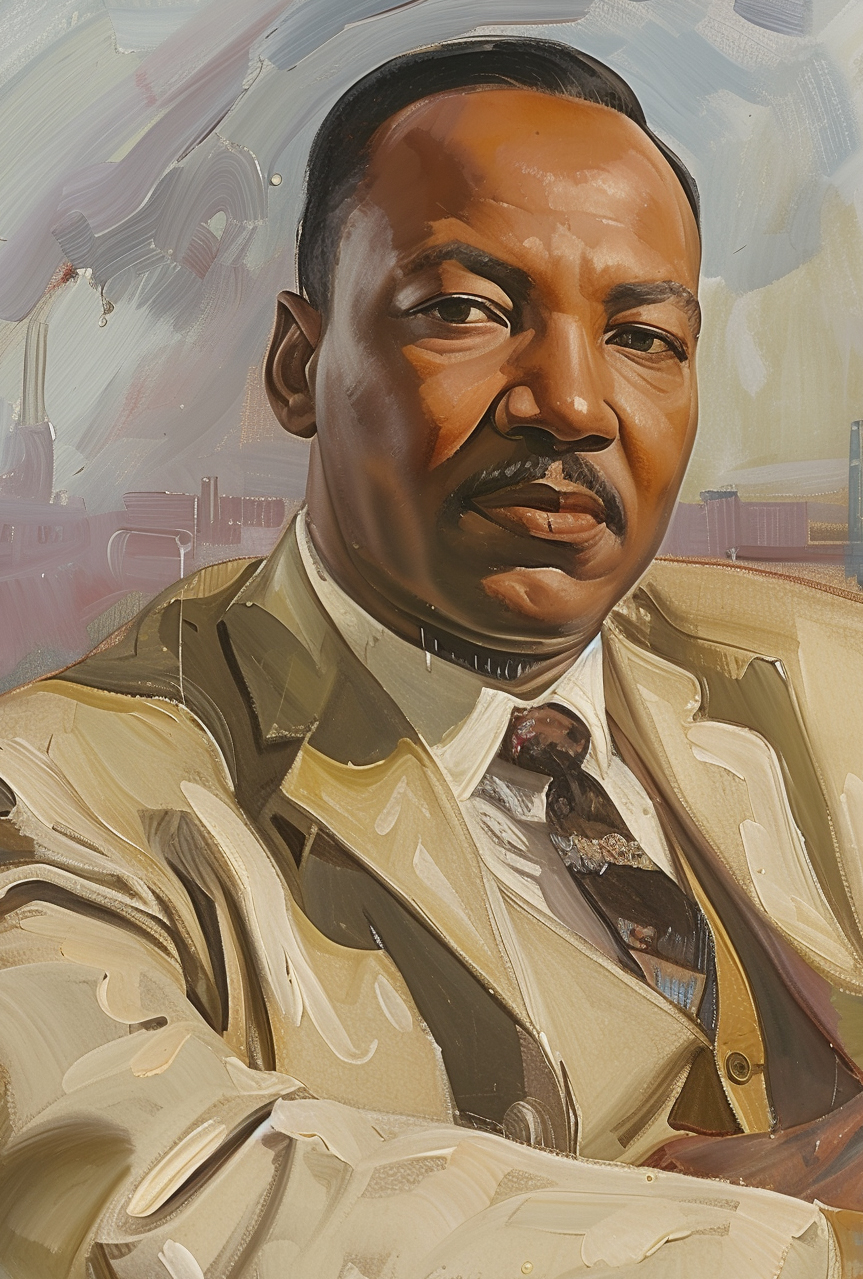
Martin Luther King Jr.’s ‘I Have a Dream’ speech is the most famous portion of the August 28, 1963, March on Washington for Jobs and Freedom. But King’s speech was less heralded during the balance of his own lifetime than it has become since his death by assassination on April 4, 1968. Exploring how and why the fame of ‘I Have a Dream’ is almost entirely posthumous allows us now, 40 years later, to understand better just how different King’s oration looked from inside the Civil Rights Movement of the 1960s than it does to many Americans today.
The idea of a 1963 March on Washington was not originally Martin Luther King’s; instead it was A. Philip Randolph, a longtime trade union activist and the senior statesman among African-American civil rights leaders, who first suggested such an event early that year. Indeed, Randolph had planned a similar mass descent upon Washington two decades earlier, in 1941, before canceling the demonstration after President Franklin D. Roosevelt agreed to stronger federal anti-discrimination policies.
What Randolph envisioned in early 1963 was a two-day gathering aimed at drawing attention to ‘the economic subordination of the American Negro.’ As sketched out by Randolph’s close aide Bayard Rustin, ‘a broad and fundamental program of economic justice’ and in particular ‘the creation of more jobs for all Americans’ would be the March’s substantive goal. ‘Integration in the fields of education, housing, transportation and public accommodations’—at that time the Civil Rights Movement’s most visible aims—will be of limited extent and duration so long as fundamental economic inequality along racial lines persists,’ Rustin asserted.
Randolph and Rustin imagined as many as 100,000 protesters besieging Congress on one day in May and then a public mass rally the following day. As weeks went by in early 1963, their target date shifted to mid-June, then October, but neither of the two largest civil rights groups—the National Association for the Advancement of Colored People (NAACP), headed by the sometimes cautious Roy Wilkins, and the National Urban League (NUL), led by Whitney Young—offered support or encouragement when informed of Randolph’s plan.
Martin Luther King Jr. and his Southern Christian Leadership Conference (SCLC) were too busy and preoccupied during the early months of 1963 with planning a major upcoming protest campaign in Birmingham, Ala., to react in any fashion to Randolph’s incipient idea. SCLC’s Birmingham demonstrations got underway in earnest in April 1963, but more than four weeks went by before those protests climaxed with internationally distributed scenes of Birmingham policemen and firemen letting loose with snarling German shepherds and high-powered fire hoses against African-American marchers and onlookers. SCLC’s Birmingham campaign was aimed at winning desegregated facilities and new job opportunities in the city’s downtown department stores, but Birmingham’s vituperatively racist public safety commissioner, Eugene ‘Bull’ Connor, was committed to doing everything he could to obstruct any possible negotiated accord between the downtown business community and the African-American protesters. Up until May of 1963, President John F. Kennedy’s administration had sought to keep civil rights issues on the back burner, notwithstanding violent flare-ups when Southern segregationists had attacked ‘Freedom Riders’ seeking to desegregate interstate buses in May 1961 and federal officials implementing court-ordered integration of the University of Mississippi in October 1962.
The Birmingham protests, however, drew the Kennedy administration into daily, face-to-face attempts to arrange a truce in a local crisis that had rapidly spiraled into a major national news story and then an international embarrassment to the United States. A negotiated accord ending Birmingham’s mass protest marches eventually was reached, but furious segregationists sought to derail the settlement with terror bombings and other acts of retaliation.
Birmingham, and the worldwide news coverage its violence received, catapulted the Southern civil rights struggle to greater national prominence than it had ever before attained. Martin Luther King, speaking to his close friend and adviser Stanley Levison on June 1 over a wiretapped phone line, told Levison, ‘We are on the threshold of a significant breakthrough and the greatest weapon is the mass demonstration.’ (J. Edgar Hoover’s Federal Bureau of Investigation, believing Levison to be a secret Communist who might be manipulating King, had obtained Attorney General Robert F. Kennedy’s approval for the wiretapping a year earlier. The transcripts of those wiretaps were released to me, pursuant to the federal Freedom of Information Act, in the mid-1980s.) Because of Birmingham, King told Levison, ‘We are at the point where we can mobilize all of this righteous indignation into a powerful mass movement’ that could pressure the Kennedy administration to finally take decisive action on behalf of black civil rights.
More specifically, King told Levison that they should publicly announce a ‘march on Washington,’ for ‘the threat itself may so frighten the President that he would have to do something.’ Given the standoffish attitude that the Kennedy brothers had manifested toward King and the movement from January 1961 up through May 1963, neither King nor his colleagues had any expectation whatsoever that the Kennedys would change their stance absent widespread objections.
King’s hope was that the president could unilaterally issue an executive order nullifying segregation, and a week after his wiretapped conversation about a march King went public, saying that such an event could feature’sit-in’ protests at the U.S. Capitol. ‘Dr. King Denounces President on Rights’ was The New York Times headline on the resulting news story.
But neither King nor the press knew that privately, for more than two weeks, the president, his attorney general brother and their closest civil rights advisers had been secretly putting together an outline for a dramatically far-reaching civil rights bill that the administration would place before Congress. On the evening of June 11, John F. Kennedy went on nationwide television to announce that proposal and to tell the American people that the civil rights struggle confronted them ‘primarily with a moral issue. It is as old as the scriptures and is as clear as the American Constitution.’
Kennedy’s remarkable address deeply impressed King. ‘He was really great,’ King told Levison in yet another wiretapped phone call. Most immediately, King added, Kennedy’s speech meant that their March on Washington now ought to target Congress, not the president. King publicly amplified that thought a week later in Birmingham: ‘As soon as they start to filibuster, I think we should march on Washington with a quarter of a million people.’
But two important entities were unpersuaded of the political wisdom of any such march. One was the two mainline civil rights groups that previously had rebuffed Randolph, the NAACP and the NUL. The other was the Kennedy administration, which quickly invited King, Randolph, Young and other civil rights leaders to a private meeting with the president on June 22. ‘We want success in Congress, not just a big show at the Capitol,’ John Kennedy told them. ‘It seemed to me a great mistake to announce a march on Washington before the bill was even in committee. The only effect is to create an atmosphere of intimidation—and this may give some members of Congress an out.’
A. Philip Randolph tried to rebut the president’s worries, but Kennedy was adamant, saying, ‘To get the votes we need, we have, first, to oppose demonstrations which will lead to violence, and, second, give Congress a fair chance to work its will.’ The president did not explicitly ask for cancellation of the March, but his message was clear. King told reporters that ‘we feel a demonstration would help the President’s civil rights legislation’ rather than hurt it, but NAACP leader Roy Wilkins was noncommittal, and in private he told his colleagues that only ‘quiet, patient lobbying tactics’ should be employed.
Two days later, at a decisive planning meeting, Wilkins expressed worries about any assemblage that might feature a ‘tinge of Harlem,’ but the NAACP grudgingly agreed to endorse a one-day Washington event on Wednesday, August 28. Yet other civil rights supporters remained extremely worried about the March; African-American Congressman Charles C. Diggs Jr., of Detroit, warned King that in Washington there was increasing concern about ‘disciplinary problems’ at such a demonstration, and that the announcement of the August 28 date had made ‘a lot of people nervous.’
In early July, the March organizers announced that no sit-ins or civil disobedience would be part of the August 28 gathering, and worries about what would occur began to recede. On July 17, President Kennedy, choosing to embrace the inevitable, publicly endorsed the March, and administration officials quietly began assisting March planners in innumerable ways. King, echoing Randolph’s original theme, told journalists the March would ‘arouse the conscience of the nation over the economic plight of the Negro,’ but the Urban League’s Whitney Young voiced the new consensus that had resulted from Kennedy’s metamorphosis: The March would be ‘an all-inclusive demonstration of our belief in the President’s program.’
As August 28 drew close, planners agreed on an afternoon rally at the Lincoln Memorial where speeches by March leaders would be interspersed among musical performances by noted entertainers. King would speak last, and four days before the March he told Al Duckett, a black journalist who was ghostwriting a forthcoming King book on the Birmingham campaign (eventually titled Why We Can’t Wait), that his August 28 oration needed to be’sort of a Gettysburg Address.’
But given how hectically frantic King’s daily schedule usually was, only in the early morning hours of August 28 itself did King finish his final revisions on an advance text of a speech. When typed out and mimeographed for advance distribution to the press, it came to less than three legal-size, double-spaced pages. Yet for King to produce any sort of an advance text for a speech was almost unprecedented, since whether at civil rights rallies or in Sunday morning church sermons, Martin Luther King Jr. almost always spoke extemporaneously, often with no outline or notes whatsoever in front of him. As Drew Hansen writes in his new book The Dream: Martin Luther King, Jr., and the Speech That Inspired a Nation, ‘King did not so much write most of his speeches as assemble them, by rearranging and adapting material he had used many times before,’ material that King the preacher knew by heart.
After master of ceremonies A. Philip Randolph introduced King as ‘the moral leader of our nation,’ King addressed the huge late afternoon crowd of more than 250,000. He began by commending his listeners for joining ‘what will go down in history as the greatest demonstration for freedom in the history of our nation.’ Then King began to make his way through his advance text almost verbatim, making reference to Abraham Lincoln’s Emancipation Proclamation and to the promises of the Declaration of Independence and the Constitution, promises that remained unfulfilled for black Americans, King noted. Speaking metaphorically, King compared those promises to a ‘bad check’ that the United States should now make good on. Using one of his favorite rhetorical devices, an anaphora featuring the recurring phrase ‘Now is the time,’ King called for America to live up to those promises. He made no direct reference to Congress or to Kennedy’s pending civil rights bill, but he did identify discriminatory evils that federal legislation could eliminate. After quoting the prophet Amos on justice and righteousness, King was close to the end of his prepared text. He later recalled that moment:
I started out reading the speech, and I read it down to a point, and just all of a sudden, I decided—the audience response was wonderful that day, you know—and all of a sudden this thing came to me that I have used—I’d used it many times before, that thing about ‘I have a dream’—and I just felt that I wanted to use it here. I don’t know why, I hadn’t thought about it before the speech.
King had indeed used it before—in Albany, Ga., and in Rocky Mount, N.C., in the fall of 1962, and in both Birmingham and in Detroit a few months earlier—but on none of those occasions had it had anywhere near the impact that it did on August 28. ‘I have a dream,’ King began, again introducing an echoing phrase. He quoted from the Declaration of Independence, alluded to the segregationist doctrines of Alabama Governor George C. Wallace, and then reiterated his ‘dream’ that one day even Alabama would achieve interracial harmony. He ended his ‘I have a dream’ repetition by quoting from the Bible’s Book of Isaiah, and then, in his concluding lines, returned to the closing that appeared in his advance text. Adding several lines from a traditional American patriotic song, King expanded on its call to ‘let freedom ring’ from every mountainside by appending some notable Southern mountains to its list of American peaks. He ended with a line he often used as a closing: ‘Free at last! Free at last! Thank God Almighty, we are free at last!’
As Drew Hansen notes in The Dream, ‘had King not decided to leave his written text, it is doubtful that his speech at the march would be remembered at all,’ for up until the beginning of his ‘dream’ anaphora, King’s oration had been impressive but not memorable. But once that spontaneous inspiration took hold, King shifted forcefully into his voice as a preacher, rather than just a public speaker, and for the first time a national American audience was exposed to King’s real sermonic power. It was a gift that King had polished in black Southern churches for more than a decade, a gift that movement colleagues had encountered from the onset of the 1955-56 Montgomery bus boycott forward, but only on August 28 did such a huge crowd, plus a live national television audience, hear the extemporaneous genius that made King such a remarkable preacher.
‘I Have a Dream’ was the signature touchstone of the August 28 March, but the hugely influential success of the March lay in its impressive turnout and in its utterly friendly and easygoing tone, far more so than in King’s address. Ten months later Kennedy’s bill, championed in Congress by the new president, Lyndon B. Johnson, was signed into law as the landmark Civil Rights Act of 1964, and one year after that the other bookend legislative achievement of the Southern civil rights struggle, the Voting Rights Act of 1965, also became law.
But in the years after 1965, the glow of the 1963 March, and of the entire 1963—65 civil rights apex, rapidly receded. King himself quickly sensed the deteriorating political scene, and even in mid-1965 he woefully complained about how ‘often in these past two years I have had to watch my dream transformed into a nightmare.’ That nightmare formulation recurred often in King’s speeches and sermons during 1966 and 1967, and as Drew Hansen rightly observes, ‘between 1963 and 1968, few people spent substantial time talking or thinking about what King had said at the march.’ Indeed, by the time of his assassination on April 4, 1968, King’s speech ‘had nearly vanished from public view.’
Yet the tragedy of King’s assassination quickly returned his 1963 speech to the popular eye. ‘Within a few weeks of King’s death,’ Hansen explains, ‘the ‘I Have a Dream’ speech had regained all the public visibility it had lost since 1963.’ Indeed, it ‘gradually came to dominate public memory of King’s legacy,’ thereby raising the significant danger that its upbeat and optimistic tone would distract most if not all attention from the more radically challenging and harshly critical parts of King’s legacy that were most obvious during his 1967-68 public attacks on American economic inequality and American foreign policy.
But 40 years after the March on Washington, there is no gainsaying that Martin Luther King Jr.’s ‘I Have a Dream’ has entered American public culture as ‘the oratorical equivalent of the Declaration of Independence,’ as Hansen puts it. If its fame threatens to swamp the balance of King’s legacy, and if its stature directs historical memory only toward the brightest and not the bleakest days of the 1960s black freedom movement, it nonetheless remains the most notable oratorical achievement of the 20th century—a’sort of a Gettysburg Address’ indeed.