Historynet/feed historynet feedback facebook link Weider History Group RSS feed Weider Subscriptions Historynet Home page

Mark W. Clark: A General Reappraisal

By Robert M. Citino 
Originally published by World War II magazine. Published Online: June 08, 2012 
Print Friendly
17 comments FONT +  FONT -

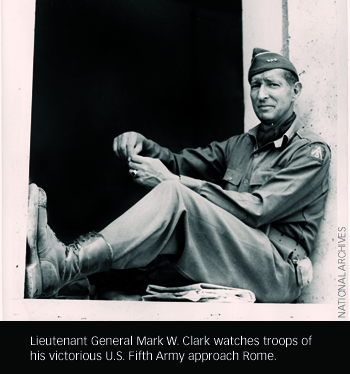
Strictly speaking, Mark W. Clark was not a controversial general. "Controversial" implies a significant divergence of opinion on a subject, and historians seem to have made up their collective mind about Clark. If there is a Pantheon of Bad Commanders, most scholars of World War II use him as exhibit A. Frankly, they should stop it. Clark certainly was no Napoleon, but neither was he particularly incompetent. In fact, he was a perfectly representative general for a U.S. Army in 1943 that was still feeling its way toward excellence.

The indictment usually begins with his personality. Clark was a blatant careerist and glory hog, his legion of attackers claim, whose ambition exceeded all bounds. He cared more about public relations and cultivating a heroic image than he did about fighting wars. He only let photographers shoot his "good side" (his left, for the rec-ord). He was cocky to the point of arrogant, dubbed Marcus Aurelius Clarkus by some cynical subordinates. He was peremptory with his subordinates. He was inexperienced, and was jumped up over more experienced and deserving officers. He was a hard-core Anglophobe, distrusting his British allies while commanding a campaign in which cooperation was essential.

In reality, every one of these accusations is specious. Was Clark any more of an egotistical glory hound than Patton? Generalship within the U.S. Army is practically defined by overweening ambition. Was Clark really more interested in cultivating his image than, say, Field Marshal Erwin Rommel? No one loved photographers more than the Desert Fox. Was he really promoted too rapidly? In February 1941, Dwight D. Eisenhower was a lieutenant colonel. Two short years later, he was a four-star general, perhaps the world's record for rapid promotion. By way of comparison, Clark was a lieutenant colonel in July 1941 and a three-star general by November 1942. In a wartime army expanding as rapidly as this one was, just about everyone was going to be promoted early. The personal arguments—and there are vast numbers of those who worked with Clark who contradict all this and who liked him just fine—simply don't hold water.

There is another accusation against Clark, however, a much more serious one: that he was incompetent. Here, the allegations range all over the map. He charged ashore too impetuously at Salerno, many say, pushing inland without consolidating his beachhead. He then proved too dilatory and unimaginative in the drive north. Before the Anzio landing, his advice to Major General John P. Lucas was hardly the stuff of the Great Captains: "Don't stick your neck out, Johnny," he said. Lucas didn't, the Anzio landing went nowhere, and Clark relieved him of duty. By contrast, Clark again reverted to being too impetuous. He launched the 36th "Texas" Division in a frontal assault against murderous German fire in a futile attempt to cross the Rapido River. It was an operational disaster that led to postwar Congressional hearings and for which Texas has still not forgiven him. Finally, the main indictment: his decision to drive for Rome after the Anzio breakout rather than encircling the German Tenth Army, which was at that moment retreating north in some confusion.

But this accusation, too, fails the evidence test. After all, surrounding a maneuver-trained German field army was not as easy as it sounds. How many times did the Western Allies ever succeed in doing so? Don't try too hard, it's an easy answer. Before the final German collapse in 1945: zero.

So if Clark is culpable for failing to encircle a German army in battle, he has some very fine company: Generals Dwight D. Eisenhower, Omar Bradley, Courtney Hodges, and George S. Patton Jr. It was possible to beat the Germans, yes. Outside of a few extraordinary circumstances in this war, however, they usually maneuvered rapidly enough to prevent themselves from being encircled—and that is exactly what they did in Italy.

Salerno certainly tested Clark, and he appeared at times to be overwhelmed. But he spent the night of September 13 doing what he had to do: taking stock and taking a sober view of things. He also spent two difficult days—September 13 and 14—rotating between his command post and tours of the front where he braved heavy enemy fire to rally the troops, just like all those heroic commanders who populate the history books. "He shared the dangers of his men," one biographer wrote, and that is all anyone can ask. In the end, Fifth Army managed to ward off fierce German attacks, to defend its bridgehead, and to drive inland from Salerno.

Clark's real problem was quite simple: it was his fate in 1943 to command an American army in the Mediterranean Theater. The inland sea had already become a graveyard of American military reputations: Major General Lloyd Fredendall of Kasserine Pass, the currently disgraced Patton, the soon-to-be disgraced Major General Ernest J. Dawley, and the later disgraced General Lucas. A year later in Western Europe, by contrast, all the commanders miraculously wound up looking pretty good. Perhaps the Mediterranean weeded out the weaklings in the officer corps. Perhaps it lacked the full attention of the U.S. high command, now deep in the planning cycle for Operation Overlord in Normandy. Perhaps it was just the luck of the draw.
In the end, Clark was no military genius—few commanders in history are—but he led his army as well as the difficult theater of operations and the current skill level of the U.S. Army would permit. Judging whether he was a "good" or "bad" general has to take a number of thorny and intertwined factors into consideration, but the real issue was time. The U.S. Army, top to bottom, was going to get a lot better by 1944, and every general looks better when the formations, staff, and support systems under his command—all of an invasion force's moving parts—are more experienced. While it's impossible to say with certainty, Clark likely would have been no exception.

Robert M. Citino is the author of nine books, most recently Death of the Wehrmacht (2007) and The Wehrmacht Retreats (2012). He spent the 2008–09 academic year teaching at the United States Military Academy at West Point; he is currently a history professor at the University of North Texas. In 2007, Citino was rated the "#1 Professor in America" by the online student rating service ratemyprofessors.com. His blog, Front & Center, can be found here.

Recommended

17 Responses to “Mark W. Clark: A General Reappraisal”


  1. 1
    Luke says:

    This article makes several good points but that is not to say they dont have weakness inherent in them. If one is questioning the incompetence of Gen. Clark bringing up the bad luck of American field commanders in the med is not entirely relevent.

    Major General Lloyd Fredendall was relieved due to incompetence in command, one of the popular points being the use of a battalion of engeniers to construct him a heavily fortified command post far removed from the front lines.

    To mention Patton in this context is perhaps the most irrelevent point you made as Patton was in disgrace for the famous slapping instances as opposed to being incompetent. The general concensus being he was one of the best field commanders of the war. Instead he was sidelined due to political reasons.

    Further your point that he shared all the dangers of his men and that is all anyone can ask for in the end is not a defence against incompetence. While it may be one aspect where he was not incompetent merely visiting troops dose not constitute all anyone can ask for. As a general of WW2 such a action is not an issolated case for instance Monty was famous for doing so as one example. However as a commanding General the expectation of everyone would be a strong level of leadership, sound understanding of militart strategy and tactics. As high a level of situational awareness possible at the time, and a competent application of planning in order to overcome hostile possitions and defences.

    That being said you are probably correct that he was not entirely incompetent nor if he was a prima dona was he alone as a general in that war. As all or at least most histrorians and other commentators have the advantage of hindsight and thus any one may suggest a better course of action than the one taken at the time, an understanding must still exist that during combat not all information is known and what is known is ever changing.

  2. 2
    jimmypete says:

    Fair enough, but the author does not address the oft repeated criticism that after the long coming breakout from Anzio Clark diverted his troops to take Rome rather than trapping at least some of the retreating German Army [some historians feel he could have rolled up most of the Germans but that seems doubtful] . His glory was short lived as it was the same week as D-Day but his moves insured a tough battle for close to a year. My dad was in the Fifth Army and he said the GI's had no respect for Clark.

    • 2.1
      Don says:

      My Dad also served in the 5th Army and still talks about what a poor General Mark Clark was. The men hated him and his arrogance, as well as his poor decisions. The 34th and 36th Infantry Divisions fought some of the worst battles of that war and are overlooked by today's 'history'.

    • 2.2
      JustaReader says:

      See the last sentence of paragraph 4 and first sentence of paragraph 5. The author does discuss the foray into Rome vs. encircling the maneuvering German army in front of him.

      • 2.2.1
        Keith says:

        True encircling a German maneuver army is difficult, but Clark did not give it his all. (By the way, aren't all field armies of the day maneuver? The Germans as a point of fact were less mobile the western allied armies, because of the Wehrmacht dependence on horses for transport). He was ordered to cut the Germans retreat. Instead he diverted forces to capture Rome.

        The situation in Italy was one of the best the allies were ever given to encircle a German army. The German had one major road to retreat on and were hemmed in by the mountains. Would an attempt have succeeded? We will never Know. Could an attempt have severely hurt the German army in Italy? Certainly.

  3. 3
    furnox says:

    I think Citino brings some good points to the call for more balance on Clark. I think one of the things many histories and historians miss is his big mistake BEFORE September 9 invasion at Salerno. He held back on massive bombing of beach and lines behind it before the invasion of Salerno. He based this on his view and decisions on invasion of Sicily … that it didn't turn out to be necessary to 'soften up' the enemy before the amphibious invasion.
    This was a major mistake that is still overlooked. I did a US Army soldier's history from Salerno. He went in on Day 3; they were still pinned down and he stayed right there in a shallow foxhole until Day 6 when they were finally able to get off the beach. He listened and stuck his head up once in a while to see Allied ships being hit; some sunk by German 88's and the first crude cruise missiles.. radio guided bombs that Germans used against our ships.
    That's overlooked, sometimes seems unknown from oral histories and belongs in the list of Clark's incompetent decisions that cost us dearly well before Rapido and other decisions.

  4. 4
    Keith says:

    During the Anzio breakout Clark did not even try to surround the retreating Germans. It is not that he failed but he did not try. His failure was in contradiction to his orders to destroy the German Army. In short he was insubordinate.

    His subordinate, Gen. Trustcott, disagreed with Clark, but obeyed his orders as a good subordinate.

    Could he have succeeded in trapping the Germans? Impossible to say. However, the Germans had two main roads, highways 6 and 7. Seven, was cut by the breakout. That left six on the west side of the Apennines, where the bulk of the German Army was. Yet, he ordered his troops to go for Rome. Rome would have fallen in a few days or a week anyway, especially if the Germans were trapped and destroyed in detail.

    The comments about Clark's personality may have some validity. He was not the only egomaniac, or quickly promoted officer, or man with poor interpersonal skills in the war.

    So, I feel that the article has some points he does deserve a lot of criticism for his leadership abilities and decisions. He was not the most incompetent Allied general, but, he was at best, at the top of the bottom half of generals. This leads me to want to comment about overrated generals, but I'll leave that for another day.

    • 4.1
      AllanS says:

      Well stated, Keith. Although saying that Clark was being insubordinant is a bit of a stretch. It seems the author is simply a fan of Gen. Clark for whatever reason and is not really attempting to be all that objective.

  5. 5
    lyndon says:

    Clark was "el supremo" United Nations Command, Korea 1953 and 1954. He woud have a far more diverse force than that when he was in Italy.

    Who was his successor as Supreme Commander, United Nations forces?
    Maxwell Taylor?

    • 5.1
      lyndon says:

      Mark Clark was supreme Commander United Nations forces Korea and as such would be stationed in Tokyo from 1952 -1953,

      Maxwell Taylor succeded Van Fleet as c-i-c of eigth army, Korea. in 1952,
      In July 1943 both were witnesses to The Korean Armistice agreement..

  6. 6
    lyndon says:

    Supreme Commanders United Nations Command Korea.
    Macarthur 1950 – 1951.
    Ridgway 1951 -1952.
    Clark 1952 – 1953.

    Who succeded Clark?

    Surely, someone who served there would know?

  7. 7
    Keith says:

    I fail to see what difference Korea makes. This is about WWII. Also, in Korea he was a higher commander. Ridgway was Eighth Army commander and was more involved in command of combat troops.

    Going back to Allan S's comment. I think calling him insubordinate is appropriate. He disobeyed a direct order at Anzio and did not destroy the German Army. Instead he went for Rome.

  8. 8
    jimmypete says:

    In the new book "The Generals" Ricks is of the opinion Clark may have been a better general that he is given historical credit for but much worse than Clark's own opinion of himself. Ricks is more concerned with strategic proficiency but it still appears to me Clark had little tactical sense, and less strategic. My father who fought in Italy would have agreed.

  9. 9
    Anthony Strickland says:

    My Father was a member of the 36th Division, as an Army "Brat" I was never allowed to ask questions about WWII, as I got older and found out some things specificaly about Mark Clark, I feel terrible about the fact that he had to do what was impossible, for the sake of the incompetence and ego of the Commanders, includes Keyes,just to ride through Rome, before anyone else did. The lives he sacrified just for publicity and glory is unforgiveable.I'am in New Jersey so not only is he disliked in Texas, likewise for New Jersey.But, I cannot find out why he was not disciplined for his Blunder at the Rapido River.

    • 9.1
      jimmypete says:

      My dad is in the 36th also, he had the same reaction to Mark Clark, the only thing that he said saved him at the Rapido was a flare up of Malaria which put him in the hospital.

  10. 10
    jimmypete says:

    Sorry should have said "was" in the 36th, Amazing you should say your description apparently the 36th had been a Texas outfit and many of the replacements were from New Jersey, there was my dad 5'5" ItalianAmerican from Newark with those cowboys, I think I got the 36th right.

  11. 11
    Phil says:

    The primary task of senior military commanders is the destruction of the opposing armies, Clark passed up on realistic opportunity to do that in exchange for Rome which had no military value at that time and served only to his personal glory, and he disobeyed his superior in the process. It may have been good politics but it was definitely bad generalship.


Leave a Reply

Human Verification: In order to verify that you are a human and not a spam bot, please enter the answer into the following box below based on the instructions contained in the graphic.


Related Articles


History Net Images Spacer
History net Spacer
History net Spacer
History Net Daily Activities
History net Spacer
History net Spacer
Historynet Spacer
HISTORYNET READERS' POLL

Which of these defensive lines best served its purpose?

View Results | See previous polls

Loading ... Loading ...
History net Spacer
STAY CONNECTED WITH US
RSS Feed Daily Email Update
History net Spacer History net Spacer

What is HistoryNet?

The HistoryNet.com is brought to you by the Weider History Group, the world's largest publisher of history magazines. HistoryNet.com contains daily features, photo galleries and over 5,000 articles originally published in our various magazines.

If you are interested in a specific history subject, try searching our archives, you are bound to find something to pique your interest.

From Our Magazines
Weider History Group

Weider History Network:  HistoryNet | Armchair General | Achtung Panzer!
Today in History | Ask Mr. History | Picture of the Day | Daily History Quiz | Contact Us

Copyright © 2012 Weider History Group. All rights reserved. Reproduction in whole or in part without permission is prohibited.
Advertise With Us | Subscription Help | Privacy Policy