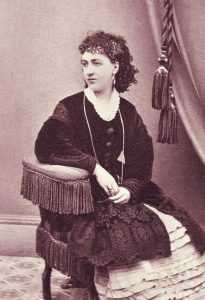

In 1876 the American public was introduced to an astonishing and controversial figure by the name of Madame Loreta Janeta Velazquez. Like so many others, she wrote a Civil War memoir, The Woman in Battle: A Narrative of the Exploits, Adventures, and Travels of Madame Loreta Janeta Velazquez, Otherwise Known as Lieutenant Harry T. Buford, Confederate States Army. Needless to say this was no ordinary war story, for Madame Velazquez claimed to have so fervently supported the Southern cause that she donned the Confederate uniform as Lieutenant Harry Buford and fought at the battles of First Bull Run, Fort Donelson, and Shiloh.
When she wrote her book, Madame Velazquez realized that her disclosures would shock her contemporaries, so she made every attempt to legitimatize her behavior by establishing a notable past and a claim to respectability. She claimed to have descended from an ‘ancient Castilian’ background and to have as her ancestors both Don Diego Velazquez, the governor of Cuba, and Don Diego Rodriguez Velazquez, the Spanish artist. At the same time, despite her unladylike behavior, she laid claim to genteel sensibilities by maintaining that she was thoroughly shocked by the behavior and language of the soldiers with whom she came in contact. She further protested that although she had posed as a man, she had carefully maintained her ‘womanly reputation unblemished by even a suspicion of impropriety.’ Having thus refuted the possible charge of being a camp follower rather than a brave soldier, at least in her own mind, she proceeded with her tale.
Madame Velazquez maintained that she had always wished for the privileges and status granted to men and denied to women. Comparing herself to Deborah of the Hebrews and Joan of Arc, she explained her desire for martial adventures by asserting the her girlhood was spent ‘haunted with the idea of being a man.’ She demonstrated unusual independence for an antebellum adolescent when, at the age of 14, she ran away from her school in New Orleans to marry an American soldier named William. Four years later in 1860 they were in St. Louis mourning the death of their three children. Madame Velazquez was only 18.
When William’s state seceded from the Union, he resigned his commission and joined the Confederate Army. At that point Madame Velazquez again fell victim to her old desire to be a man. Unable to persuade her husband to let her fight for the Confederacy, she simply waited for him to leave, adopted the name Lieutenant Harry T. Buford, was measured for two uniforms by a tailor in Memphis, and proceeded to Arkansas to raise a battalion for the Southern cause. She claimed that she enrolled 236 men in four days and shipped them to Pensacola, Florida, where she presented them to her astonished husband as his to command. Unfortunately he was killed a few days later demonstrating a weapon to his troops. The bereaved widow turned the men over to a friend and proceeded to search for military adventure at the front.
Claiming that she was serving the Confederate Army as an ‘independent,’ she crossed the South from Virginia to Tennessee searching for a suitable opportunity to display her military talents. After the First Battle of Bull Run she grew weary of camp life and borrowed female attire from a farmer’s wife so that she could go to Washington, D.C., to gather intelligence for the Southern cause. While in the Capital the soldier-turned-spy claimed to have arranged meetings with Secretary of War Simon Cameron and President Abraham Lincoln.
She finally returned to the South, where she was rewarded for her services by being assigned to the detective corps. But again she grew weary of her assignment and left her duties to go fight in Tennessee. She arrived at Fort Donelson just in time to see it surrendered. After Fort Donelson she was forced to face the possibility that someone would discover her disguise when she was wounded in the foot and examined by an army doctor. Apparently she escaped detection but decided to flee to New Orleans, where ironically she was arrested on suspicion of being a woman in disguise. Once she was released, she said, she enlisted in order to escape from the city. However, Madame Velazquez had no love for the life of a common soldier, so after showing her commission to her commanding officer, she was granted a transfer to the army in east Tennessee.
Surprisingly enough her social life did not suffer from her dual identity. Proudly she said:
All these months that, in a guise of a man, I had been breaking young ladies’ hearts by my fascinating figure and manner, my own woman’s heart had an object upon which its affections were bestowed, and I was engaged to be married to a truly noble officer of the Confederate army, who knew me, both as a man and as a woman, but who little suspected that Lieutenant Harry T. Buford, and his intended wife, were one and the same person.
And so the charade continued until April 1862 and the Battle of Shiloh, the scene of her greatest military triumph. Here she found the battalion she had raised in Arkansas and joined them for the fight:
We had not been long engaged before the second lieutenant of the company fell. I immediately stepped into his place, and assumed the command of his men. This action was greeted by a hearty cheer from the entire company, all the veterans of which, knew me, and I took the greeting as an evidence that they were glad to see their original commander with them once more. This cheer from the men was an immense inspiration to me; and the knowledge that not my lover only, but the company which I had myself recruited and thousands of others of the brave boys of our Southern army were watching my actions approvingly, encouraged me to dare everything, and to shrink from nothing to render myself deserving of their praises.
Having fought gallantly the first day, she decided that night to again gather intelligence. Hidden away in the brush she claimed to have spotted General Ulysses S. Grant and to have been close enough to have shot him. But she decided against it. ‘It was too much like murder,’ she said.
She was wounded by a shell while burying the dead after the battle, and an army doctor discovered her identity. She fled again to New Orleans and was there when Major General Benjamin F. Butler took command of the city in May 1862. Believing that her military career was at an end because too many people now knew her true identity, she gave up her uniform. She bought a British passport from an acquaintance and began her second war career as a drug smuggler, blockade runner, and double agent.
She claimed to have been hired by the authorities in Richmond to serve in the secret service corps and began to travel freely throughout the North as well as the war torn South, pausing only long enough to marry her beloved, Captain Thomas DeCaulp. Widowed shortly after the wedding when her new husband died in a Chattanooga hospital, she traveled north, gained the confidence of Northern officials and was hired by them to search for herself.
During her search she continued to serve the Southern cause by trying to organize a rebellion of Confederate prisoners held in Ohio and Indiana. She also claimed to have stolen electrotype impressions of Northern bond and note plates so that the Confederates could make forgeries. During the last months of the war she claimed to have traveled to Ohio, Canada, London, and Paris. She arrived back in New York City the day after Lee’s surrender.
She spent a number of months after the war traveling through Europe and the South. She also married for the third time. She and her new husband, a Major Wasson, left the United States as immigrants to Venezuela. But when her husband died in Caracas, she returned to America to convince her friends that immigration was a mistake.
Again she began to travel, this time through the West, stopping long enough in Salt Lake City to have a baby and meet Brigham Young. In Nevada she claimed to have married again for the fourth time to an unnamed gentleman. Then she was off again. ‘With my little baby boy in my arms, I started on a long journey through Colorado, New Mexico, and Texas, hoping, perhaps, but scarcely expecting, to find the opportunities which I had failed to find in Utah, Nevada and California.’
Her story ends at this point. Her final plea was that the public would buy her book so that she could support her child. She was not ashamed of her behavior and hoped that her conduct would be judged with ‘impartiality and candor’ and that credit would be given her for ‘integrity of purpose.’ She offered no apologies for her conduct. ‘I did what I thought to be right,’ she said, ‘and, while anxious for the good opinion of all honorable and right thinking people, a consciousness of the purity of my motives will be an ample protection against the censure of those who may be disposed to be censorious.’
The historical validity of the Velazquez claims remains to be determined. Historians themselves are divided on the issue. Mary Massey in the Bonnet Brigades takes note of the ‘incredible’ Velazquez claims but maintains that while they are not provable, she could have done some of the things she claimed. Ella Lonn in her book on foreigners in the Confederacy describes Velazquez as’strange and romantic’ and appears to accept her story as true while at the same time admitting that the only evidence which exists in the matter is The Woman in Battle. Katherine Jones includes an except from the Velazquez book in her two-volume Heroines of Dixie along with unquestionably legitimate memoirs and in that sense leaves the impression that the Velazquez story is as much a historical record as that of Kate Cumming or Mary Boykin Chestnut.
At least one of Madame Velazquez’ contemporaries challenged her story. In the winter of 1877-78 Lieutenant General Jubal A. Early, who was then in New Orleans happened upon The Woman in Battle. After a cursory examination he satisfied himself that ‘the writer of that book, whether man or woman, had never had the adventures therein narrated.’ Some time later at his hotel he met a man from Richmond who told him that he had met Madame Velazquez on a train and was so intrigued by her story that he had bought her book. Recognizing the book that the man showed to him, Early protested that’she could not be what she pretended to be.’ He then pointed out’several inconsistencies, absurdities, and impossibilities’ in her narrative in order to prove his point. Subsequently Early had a brief interview with Velazquez after which he was even more convinced that her story was untrue.
In May of 1878 General Early received a letter signed by Madame Velazquez protesting his alleged attempt to injure her book by publicly questioning the truthfulness of her story. She maintained that her view of the war could never be the same as his because they were never in the same position to observe, nor did they ever have access to the same information. ‘I do not pretend,’ she said in her letter, ‘to know even one truth that transpired upon any one battlefield I served upon. I only endeaver [sic] to give the most important facts that came under my immediate observation.’
One of Early’s objections to her story was that she had failed to identify many of the people she talked about, thus making it impossible to check her story. In her letter she explained that she had left out the names in order to condense her manuscript and also had wanted to protect the families of men she claimed were defrauding the government. She then gave as personal references the names of Alexander H. Stephens of Georgia, ex-Governor John C. Brown of Tennessee, and Congressman John M. Glover of Missouri, and sent the letter through Congressman William H. Slemons of Tennessee.
Apparently Early did not quite know how to react to her letter. On one hand he was tempted to ignore her and the book as not worthy of comment. But on the other hand he felt that her book was so full of inaccuracies that he had a duty to expose it. So on May 22 he sat down to answer her letter. Directing his comments to Congressmen Slemons, he proceeded to point out inconsistencies in her story page by page. He was incredulous at her recruiting expedition. ‘This battalion has been raised without the instrumentality of the Governor of Arkansas, or of the President of the Confederacy, or without her saying to either as much as, ‘by your leave,’ and carried just where she thought proper, all the expenses being paid out of her own pocket; though where the money came from is an unsolved mystery. . . .’
Later in the letter he says, ‘Her statements about her flitting from one army in the Confederacy to anotherof her being employed as a secret agent, and going on missions for the government to Washington, New York, Havanna [sic], Canada, and always having abundant means provided for her, and of her being in the secret service of the United States at the same time she was in that of the Confederacy are simply incredible.’
After exposing a number of other improbabilities, he concluded that the book was untrue and that it could not even be considered good fiction since it libeled Confederate officers as ‘drunken, gasconading brutes’ and pictured the flower of Southern womanhood as ‘ready to throw themselves into the arms of the dashing ‘Lieutenant Harry T. Buford,’ and surrender without waiting to be asked, all that is dear to women of virtue.’
He apologized for any injury his opinion of the book may have done to Madame Velazquez or her child but added, ‘I cherish most devotedly the character and fame of the Confederate armies, and of the people of the South, especially of the women of the South, and when a book affecting all these is sought to be palmed on the public as true, and bears on its face the evidence of its want of authenticity, then I have the right to speak my opinion and will speak it, whether the author be a man or woman.’
Early finished the letter but did not immediately send it to Slemons. He still had not convinced himself that he should answer Velazquez but feared that if he failed to respond, she could say that she had silenced his criticism. After considerable thought Early sought the advice of a friend and sent a copy of the Velazquez letter along with his answer to John R. Tucker, a congressman from Virginia. He asked Tucker to consider his problem and advise him whether or not he should mail his letter to Slemons. Early’s response to Madame Velazquez was never sent and all three letters reside in the Tucker family papers in the Southern Historical Collection at Chapel Hill, North Carolina.
Two other of her contemporaries believed her story. Her editor, C. J. Worthington, understandably wrote that he had complete confidence in her veracity.
There are thousands of officers and soldiers who fought in the Confederate armies who can bear testimony, not only to the valor she displayed in battle…but to her integrity, her energy, her ability, and her unblemished reputation. . . that it is a true story in every particular, there are abundant witnesses whose testimony will not be disputed.
Unfortunately for the researcher trying to determine the truth, the value of his testimony as well as his judgment becomes questionable when a few sentences later he described Madame Velazquez as a ‘typical Southern woman of the war period.’ Anyone who reads her book can clearly see that there was nothing typical about Loreta Velazquez.
A third contemporary source whose testimony is available was a reporter for the New Orleans daily Picayune. His story about her appeared in January of 1867. At that time she had just arrived in New Orleans to serve as an agent for the Venezuelan Emigration Company and was using the name Mary DeCaulp. The article described her adventurous life in some detail, must of it inaccurate if one accepts the story she published nine years later as true. For example, the article asserted that she was a first lieutenant in a Texas cavalry company and mentions nothing about her espionage activities. The reporter also mentioned that he remembered having seen her in New Orleans during the war ‘dressed in a rough gray jacket and pants, the suit rather the worse for wear, with her hair cut short, and supporting a bandaged foot with a crutch of the most primitive pattern.’ A few sentences later, however, his identification of her became less conclusive when he admitted that Madame Velazquez looked considerably different from the soldier who came to New Orleans during the war.
Contemporaries as well as historians disagree about the truthfulness of the Velazquez story. If they are to base their judgment on the information that can be confirmed we still do not come up with an entirely verifiable story. First of all, her book contains very little factual information. True, she put the right generals at the right place in the right battles, but this kind of information was easily accessible. Even the charges that she made concerning corruption and profiteering are not specific. She included no complete names and spoke only in vague generalities. Most of the individuals in her book have only a first or a last name. Even though she married four times, she provided us with the full name of only one of her husbands!
One of the few times she gave enough information to allow the researcher to check her story is when she claimed to have enlisted in Captain B. Moses’ company of the 21st Louisiana Regiment in order to escape from New Orleans after her arrest. This is the only time in her military career that she mentioned serving as something other than an ‘independent’ who served on her/his own authority and paid most of her own expenses. The National Archives shows no record of such an enlistment. And Dr. Arthur W. Bergeron, Jr., of the Archives and Records Service in Baton Rouge has indicated that although Captain B. Moses did command the McClellan Guards of the 21st Louisiana units of the Civil War, Dr. Bergeron also analyzed various references which Madame Velazquez made concerning troops from that state. He found some of her information to be inaccurate. For example, she maintained that the 5th and 8th Louisiana regiments fought at Bull Run. Bergeron points out that the 6th and 8th fought together there. Her assertion about the 5th, which was at the time stationed near Yorktown and Williamsburg, is an obvious error, but the mistake could be attributed to bad memory since she claimed to have written the book without her papers, which had been lost.
Yet her book in some cases contains just enough information to justify Massey’s contention that she could have done some of the things she claimed. Velazquez revealed, for example, that one of the names she used in her espionage activities was ‘Mrs. Williams.’ Massey found evidence that a Mrs. Alice Williams was arrested in Richmond but released after her identity was established and that papers in Richmond lauded her work as a soldier and nurse. Massey also found evidence that a reporter from the New York Herald knew Mrs. Williams as a prisoner in Richmond and wrote about her in an article which appeared in October 1863. We may conclude from this evidence that someone who called herself Alice Williams existed. The War of the Rebellion contains another reference to a Miss Alice Williams ‘who was commissioned in the rebel army as a lieutenant under the name of Buford.’ Such evidence appears to confirm this claim at least, even this documentation is suspect, however. The letter in The War of the Rebellion was written by Sanford Conover, later revealed as a perjurer and forger.
The war memoir written by Madame Velazquez was certainly more bizarre than most, and at times she tended to stretch her credibility by claiming too much. For example, although officials during the Civil War were far more accessible to the general public than is the case today, she maintained that within the span of four years and in the middle of a bloody war she had personal access to such Southern and Northern officials as Leroy P. Walker and Secretary of War Simon Cameron, Jefferson Davis and Abraham Lincoln, a host of generals such as Stonewall Jackson, Leonidas Polk, William Hardee, Benjamin Butler, John Winder, James Longstreet, and William Rosecrans, as well as the governors of Ohio and Indiana and financier James Fisk. This, combined with her claimed astonishing ability to travel throughout the North as well as the South with little or no difficulty, using charm and guile as her most effective passport, is incredible.
One final factor that should be considered is her personal motivation for writing her book. One cannot read it without concluding that she was at the very least an opportunist. She admitted that her reasons for writing the book were pecuniary rather than patriotic, educational, or literary. Certainly the character she revealed in her book was capable of taking advantage of a reading public inclined to buy romantic literature. She made no attempt to hide her ability to tell a convincing lie and even defended it by saying that ‘lying was as necessary as fighting in warfare.’ As a double agent her very life depended on her ability to tell a believable lie. Thus she was quite capable of using her wits and the gullibility of her readers in order to support herself and her child.
In the end we will probably never know conclusively if Madame Loreta Janeta Velazquez was a brave soldier and spy or merely a literary opportunist–or both. If we assume that all of her claims must be confirmed by other evidence in order to be judged true, then we must conclude that much of her story is untrue simply because there is not enough evidence available to substantiate it. And since in every lie there is usually a seed of truth, we may definitely assume that Madame Velazquez has expanded on that seed.
This article was written by Sylvia D. Hoffert and originally appeared in the August 1999 issue of Civil War Times magazine.
For more great articles, be sure to subscribe to Civil War Times magazine today!