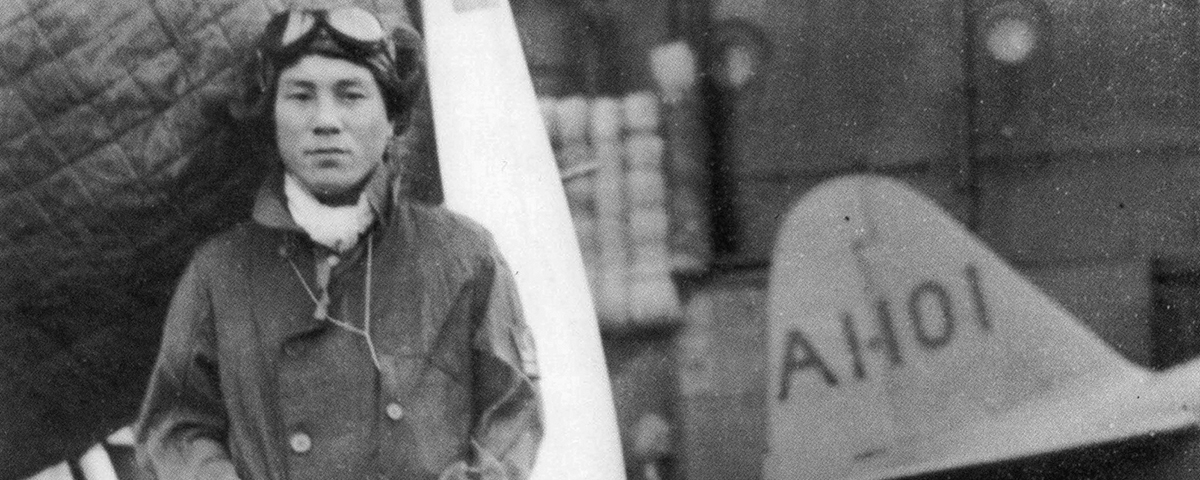
Zenji Abe, one of the pilots who bombed Pearl Harbor, was born in 1916 in a small mountain village in Yamaguchi prefecture on the southern tip of the island of Honshu, the son of a sake brewer. He grew up in a time of worldwide depression, and his father was financially hard pressed to provide for his family. Nevertheless, Abe’s father saved enough to send Abe’s older brother through high school and college. As Abe said, ‘My father was not skillful in his business, but he paid earnest attention to the education of his children.’
After completing the sixth grade in primary school, Abe passed the entrance examination for the Bocho Military School, which was a private school founded and operated by general officers of the Japanese army in Yamaguchi prefecture. He subsequently attended Yamaguchi High School, financed by a fund provided by the Bocho Military School, and at age 16, Abe took the entrance examination for the Imperial Naval Academy. He was successful in spite of competition that eliminated 39 out of 40 applicants.
Abe’s mother had died when he was 9, and only his father was on hand when he entered the Imperial Naval Academy in April 1933. For four years Abe pursued a curriculum of naval subjects as well as language, mathematics, physics, history and other cultural subjects in the Spartan atmosphere of the samurai. (One saying goes, ‘The samurai glories in honorable poverty but takes a toothpick when he has not eaten.’)
As an ensign, he enrolled in the Naval Air School; he graduated a year later as a naval pilot. Abe was assigned to the carrier Soryu and flew many missions in the Sino-Japanese War. He participated in the attack on Pearl Harbor and later took part in raids on Dutch Harbor in the Aleutians, as well as battles in the Indian Ocean, Australia and the Pacific. During the Battle of the Philippine Sea on June 19, 1944, Abe flew a one-way, long-range attack mission off the carrier Junyo. He made a forced landing on the island of Rota, between Saipan and Guam, and lived in a cave on the island until the end of the war, when he was taken prisoner and held for 15 months until he was repatriated to Japan. During his time as a POW, his wife believed him dead.
Forbidden by the Potsdam Agreement to hold a government office, Abe diligently set out to shape himself a new career as a merchant. He had made a modest success of his new venture when war broke out in Korea in 1950. The subsequent withdrawal of American troops from Japan to oppose the North Korean invasion of South Korea created a vacuum that was filled by the hurriedly organized Japanese National Police Reserve (NPR).
In September 1951, it was finally decided that the rule prohibiting certain former officers in the Japanese military service from holding public office should be lifted. Abe was offered the position of superintendent third class in the NPR in view of his demonstrated proficiency and wartime experience. During his refresher schooling, Abe became passably fluent in the English language.
It was on December 6, 1952, that Zenji Abe finally consented to tell his side of the story about Pearl Harbor. He began by quoting a Japanese proverb: ‘The defeated should not talk about the battle.’ He then added, ‘I can only say that I fought as I was trained in those times.’ What follows is his account.
In April 1941, I was in command of a bomber company on board the carrier Akagi. There were nine bombers in my company. All the airplanes of six carriers were assembled in several aerodomes at Kyushu, and we trained hard every day and night, without rest.
The bombers dived in at an angle of 50 to 60 degrees and released their bombs on the target at an altitude of 400 meters. Our target was a naval vessel that attempted to escape from us, and each plane used eight practice bombs on the vessel. We had some bombers that dived into the sea due to their pilots’ severe exhaustion, caused by excess training.
Zero fighters (Mitsubishi A6M2s) were busy with dogfighting exercises and target practice. Three-seat attack bombers (Nakajima B5N2s) had the exercise of level bombing in formation at the height of 3,000 meters and of torpedo bombing at extremely low level.
As a navy lieutenant and a company commander, I trained my men–not knowing what we were training for–paying the greatest attention to their achievement in precision bombing. My company had various duties in our training, but when we attacked and bombed ships, even if we were bombing for five hours, and our bombs did not hit the ships, our training was considered worthless and we would have to bomb more. When I think of the hard training of the torpedo planes that flew every day over Kagoshima City, almost touching the rooftops and having the practice of dropping torpedoes at low altitude, I must conclude that our higher command headquarters had already begun to plan the raid for Pearl Harbor.
It soon proved true. The proficiency of the crewmen for each type of airplane had reached its required standard, and many combined exercises had been practiced. One day in October, all of the officers above the grade of company commander in our task force were assembled at the Kasanohara Aerodrome in the southern part of Kyushu. Commander Minoru Genda, the operation staff officer, came into the conference room and without formality opened the curtain on the front wall to reveal models of Pearl Harbor and Oahu Island, constructed on the full space of the wall.
For a few moments, he explained the plan of the attack on Pearl Harbor. Then Rear Adm. Munetaka Sakamaki, who had just returned from Germany, reported the progress of war by the German air force. All this was only confided to the officers who would lead the attack, and all was kept in the highest degree of secrecy.
When I was authorized to have a few days’ leave in November, I called my wife to Kagoshima, fearing that it might be the last time I would see her. Cheerfully, I sent her and our 6-month-old baby to her native place, without informing her about the coming war.
Now aircraft were being stowed aboard the carriers. One day before leaving Kyushu from Kunashiri Island, our last assembling point, a party was held in a restaurant in Kagoshima. Vice Admiral Chuichi Nagumo, commander in chief of the task force, exchanged cups of wine with each of the officers, shaking hands with them. I thought that I perceived the sparkle of a tear in his eye.
Our six carriers left for the assembly point at Hitokappu Bay, each followed by a destroyer. Some passed through the Sea of Japan, while the others went around the Pacific coast. Our departure was covered by training planes from several airfields in Kyushu, which continued to broadcast radio waves similar to those made by our carrier planes while exercising, in order to camouflage the sudden change in them when we left.
From November 19-22, all ships of the task force of the Hawaiian operation concluded their assembly in Hitokappu Bay. They were: our unit under Admiral Nagumo, composed of the six carriers Akagi, Kaga, Soryu, Hiryu, Shokaku and Zuikaku, with the mission of carrying out the air attack on Pearl Harbor and military installations on Oahu; the covering unit, made up of the light cruiser Abukuma and nine destroyers under Rear Adm. Sentaro Omori; the supporting unit, consisting of the battleships Hiei and Kirishima and the heavy cruisers Tone and Chikuma under Rear Adm. Gunichi Mikawa; the scouting unit of three submarines under Captain Kijiro Imaizumi; the Midway Island attack unit of three destroyers under Captain Yojin Konishi; and the supply unit of eight tankers under Captain Kyokuto Maru.
During the few days we stayed at Hitokappu Bay, the final consultations were held. At 6 a.m. on November 26, we departed Hitokappu Bay, passing eastward through the stormy North Pacific Ocean, keeping away from the merchant ship routes–secrecy was important.
But still it was not yet decided to commence hostilities at that time–merely to deploy for war. Nagumo’s fleet was advancing on the staging area at 42 degrees north, 170 degrees west.
On December 2, the combined fleet received a telegraphed message that war would break out on December 8 (Tokyo time). Therefore Nagumo’s fleet continued its advance and speeded up to 24 knots. At 7 a.m. on December 7, we rapidly approached Oahu.
Before dawn the next day, December 8, Nagumo’s fleet was 200 miles north of Oahu and sent out the first wave of the air attack force at 1:30 a.m.–30 minutes before sunrise. The second wave took off about one hour later. The entire assault force of 354 aircraft was commanded by Mitsuo Fuchida.
‘The fate of the Empire rests on this battle. Let everyone do his duty.’ This was the famous signal that Admiral Heihachiro Togo hoisted on his flagship, Mikasa, at the Battle of Tsushima Strait during the Russo-Japanese War, 36 years before. Now, right above my head, the same signal snapped in the wind at the tip of the mast of our flagship, Akagi.
The wind was competing with the roar of the plane engines warming up. First away from the carrier were nine Zero fighters, led by Lt. Cmdr. Shigeru Itaya. The planes were guided by hand lamps in the dark. They moved one by one into position and took off into the black sky.
Next, Commander Fuchida took off, closely followed by his 14 attack bombers, and then Lt. Cmdr. Juji Murata’s 12 torpedo planes. The radio operator-observers could be seen waving their rising sun headbands (specially prepared for this day) in response to the farewell of the ship’s crew. In each pilot’s mind as well as in the minds of the crewmen, both those remaining behind and those on the planes, was the thought: ‘With this one torpedo, this one bomb, if God wills.’ All were united in a common purpose.
From the other five carriers, planes were taking off and falling into formation while gaining altitude, circling the task force. When they were formed up, they set their course south.
All the carriers were anthills of activity. Planes were lifted from the hangars and readied for the takeoff of the second wave, which was to follow the first by one hour. From the Akagi there were nine Zero fighters under Lieutenant Saburo Shindo and the 18 bombers, of which I led the second company.
My men were standing in a row. Their eyes were bright and eager and their mouths firm. Such was the extent of their training that I only ordered ‘Go ahead,’ knowing that they would do all that should be done, even under unexpected circumstances.
I went to my plane, and from the pilot seat I tested the voice tube to my observer, Warrant Officer Chiaki Saito. I then examined my instruments very carefully.
The ship was rolling and pitching, but not enough to cause me any concern. I felt as if it were just another routine exercise.
The carriers were now turning into the wind. We took off across the bow, one by one, as the first wave had done. We circled to my left and formed up while gaining altitude in the lightening sky. Our wave was led by Lt. Cmdr. Shigekazu Shimazaki and was made up of 35 fighters and 78 bombers under Lt. Cmdr. Takashige Egusa. My own unit, Assault Group 11, was led by Lieutenant Takehiko Chihaya, who was in the observer-gunner’s position on the lead dive bomber. As junior buntaicho (squad leader), I led the rear company within the group.
Our 167 airplanes turned south, with the fighters covering the sides, one hour after the first wave. The weather was not so good. A 10-odd-kilometer wind was blowing from the northeast, and the sea was rough.
As we flew, I thought many thoughts. If we could not find the carriers, our secondary targets would be cruisers. I wondered if the special midget submarines had arrived in the harbor. They were to wait until the air attack started. Could we ask a man to have patience like this? I worried that one of our bombs would be dropped by mistake on their back.
I don’t know how long I meditated, but I was suddenly aroused by Warrant Officer Saito’s voice. From the back seat, Saito let me know that he had caught a radio signal.
Commander Fuchida had given the signal to attack. It was 3:19 a.m., December 8, Tokyo time and 7:49 a.m., December 7, Honolulu time.
I looked back and my planes were following me as steadily as if I were their father. I was assured that all of them had heard and understood that radio signal.
I waited for what seemed millions of hours for the next radio signal. It was really only several minutes later that Warrant Officer Saito called through the voice tube, ‘Sir, the surprise attack was successful.’ Saito was an excellent man and also quite an expert as an observer and radio operator. He had much experience in battle. He was killed the following year, but he always acted in any critical time as if he were playing a game.
He was calm, as usual, at this historic moment. I, on the other hand, was a little nervous. I took deep breaths and tested my guns. I checked the fuel, altitude meter and all apparatus once more–speed was 125 knots, altitude 4,000 meters. Everything was OK. I test-fired my machine gun, and it chattered eagerly.
The formations in front of me flew on majestically as if nothing could stop them. I was filled with impatience. What would Pearl Harbor look like? Would the island of Oahu look like the map I had studied? My eyes strained toward the horizon through breaks in the clouds.
Finally, a white line appeared, breaking the smooth edge where water meets the sky. Above the white line of the breakers was a blue-violet color. ‘There is Oahu,’ I informed Saito through the voice tube, trying to keep my voice calm. I approached the island with a mixture of dreadful fear and fascination. I felt it was the ‘devil’s island’ of Japanese legend. I wondered if aerial battles had already started above the island. Our formation, led by Commander Shimazaki, continued on a 180-degree bearing.
The scattered clouds gradually decreased, and I could see a part of the devil’s island clearly. As we crowded the shoreline, a group of black puffs of smoke appeared to our right front, and then another group appeared quite near our formation–about 200 in all. Anti-aircraft fire! Except for scattered shots in China, it was the first time I had experienced that. I watched the puffs come closer and closer. The thought flashed across my mind that perhaps our surprise attack was not a surprise at all. Would we be successful? I felt awful.
We passed Kahuku Point on our right. Commander Shimazaki had just changed our direction. Then I spotted Kaneohe Air Base just as had been planned. This was just like an exercise. Everything was all right. My nervousness went away. I became calm and steady.
We had not met the fighter resistance we had expected, and our own fighters had broken formation to attack the airfields. Commander Shimazaki gave the signal to attack and then peeled out of the formation, leading the main part of his group to strike Hickam Field. The rest of his group attacked Kaneohe Air Base and Ford Island. Our bombing altitude was 400 meters, below the cloud bank. In spite of this extremely low altitude and severe anti-aircraft fire, our group did not lose so many planes, although 29 of us were hit and crashed.
Our 78 bombers turned to the right, and led by Egusa, approached Pearl Harbor from the east. At the head of my bombers, I brought up the rear of the formation. Our altitude was 4,000 meters at the time, and beneath the clouds ahead I could see Pearl Harbor. Dive bombers were swooping downward to the attack.
Above the city of Honolulu, the companies successively speeded up and went into their attack formations. I checked my bombing equipment and slid the canopy over the cockpit. I could not see well due to the smoke, but as I drew nearer, I made out a line of battleships on the near side of Ford Island. Some were covered by smoke, and others were spouting great brown waves of oil from their sides. Their decks and superstructures danced with the flashes of anti-aircraft guns that all seemed to be pointed at me. I caught sight of another formation of bombers diving below on our right, and I no longer felt alone. One by one they dived until the last had gone into his dive, and then it was our turn.
I banked as a signal to my men and headed down. From the ground, thousands of tracer bullets soared upward, seeming to gain speed as they passed close by my plane. My altitude was 3,000 meters and my speed 200 knots. I applied my air brake and took the cover off my bombsight. I was diving at about a 50-degree angle. There were no aircraft carriers in the harbor, so I decided to attack a cruiser.
Ford Island was ablaze, and a heavy pall of smoke hung in the morning air. With my eyes glued to the bombsight, it seemed that fiery candy-colored bullets were being funneled directly into my eye, but seemingly at the last moment they whizzed by the sides of my plane. My other eight bombers were following close behind me in a straight line.
I caught my target, a big cruiser, squarely in the middle of the range scale of my sight. Warrant Officer Saito began to call the altitude. A strong northeast wind was blowing the plane to the left. I corrected for the drift as the target drew nearer and nearer until it almost filled my sight. ‘Six hundred meters,’ Saito called. ‘Ready…release!’
I released my bomb and at the same time pulled back on the stick. I almost blacked out for a moment, but I pulled out at 50 meters to the sound of Saito’s voice in the voice tube. My observer was excitedly calling out the results of our bombing. ‘Formation leader short. Second plane short. Third plane hit! Adjustment correct. Second echelon successful!’ I was later able to identify our target as an Omaha-class light cruiser–Raleigh.
The entire attack lasted about two hours. I saw only the part in which the second wave participated. Later, upon our return, I heard the story of the first wave from Commander Fuchida’s own lips.
As the first wave approached Pearl Harbor, a faint haze of kitchen smoke from houses preparing breakfast hung over the water. It was a peaceful scene. Fuchida was observing through his field glasses, and as the wave drew nearer, the basket and tripod masts of the battleships Nevada, Arizona, Tennessee, West Virginia, Oklahoma, California and Maryland appeared through the haze. Every battleship of the U.S. Pacific Fleet was in the harbor. There were no aircraft carriers, but Fuchida smiled at the luck that fate had given him. He gave the order for attack formation and led his own formation around the west side of Oahu and over Barbers Point. This point had strong anti-aircraft installations, but not a shot was fired.
As he drew near to the fleet, nobody stirred. Everyone appeared sound asleep. Confident of the success of his mission and in obedience to his instructions, he radioed, ‘Our surprise attack is successful.’
This signal was picked up by our flagship, Akagi, and relayed to the war council in Tokyo and to Nagato, the flagship of the combined fleet in Hiroshima. Upon receipt of this message, the signal was sent to waiting units poised to attack Malaya, Hong Kong, Guam, Wake and other targets.
Soon after Fuchida sent his message, black smoke rose above Hickam Field and then Ford Island. This showed that the dive-bomber attack had started. In the distance, Hoiler Field was also covered with heavy black smoke.
From his post as commander of the attack and leader of the level-bombing group, Fuchida saw a water spout and then another and another appear beside the group of warships. That indicated that the submarine torpedo attack was underway.
He gave the attack order to his formation to begin bombing. Suddenly, intense anti-aircraft fire burst in front of his formation. The bursts were first ahead but then adjusted to burst among the planes of his group. Most of the fire came from the ships, but some came from anti-aircraft positions on shore.
He expressed his admiration for the enemy’s ability to react to an attack and fight back so quickly after the raid started. The anti-aircraft fire became more and more accurate. Suddenly, Fuchida’s plane shuddered violently and fell off into a slip. He later found that one of his control cables had been almost shot away. Nevertheless, he put his planes into attack formation to hit Diamond Head. As they came about, a red and black tower of fire, almost 1,000 meters in height, rose from the battleship Arizona on the east side of Ford Island. The explosion was so violent that it rocked the planes across the harbor. He signaled his bombers to hit Maryland again, and the battle became more and more severe. By the time the second wave arrived, the battle was at its height.
After two hours we broke contact and returned to our carriers, arriving at 8:30 a.m. Our overall losses were nine fighters, 15 dive bombers, five torpedo bombers and 54 men killed in action. We had destroyed the main power of the U.S. Pacific Fleet. We missed our main objective, the aircraft carriers, since they were at sea, but Admiral Nagumo considered us to have accomplished our mission.
I was still in a dazed and dreamy state when I returned to my quarters. I entered the tiny room and began to remove my flying clothes. In the center of my otherwise clean desk lay the envelope containing my will, addressed to my father. Suddenly, my spirits lifted. It was good to be alive.
At 9 a.m. the fleet turned northwest, and we headed for home. The raid was over. We had accomplished our mission. The war was on.
I have been asked by many American officers why we did not follow up our advantage and invade Hawaii. I was in no position to know the strategic plans, but I suppose no one expected our raid to be so successful. Also, it would have been very difficult to supply and support an invasion force over such a long distance. As we Japanese know, even a few Americans can put up a very strong resistance, and I think it would have been a very hard job.
I have told of the Pearl Harbor raid and my part in it from my own experience. Today, thanks to American generosity and understanding, Japan is beginning its history as a free democratic nation. When I graduated from the National Police Reserve and reported to my first assignment, it was on December 8, 1951. At the time, even I did not realize the significance of the day. Those persons who lost husbands and fathers and sons, of course, can never forget that day, and I am afraid that even this small story is like opening an old wound. I pray from the bottom of my heart for those who were killed in action and their bereaved families.
I once explained the meaning of the word samurai to an American. The words are written with two Chinese characters. The first means ‘stop enemy’s sword,’ and the second means ‘gentleman.’ So you see, actually there is nothing aggressive in the samurai spirit; it is the same as your American defense.
The late Admiral Isoroku Yamamoto, who commanded the force that struck Pearl Harbor, was strongly opposed to war with the United States. He knew America, and although opposed to war, he was also a loyal naval officer. When he came aboard the flagship Akagi, he told us: ‘If we go to war with the United States, you will have to face the U.S. Pacific Fleet. Its commander, Admiral Kimmel, is an extremely able officer, selected for his post over many older officers. It will be very difficult to overcome him.’
Two days after we attacked Pearl Harbor, we were listening to the American radio in the command compartment of the Akagi. Admiral Nagumo was in the room. When I told him that Admiral Husband Kimmel had been relieved because of our attack, he was very sympathetic and said he was very sorry for him.
There was no ill feeling or hate before the war against the United States. Why did we make such a mistake? No more Pearl Harbors and no more Hiroshimas should be the watchword for those who believe in peace.
I hereby again pray for those who lost their lives at Pearl Harbor…with all my heart.
This article was written by Warren R. Schmidt and originally appeared in the May 2001 issue of World War II magazine.
For more great articles subscribe to World War II magazine today!