A little before noon on the 7th of April, 1865, General Grant, with his staff, rode into the little village of Farmville, on the south side of the Appomattox River, a town that will be memorable in history as the place where he opened the correspondence with Lee which led to the surrender of the Army of Northern Virginia. He drew up in front of the village hotel, dismounted, and established headquarters on its broad piazza….
[Major General Edward O.C.] Ord and [Major General John] Gibbon had visited the general at the hotel, and he had spoken with them as well as with [Major General Horatio G.] Wright about sending some communications to Lee that might pave the way to the stopping of further bloodshed. Dr. Smith, formerly of the regular army, a native of Virginia and a relative of [Confederate Lieutenant] General [Richard S.] Ewell, now one of our prisoners, had told General Grant the night before that Ewell had said in conversation that their cause was lost when they crossed the James River, and he considered that it was the duty of the authorities to negotiate for peace then, while they still had a right to claim concession, adding that now they were not in condition to claim anything. He said that for every man killed after this somebody would be responsible, and it would be little better than murder. He could not tell what General Lee would do, but he hoped he would at once surrender his army. This statement, together with the news that had been received from [Union Major General Philip H.] Sheridan saying that he had heard that General Lee’s trains of provisions which had come by rail were at Appomattox, and that he expected to capture them before Lee could reach them, induced the general [Grant] to write the following communication:
Headquarters,
Armies of the U.S.
General R.E. LEE,
Commanding C.S.A:
5 p.m., April 7th, 1865
The results of the last week must convince you of the hopelessness of further resistance on the part of the Army of Northern Virginia in this struggle. I feel that it is so, and regard it as my duty to shift from myself the responsibility of any further effusion of blood by asking of you the surrender of that portion of the Confederate States army known as the Army of Northern Virginia.
U.S. Grant,
Lieutenant-General
This he entrusted to [Brigadier] General Seth Williams, adjutant-general, with directions to take it to [Major General Andrew A.] Humphreys’s front, as his corps was close up to the enemy’s rear-guard, and have it sent to Lee’s lines. The general decided to remain all night at Farmville and await the reply from Lee, and he was shown to a room in the hotel in which, he was told, Lee had slept the night before. Lee wrote the following reply within an hour after he received General Grant’s letter, but it was brought in by rather a circuitous route and did not reach its destination till after midnight:
April 7th, 1865.
General: I have received your note of this date. Though not entertaining the opinion you express of the hopelessness of further resistance on the part of the Army of Northern Virginia, I reciprocate your desire to avoid useless effusion of blood, and therefore, before considering your proposition, ask the terms you will offer on condition of its surrender.
R.E. Lee, General
The next morning before leaving Farmville the following reply was given to General Williams, who again went to Humphreys’s front to have it transmitted to Lee:
April 8th, 1865.
General R.E. Lee,
Commanding C.S.A.
Your note of last evening in reply to mine of the same date, asking the conditions on which I will accept the surrender of the Army of Northern Virginia, is just received. In reply I would say that, peace being my great desire, there is but one condition I would insist upon–namely, that men and officers surrendered shall be disqualified from taking up arms against the Government of the United States until properly exchanged. I will meet you, or will designate officers to meet any officers you may name for the same purpose, at any point agreeable to you, for the purpose of arranging definitely the terms upon which the surrender of the Army of Northern Virginia will be received.
U. S. Grant,
Lieutenant-General.
…General Grant had been marching most of the way with the columns that were pushing along south of Lee’s line of retreat; but expecting that a reply would be sent to his last letter and wanting to keep within easy communication with Lee, he decided to march this day with the portion of the army of the Potomac that was pressing Lee’s rear-guard. After issuing some further instructions to Ord and Sheridan, he started from Farmville, crossed to the north side of the Appomattox, conferred in person with [Army of the Potomac commander, Major General George G.] Meade, and rode with his columns. Encouraging reports came in all day, and that night headquarters were established at Curdsville in a large white farmhouse, a few hundred yards from Meade’s camp. The general and several of the staff had cut loose from the headquarters trains the night he started to meet Sheridan at Jetersville, and had neither baggage or camp-equipage. The general did not even have his sword with him. This was the most advanced effort yet made at moving in light marching order, and we billeted ourselves at night in farm-houses, or bivouacked on porches, and picked up meals at any camp that seemed to have something to spare in the way of rations. This night we sampled the fare of Meade’s hospitable mess and once more lay down with full stomachs.
General Grant had been suffering all the afternoon from a severe headache, the result of fatigue, anxiety, scant fare, and loss of sleep, and by night it was much worse. He had been induced to bathe his feet in hot water and mustard, and apply mustard plasters to his wrists and the back of his neck, but these remedies afforded little relief. The dwelling we occupied was a double house. The general threw himself upon a sofa in the sitting-room on the left side of the hall, while the staff-officers bunked on the floor of the room opposite to catch what sleep they could. About midnight we were aroused by Colonel Charles A. Whittier of Humphreys’s staff, who brought another letter from Lee. [Grant’s chief of staff, Brigadier General John A.] Rawlins at once took it in to General Grant’s room. It was as follows:
April 8th, 1865.
General: I received at a late hour your note of to-day. In mine of yesterday I did not intend to propose the surrender of the Army of Northern Virginia, but to ask the terms of your proposition. To be frank, I do not think the emergency has arisen to call for the surrender of this army, but as the restoration of peace should be the sole object of all, I desired to know whether your proposals would lead to that end. I cannot, therefore, meet you with a view to surrender the Army of Northern Virginia; but as far as your proposal may affect the Confederate States forces under my command, and tend to the restoration of peace, I should be pleased to meet you at 10 a.m. to-morrow on the old stage road to Richmond, between the picket-lines of the two armies.
R.E. Lee, General
Lieutenant-General U.S. Grant.
General Grant had been able to get but very little sleep. He now sat up and read the letter, and after making a few comments upon it to General Rawlins lay down again on the sofa.
About 4 o’clock on the morning of the 9th I rose and crossed the hall to ascertain how the general was feeling. I found his room empty, and upon going out of the front door saw him pacing up and down in the yard holding both hands to his head…. We were soon joined by some others of the staff, and the general was induced to go over to Meade’s headquarters with us and get some coffee, in the hope that it would do him good. He seemed to feel a little better now, and after writing the following letter to Lee and dispatching it he prepared to move forward. The letter was as follows:
April 9th, 1865.
General: Your note of yesterday is received. I have no authority to treat on the subject of peace. The meeting proposed for 10 A.M. to-day could lead to no good. I will state, however, that I am equally desirous for peace with yourself, and the whole North entertains the same feeling. The terms upon which peace can be had are well understood. By the South laying down their arms, they would hasten that most desirable event, save thousands of human lives, and hundreds of millions of property not yet destroyed. Seriously hoping that all our difficulties may be settled without the loss of another life, I subscribe myself, etc.,
U.S. Grant,
Lieutenant-General.
It was proposed to him to ride during the day in a covered ambulance which was at hand, instead of horseback, so as to avoid the intense heat of the sun, but this he declined to do, and soon after mounted Cincinnati and struck off toward New Store. From that point he went by way of a crossroad to the south side of the Appomattox with the intention of moving around to Sheridan’s front. While riding along the wagon road that runs from Farmville to Appomattox Court House, at a point eight or nine miles east of the latter place, Lieutenant Charles E. Pease of Meade’s staff overtook him with a dispatch. It was found to be a reply from Lee, which had been sent in to our line on Humphreys’s front. It read as follows:
April, 9th, 1865.
General: I received your note of this morning on the picket-line, whither I had come to meet you and ascertain definitely what terms were embraced in your proposal of yesterday with reference to the surrender of this army. I now ask an interview, in accordance with the offer contained in your letter of yesterday, for that purpose.
R.E. Lee, General
Lieutenant-General U.S. Grant.
Pease also brought a note from Meade, saying that at Lee’s request he had read the communication addressed to General Grant and in consequence of it had granted a short truce.
The general, as soon as he had read these letters, dismounted, sat down on the grassy bank by the roadside, and wrote the following reply to Lee:
General R.E. Lee,
Commanding C.S. Army:
Your note of this date is but this moment (11:50 A.M.) received, in consequence of my having passed from the Richmond and Lynchburg road to the Farmville and Lynchburg road. I am at this writing about four miles west of Walker’s Church, and will push forward to the front for the purpose of meeting you. Notice sent to me on this road where you wish the interview to take place will meet me.
U.S. Grant,
Lieutenant-General
He handed this to Colonel [Orville E.] Babcock of the staff, with directions to take it to General Lee by the most direct route. Mounting his horse again the general rode on at a trot toward Appomattox Court House. When five or six miles from the town, Colonel [Frederick C.] Newhall, Sheridan’s adjutant-general, came riding up from the direction of Appomattox and handed the general a communication. This proved to be a duplicate of the letter from Lee that Lieutenant Pease had brought in from Meade’s lines. Lee was so closely pressed that he was anxious to communicate with Grant by the most direct means, and as he could not tell with which column Grant was moving he sent in one copy of his letter on Meade’s front and one on Sheridan’s. Colonel Newhall joined our party, and after a few minutes’ halt to read the letter we continued our ride toward Appomattox. On the march I had asked the general several times how he felt. To the same question now he said, The pain in my head seemed to leave me the moment I got Lee’s letter.
…About 1 o’clock the little village of Appomattox Court House, with its half-dozen houses, came in sight, and soon we were entering its single street. It is situated on some rising ground, and beyond the country slopes down into a broad valley. The enemy was seen with his columns and wagon trains covering the low ground. Our cavalry, the Fifth Corps, and part of Ord’s command were occupying the high ground to the south and west of the enemy, heading him off completely. Generals Sheridan and Ord, with a group of officers around them, were seen in the road, and as our party came up General Grant said: How are you, Sheridan? First-rate, thank you; how are you? cried Sheridan, with a voice and look that seemed to indicate that on his part he was having things all his own way. Is Lee over there? asked General Grant, pointing up the street, having heard a rumor that Lee was in that vicinity. Yes, he is in that brick house, answered Sheridan. [Lee was waiting for Grant in Wilmer McLean’s home.] Well, then we’ll go over, said Grant.
The general-in-chief now rode on, accompanied by Sheridan, Ord, and some others, and soon Colonel Babcock’s orderly was seen sitting on his horse in the street in front of a two-story brick house, better in appearance than the rest of the houses. He said General Lee and Colonel Babcock had gone into this house a short time before, and he was ordered to post himself in the street and keep a lookout for General Grant, so as to let him know where General Lee was….
The house had a comfortable wooden porch with seven steps leading up to it. A hall ran through the middle from front to back, and on each side was a room having two windows, one in front and one rear. Each room had two doors opening into the hall. The building stood a little distance back from the street, with a yard in front, and to the left was a gate for carriages and a roadway running to a stable in rear. We entered the grounds by this gate and dismounted. In the yard were seen a fine large gray horse, which proved to be General Lee’s, and a good-looking mare belonging to Colonel [Charles] Marshall [Lee’s military secretary]. An orderly in gray was in charge of them, and had taken off their bridles to let them nibble the grass.
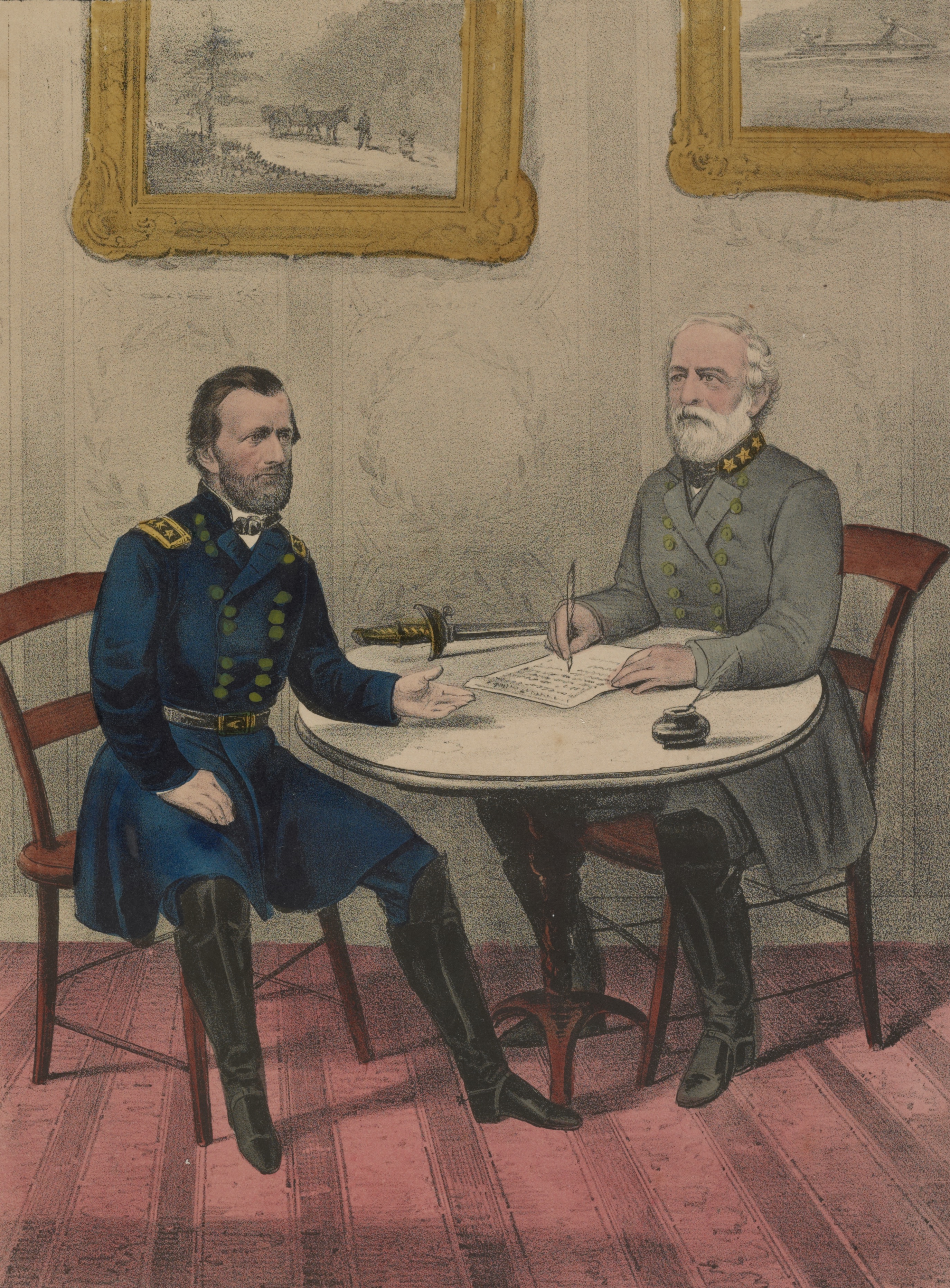
General Grant mounted the steps and entered the house. As he stepped into the hall Colonel Babcock, who had seen his approach from the window, opened the door of the room on the left, in which he had been sitting with General Lee and Colonel Marshall awaiting General Grant’s arrival. The general passed in, while the members of the staff, Generals Sheridan and Ord, and some general officers who had gathered in the front yard, remained outside, feeling that he would probably want his first interview with General Lee to be, in a measure, private. In a few minutes Colonel Babcock came to the front door and, making a motion with his hat toward the sitting-room, said: The general says, come in. It was then about half-past one of Sunday, the 9th of April. We entered, and found General Grant sitting at a marble-topped table in the center of the room, and Lee sitting beside a small oval table near the front window, in the corner opposite the door by which we entered, and facing General Grant. Colonel Marshall, his military secretary, was standing at his left….
The contrast between the two commanders was striking, and could not fail to attract marked attention as they sat ten feet apart facing each other. General Grant, then nearly forty-three years of age, was five feet eight inches in height, with shoulders slightly stooped. His hair and full beard were a nut-brown, with a trace of gray in them. He had a single-breasted blouse, made of dark-blue flannel, unbuttoned in front, and showing a waistcoat underneath. He wore an ordinary pair of top-boots, with his trousers inside, and was without spurs. The boots and portions of his clothes were spattered with mud. He had had on a pair of thread gloves, of a dark-yellow color, which he had taken off on entering the room. His felt sugar-loaf stiff-brimmed hat was thrown on the table beside him. He had no sword, and a pair of shoulder-straps was all there was about him to designate his rank. In fact, aside from these, his uniform was that of a private soldier.
Lee, on the other hand, was fully six feet in height, and quite erect for one of his age, for he was Grant’s senior by sixteen years. His hair and full beard were a silver-gray, and quite thick, except that the hair had become a little thin in front. He wore a new uniform of Confederate gray, buttoned up to the throat, and at his side he carried a long sword of exceedingly fine workmanship, the hilt studded with jewels. It was said to be the sword that had been presented to him by the State of Virginia. His top-boots were comparatively new, and seemed to have on them some ornamental stitching of red silk. Like his uniform, they were singularly clean, and but little travel-stained. On the boots were handsome spurs, with large rowels. A felt hat, which in color matched pretty closely that of his uniform, and a pair of long buckskin gauntlets lay beside him on the table….
General Grant began the conversation by saying: I met you once before, General Lee, while we were serving in Mexico, when you came over from General [Winfield] Scott’s headquarters to visit [Lieutenant Colonel John] Garland’s brigade, to which I then belonged. I have always remembered your appearance, and I think I should have recognized you anywhere.
Yes, replied General Lee, I know I met you on that occasion, and I have often thought of it and tried to recollect how you looked, but I have never been able to recall a single feature. After some further mention of Mexico, General Lee said: I suppose, General Grant, that the object of our present meeting is fully understood. I asked to see you to ascertain upon what terms you would receive the surrender of my army.
General Grant replied: The terms I propose are those stated substantially in my letter of yesterday–that is, the officers and men surrendered to be paroled and disqualified from taking up arms again until properly exchanged, and all arms, ammunition, and supplies to be delivered up as captured property.
Lee nodded an assent, and said: Those are about the conditions which I expected would be proposed.
General Grant then continued: Yes, I think our correspondence indicated pretty clearly the action that would be taken at our meeting; and I hope it may lead to a general suspension of hostilities and be the means of preventing any further loss of life.
Lee inclined his head as indicating his accord with this wish, and General Grant then went on to talk at some length in a very pleasant vein about the prospects of peace. Lee was evidently anxious to proceed to the formal work of the surrender, and he brought the subject up again by saying: I presume, General Grant, we have both carefully considered the proper steps to be taken, and I would suggest that you commit to writing these terms you have proposed, so that they may be formally acted upon.
Very well, replied General Grant, I will write them out. And calling for his manifold order-book, he opened it on the table before him and proceeded to write the terms. The leaves had been so prepared that three impressions of the writing were made. He wrote very rapidly, and did not pause until he had finished the sentence ending with officers appointed by me to receive them. Then he looked toward Lee, and his eyes seemed to be resting on the handsome sword that hung at that officer’s side. He said afterward that this set him to thinking that it would be an unnecessary humiliation to require the officers to surrender their swords, and a great hardship to deprive them of their personal baggage and horses, and after a short pause he wrote the sentence: This will not embrace the side-arms of the officers, nor their private horses or baggage. When he had finished the letter he called Colonel (afterward General) Ely S. Parker, one of the military secretaries on the staff, to his side and looked it over with him and directed him as they went along to interline six or seven words and to strike out the word their, which had been repeated. When this had been done, he handed the book to General Lee and asked him to read over the letter. It was as follows:
Appomattox Ct. H., VA.,
April 9, 1865.
General R.E. Lee,
Commanding C.S.A.
General: In accordance with the substance of my letter to you of the 8th inst., I propose to receive the surrender of the Army of Northern Virginia on the following terms, to wit: Rolls of all the officers and men to be made in duplicate, one copy to be given to an officer to be designated by me, the other to be retained by such officer or officers as you may designate. The officers to give their individual paroles not to take up arms against the Government of the United States until properly [exchanged], and each company or regimental commander to sign a like parole for the men of their commands. The arms, artillery, and public property to be parked, and stacked, and turned over to the officers appointed by me to receive them. This will not embrace the side-arms of the officers, nor their private horses or baggage. This done, each officer and man will be allowed to return to his home, not to be disturbed by the United States authorities so long as they observe their paroles, and the laws in force where they may reside.
Very respectfully,
U.S. Grant,
Lieutenant-General.
Lee took it and laid it on the table beside him, while he drew from his pocket a pair of steel-rimmed spectacles and wiped the glasses carefully with his handkerchief. Then he crossed his legs, adjusted the spectacles very slowly and deliberately, took up the draft of the letter, and proceeded to read it attentively. It consisted of two pages. When he reached the top line of the second page, he looked up, and said to General Grant: After the words ‘until properly,’ the word ‘exchanged’ seems to be omitted. You doubtless intended to use that word.
Why, yes, said Grant; I thought I had put in the word ‘exchanged.’
I presumed it had been omitted inadvertently, continued Lee, and with your permission I will mark where it should be inserted.
Certainly, Grant replied.
Lee felt in his pocket as if searching for a pencil, but did not seem to be able to find one. Seeing this and happening to be standing close to him, I handed him my pencil. He took it, and laying the paper on the table noted the interlineation. During the rest of the interview he kept twirling this pencil in his fingers and occasionally tapping the top of the table with it. When he handed it back it was carefully treasured by me as a memento of the occasion. When Lee came to the sentence about the officers’ side-arms, private horses, and baggage, he showed for the first time during the reading of the letter a slight change of countenance, and was evidently touched by this act of generosity. It was doubtless the condition mentioned to which he particularly alluded when he looked toward General Grant as he finished reading and said with some degree of warmth in his manner: This will have a very happy effect upon my army.
General Grant then said: Unless you have some suggestions to make in regard to the form in which I have stated the terms, I will have a copy of the letter made in ink and sign it.
There is one thing I would like to mention, Lee replied after a short pause. The cavalrymen and artillerists own their own horses in our army. Its organization in this respect differs from that of the United States. This expression attracted the notice of our officers present, as showing how firmly the conviction was grounded in his mind that we were two distinct countries. He continued: I would like to understand whether these men will be permitted to retain their horses?
You will find that the terms as written do not allow this, General Grant replied; only the officers are permitted to take their private property.
Lee read over the second page of the letter again, and then said: No, I see the terms do not allow it; that is clear. His face showed plainly that he was quite anxious to have this concession made, and Grant said very promptly and without giving Lee time to make a direct request:
Well, the subject is quite new to me. Of course I did not know that any private soldiers owned their animals, but I think this will be the last battle of the war–I sincerely hope so–and that the surrender of this army will be followed soon by that of all the others, and I take it that most of the men in the ranks are small farmers, and as the country has been so raided by the two armies, it is doubtful whether they will be able to put in a crop to carry themselves and their families through the next winter without the aid of the horses they are now riding, and I will instruct the officers I shall appoint to receive the paroles to let all the men who claim to own a horse or mule take the animals home with them to work their little farms. (This expression has been quoted in various forms and has been the subject of some dispute. I give the exact words used.)
Lee now looked greatly relieved, and though anything but a demonstrative man, he gave every evidence of his appreciation on this concession, and said, This will have the best possible effect on the men. It will be very gratifying and will do much toward conciliating our people. He handed the draft of the terms back to General Grant, who called Colonel T.S. Bowers of the staff to him and directed him to make a copy in ink. Bowers was a little nervous, and he turned the matter over to Colonel Parker, whose handwriting presented a better appearance than that of any one else on the staff. Parker sat down to write at the table which stood against the rear side of the room. Wilmer McLean’s domestic resources in the way of ink now became the subject of a searching investigation, but it was found that the contents of the conical-shaped stoneware inkstand which he produced appeared to be participating in the general breaking up and had disappeared. Colonel Marshall now came to the rescue, and pulled out of his pocket a small box-wood inkstand, which was put at Parker’s service, so that, after all, we had to fall back upon the resources of the enemy in furnishing the stage properties for the final scene in the memorable military drama.
Lee in the meantime had directed Colonel Marshall to draw up for his signature a letter of acceptance of the terms of surrender. Colonel Marshall wrote out a draft of such a letter, making it quite formal, beginning with I have the honor to reply to your communication, etc. General Lee took it, and, after reading it over very carefully, directed that these formal expressions be stricken out and that the letter be otherwise shortened. He afterward went over it again and seemed to change some words, and then told the colonel to make a final copy in ink. When it came to providing the paper, it was found we had the only supply of that important ingredient in the recipe for surrendering an army, so we gave a few pages to the colonel. The letter when completed read as follows:
Headquarters,
Army of Northern Virginia,
April 9th, 1865.
General: I received your letter of this date containing the terms of the surrender of the Army of Northern Virginia as proposed by you. As they are substantially the same as those expressed in your letter of the 8th inst., they are accepted. I will proceed to designate the proper officers to carry the stipulations into effect.
R.E. Lee, General
Lieutenant-General U.S. Grant.
While the letters were being copied, General Grant introduced the general officers who had entered, and each member of the staff, to General Lee. The General shook hands with General Seth Williams, who had been his adjutant when Lee was superintendent at West Point, some years before the war, and gave his hand to some of the other officers who had extended theirs, but to most of those who were introduced he merely bowed in a dignified and formal manner. He did not exhibit the slightest change of features during this ceremony until Colonel Parker of our staff was presented to him. Parker was a full-blooded [Seneca] Indian, and the reigning Chief of the Six Nations. [Actually, Parker had been elected one of 50 sachems of the Iroquois Confederacy in 1851.] When Lee saw his swarthy features he looked at him with evident surprise, and his eye rested on him for several seconds. What was passing in his mind probably no one ever knew, but the natural surmise was that he at first mistook Parker for a Negro, and was struck with astonishment to find that the commander of the Union armies had one of that race on his personal staff.
…General Lee now took the initiative again in leading the conversation back into business channels. He said:
I have a thousand or more of your men as prisoners, General Grant, a number of them officers whom we have required to march along with us for several days. I shall be glad to send them into your lines as soon as it can be arranged, for I have no provisions for them. I have, indeed, nothing for my own men. They have been living for the last few days principally upon parched corn, and we are badly in need of both rations and forage. I telegraphed Lynchburg, directing several train-loads of rations to be sent on by rail from there, and when they arrive I should be glad to have the present wants of my men supplied from them.
At this remark all eyes turned toward Sheridan, for he had captured these trains with his cavalry the night before, near Appomattox Station. General Grant replied: I should like to have our men sent within our lines as soon as possible. I will take steps at once to have your army supplied with rations, but I am sorry we have no forage for the animals. We have had to depend upon the country for our supply of forage. Of about how many men does your present force consist?
Indeed, I am not able to say, Lee answered after a slight pause. My losses in killed and wounded have been exceedingly heavy, and, besides, there have been many stragglers and some deserters. All my reports and public papers, and, indeed, my own private letters, had to be destroyed on the march, to prevent them from falling into the hands of your people. Many companies are entirely without officers, and I have not seen any returns for several days; so that I have no means of ascertaining our present strength.
General Grant had taken great pains to have a daily estimate made of the enemy’s forces from all the data that could be obtained, and judging it to be about 25,000 at this time, he said: Suppose I send over 25,000 rations, do you think that will be a sufficient supply?
I think it will be ample, remarked Lee, and added with considerable earnestness of manner, and it will be a great relief, I assure you.
General Grant now turned to his chief commissary, Colonel (now General) M.R. Morgan, who was present, and directed him to arrange for issuing the rations. The number of officers and men surrendered was over 28,000. As to General Grant’s supplies, he had ordered the army on starting out to carry twelve days’ rations. This was the twelfth and last day of the campaign.
Grant’s eye now fell upon Lee’s sword again, and it seemed to remind him of the absence of his own, and by way of explanation he said to Lee: I started out from my camp several days ago without my sword, and as I have not seen my headquarters baggage since, I have been riding about without any side-arms. I have generally worn a sword, however, as little as possible, only during the actual operations of a campaign.
I am in the habit of wearing mine most of the time, remarked Lee; I wear it invariably when I am among my troops, moving about through the army.
General Sheridan now stepped up to General Lee and said that when he discovered some of the Confederate troops in motion during the morning, which seemed to be a violation of the truce, he had sent him (Lee) a couple of notes protesting against this act, and as he had not had time to copy them he would like to have them long enough to make copies. Lee took the notes out of the breast-pocket of his coat and handed them to Sheridan with a few words expressive of regret that the circumstance had occurred, and intimating that it must have been the result of some misunderstanding.
After a little general conversation had been indulged in by those present, the two letters were signed and delivered, and the parties prepared to separate. Lee before parting asked Grant to notify Meade of the surrender, fearing that fighting might break out on that front and lives be uselessly lost. This request was complied with, and two Union officers were sent through the enemy’s lines as the shortest route to Meade–some of Lee’s officers accompanying them to prevent their being interfered with. At a little before 4 o’clock General Lee shook hands with General Grant, bowed to the other officers, and with Colonel Marshall left the room. One after another we followed, and passed out to the porch. Lee signaled to his orderly to bring up his horse, and while the animal was being bridled the general stood on the lowest step and gazed sadly in the direction of the valley beyond where his army lay–now an army of prisoners. He smote his hands together a number of times in an absent sort of a way; seemed not to see the group of Union officers in the yard who rose respectfully at his approach, and appeared unconscious of everything about him. All appreciated the sadness that overwhelmed him, and he had the personal sympathy of every one who beheld him at this supreme moment of trial. The approach of his horse seemed to recall him from his reverie, and he at once mounted. General Grant now stepped down from the porch, and, moving toward him, saluted him by raising his hat. He was followed in this act of courtesy by all our officers present; Lee raised his hat respectfully, and rode off to break the sad news to the brave fellows who he had so long commanded….
This article was written by Mark H. Dunkelman and originally published in the May 2000 issue of Civil War Times Magazine.
For more great articles, be sure to subscribe to Civil War Times magazine today!
*The Century Magazine between 1884 and 1887. The magazine’s editors then included it in their 1887 compilation, Battles and Leaders of the Civil War. We have reproduced most of it here, lightly edited for clarity and length.