‘The XB-70 fulfilled General Curtis E. LeMay’s dream of a bomber that could penetrate the Soviet Union with impunity, carrying enough ordnance to decide the outcome of a war in a single strike’
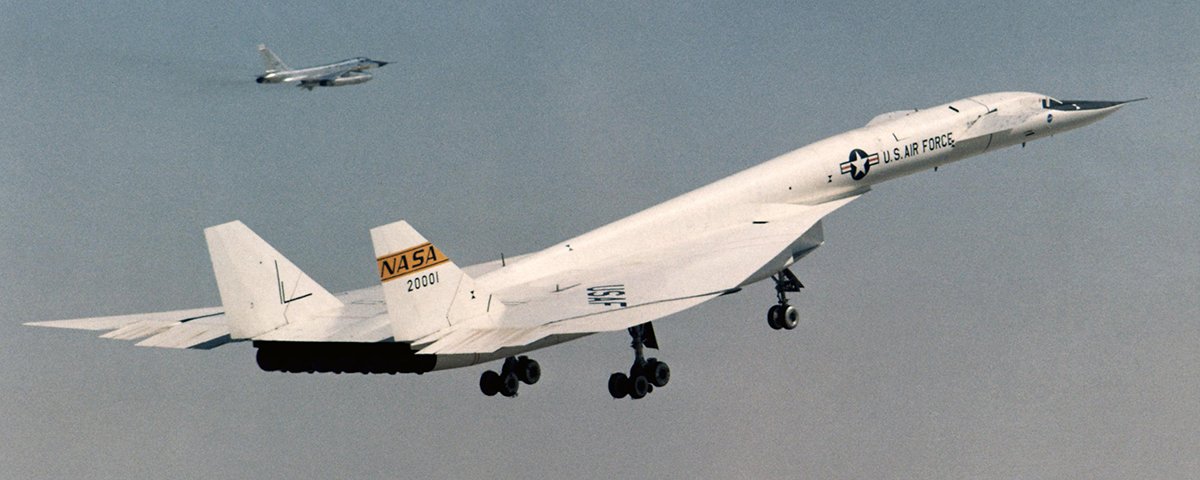
The magnificent 500,000-pound Valkyrie could cruise at Mach 3. It had monumental firepower, wingtips that folded down to enhance its exotic lines, and—best of all—a shape that did the impossible: obtain something for nothing from the air. North American Aviation’s XB-70 fulfilled General Curtis E. LeMay’s dream of a bomber that could penetrate the Soviet Union with impunity, carrying enough ordnance to decide the outcome of a war in a single strike. To the public, the Valkyrie represented the epitome of American aeronautical genius, and so it was. Yet the XB-70 took years to conceive, design and build. It was fatally compromised by a declining defense budget and the advent of improved surface-to-air and intercontinental ballistic missiles.
Today the legacy of the space age—from Sputnik to the International Space Station—has left the public somewhat jaded about aviation advances. Yet during the 15 years from the initial requirement to the XB-70A’s retirement, most Americans were still excited about new airplanes. With its striking, lethal beauty, the Valkyrie captured the public’s imagination like few other aircraft.
Considered by many the most extreme example of aircraft engineering to date, the XB-70A was in truth a simplified version of even more extravagant concepts. American aeronautical engineers were tasked in 1954 with achieving General LeMay’s goal of a true strategic bomber. His call came when the Soviet Union was recognized as a genuine superpower that possessed nuclear weapons and subscribed to a first-strike policy. And LeMay knew that improvements in Soviet radar and missile systems would raise the attrition rate for Boeing B-47 and B-52 bombers to an unacceptable level by the early 1960s.
LeMay charged the Air Force and the industry with a dual task. They were to develop two weapon systems in parallel that would have some commonality in components, but using two entirely different types of power plants. Weapon System 125A was to be a nuclear-powered bomber, one that created an astounding story all its own before being canceled. Weapon System 110A was to use a more conventional power plant, possibly enhanced by high-energy chemical fuels.
At this point all the competing design firms believed that sustained supersonic flight used impractical amounts of fuel. Thus the specs for WS-110A called for a Mach 0.9 cruise to the combat zone, followed by as high speed a supersonic dash as possible, for as long as 1,000 to 2,000 miles. And while an altitude of 60,000 to 70,000 feet was desired, manufacturers were also told to investigate the possibility of low-level operations.
Boeing and North American both became contenders for the WS-110A prize. They developed a series of highly varied designs, some with gross weights of 750,000 pounds. Both firms turned to a “floating wing panel” system originally advocated by German designer Richard Vogt. On one North American design, the 190,000-pound floating wing panels, roughly the size of a B-47, were to be drained of fuel in combat, then jettisoned, with the now smaller, cleaner element of the bomber capable of Mach 2. LeMay complained that it looked like a three-ship formation, not an airplane.
North American and Boeing came to believe the Air Force’s goals could be achieved by a smaller plane that flew at supersonic speed for the entire mission. Competing engine manufacturers—Allison, General Electric and Pratt & Whitney—agreed. The Air Force then revised its specs, calling for a cruise speed of Mach 3 to Mach 3.2, capability of flying at 70,000 feet and a range of between 6,000 and 10,000 miles.
North American redesigned the WS-110A to use “compression lift,” a theory advanced in a National Advisory Committee on Aeronautics study, sometimes called the “wave-rider” effect. The study stipulated that in high-speed aircraft, the fuselage created a shock wave that generated pressure which could be used against the lower surface of aft-positioned wings. North American’s design featured a long, narrow fuselage with canard surfaces, superimposed on top of the wing, which in turn was on top of the engine bay where six engines were installed. North American realized its current layout could be optimized to take advantage of the “free ride” of compression lift, resulting in an approximate 30-percent increase in lift, with no increase in drag. The most significant change was repositioning the variable-geometry inlet that fed air to the engines, moving it forward to improve the position of the shock wave relative to the wings.
Despite many studies, the Model 804-4 submitted by Boeing was similar to its previous proposal but slightly larger, with a less trapezoidal delta-wing shape. The articulated nose was eliminated. It also featured a canard that was deployed from upright during subsonic flight to horizontal during supersonic flight.
When the Air Force evaluated the two designs in the fall of 1957, North American’s plan proved superior in most respects. But the additional range implicit in the “free” 30-percent improvement in lift was probably the decisive factor. The design then had to be refined and built.
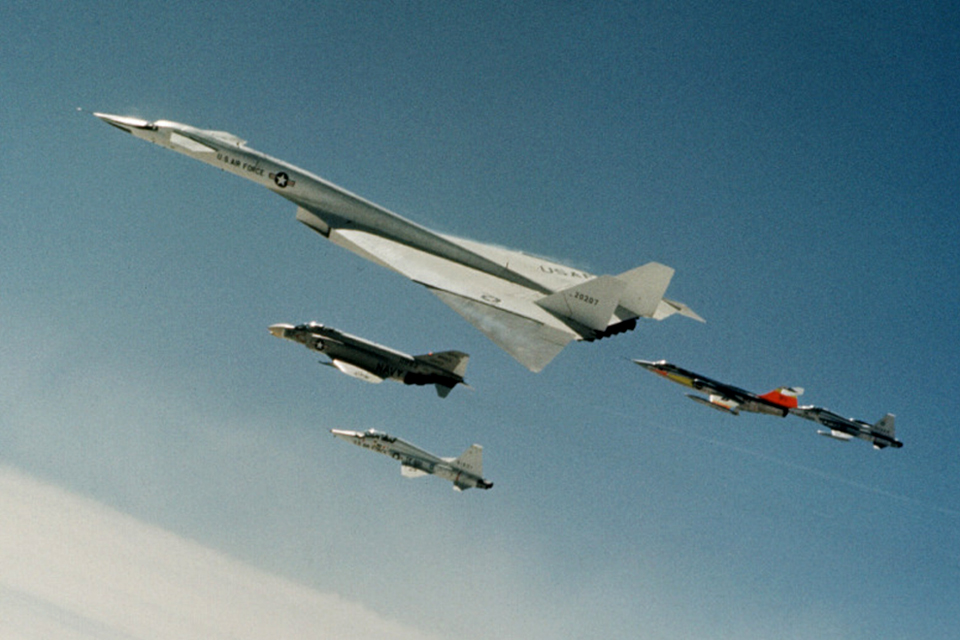
North American made numerous changes during the years of development. A fixed windscreen was replaced by a movable windshield ramp, á la Concorde. The controversial canard surfaces were reshaped and repositioned. The fuselage was blended smoothly into the upper body. The two large vertical stabilizers, with rudders, were first reduced in size, then changed into all-moving vertical stabilizers. The movable wingtips, which were lowered in flight, were now folded at a point 60 percent of the span of each wing. These folding surfaces were huge, approximately the same size as the wing of the Convair B-58 Hustler. Contrary to popular belief, they weren’t specifically intended to augment the so-called wave-rider effect, but rather provided additional stability that allowed the vertical surfaces to be smaller, reducing drag.
Realizing that the aircraft would experience extremely high surface temperatures during sustained Mach 3 flight, North American elected to use a stainless steel honeycomb sandwich for almost 70 percent of the plane’s weight. It was light, strong, smooth and able to withstand temperatures of up to 650 degrees.
Sadly, the closer the XB-70A moved to its first flight, the more official interest in it declined. In November 1959, when President Dwight D. Eisenhower expressed his doubts about the XB-70 program, the Air Force maintained its support, letting a contract calling for one XB-70A and 11 YB-70A service test bombers. But President John F. Kennedy accepted the recommendation of Secretary of Defense Robert S. McNamara, who was against manned bomber development. The Air Force reduced the contract to three XB-70A prototypes, ending any real hope for production.
In the end, only two XB-70As were built. The first flew on September 21, 1964, with Al White and Joe Cotton at the controls. The second Valkyrie flew on July 17, 1965, with the same pilots. In total, the XB-70As made 129 flights, demonstrating sustained performance at Mach 3.
While a tremendous amount of data was gleaned from the program, today the XB-70A is most remembered for two flights of a very different nature. The first came on June 8, 1966, when an F-104N Starfighter flown by test pilot Joe Walker collided with the number two XB-70A during a photo mission. The T-tail of Walker’s F-104 struck the drooped right wingtip of the XB-70, then the Starfighter rolled inverted, cutting off parts of both of the bomber’s vertical stabilizers. The Valkyrie crashed, killing pilot Carl Cross. Al White, who ejected in the XB-70’s capsule, survived. Walker was killed instantly.
The second memorable mission was the last flight of the first prototype, when it was delivered to Wright Patterson to become part of the National Museum of the U.S. Air Force. Its touchdown on February 4, 1969, ended the 15-year saga of one of history’s most extreme aircraft.
Anyone interested in the XB-70A should refer to the definitive book on the topic, Valkyrie: North American’s Mach 3 Superbomber, by Dennis R. Jenkins and Tony R. Landis.