The Norsemen had formed into a traditional shield wall, against which the oncoming English smashed themselves like waves on a rocky shore.
In September 1066, while England warily watched its southern coast, anticipating the Norman invasion force forming up across the channel, a nasty surprise erupted at the other end of the country: A fleet of 300 dragon-headed Viking longships descended from the northeast, bearing some 9,000 armed, plunder-seeking warriors. The berserkers had returned.
As the village of Cleveland and then the city of Scarborough fell to Norse axes and fire, it became clear that several thousand mounted Normans were no longer England’s most immediate concern. After sacking Scarborough, the Viking force—which largely consisted of Norwegians, as well as Scots, Flemings and some English—sailed up the Humber estuary as far as Riccall on the River Ouse. The invaders lined miles of riverfront with their ships, then disembarked and made for the city of York, just nine miles north of the Ouse.
The Viking commander alone was enough to strike terror in the hearts of English defenders: King Harald III Sigurdsson of Norway, aka Harald Hardrada (“the Hard Ruler”), was a career warlord, a broad-shouldered giant of a man who stood well over 6 feet and who had spent the preceding 35 years honing his martial skills in a variety of conflicts, taking him from the royal court in Kiev to the palaces of Byzantium. Soon after assuming the throne of Norway in 1047, Hardrada—who was flamboyant as he was fierce and a prolific composer of heroic sagas—launched into a protracted war with Denmark, not tasting victory until 1064. By 1066 the ever-ambitious warrior—who, like Duke William of Normandy, was a potential claimant to the English throne—hungered for a new conquest. At the urging of a future ally, Hardrada set his sights on England.
That ally was Tostig Godwinson, the recently deposed earl of Northumbria and the estranged and exiled brother of King Harold Godwinson, who’d been crowned less than a year earlier. A cruel, heavy-handed ruler, Tostig had been ousted from his earldom by a violent rebellion in 1065, during the waning days of the reign of King Edward “The Confessor.” Tostig harbored a venomous grudge against his brother after his fall and suspected Harold of being behind the revolt. Broken and bitter, Tostig sailed to Flanders, the native home of his wife, Judith, who was daughter to the region’s overlord, Count Baldwin IV. From Flanders, Tostig began recruiting pirates and outfitting ships for an armed return to England. Scurrying from court to court, he solicited support from first the French and Normans, then later the Scots and Norwegians.
Eventually, Tostig found a willing coconspirator in Hardrada and made plans to rendezvous off England’s northern coast by summer’s end in 1066. Departing in late August, the Norwegian invaders sailed the same northerly wind that, ironically, kept Duke William grounded. The longships sailed from the Solund Islands to Shetland, then to the Norse-controlled Orkneys to rally additional men and ships. From there the fleet sailed to its appointment with Tostig while the largely unsuspecting English prepared to meet a different foe, the Normans.
Fearing that the south was incapable of providing timely reinforcements—or perhaps due to youthful hubris—two brothers, the young, inexperienced northern earls Edwin of Mercia and Morcar of Northumbria (Edwin, the eldest, was perhaps 18 at the time) mounted the initial English response to the Viking invasion. The brothers placed their armies in Hardrada’s path on a boggy patch of ground near the Ouse at Fulford, about a mile from York. On September 20, the earls positioned their men—many as green as their commanders—along the approach road. A large, water-filled ditch and marshy ground near Heslington protected their left, the Ouse their right. The ensuing clash was a daylong, bloody, shield-smashing slog, as opponents hacked, stabbed, bled and died for every inch of ground.
The English gained early momentum, especially on their left flank, but in the end Hardrada’s military expertise proved decisive. Fighting under his fearsome Landwaster (“Terror of the Land”) standard—a black raven on a white background—the Viking warlord sensed an opportunity to turn the battle and swung his left inward away from the Ouse, rolling the English into the ditch. A terrible rout followed, many Saxons meeting death by drowning or at the point of Norse steel. When the fighting ended, the marshes were choked with the corpses of more than a thousand English warriors—men who would be sorely missed in the weeks ahead.
After their victory, Hardrada and Tostig negotiated the terms of York’s surrender and then, for reasons still unclear, elected to return to their ships rather than occupy the city. They selected Stamford Bridge—a large wooden span of the River Derwent at the intersection of four Roman roads, 8 miles east of York and 12 miles from their camp at Riccall—as the spot where hostages, cattle and other spoils would be received. (The bridge that stands today is roughly 400 yards downstream of the original.) Hardrada and a force of surprisingly lightly armed and armored men embarked for Stamford Bridge, leaving at least a third of the force at Riccall under the watch of Eystein Orri, a rising young warrior Hardrada had promised in marriage to his daughter, Maria. By September 24, Hardrada and Tostig were encamped in the meadows near the meeting place, with no inkling of the battle to come.
Meanwhile, King Harold, with funds and rations dwindling and harvesttime approaching, had been forced to abandon his southern defenses. He dismissed the fyrd, or citizen militia, to the shires and sent back to London his fleet and force of housecarls—notoriously fierce, ax-wielding professional soldiers of Danish origin who’d served as royal bodyguards since the days of King Canute. Harold had waited all summer for the anticipated Norman assault. He hoped the season for an invasion had passed but knew that William might still appear on English soil. The general dismissal fell on September 8, just a week prior to the Viking landing.
On learning of the events in the north, the king, who as a young earl had mounted effective lightning assaults against the troublesome Welsh, took swift action: Between September 18 and 20, the king, his brother Gyrth and the reassembled housecarls, who numbered some several thousand strong, mounted their shaggy ponies and departed London, racing north on the old Roman road in seven divisions, enlisting the shire levies along the way. Within four days the king’s army reached Tadcaster, near York, having traveled some 185 miles in one of military history’s great troop movements. Harold is said to have been ill at the time. He was struck one evening with severe leg pain that kept him awake all night. In the morning, while praying for relief, he reportedly fell into a trance and had a vision of victory over the Norwegians.
Determined yet weary, the army paused at Tadcaster, preparing to meet the Viking invaders. Their rest proved brief. Harold got word that his foe was camped within 10 miles and knew he must seize the element of surprise. The king mustered his exhausted troops and gave the order to march. At dawn on September 25, the army departed Tadcaster en route to York. Beyond lay Stamford Bridge.
On the morning of September 25, Hardrada’s army was probably more concerned with sheltering from the autumn heat than preparing for an English attack. Tossing aside their heavy mail hauberks, men lolled in the meadows on the east bank of the Derwent near present-day Battle Flats Farm, while a smaller force maintained a watch on the west bank. When Viking sentries spotted dust clouds rising from the road near York, just over the ridge a mile west at Gate Helmsley, then saw sunlight glinting off Saxon armor and spearheads, they must have realized the gravity of their miscalculation. Harold’s Wessex dragon banner and Fighting Man standard signaled to all that the king’s forces now approached.
Scandinavian sagas that describe the battle—allowing for poetic license—claim that at the outset, Harold and 20 of his housecarls rode to the foot of the bridge to parley with the Viking commanders. Disguised as a herald, the king met both Tostig and Hardrada. Tostig, perhaps feeling a tinge of regret, allowed his brother’s subterfuge to continue throughout the discussions. Harold is said to have offered his outcast brother reinstatement of his earldom and one-third of the kingdom; but when Tostig inquired as to Hardrada’s fate, Harold sternly replied, “We will give him seven feet of English ground or as much more, as he is taller than most men.” With his honor on the line, Tostig countered that he would not be remembered for bringing the king of Norway to England only to betray him. Tostig and Hardrada then rode off.
As they trotted away, Hardrada asked Tostig who that herald was. When Tostig told him it was his brother the king, the mighty Norwegian growled that he would’ve killed Harold on the spot had he known his true identity. Tostig explained that he couldn’t knowingly betray and murder a brother who’d offered him peace, and further, if one brother was destined to kill the other this day, he wished to be the one who fell under the other’s sword. Composing himself, Hardrada is said to have remarked that the English king stood well in his stirrups for such a small man—an especially cocky quip considering that at 5-foot-11, Harold Godwinson was fairly tall for his day. But as men raced to find weapons and armor to replace those they’d left behind at the ships, it became clear that Hardrada’s overconfidence could be his undoing.
As Vikings on the east bank of the Derwent raced to prepare for battle, the scouts west of the river faced the task of delaying the English advance across the bridge. Fighting uphill, their backs against the river, the Norsemen were quickly overrun by the oncoming English. What happened next has taken on a mythical quality but is largely accepted: As Harold’s troops reached the bridge, they were met by a lone Viking defender, who used his massive battle-ax to cut down numerous challengers (some sources claim 40 Saxons), much to the glee of onlookers on the east bank. The lone warrior’s feat provided his compatriots with crucial time to assemble their defense.
Chroniclers state that one of Harold’s housecarls found an empty swill tub upstream and, under the cover of overhanging willows, managed to glide undetected beneath the bridge. The housecarl then aimed his spear deliberately at the Viking’s unprotected groin and, with necessity prevailing over honor, skewered the berserker where he stood. The English then poured over the bridge.
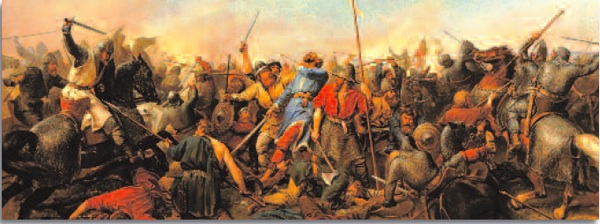
Waiting for them on ground now called Battle Flats, the Norsemen had formed into a traditional shield wall, against which the oncoming English smashed themselves like waves on a rocky shore, pitting famed housecarls against feared Vikings. Details of the combat remain murky, except that the fighting was as savage as one might imagine. The English may have well outnumbered their opponents, and a Viking messenger was dispatched to Riccall to summon Eystein Orri with reinforcements. Whatever the numbers, the Vikings were renowned for their ferocity in combat, and the fighting is said to have lasted well into dusk, both sides sustaining heavy casualties.
When Hardrada, slashing away savagely amid the fray, took an arrow in the throat, the balance tipped in favor of the English. As the Viking commander fell, there was a brief pause in the fighting, and Harold made another attempt at diplomacy in the interest of sparing lives, again offering peace to Tostig. But the fever of battle proved too much, and the Norwegians rejected the offer, opting to fight to the death in a “corpse ring” around their fallen leader. The surging English cut down scores of Vikings and drove still more into the river to drown. Tostig was soon dispatched to join Hardrada.
Orri’s eventual arrival (celebrated as “Orri’s Storm” in Norse legend) prompted a final, frenzied third wave of fighting. He raised the toppled Landwaster banner, attempting to rally the dispirited troops, but by nightfall Orri too had been slain, and the invaders’ shield wall disintegrated. The English had won the day, and the victorious Saxons chased the Vikings back to their ships at Riccall.
Harold, by most accounts an affable, good-natured man, offered mercy to Hardrada’s young son, Olaf, as well as to young earls Paul and Erlend Thorfinnsson of Orkney, allowing them to sail home free of ransom, provided they swore never to invade England again. Of the original 300-vessel Viking fleet, a mere two dozen longships departed England’s shores—all that was required to carry away the survivors. The vanquished Norwegian nobles regrouped in the Orkneys and later retrieved Hardrada’s remains from England. He was laid to rest at St. Mary’s Church in Nidaros (modern-day Trondheim, Norway), while Tostig was laid to rest in his former earldom of York. For nearly a century afterward, the bleached bones of the dead are said to have littered the fields near Stamford Bridge.
For Harold and the victorious English, there was scant time for celebration. After just two days of rest at York, he and his housecarls began a hasty ride back to London, which the exhausted men completed in just eight days. Along the way, their spirits would sink at the news of Duke William’s September 28 landing at Pevensey Bay and the subsequent Norman rape of the Sussex countryside. The epic clash at Hastings on Oct. 14, 1066, would alter the course of Western history, and the Saxons had little choice but to meet it head on with whatever men they could muster. Had a full-strength, rested English army met the Normans that day, the outcome might have been very different.
Despite being overshadowed by the loss to the Normans and death of King Harold at Hastings, the Battle of Stamford Bridge, one of England’s greatest military victories, marked the near-total defeat of a formidable foe led by a legendary warlord. It was the last time a largely Scandinavian force would assault the island nation. After centuries of bloodshed and terror, the Viking Age in England had come to an end.
For further reading, Brendan Manley recommends: 1066: The Year of the Three Battles, by F.J. McLynn; Harold II: The Doomed Saxon King, by Peter Rex; and 1066: The Year of the Conquest, by David Howarth.