‘My paint had light, warmth. My colors got warmer. I released a lot from my mourning’
Rain-in-the-Face—with or without three hyphens in his name—was a fearless Hunkpapa Lakota warrior. Some accounts trace his evocative moniker to the time an enemy’s blood splattered like rain on his face during a fight. Others suggest his war paint streaked as he fought in a heavy storm. In any case, he is perhaps the third-best-known Sioux warrior—behind Crazy Horse and Sitting Bull—present at the June 1876 Battle of the Little Bighorn. Some claim Rain-in-the-Face killed George Custer and mutilated Tom Custer’s remains; he denied such accusations. Regardless, that grim business inspired Henry Wadsworth Longfellow’s poem “The Revenge of Rain in the Face”:
“Revenge!” cried Rain-in-the-Face,
“Revenge upon all the race
Of the White Chief with yellow hair!”
And the mountains dark and high
From their crags re-echoed the cry
Of his anger and despair.
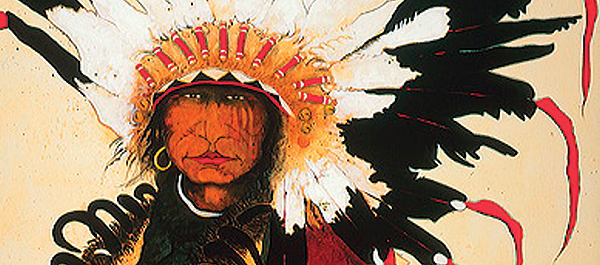
Crow Indian artist Kevin Red Star took a different approach in his acrylic-on-canvas portrait of the Lakota leader (detail above). Rain in the Face—Red Star’s hyphenless depiction—is strikingly powerful, a fierce, strong, passionate portrait of a fierce, strong and passionate warrior. Then again, you would expect nothing less from a fierce, strong and passionate Indian artist.
“The Crows didn’t side with the Cheyenne, Arapaho and Sioux battling the government,” Red Star says. “We, the Crows, say they came to annihilate the Crows because we are so small. The Sioux and Cheyenne banded together to wipe us out because we have nice pastures for our horses and plenty of game in the foothills and mountains.…There are always sides. Some are peaceful, some belligerent. It’s just basically territorial rights, fishing and hunting rights, grazing rights. Which is what it is now, too.”
Born in 1943, Red Star grew up in a household of art and music on the Crow Agency reservation in Lodge Grass, Mont., near the Little Bighorn Battlefield National Monument. “I’m on the reservation,” he says. “We didn’t know about paintbrushes. We drew with crayons.” He sketched “all the time” but never thought about painting until he transferred to the Institute of American Indian Arts, a school established in Santa Fe, N.M., in 1962.
Red Star’s exposure in Santa Fe to different types of art, different Indians, different cultures put him on the path to becoming an artist. “A person has to have passion,” he says. “I guess I acquired that…wanting to keep up the history of Montana and the Crow Indians. That’s one of the things that kept me going—interpreting it in my own way.”
Red Star’s Montana home provided much inspiration. His father picked up prints of artists like longtime Montana resident Charlie Russell and vintage photographs from secondhand shops. But Red Star also learned much by observing his surroundings.
“I was able to see, when I was very young, old people with braids and reservation hats coming in on horseback to our little town to go to the store and buy tobacco or something,” he recalls. “It was so good to see that. It was natural. You always saw tepees. You’d have regular log homes, but tepees were kind of like a guesthouse. And I think just about every home had a sweat lodge. Those memories I try to keep fresh and translate into the ideas I produce.”
For more than 30 years, Red Star’s work—contemporary but with a deep appreciation of the past—has earned the respect of collectors and critics, resulting in more than 100 large-scale exhibitions, including some 40 one-man shows. His paintings have found their way into galleries at the Smithsonian Institution, the National Museum of the American Indian, the Heard Museum, Eiteljorg Museum of American Indians and Western Art, the Whitney Gallery of Western Art and even the U.S. State Department.
His career and life were on an upward trajectory until tragedy struck on May 14, 2008, when a car accident in Montana took the life of his daughter. She was also Red Star’s business manager.
“I couldn’t paint forever,” he says. “I loved her so much. I still do. That’s what kept me going—her love.”
Eventually, he picked up his paintbrushes again, knowing that’s what she would want. And when he started painting again, he noticed something remarkable.
“My paint had light, warmth,” he says. “My colors got warmer. I released a lot from my mourning.”
Red Star is producing again, dividing his time between Montana and New Mexico, recreating the past and envisioning the future with his fierce, strong, passionate images.
“My palette is warm,” he says, “and I like that.”
Browse Kevin Red Star’s work at Legends Santa Fe and on his Web site.