The surprise Japanese raid on Pearl Harbor of December 7, 1941, was only the beginning of bad news from the Pacific. In the ensuing weeks, Wake Island, Singapore, Hong Kong and most of the Philippines were overrun by the Japanese army.
Within an incredibly short time, the Japanese had invaded and conquered huge land areas on a front that extended from Burma to Polynesia. By April 1, 1942, Bataan had fallen, and 3,500 Americans and Filipinos were making a brave last stand on the tiny island of Corregidor. There seemed to be no end to the Japanese aggression. Never before had America’s future looked so grim.
Soon after the death toll at Pearl Harbor had been totaled, President Franklin D. Roosevelt asked America’s top military leaders, Army Generals George C. Marshall and Henry H. ‘Hap Arnold and Admiral Ernest J. King, to figure out a way to strike back at Japan’s homeland as quickly as possible. Although there was nothing they wanted to do more, it seemed an impossible request to carry out.
In response to the president’s persistent urging, Captain Francis S. Low, a submariner on Admiral King’s staff, approached Admiral King and asked cautiously if it might be possible for Army medium bombers to take off from a Navy carrier. If so, could they be launched against Japan?
The question was passed to Captain Donald B. Wu Duncan, King’s air operations officer. After studying the capabilities of several AAF (Army Air Force) medium bombers, Duncan concluded that the North American B-25 might be capable of taking off from a carrier deck. He recommended takeoff tests be conducted before any definite plans were made.
When this basic idea was passed to General Arnold, he called in Lt. Col. James H. Jimmy Doolittle, noted racing and stunt pilot who had returned to active duty in 1940 and was now assigned to Arnold’s Washington staff. He asked Doolittle to recommend an AAF bomber that could take off in 500 feet from a space not over 75 feet wide with a 2,000-pound bombload and fly 2,000 miles. Arnold did not say why he wanted the information.
Doolittle checked the manufacturers’ data on the AAF’s medium bombers– the Douglas B-18 and B-23, North American’s B-25 and the Martin B-26. He concluded that the B-25, if modified with extra fuel tanks, could fulfill the requirements. The B-18 could not carry enough fuel and bombs, the wingspan of the B-23 was too great and the B-26 needed too much takeoff distance.
Arnold then told Doolittle why he had asked for the information, cautioning him that because such an unprecedented mission was possible, it must be kept top-secret by all concerned. Doolittle promptly volunteered to lead the effort, and Arnold promised him his complete, personal backing for whatever support he felt necessary.
The concept could be expressed succinctly: A Navy task force would take 15 B-25s to a point about 450 miles off Japan where they would be launched from a carrier to attack military targets at low altitude in five major Japanese cities, including Tokyo, the capital. The planes would then fly to bases in China where the planes and the crews would be absorbed into the Tenth Air Force, then being organized to fight in the China-Burma-India (CBI) theater.
On February 2, 1942, two B-25s were hoisted aboard the USS Hornet, the Navy’s newest carrier, at Norfolk, Va. A few miles off the Virginia coast, the lightly loaded bombers were fired up and took off without difficulty. The Hornet was then ordered to proceed to the West Coast for its first war assignment.
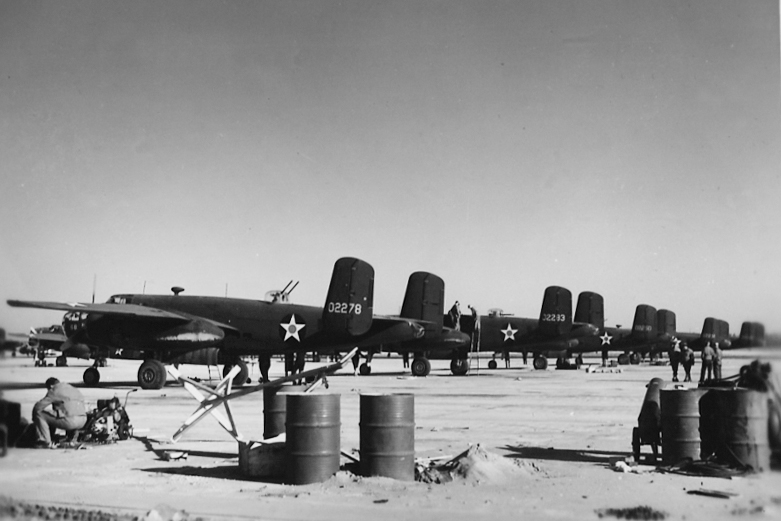
Jimmy Doolittle, a very energetic man, decided that the B-25 crews would consist of five men: pilot, copilot, navigator, bombardier and engineer-gunner. Twenty-four B-25s and crews would be assigned to the mission from the three squadrons of the 17th Bomb Group and its associated 89th Reconnaissance Squadron, located at Pendleton, Ore. To preserve secrecy, Doolittle personally began making all the arrangements for the training and special equipment without revealing why he wanted things done.
The four squadrons were ordered to Columbia, S.C. En route, the designated planes were modified with extra fuel tanks and associated plumbing at Minneapolis, Minn. New incendiary bombs and shackles were ordered, along with electrically operated motion-picture cameras that would be activated when the bombs were released. Intelligence information maps and target folders for the five major Japanese cities were prepared.
When the four squadrons arrived at Columbia, the word was passed that volunteers were needed for a dangerous mission. Almost every man in the four squadrons volunteered; the squadron commanders chose 24 crews, plus extra armament specialists and mechanics to ready the aircraft. The selected men and the planes were sent to Eglin Field, Fla., beginning on the last week of February.
Doolittle arrived at Eglin on March 3 and assembled the entire group of 140 men.
My name’s Doolittle, he said. I’ve been put in charge of the project you men have volunteered for. It’s a tough one, and it will be the most dangerous thing any of you have ever done. Anyone can drop out and nothing will ever be said about it.
Doolittle paused and the room was quiet. Several hands went up, and a lieutenant asked if he could give them any more information. Sorry, I can’t right now. I’m sure you will start getting some ideas about it when we get down to work. Now that brings up the most important point I want to make, and you’re going to hear this over and over again. This entire mission must be kept top-secret. I not only don’t want you to tell your wives or buddies about it, I don’t even want you to discuss it among yourselves.
From the first day of training, it was understood that all the volunteer crews would take the training; however, only 15 planes would eventually go on the mission. This was done to assure that there would be plenty of spare crews on hand to replace anyone who became ill or decided to drop out.
As the takeoff training of the pilots progressed, it proved to be a harrowing experience for most of them. Army Air Force pilots were not taught during their training to take off in extremely short distances at bare minimum airspeed. Taking off in a medium bomber with the tail skid occasionally striking the ground was unnatural and scary to them. But under U.S. Navy Lieutenant Henry L. Miller’s patient instruction, they all soon learned.
In addition to takeoff practice, it was hoped that each crew would receive 50 hours of flying time to be divided into day and night navigation, gunnery, bombing and formation flying. But maintenance problems kept the planes on the ground most of the time.
Each B-25B model at that time was equipped with one upper and one lower turret, each with twin .50- caliber machine guns. But the upper and lower turret mechanisms malfunctioned continually; the lower turret was especially difficult to operate. Doolittle ordered the lower turrets removed and additional gas tanks installed in their place.
There was a single, .30-caliber movable machine gun in the nose, which was placed in a gunport by the bombardier when needed. There were no guns in the tail, so Captain C. Ross Greening, the armament officer, suggested that two broomsticks be painted black and installed there to deceive enemy fighters. Since the bombing was to be at 1,500 feet or less, Greening also designed a simple bombsight he called the Mark Twain to replace the top-secret Norden bombsight. It was made from two pieces of aluminum that cost about 20 cents.
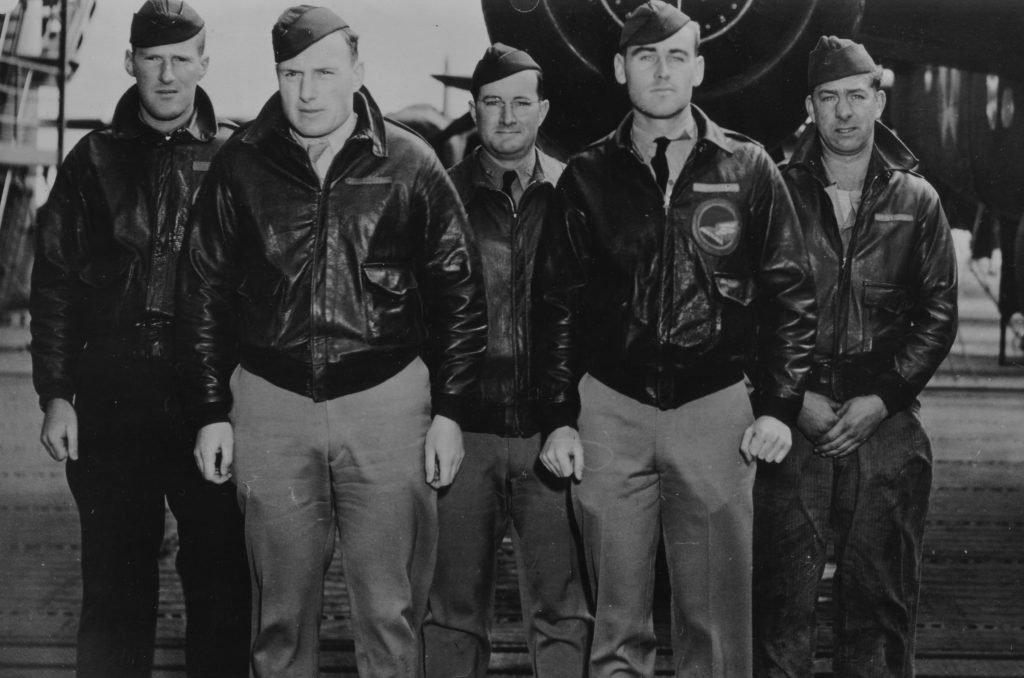
One of the volunteer gunners had, other duties. When 1st Lt. T. Robert Doc White, a physician attached to the 89th Reconnaissance Squadron, heard of the call for volunteers, he asked to be included. He was told there was no room for a passenger; the only way he could go would be as a gunner. He said that was all right with him. He took gunnery training, qualified with the second highest score with the twin .50s on the ground targets, and was assigned to a crew. His presence on the mission proved to be fortuitous, as shall be seen later.
Doolittle wanted to fly the mission as a pilot. But I wanted to go only on the basis that I could do as well as or better than the other pilots who took the training, he said. I took Hank Miller’s course and was graded along with the others. I made it, but if I hadn’t I intended to go along as a copilot and let one of the younger, more proficient pilots occupy the left seat.
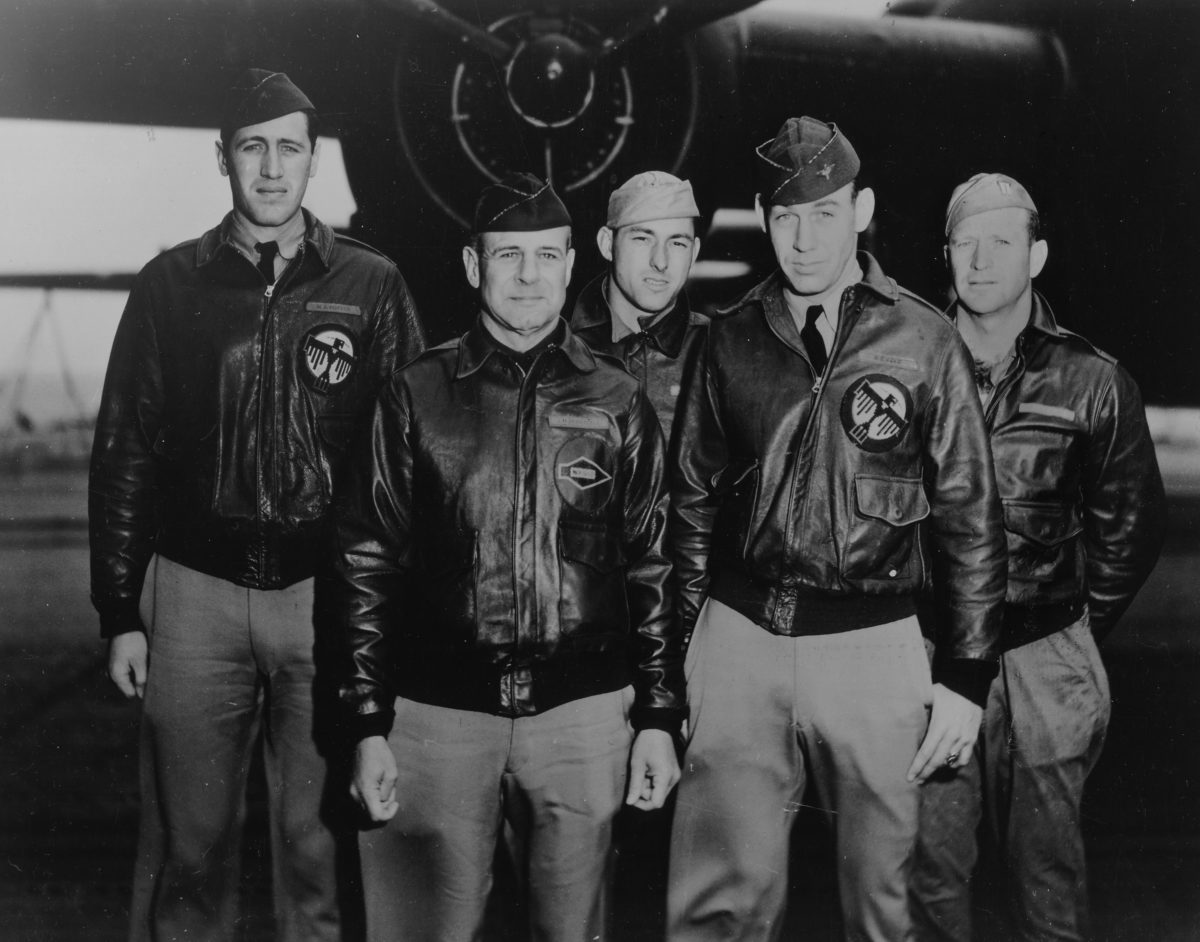
On one of his training flights, Doolittle flew with Lieutenant Richard E. Cole, copilot; Lieutenant Henry A. Potter, navigator; Sergeant Fred A. Braemer, bombardier; and Sergeant Paul J. Leonard, engineer-gunner. The original pilot had become ill and did not return to flying duty. These men became Doolittle’s crew.
Meanwhile, Captain Wu Duncan had arrived in Honolulu and conferred with Admiral Chester W. Nimitz, commander in chief of the Pacific Fleet, and conveyed the plan for a Navy task force to transport the army bombers to the launch point. Nimitz liked the idea and gave the task of carrying it out to Admiral William F. Bull Halsey, who was anxious to tangle with the enemy any way he could.
Duncan worked with the CINCPAC (commander in chief, Pacific) planning staff on the details for a 16-ship task force. It was decided that seven ships would accompany the Hornet from the Alameda Naval Air Station near San Francisco and rendezvous with an eightship force that included Halsey’s flagship, the carrier Enterprise. The joinder would take place near the 180th meridian.
By the middle of March, the Hornet, now destined to be the ship that would deliver the B-25s to the takeoff point, passed through the Panama Canal and proceeded to Alameda. At the end of the third week in March, Captain Duncan wired Washington from Honolulu: Tell Jimmy to get on his horse.
This coded message was all Doolittle needed to get his men and planes moving to the West Coast. Since two of the B-25s had been damaged in training, the 22 remaining planes were flown to McClellan Field, Sacramento, Calif., for final inspections before proceeding to Alameda. All of these crews would go aboard the carrier.
Captain Duncan flew to San Diego to confer with Captain Marc A. Mitscher, skipper of the Hornet. Mitscher had not been told about the mission until then and was delighted to have a part in it. Since he had watched the first two B-25s take off successfully several weeks previously, he was confident it could be done. Duncan then went to San Francisco to await the arrival of Doolittle from Florida, Halsey from Hawaii and the Hornet from San Diego.
The three men, joined by Captain Miles Browning, Halsey’s chief of staff, met informally in downtown San Francisco to discuss the details and determine if anything had been left undone. The plan was for the Hornet, in company with the cruisers Nashville and Vincennes, the oiler Cimarron, and the destroyers Gwin, Meredith, Monssen and Grayson–to be known as Task Force 16.2–to leave San Francisco April 2. Halsey, on the Enterprise and in charge of Task Force 16.1, would leave Hawaii on April 7, accompanied by the cruisers Northampton and Salt Lake City, the oiler Sabine,, and destroyers Balch, Benham, Ellet and Fanning.
The rendezvous of the two forces would become Task Force 16 and would take place on Sunday, April 12, at approximately 38 degrees 0 minutes north latitude and 180 degrees 0 minutes west longitude. The force would then proceed westward and refuel about 800 miles off the coast of Japan. The oilers would then detach themselves while the rest of the task force dashed to the launch point.
Halsey later reported in his memoirs that, Our talk boiled down to this: we would carry Jimmy within 400 miles of Tokyo, if we could sneak in that close; but if we were discovered sooner, we would have to launch him anyway, provided he was in reach of either Tokyo or Midway.
What Halsey did not discuss was the tremendous risk the Navy was taking. If marauding Japanese submarines discovered the task force steaming westward, it would be an excellent opportunity to cripple what was left of the Navy’s strength in the Pacific. Doolittle knew full well that if Halsey’s ships were under heavy attack, the B-25s stored topside would be pushed over the side to make flight deck available so the Hornet’s fighters could be brought up on deck to help protect the task force.
When the B-25s landed at Alameda on April 1, Doolittle and Captain Ski York greeted each crew. Anything wrong with your plane? they asked. If a pilot admitted some malfunction, he was directed to a nearby parking ramp instead of the wharf.
Originally, only 15 planes were to be loaded, but Doolittle asked for one more to be hoisted aboard. When the carrier was at sea, it would take off and return to the mainland to show the other B-25 crews that takeoffs were not only possible but could be made easily. Although the bomber crews had been told that B-25s had made carrier takeoffs previously, none had ever seen it done nor had they done it themselves. Lieutenant Miller, the Navy pilot who had instructed them in carrier takeoffs, would be aboard that B-25.
The next morning, Task Force 16.2 prepared to depart from San Francisco Bay. Just before the Hornet was to depart, Doolittle was ordered ashore to receive an urgent phone call from Washington. He recalled:
I thought it was going to be either General Hap Arnold or General George Marshall telling me I couldn’t go. My heart sank because I wanted to go on that mission more than anything….
It was General Marshall. ‘Doolittle?’ he said. ‘I just called to wish you the best of luck. Our thoughts and our prayers will be with you. Goodbye, good luck, and come home safely.’ All I could think of to say was, ‘Thank you, Sir, thank you.’ I returned to the Hornet feeling much better.
Shortly before noon, the Hornet passed under the Golden Gate Bridge. That afternoon, Mitscher decided to tell his men where they were going. He signaled to the other ships, This force is bound for Tokyo. As he recalled later, when he made the announcement on the Hornet, Cheers from every section of the ship greeted the announcement, and morale reached a new high, there to remain until after the attack was launched and the ship was well clear of combat areas.

The next day, April 3, Doolittle changed his mind about sending the 16th plane back to the mainland. A Navy blimp, the L-8, arrived overhead with spare parts for the B-25s. Air-patrol coverage was provided as far as possible by a Consolidated PBY Catalina.
Doolittle assembled his crews and introduced Commander Apollo Soucek and Lt. Cmdr. Stephen Jurika. Soucek was the ship’s air officer, and he described the basics of carrier operations. Jurika, the Hornet’s intelligence officer, briefed them on the target cities and surrounding areas.
Jurika had been an assistant naval attache in Japan in 1939 and had obtained much valuable information about Japanese industry and military installations. He spoke to the crews almost every day, telling them of Japanese customs, political ideologies and history. Doolittle allowed the pilots to choose their targets in the assigned cities. Lieutenant Frank Akers, the carrier’s navigator, gave the pilots a refresher course on navigation. Doc White, the physician gunner on Lieutenant Don Smith’s crew, gave talks on sanitation and first aid.
Doolittle made it a practice to meet with the crews two or three times a day. He continually warned them not to bomb the Imperial Palace and to avoid hospitals, schools and other non-military targets. He said that most planes would carry three 500-pound demolition bombs and one 500-pound incendiary. He planned to take off in the late afternoon with four incendiaries and drop them on Tokyo in darkness. The resulting fires would light up the sky and serve as a beacon for those following and guide them toward their respective targets in Tokyo, Yokohama, Kobe, Nagoya and Osaka. All aircraft would then proceed to China and be guided by homing beacons to landing fields where they would refuel before proceeding to Chungking, the ultimate destination.
Mitscher and Halsey joined forces as planned. Meanwhile, arrangements in China were not going well. Japanese ground forces were moving in strength toward the airfields where the B-25s were to refuel. Although the Americans and Chinese in Chungking were told that they could expect some aircraft to arrive and to prepare for them by placing fuel and setting up homing beacons, they were not told that the planes would be arriving from the east after bombing Japan. Misunderstandings developed, and were compounded when Generalissimo Chiang Kai-shek asked that the arrival of the planes be delayed so he could move his ground forces into position to prevent occupation of the Chuchow area where one of the refueling airfields was located.
As the task force continued westward, the Japanese knew from intercepted radio messages as early as April 10 that an enemy carrier force was steaming toward them. However, it was estimated that it would have to approach within 300 miles of their coast in order to launch any carrier planes. If that was where the task force was headed, there would be plenty of time to intercept it.
Unknown to the Americans, a line of radio-equipped picket ships was positioned about 650 miles off Japan, and they could signal the approach of any large force and warn the land-based air defense forces to prepare for an attack.
Meanwhile, a Japanese navy air flotilla was alerted to back up homeland air defenses. Patrol bombers would be dispatched when the enemy force was estimated to be about 600 miles out. However, when the American task force observed radio silence for the last 1,000 miles, the Japanese cautiously decided that it might be headed elsewhere.
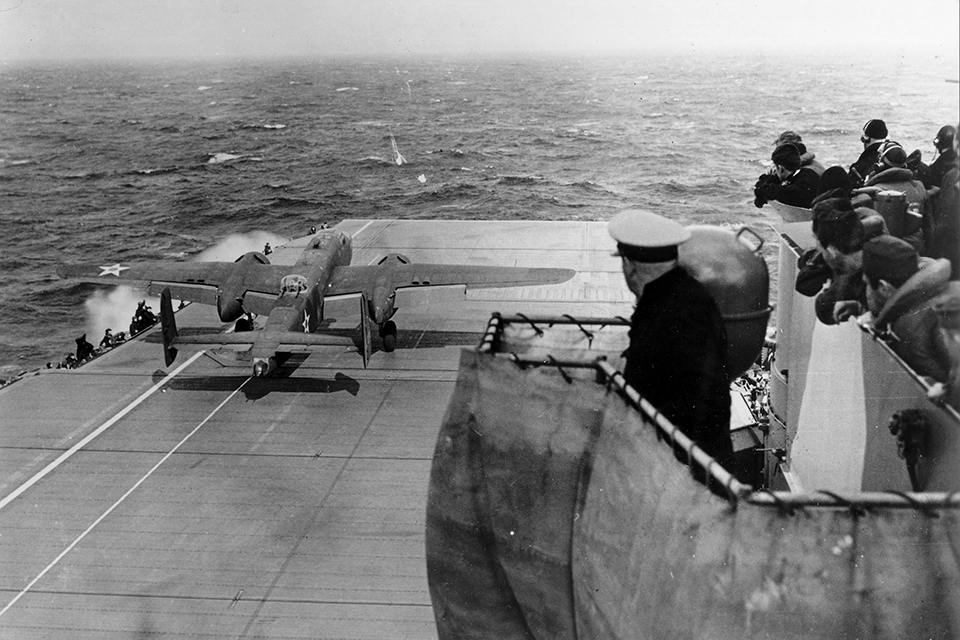
In the early morning hours of April 18, the Enterprise’s radar spotted two small ships. The force changed course briefly to avoid them. The weather turned sour; light rain was falling and green water was plunging down the Hornet’s deck. A dawn patrol was sent up from the Enterprise to scout the area. One of the pilots sighted an enemy surface ship and dropped a message to the Big E’s deck, noting the ship’s position and adding, Believed seen by enemy.
Admiral Halsey promptly flashed a message to Captain Mitscher: Launch planes to Col. Doolittle and gallant command, good luck and God bless you.
The B-25s were quickly loaded and one by one moved into takeoff position. Doolittle was first off at 0820; the 16th B-25 was off an hour later. Just as the pilot of the last plane had started his engines, a deckhand slipped on the wet deck and fell into the B-25’s whirling left propeller, which severed his arm.
One by one, the B-25s droned on toward Japan. None flew in close formation with another, and only a few actually saw any other B-25s as they droned along toward their respective target cities.
Shortly after noon, Tokyo time, Doolittle called for bomb doors open, and Sergeant Fred Braemer sighted down the 20- cent bombsight and triggered off four incendiaries into the capital city’s factory area. Fourteen other crews found their respective targets; however, one B-25, with its top turret inoperative and under attack by fighters, dropped its bombs in Tokyo Bay. Several others were also attacked, but none suffered any noticeable damage.
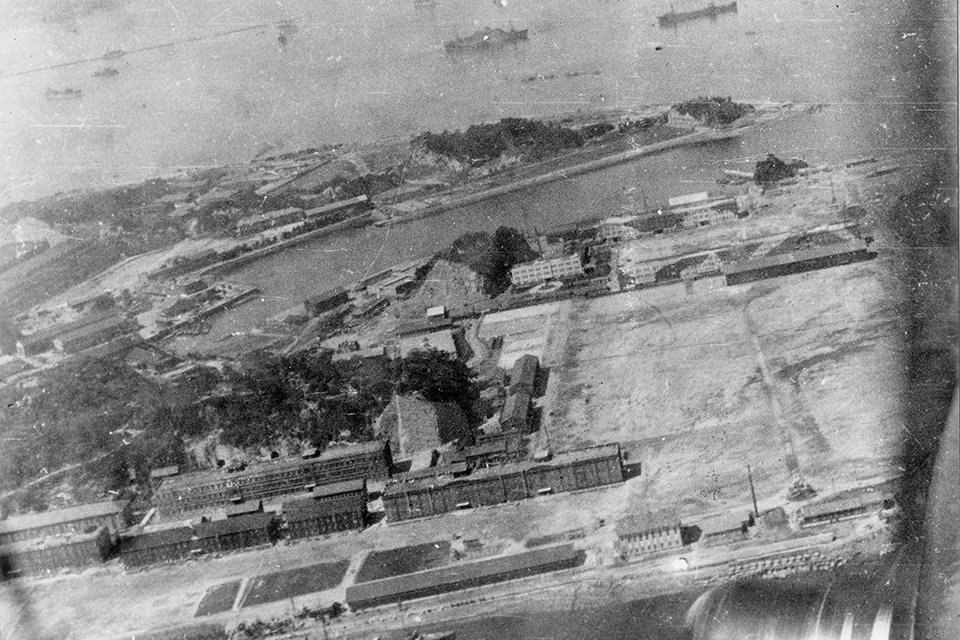
All of the planes except one turned southward off the east coast of Japan and then westward toward China. Captain York had a difficult decision to make. Both of his B-25s’ engines had burned excessive amounts of fuel on the way to Japan, and he knew he and his crew would have to ditch in the shark infested China Sea if they followed the planned route to China. He elected to proceed against orders to Soviet territory and landed near Vladivostok. He had hoped he could persuade the Soviets to refuel the plane and allow them to continue to China, but the aircraft and crew were promptly interned because the Soviet Union wanted to retain its neutral status with Japan. The crew finally escaped into Iran 14 months later.
As the other aircraft turned toward China, they experienced head winds, and it appeared that few, if any, would reach the coast before running out of fuel. Although the head winds then fortuitously turned into tail winds, the weather worsened in the late afternoon as they were approaching the coastline. Doolittle and eleven other pilots elected to climb into the clouds and proceed inland on instruments. When their fuel reached the zero mark, the crews bailed out. One crew member was killed attempting to depart the airplane. All others made it with only bruises, slight cuts or sprained ankles and slowly made their way to Chuchow and Chungking with the help of Chinese peasants. More than a quarter-million Chinese subsequently paid with their lives when ruthless Japanese soldiers murdered anyone suspected of helping the Americans and even people whose villages the Americans had passed through.
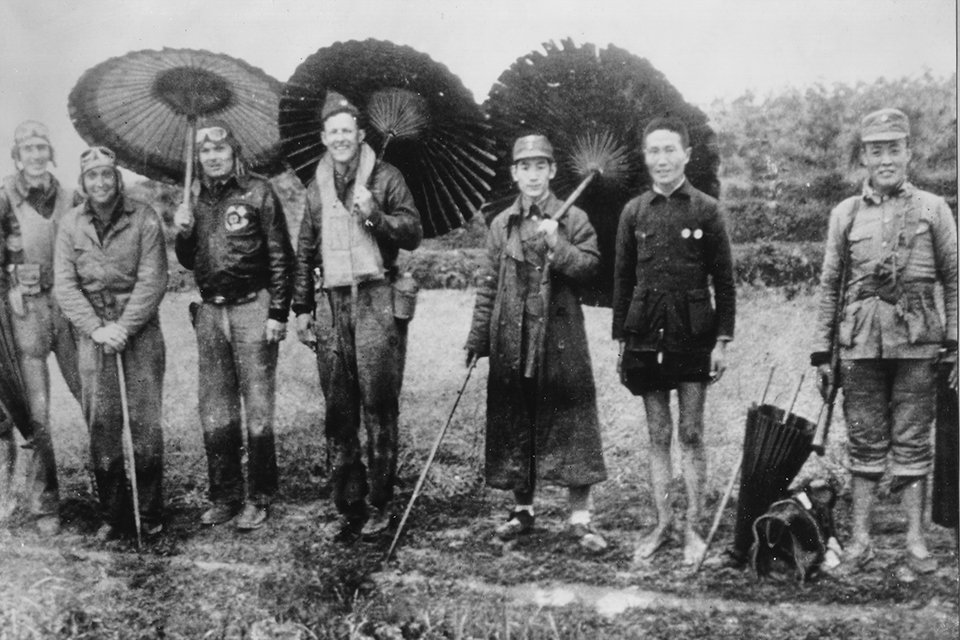
Four pilots elected to crash-land or ditch their aircraft. Two crewmen drowned swimming to shore. Four members of one crew were seriously injured; they were assisted by the rear gunner, Corporal David Thatcher, and friendly Chinese to a hospital run by missionaries and were joined there by Lieutenant White and his crew. It was there that White amputated the leg of the pilot Lieutenant Ted W. Lawson and gave two pints of his own blood to save Lawson’s life. Lawson later wrote about his experiences in Thirty Seconds over Tokyo. Thatcher and White later received the Silver Star for their gallantry.
Sixty-four of Doolittle’s Raiders eventually arrived in Chungking; some were retained in the theater to serve in the Tenth Air Force; others were returned to the States and assigned to new units. Three pilots and one navigator later became prisoners of the Germans.
Eight crewmen were captured by the Japanese, tortured, given a mock courtmartial and sentenced to die. Three of them were executed by firing squad; one died of malnutrition. The remaining four–George Barr, Jacob DeShazer, Robert L. Hite and Chase J. Nielsen– survived 40 months of captivity, most of it in solitary confinement, and returned to the States after the war.
The question has been asked: Can this raid be considered successful if all aircraft were lost and relatively little damage was done to the targets?
The answer is a strong affirmative. The mission provided the first good news of the war and was a tremendous morale boost for America and her allies. Japanese morale, on the other hand, was shattered because their leaders had promised that their homeland could never be attacked.
The original purpose of the raid, as stated by Doolittle before he departed, was to prove that Japan was vulnerable and that a surprise air raid would create confusion, impede production and cause air defense forces to be withdrawn from the war zones to defend the home islands against further attacks. All of that occurred.
Besides being the first offensive air action against the Japanese home islands, the Doolittle-led raid accomplished some other historic firsts. It was the first combat mission in which the U.S. Army Air Forces and the U.S. Navy teamed up in a full-scale operation against the enemy. Jimmy Doolittle and his raiders were the first to fly landbased bombers from a carrier deck on a combat mission and first to use new cruise-control techniques in attacking a distant target. The incendiary bombs they carried were forerunners of those used later in the war. The special camera equipment specified by Doolittle to record the bomb hits was later adopted by the AAF. The after-action crew recommendations concerning armament, tactics and survival equipment were used as a basis for other improvements.
Jimmy Doolittle’s famous air raid against Japan marked the beginning of the turnaround toward victory for America and her allies in World War II.
This article was written by C.V. Glines and originally published in the March 1992 issue of Aviation History. For more great articles subscribe to Aviation History magazine today!
Want to add one of Doolittle’s raiders to your collection? Check out our exclusive modeling feature and build your own B-25B!