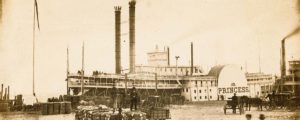
 A visitor to the town of Mauch Chunk, Pennsylvania, in 1876 looked in amazement at the rough terrain and tall mountains surrounding it and asked, “How did the people here ever find this place?” Yet it was its location in the heart of coal country that made this small eastern Pennsylvania town on the Lehigh River a major transportation center for the state’s mining industries.
By the 1950s, the coal industry had declined, bringing the neighboring communities of Mauch Chunk and East Mauch Chunk down with it. Desperate to recapture their nineteenth-century prosperity, the two towns decided to merge, change their names, and look for a way to attract visitors. It took the death of a famous American athlete with absolutely no connection to the area to give them a new lease on life.
When Jim Thorpe died in 1953, his home state of Oklahoma lacked the funds to erect a fitting tribute for him. His widow, hearing about the Mauch Chunks’ impending name change during a visit to Philadelphia, approached town officials with a proposal. If they would organize an appropriate burial spot and memorial to her husband in their community, they could name their new town after him. In 1954 they did just that, and in the years since, Jim Thorpe has become a popular tourist spot that overflows with crafts and antiques shops, art galleries, and boutiques. A 20-ton granite memorial situated in a small park on the east side of town marks the burial place of the famous athlete.
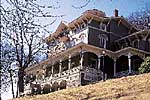 One of Jim Thorpe’s historic attractions, standing on a hill overlooking the railway station, is the Asa Packer Mansion, built in 1860 by one of the nation’s wealthiest tycoons. Asa Packer made his money by building his own canal boats to bring coal to market and later backed the new Lehigh Valley Railroad.
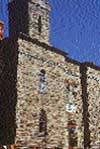 Another place of interest is the Old Jail Museum, which sits high on a hill toward the upper end of the main street (West Broadway). From 1871 until 1995 the building housed the Carbon County prison, and it was one of the sites of the Molly Maguire executions starting in 1877. The two-story jail, built of hand-cut stone and set into the side of a mountain, contained 28 cells that each housed two prisoners, 16 dungeon cells for solitary confinement, and the warden’s living quarters. Three cells for women prisoners were added in the 1950s. When a new Carbon County jail opened in January 1995 and the old jail closed, local residents Thomas and Betty Lou McBride purchased the building. The couple restored the prison and opened it to visitors in April of that year. “I wanted to preserve a piece of history. It’s a landmark,” said Thomas McBride, a soft-spoken man with a passion for Molly Maguire history who sometimes conducts jail tours himself.
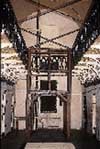
 The main cell block has seen few changes since it opened 128 years ago. Visitors enter through the original wooden door and are met with a chilling reconstruction of the gallows used to hang all seven of the Molly Maguires executed in Mauch Chunk. On June 21, 1877, more than 250 people crowded into the cell block’s two tiers to watch the first round of executions. Reporters stood on the upper level for a good vantage point, while witnesses, officials, and doctors sat in rows in front of the gallows. (McBride noted that most of the medical doctors in the area asked to see the hangings.) The convicted murderers, Alexander Campbell, Michael Doyle, John Donahue, and Edward Kelly, were hanged simultaneously. Another Molly Maguire member, Thomas Fisher, was hanged on March 28, 1878; James McDonnell and Charles Sharp went to the gallows on January 14, 1879.
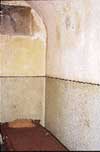
The jail’s main area is flanked by the 8-by-13-foot cells, each secured by two doors, an outer oak padlocked door and an inner door made of iron bands and locked by a bar and padlock. The cells, cold and damp, remain just as they were when prisoners occupied them less than five years ago. The main area is lit by a skylight, but the meager daylight that reaches each cell does so through a high, narrow, six-inch-wide window that is secured by bars.
The jail tour’s main attraction is cell number 17, which contains a faint handprint on the wall. According to legend, just before his execution, one of the Molly Maguires–either Campbell or Fisher–placed his hand on the wall and declared that his handprint would remain there forever as a sign of his innocence. McBride said that the wall has been cleaned and painted many times in the years since, but the handprint always returns.
Like the handprint, memories of the Molly Maguires refuse to fade from Jim Thorpe. During the local St. Patrick’s Day parade each year, members of the Ancient Order of Hibernians (an Irish fraternal organization) place a large, green-tinted chrysanthemum wreath bound with a black ribbon outside the main door of the Old Jail Museum to commemorate the men who were hanged there.
The Mollies are remembered elsewhere in the region. The Historical Society of Schuylkill County in Pottsville displays portions of the ropes used to hang the men, trial transcripts, and a revolver used by an adversary of the Mollies; and what was once the headquarters of alleged Molly boss Jack Kehoe in Girardville is now a bar run by Kehoe’s great-grandson. To get a sense of the conditions the Mollies and their fellow miners experienced, visitors can stop by the No. 9 Mine “Wash Shanty” Anthracite Coal Mining Museum in Lansford and see a collection of mining memorabilia, while the Pioneer Tunnel Coal Mine in Ashland offers tours of an anthracite mine.
Christine Techky
| For more information about Jim Thorpe and Carbon County, call (888) JIM THORPE; for information about Pottsville and Schuylkill County, call (800) 765 -7282; and for more about the Old Jail Museum, call Thomas McBride at (570) 325-5259. |