
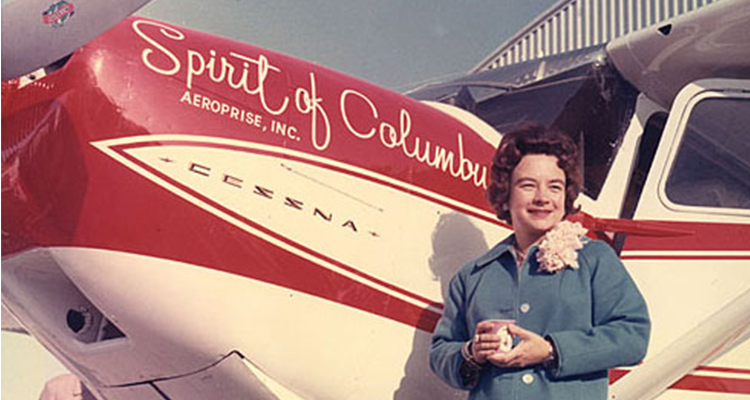
As the plane turned onto the taxiway, three trucks full of soldiers careened around a corner from another taxiway and slammed to a stop within inches of the plane,” wrote Geraldine Frederitz Mock. Guns in hand, the soldiers leaped from the trucks and surrounded the airplane. Accustomed to seeing military planes piloted by men, the Egyptians were apparently staggered when they saw a woman at the controls of the 1953 Cessna 180, dubbed Spirit of Columbus and nicknamed “Charlie.” In the cockpit was Mock, a 38-year-old mother of three from Bexley, a Columbus, Ohio, suburb.
It was 1964, and “Jerrie” Mock—who would later chronicle her adventures in the book Three-eight Charlie—was on the sixth leg of her historic flight around the world. During her flight from Tripoli to Cairo, she had accidentally landed at a secret military base instead of at the Cairo airport. Despite that incident—which ended peacefully—and several other scary moments (ice on the wings, sand in the engine and an antenna motor that burned out), Mock would eventually return to Columbus Airport on April 17, becoming the first woman to fly around the world solo. She completed the trip in 29 days, 11 hours and 59 minutes. Upon landing, she was greeted by Ohio’s Governor James A. Rhodes and a mob of fans. Dubbing her ‘”Ohio’s Golden Eagle,” Rhodes proclaimed April 18 “Jerrie Mock Day.”
Geraldine Frederitz grew up at a time when young girls were expected to play with dolls and learn household chores. But because she wasn’t allowed to venture across the street to the area where most of the other girls in her neighborhood lived, she actually ended up playing plenty of boys’ games like cowboys and Indians, and had decided those were much more fun. Although her mother refused to buy her little girl the toy train she so much desired, she eventually gave up the idea of teaching Jerrie to knit, a chore the child loathed.
At school, Jerrie refused to learn embroidery and resented the fact that the boys were allowed to go to mechanics class but she was not. When she was around 12, Jerrie was surprised to learn that women could only work for five hours in factories before taking a break, under Ohio’s Women’s Protective Laws. In a Columbus Dispatch article, she later said, “I was never going to abide by man-made laws that said women couldn’t do something.”
Frederitz determined early on to go well beyond the narrow boundaries of her hometown. “I was stuck in a little town called Newark, where no one went anywhere,” she later recalled. “I also grew up in an age where there was no television and you could only learn about the world from geography books. I had no idea what it was like in other parts of the world but I wanted to be different than everyone else and find out.”
Frederitz caught the flying bug at age 7, when she took her first ride in a Ford TriMotor with her parents. Even though the ride only lasted 15 minutes, it made quite an impression. She told everyone who would listen that when she grew up she would fly around the world. Flying may have been in her blood. Her mother’s maiden name was Wright, and Mock had heard she might have been related to the Wright brothers in some way. “I remember my aunt telling me about how she got invited to tour the Wrights’ bicycle factory,” she later recalled. The youngster was also impressed by Amelia Earhart’s highly publicized feats. As a result, Jerrie took a preflight course during her high school years (the only other female in the course dropped out after the first session).
Marriage to Russell Mock in 1945 and motherhood temporarily interrupted Jerrie’s flying dreams and ended her college education. She had been attending Ohio State University, the only woman then enrolled in its aeronautical engineering program. In addition to raising a family, for five years Mock coproduced an educational television program for local schools.
When Mock finally took her first flying lesson in 1956, it was immediately obvious that she was a natural pilot. She soloed after only nine hours and 15 minutes of instruction. In 1958, she earned her license. Mock learned to fly by landmark navigation, since at the time pilots were not legally required to fly with radios. She quickly became dissatisfied with the simple routes most Ohio pilots flew and was later disappointed to learn that no one in Columbus could teach her how to fly across oceans. “I plotted more complicated routes to fly than experienced pilots,” she recalled. “Even the old-timers asked me how I navigated.”
In 1961, Mock became the first woman licensed by Ohio to manage an airport, Price Field in Columbus, a job she held for about a year. On Sundays, she was there alone, which meant fueling airplanes, tying them down, and even doing despised household chores like making coffee. “The male instructors did not like a woman telling them what to do,” Mock recalled. “I did not worry about it and ignored them.” Mock also managed Logan County Airport in Lincoln, Illinois, for a few months to help out a friend, flying back and forth from Columbus to do so.
Although she only had 700 flying hours before she embarked on her round-the-world adventure, most of that time was spent flying long distance—to the Bahamas, Canada and Mexico. In contrast, Mock later met an instructor who had accumulated thousands of hours of flying experience but none of it was long distance. While flying to Mexico, she had to learn the hard way that radio stations could go off the air. It prepared her for similar conditions on her world flight.
Several years after earning her license, Mock told her husband that she was bored with being a housewife and wanted to do something exciting. He jokingly suggested she fly around the world. The joke stopped when Mock contacted the National Aeronautic Association (NAA) in 1962 and found out that a woman had never flown solo around the world. She had taken it for granted that a woman had already done so. After all, that was Amelia Earhart’s intent in the 1930s, when she and navigator Fred Noonan disappeared in the Pacific. It immediately became Mock’s goal.
Mock soon discovered that in Columbus, U.S. Air Force personnel were the only people who knew what was needed to get her started. They agreed to help her out on an unofficial basis. She also received valuable information from two brothers—mechanic John Peck at Price Field, who had been World War I ace Eddie Rickenbacker’s personal mechanic, and Robert Peck, an engineer at Purdue University. Brigadier General O.F. “Dick” Lassiter of the Strategic Air Command (SAC), a family friend, also gave her advice.
Next year, the Columbus Dispatch agreed to be a sponsor (thanks to her husband’s advertising connections) and to fund most of the trip. Then she needed to plot a route, gain permission to fly across countries, and have observers and timers appointed by the NAA at each stop to document landings and takeoffs for establishing official records. “I visited each embassy in Washington, D.C., to get clearance,” Mock later recalled. “The actual flying was a lot less complicated than putting together all these little details.”
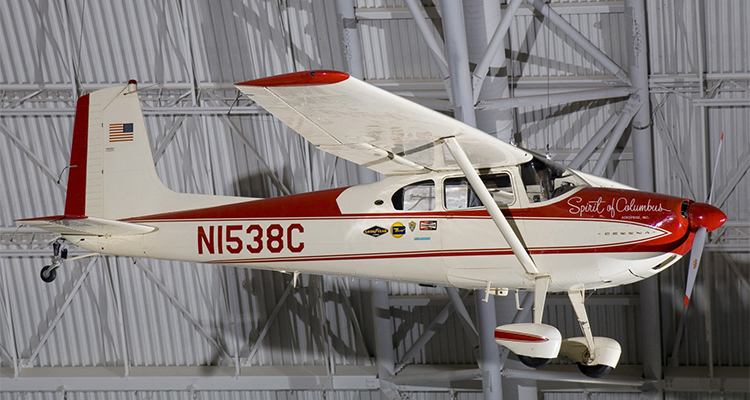
Most important, a single-engine airplane had to be modified to make a round-the-world trip. Mock’s 11-year-old Cessna 180, with the Federal registration number N1538C, was equipped with a new engine, an airline-type compass, twin radio direction finders, dual short-range radios and a long-range high-frequency radio system with a trailing antenna. The passenger seats were replaced with huge gas tanks (the fuel tank installation alone cost around $4,000).
The plane had to be flown to Wichita, Kansas, for these modifications, and before Mock could even begin her historic flight, she had to fly back to Columbus, an additional 1,000 miles, since she had to fly around a restricted area. “I also had to fly to Florida to get the high-frequency radio installed, since no one in Columbus knew how,” recalled Mock, “and fly to Muskegon, Michigan, where they built the Continental engine.” When she finally took off from Columbus, at 9:31 a.m. on March 19, 1964, it would be another 1,000 miles or so to reach her next stop, Bermuda.
For a time, it seemed that another female pilot—Joan Merriman Smith of Long Beach, California, had beaten Mock to the punch. Smith took off two days ahead of Mock to fly around the world, challenging the Ohio pilot. Now the flight had become a race, which meant Mock could not take the time to sightsee en route as originally planned. Each time she touched down at her latest destination and was ready to go exploring, her husband would track her down and demand she get back into the air as soon as possible. She had a race to win, and luck was with her, not her challenger. Smith ran into mechanical and logistical problems, completing her globe girdle well after Mock’s (it took Smith 50 days). “After I returned home, I remember reading a newspaper story about Smith shopping in Singapore,” recalled Mock.
To Mock, the long hours alone in her plane were a picnic compared to the administrative and logistical problems she often faced on the ground. Red tape and language barriers on stops abroad sometimes forced Mock to spend more hours on the ground than in the air. At the Cairo airport, for example, Egyptian officials didn’t believe she was a pilot and not just a passenger—refusing at first to stamp her visa without a boarding ticket.
Despite such problems, and her husband’s urgings, Mock did find the time and energy to fulfill some of her childhood dreams along the way. She saw an elephant up close in Sri Lanka and rode a camel in Egypt near the Sphinx. She also got to meet some notable personalities, including Pakistan’s most famous woman flier, Suchria Ali, a commercial glider pilot and instructor for the Aero Club who came to Karachi’s airport to see her off. When she landed in Guam, Mock was greeted by an enthusiastic crowd that included a general, an admiral and a band—and she was invited to stay in the governor’s mansion.
Mock’s flight was monitored by the NAA and the Fédération Aéronautique Internationale (FAI), which certified it as a round-the-world speed record for aircraft weighing less than 3,858 pounds. Mock also became the first woman to fly from the United States to Africa via the North Atlantic, the first woman to fly the Pacific in a single-engine plane and the first woman to fly both the Atlantic and Pacific alone. During her flight, Mock established another first that did not go into the record books: She became the first woman to land a plane in Saudi Arabia.
After completing her round-the-world flight, Mock never again flew Spirit of Columbus. Cessna gave her a 206, and her old 180 was stored in the Cessna factory in Wichita until the firm donated it to the National Air and Space Museum in 1975. It was displayed in the General Aviation gallery until 1984, and is now stored at the Garber Preservation, Restoration and Storage Facility.
Mock continued to break records, a total of 21 for speed and distance in all. In 1965, she broke the speed record for a closed course of 312 miles and with a plane weighing less than 2,200 pounds, flying 205 mph in an Aero Commander 200. In 1966, just one week shy of the second anniversary of her global flight, Mock broke the nonstop distance record for a woman after a 4,550-mile flight from Honolulu to Columbus that took 31 hours. Governor Rhodes was again at the airport to greet her when she landed. Three Russian women had set the previous record of 3,071 miles in 1938.
In 1968, Mock broke another world speed record, flying from Columbus to Puerto Rico and back in 33 hours. The next year, she shattered nine world speed records while delivering her Cessna 206 (the same one given her after her world flight) to a priest in New Guinea to use for his missions. Lae, New Guinea, the last place Mock flew to in her career, was also the last place Earhart took off from before she disappeared in July 1937.
Mock decided to give up flying after 1968 because it would be too expensive to continue flying around the world to all the exotic places she still wanted to go. “Anything else would have been anticlimactic,” she pointed out.
Surprisingly, in later years Mock pointed out that her round-the-world flight was not actually her most memorable. Several months after that journey, she became one of the few women to fly at supersonic speeds, thanks to an Air Force pilot who gave her a ride in a McDonnell F-101 Voodoo jet fighter. The jet reached a speed of 1,038 mph (Mach 1.7), and Mock briefly handled the controls. “Fantastic,” Mock told a Columbus Dispatch reporter. “I didn’t want to come down.”
Mock received the Federal Aviation Agency’s Gold Medal for Exceptional Service on May 4, 1964, from President Lyndon Johnson, and a year later became the first woman, and first American, to earn the Louis Bleriot Silver Medal for aviation—the award for breaking an existing record of a light plane under 1,000 kilos (2,200 pounds). She received numerous other regional and national awards in recognition of her aviation accomplishments, as well as keys to 10 cities and 18 honorary memberships (including in the 87th Fighter-Interceptor Squadron of the U.S. Air Force). In 1979, she was inducted into the Ohio Women’s Hall of Fame.
Despite all that fulsome recognition, Mock tended to downplay her achievements. “I just went out to have fun and to see the world,” she said matter-of-factly in one interview. But she did write about her achievements in the book Three-eight Charlie, in which she recorded her impressions of all the publicity she received. When she landed in Columbus after her round-the-world flight, for example, she was overwhelmed by the crowds of people and being in the spotlight. “It didn’t seem right that these people should say such wonderful things about me,” she wrote. “I had just had a little fun flying my airplane.'”
Despite her modesty, Mock has said she believed that more women took up flying after her 1964 venture. And decades later, long after she retired and moved to Florida, she still received mail from women who said her accomplishments have changed their lives. One recent letter came from a Newark woman in her 50s who said Jerrie made her realize she did not have to be ‘just a housewife.’
Another Columbus woman remembers Jerrie Mock’s impact on her own life. “I followed her flying career closely, even though I was just a kid,’ recalled Terry Fogle. ‘I thought it was so cool that she was such a fearless woman flying everywhere in her little plane.”
Editor’s Note: Jerrie Mock died on September 30, 2015, in her Florida residence. She was 88 years old.
This article was written by Laurel M. Sheppard and originally published in the July 2005 issue of Aviation History. Additional reading: Three-eight Charlie, by Jerrie Mock.
For more great articles subscribe to Aviation History magazine today!