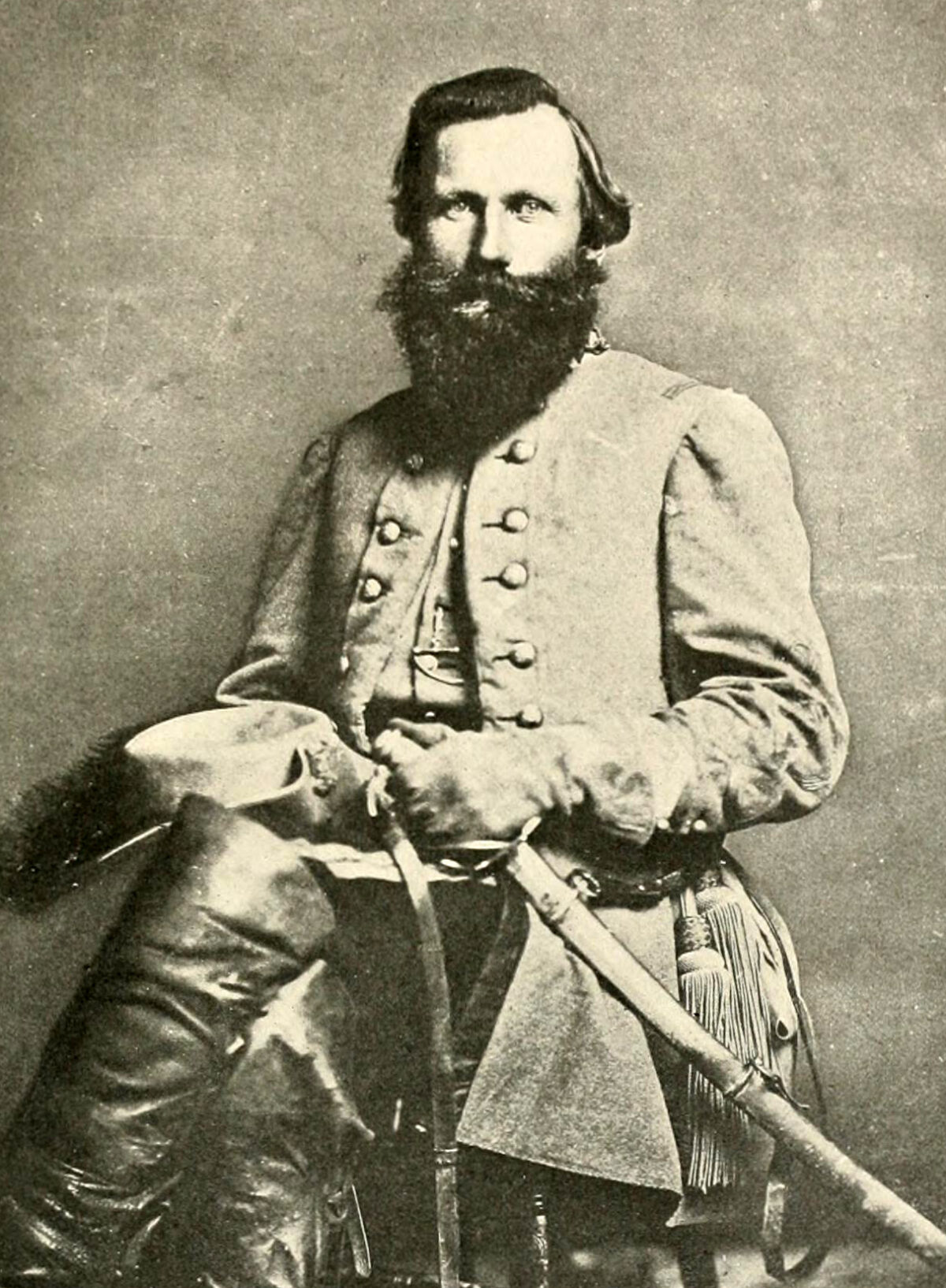
The guns had scarcely fallen silent at Gettysburg before the questions and recriminations began. Disappointed Southerners refused to believe that the infallible Robert E. Lee could lose a battle, particularly one as vital as Gettysburg. Someone else must be to blame. Even after Lee himself had said (with much reason), ‘It is all my fault, supporters inside and outside the Army began looking about for a convenient scapegoat. They quickly found one in the outsized personality of Major General J.E.B. Stuart, Lee’s flamboyant cavalry chief.
Criticism of Stuart, which began as a murmur among Lee’s personal staff, soon exploded onto the front pages of prominent Southern newspapers, which were read by both private citizens and high-ranking members of the Confederate government. At issue was Stuart’s supposed failure to provide Lee with crucial information about the enemy’s troop movements in the days leading up to Gettysburg. This lack of accurate intelligence, it was said, had caused Lee to blunder into a battle he did not seek, on ground he did not choose. It was all Stuart’s fault, for going off on an ill-advised raid around the Union army when Lee needed him close at hand. Contrary to popular belief, however, Stuart had followed Lee’s orders strictly, if not perhaps totally, and he was innocent of the harshest accusations made against him. In no way did Stuart’s raid deprive Lee of the cavalry needed to monitor his opponent’s movements, only of the officers skilled enough to do so successfully.
How, then, did Stuart become the scapegoat of Gettysburg? Simply put, he was at the end of a long chain of mistakes and misjudgments stretching from the commanding general to a lone scout on horseback. Indeed, there is a certain inevitability to the miscarried raid and its aftermath, an inevitability rooted in the personalities of Lee, Stuart and the many others who contributed, either actively or passively, to the Confederate defeat at Gettysburg. And if Stuart himself was not completely blameless, he had a great deal of company.
Planning for the raid began on the morning of June 22, 1863, three days after the vanguard of Lee’s army had crossed into Pennsylvania on its second massive invasion of the North, when Stuart asked Lee for guidance in the next phase of the campaign. Specifically, he wondered which route he should take while following the infantry into enemy territory. If he moved down the Shenandoah Valley west of the Blue Ridge Mountains, he might alert Union cavalry to Lee’s hitherto carefully screened advance. If, on the other hand, he moved east from his camp at Rector’s Cross Roads (near Salem), he could cross the Potomac between Maj. Gen. Joseph Hooker’s Union army and Washington, D.C. Such a move might throw the Federals into confusion and give Lee an extra advantage on his move north.
Stuart sent his request for guidance to Lee through I Corps commander Lt. Gen. James Longstreet, who responded with his own recommendation: I think your passage of the Potomac by our rear at the present will, in a measure, disclose our plans. You had better not leave us, therefore, unless you can take the route in rear of the enemy. It was the first of several mixed messages Stuart received from his immediate superiors. Later that same day, Lee responded with a letter of his own, stating: If you find that he [Hooker] is moving northward, and that two brigades can guard the Blue Ridge and take care of your rear, you can move with the other three into Maryland, and take position on General [Richard] Ewell’s right, place yourself in communication with him, guard his flank, keep him informed of the enemy’s movements, and collect all the supplies you can for the use of the army.
Based on Lee’s instructions, Stuart began fabricating a plan for another dramatic cavalry raid that would pass around the rear of the Union army. It is possible, as critics later charged, that the recent disappointments at Brandy Station and Upperville (where the Union cavalrymen gave good accounts of themselves) might have made Stuart more eager than usual for an opportunity to reassert the superiority of his own vaunted cavalry and restore his slightly tarnished reputation. More likely, however, he was simply thinking along the same lines as Lee and Longstreet on how best to use his light cavalry in the upcoming campaign.
With Lee’s and Longstreet’s rather vague advice in hand, Stuart turned to his most trusted scout, John Singleton Mosby, for information on the best route to take into Pennsylvania. Mosby, who would later find fame as the commanding colonel of an effective independent cavalry unit in northern Virginia, Mosby’s Rangers, was still serving on Stuart’s personal staff. He rode into headquarters on June 23 with word that Stuart could pass safely around the rear of Hooker’s widely dispersed army in western Maryland en route to Pennsylvania. Hooker, said Mosby, was lying idle along a 25-mile-long line from Leesburg, Va., to Thoroughfare Gap, just west of Haymarket, and the Federal line was stretched so thin that Stuart could simply ride through it. It was a dangerously overoptimistic assessment of the military situation, based on the assumption that the Federals would simply sit still and wait for events to overtake them. But Stuart trusted Mosby implicitly and was, at any rate, always ready to accept information that conformed to his own expectations.
Stuart liked the plan so well that he committed it to paper and showed it to the commanders of his two brigades, Brig. Gens. Fitzhugh Lee and Wade Hampton. He then detailed his strategy to Lee and Longstreet. Stuart’s plan called for him to pass through Glasscock Gap, then head northeast, crossing the Potomac at Seneca Ford and joining Ewell in Pennsylvania. Stuart fully expected his cavalry to pass to the rear of the Union army, severing communications between Hooker and his own cavalry commander, Brig. Gen. Alfred Pleasonton, destroying transportation for the Union army, and taking pressure off Lee by creating a diversion and slowing down Hooker’s movements. Once in Maryland, Stuart would wreck the C&O Canal and destroy railroad communications with Washington.
Stuart went to army headquarters at Berryville to await Lee’s approval of his plan. He was sleeping out in the open under a poncho when Lee’s response arrived. Stuart’s adjutant, Major Henry McClellan, opened the letter (clearly marked confidential) and woke Stuart to show him the message. Lee had written: If General Hooker’s army remains inactive, you can leave two brigades to watch him, and withdraw with the three others, but should he not appear to be moving northward, I think you had better withdraw this side of the mountain tomorrow night, cross at Shepherdstown next day and move to Fredericktown [Frederick]. You will, however, be able to judge whether you can pass around their army without hindrance, doing them all the damage you can, and cross the river east of the mountains. In either case, after crossing the river, you must move on and feel the right of Ewell’s troops, collecting information, provisions, etc. Give instructions to the commander of the brigades left behind to watch the flank and rear of the army and (in event of the enemy leaving their front) retire from the mountains west of the Shenandoah, leaving sufficient pickets to guard the passes, and bringing everything clean along the valley, closing upon the rear of the army.
The second letter from Lee was ambiguous and somewhat illogical, especially when considering his first letter. Initially, Lee had told Stuart he was concerned that Hooker might steal a march on us and get across the Potomac before we are aware. His first set of instructions ordered Stuart to link up with Ewell’s right and guard his flank, while also collect[ing] all the supplies you can for the use of the army. That in itself was a rather contradictory order, especially for a cavalryman famous for his independent raiding sorties.
The second letter told Stuart he could move if General Hooker’s army remains inactive [emphasis added] and simultaneously advised Stuart to enter Maryland west of the Blue Ridge Mountains or pass around the Federals east of the mountains and then feel the right of Ewell’s troops. Besides giving Stuart two dramatically different routes to take, Lee had softened the stipulation that the cavalry link up with Ewell and guard his flank. And his remark that Stuart should do as much damage as possible seemed to be directed more at a raiding party than a flank-guarding detail. Lee also gave Stuart the latitude to judge whether he could pass around their army without hindrance. It would be up to Stuart to decide what constituted a true hindrance, as opposed to a momentary complication.
The sleep-befuddled Stuart read Lee’s second letter by firelight and characteristically interpreted it to mean that the commanding general had complete confidence in Stuart’s judgment and was giving him the go-ahead to raid the enemy rear. Had Stuart read the letter in the cold light of dawn–that is to say, had Major McClellan not awakened him in the middle of the night and handed him the opened confidential letter–he might have sought a clarification of the orders. He was, after all, within easy riding distance of Lee’s headquarters. Then again, he might not have, because even if the orders were not exactly clear, they were at least discretionary enough to allow Stuart to exercise his own judgment–and that judgment, as usual, was to go off raiding on his own.
With Lee’s approval in hand, Stuart made the final decision to execute his raid. Now all he needed was to meet Lee’s two conditions. On the morning of June 24, Mosby reported that Hooker was remaining inactive, thus fulfilling the first of Lee’s conditions. The second was easy; Stuart had already decided that he could move around the enemy without hindrance. The three brigades of Hampton, Fitzhugh Lee and Colonel John Chambliss were ordered to rendezvous that night at Salem. The brigades of Brig. Gens. Beverly Robertson and William E. Grumble Jones were ordered to remain at the mountain passes, keeping an eye on the enemy.
Stuart had several good reasons for disposing his forces in this manner. Since the raid would be highly dangerous, it is understandable that he wanted his best troops to go along with him, under officers in whom he had the most confidence. In addition, the two brigades left behind with Lee’s army were nearly equal to those he took with him. Stuart believed that this force, combined with Brig. Gen. Albert Jenkins’ brigade, which was already detached to Ewell’s corps, would be sufficient to fulfill all duties that might be required of the cavalry in his absence.
Another more personal consideration was that Jones and Robertson were the two brigadiers Stuart liked least. Stuart considered Robertson by far the most troublesome man I had to deal with, in large part due to the fact that Robertson had been a former beau of Stuart’s wife, Flora, and an Old Army protégé of Stuart’s much-detested father-in-law, Union Brig. Gen. Phillip St. George Cooke. The irascible Jones had more than once lived up to his nickname of Grumble, but Stuart could justify leaving him behind since he had a widespread reputation as the best outpost officer in the service and therefore seemed eminently qualified to observe and report the enemy’s movements. The problem was that Robertson outranked Jones and would be in titular command of the remaining cavalry. Stuart sought to remedy this by giving Robertson clearly worded instructions to guard the Blue Ridge passes, observe the Union army and hasten north to rejoin Lee’s infantry at the first sign of enemy movement.
Although the orders were clear enough, they were given (as Stuart should have known only too well) to an officer of inferior ability. James Longstreet charged later–with much justice–that Stuart had purposely left him his least-favorite officers and commands. Moreover, Stuart ignored Longstreet’s directive to order General Hampton–whom I suppose you will leave here in command–to report to me…either by letter or in person. Again, this was less than a clear order. Longstreet only supposed that Stuart would leave Hampton behind to command the rest of the cavalry in his absence. It was not, as Longstreet charged in his memoirs, a direct order to leave Hampton with the army. Still, it was obvious that Longstreet wanted someone to report to him from the cavalry. Stuart either ignored the request, perhaps in his haste to get moving, or else was guilty himself of supposing that Robertson or Jones would see to it that Longstreet was fully apprised of the situation. In any case, the officers left in charge of his cavalry while Robert E. Lee commenced the perilous invasion of Northern territory were not up to the task. Whether Stuart could fairly be blamed for their shortcomings is beside the question; as overall cavalry commander, he was ultimately responsible for all the troops under his command. Jones’ and Robertson’s failure to notify Lee that the Union army had broken camp and set out after him was at least an indirect result of Stuart’s decision to leave them in charge while he rode around the enemy.
Having commenced his raid on June 25, Stuart almost immediately ran, literally, into a roadblock. At Haymarket, Va., Stuart discovered that Union Maj. Gen. Winfield Scott Hancock’s II Corps was already occupying the road on which Stuart expected to move. Not wanting to engage an infantry corps, Stuart was content to fire off a few artillery rounds and then let Hancock continue on his way, while Stuart spent most of the day grazing his horses in a field nearby. Stuart later claimed that he had sent a message to Lee reporting Hancock’s movements, a report that undoubtedly would have set off warning bells in Lee’s quicksilver mind, but the message never arrived.
With this early setback, Stuart made his first–and in many ways his most controversial–decision. Many believed, then and later, that in the face of the enemy movement north, Stuart no longer met Lee’s condition to move without hindrance and should have turned back immediately. Lee’s orders did not define exactly what constituted a hindrance, however, and Stuart obviously did not consider Hancock’s rapidly departing corps as a sufficient hindrance to cause him to turn back. At any rate, the orders left it up to him to choose the most expeditious route to take to rejoin the army.
On the evening of June 25, the distance between Stuart’s camp and Shepherdstown, the nearest ford west of the mountains, was more than 60 miles. Stuart could not possibly have reached Shepherdstown before the evening of June 27 or the passes at South Mountain before late the next day. That would still have left him 60 miles from York, where he expected to meet Maj. Gen. Jubal Early’s division of Ewell’s corps. Assuming that he did not encounter further enemy opposition, Stuart reasoned that he still could not have reached York until late on June 30. He believed he could get there on his current route just as quickly. He also expected that the information he had forwarded regarding Hancock’s movement would cause Robertson and Jones to spring into action and rejoin Lee’s army. Based on these expectations and the chance to obey at least part of Lee’s initial order to wreak havoc on the Union rear, Stuart determined to continue his raid by making a slight detour around the enemy’s line of march.
While Stuart was continuing his ride–crossing the Potomac at Rowser’s Ford, tearing up a portion of the C&O Canal and snapping up whatever unwary Federals crossed his path–Lee was inching forward into Pennsylvania. As late as June 27, Lee was telling Brig. Gen. Isaac Trimble, I have not yet heard that the enemy have crossed the Potomac, and am waiting to hear from General Stuart. He was still waiting to hear from Stuart when the cavalry leader reached Rockville, Md., around noon on June 28. While lingering in the area to destroy telegraph lines, Stuart learned that a large, heavily laden wagon train was nearby, heading for the Union army. Here, Stuart made his second controversial decision of the raid. Succumbing to temptation, but also believing that he was following Lee’s orders to hurt the enemy whenever possible, Stuart attacked and captured the 8-mile-long train. However, it took him several hours to burn the wrecked wagons, parole prisoners and gather together the widely scattered brigades of Fitz Lee and Chambliss.
A second message to Lee reporting Stuart’s progress was somehow lost, and Stuart fought his way out of Hanover. Unaware of Lee’s location, Stuart proceeded to York, then on to Carlisle, where he was informed that Lee and his men had been in Gettysburg waiting for him. He finally linked up with Lee’s army late in the afternoon of July 2, several days behind schedule and far too late to help with the arrangements of the ongoing battle.
Ever since Stuart reported to Lee in person on the afternoon of the 2nd, the success or failure of his raid has been the subject of intense debate. Certainly, Lee himself was dissatisfied with Stuart’s performance. The exact wording of his opening statement to Stuart has been disputed. According to some, he said simply, Well, General Stuart, here you are at last. Others maintained that Lee asked icily: General Stuart, where have you been? I have not heard a word from you for days, and you the eyes and ears of my army. Whatever Lee said, it was obvious that he was unhappy with his cavalry commander, an unhappiness that was echoed by Lee’s staff officers, particularly Colonel Charles G. Marshall, who later urged Lee to court-martial Stuart for disobeying orders. The next day, while Stuart ineffectually attacked the Union rear, the Battle of Gettysburg was lost.
Initial blame for the disaster at Gettysburg was directed, naturally enough, at Lee. Texas Senator Louis T. Wigfall spoke openly of Lee’s blunder at Gettysburg and his utter want of generalship. For his part, Lee offered to resign, a pro forma offer that he knew Confederate President Jefferson Davis would refuse. Soon, however, critics zeroed in on another high-ranking general: Jeb Stuart. A well-connected Mobile newspaper correspondent based in the Confederate capital of Richmond reported that for some time back many serious charges have been made against Stuart, reflecting severely upon him. His vanity seems to have controlled all his actions, and the cavalry was used frequently to gratify his personal pride and to the detriment of the service. The reporter continued, At the Battle of Gettysburg, he was not to be found, and Gen. Lee could not get enough cavalry together to carry out his plans.
Lee himself, in his mild way, complained that the movements of the army preceding the battle of Gettysburg had been much embarrassed by the absence of cavalry. To this, Stuart’s adjutant, Henry McClellan, responded: It was not the want of cavalry that General Lee bewailed, for he had enough of it had it been properly used. It was the absence of Stuart himself that he felt so keenly.
John S. Mosby, whose initial scouting report had contributed much to Stuart’s decision to go ahead with the raid, criticized Robertson for his failure to join Lee’s army quickly enough after the Union army had begun its pursuit. Stuart had ridden around General Hooker while Robertson had ridden around General Lee, Mosby said. The only thing I blame Stuart for was not having him [Robertson] shot.
The frustration of not having Stuart’s counsel, and the meager results of his raid, might have been overshadowed by a great victory at Gettysburg. The shock of defeat, however, led the South to look for scapegoats. Stuart has been criticized through the years for misinterpreting Lee’s orders, and this has caused him to receive more widespread unfavorable comments than any other commander involved in the campaign.
The raid, its failure and its impact on the operations of the Army of Northern Virginia at Gettysburg should be evaluated in three respects. First, the raid’s accomplishments must be evaluated against what was expected. Did the raid accomplish what Lee and Stuart had hoped for? Second, the raid must be appraised against the larger strategic picture. What influence, if any, did the raid have on the operations of the army? Third, was the raid a sound military movement, and if not, who should be held accountable for the consequences?
Stuart was tasked by Lee to gain information on the enemy’s movements and to damage and delay the enemy before joining Ewell in Pennsylvania. By evaluating the validity of Stuart’s claims of success in his battle report, it becomes clear that the raid was a failure in this respect. First, Stuart claimed that he caused serious loss to the enemy in men and material and spread terror and consternation to the very gates of the capital. He captured a large wagon train of supplies, but the loss only inconvenienced Hooker. By no means did it affect Union army operations. Many of the 1,000 prisoners were teamsters, garrison troops or detached cavalry, and their loss therefore had no impact on the Union Army. And although Stuart damaged telegraph lines and the Baltimore & Ohio Railroad, the damage was quickly repaired and the railroad between Baltimore and Washington remained intact. The panic Stuart claimed he instigated in Washington and Baltimore in no way affected Maj. Gen. George C. Meade and the Union army’s movement toward Lee.
Second, Stuart asserted that a large part of Union cavalry and the entire Union VI Corps was sent to intercept him, which prevented its participation in the first two days’ fight at Gettysburg. There is little truth to this claim. Most of the Union cavalry was already placed on the army’s flanks, and only two brigades of Brig. Gen. Irvin Gregg’s division were sent in pursuit of Stuart. The VI Corps was sent through Westminster as part of Meade’s strategy to guard his right flank against Lee, but not in response to Stuart. At any rate, the VI Corps arrived at Gettysburg late on July 2 and helped to stop the Confederate attack.
Third, Stuart claimed that Meade was forced to detach 4,000 men from the army to protect property between Washington and Frederick. Meade did detach those forces for protection, but because of the threat of incursions by guerrillas. Stuart’s raid did not cause Meade to send out any of his forces, nor did it mislead the enemy about the army’s real intentions, as Longstreet had suggested. Instead, Union signal stations on Maryland heights observed and reported the crossing of Lee’s army into Maryland as early as June 23.
Stuart receives most of his criticism when the raid is reviewed strategically. His detractors claimed that Stuart’s willful misinterpretation of Lee’s orders caused his late arrival at Gettysburg and thus was a major cause of Lee’s defeat, since the absence of cavalry permitted Lee to be surprised by the Union troops and forced into an early general engagement. Critics ask: What if Stuart had not brought along his captured wagon train and had made it to Gettysburg on July 1? Could he have helped to sweep the small force of Union cavalry out of town before Maj. Gen. John Reynolds’ I Corps arrived? And what if Stuart had been available on July 2? Would this have led to better reconnaissance, with Lee deciding to go along with Longstreet’s suggestion of a turning movement to force Meade out of his position?
To say that Stuart’s late arrival left Lee with no cavalry is ridiculous. Lee had Jenkins’ cavalry available at Gettysburg on July 1 and could have had Robertson’s and Jones’ brigades. On July 2, 250 men from Hampton’s brigade were available to Lee and Longstreet for reconnaissance, but they were used instead to guard roads at Longstreet’s rear. And Lee should not have been surprised, as he claimed. He knew the Union army had been shifting troops toward Leesburg, and on June 28 he found out that the enemy was building a pontoon bridge at Edward’s Ferry. And if it is true that Lee had been forced into an early encounter at Gettysburg, it is also true that Meade was just as surprised, and the initial advantage lay with Lee.
Why then did Stuart receive such harsh criticism? His own long, detailed report attempted to prove the virtues of the raid and its strategically sound foundation. He wrote too much, however, and his self-righteous attitude and tendency to blame others for the failures of the campaign caused the report to be considered unreliable. Moreover, by accusing the army of not being where he thought it would be, he unwittingly questioned the soundness of Lee’s strategy, thus incurring the wrath of all who thought Lee could do no wrong.
The ultimate responsibility for authorizing Stuart’s raid lies with Lee. Whether the risk of wearing out three cavalry brigades was worth the effort is debatable. What is undeniable is that Lee authorized the raid. In doing so, his faith in Stuart led him merely to indicate his wishes, thus giving Stuart considerable latitude in carrying them out. His two letters were more like suggestions than orders. They provided no definate timetable for Stuart and only a vague location of where Ewell’s corps would be headed. Regardless of Stuart’s abilities, if orders or suggestions are conditional, then the conditions implied should be made explicitly clear. In this case, they were not.
Having given Stuart permission to raid the Union rear, implying that he might roam widely for an unspecified period of time, Lee should have expected that Stuart would be out of touch for several days and that he would have to rely on the cavalry left with him. Lee’s battle report states that General Stuart would give notice of its [the enemy’s] movements, and nothing having been heard from him since our entrance into Maryland, it was inferred that the enemy had not yet left Virginia. This comment was unfounded and based on hindsight. Lee’s assumption was a dangerous one, and not good generalship. If Stuart’s presence is what Lee missed, and if he had no confidence in Robertson and Jones, then he should have insisted that Stuart leave behind a commander he could trust. The fault of not having the army properly screened and aware of the Union army’s movements lies with Lee, not Stuart.
Stuart, based on the directions given him, did everything that could have been expected of him. Typically, raids on enemy communications are only a nuisance and rarely cause any real damage. Still, in carrying out the raid, Stuart followed his orders to the letter. Given no real timetable, he moved quickly, doing what damage he could, and brought in much-needed provisions for the army. Expecting to meet Ewell’s corps at the Susquehanna River, Stuart chose the best available route. All the same, he lost valuable time by lugging with him the captured wagon train and prisoners, which gave the Union cavalry time to intercept him at Hanover, Pa., causing Stuart to lose an extra day.
In the end, there was blame enough for all. Lee and Longstreet should have given better instructions. Stuart should have left behind better officers than Jones and Robertson, who, in turn, should have better carried out their clearly stated orders. Mosby should have given Stuart better scouting information. Ewell should have made more of an effort to find Stuart and come to his aid at Hanover. All could have joined Lee in groaning, after Gettysburg, Too bad! Too bad! Oh, too bad!
This article was written by Daniel Zimmerman and originally appeared in the May 1998 issue of America’s Civil War. For more great articles be sure to pick up your copy of America’s Civil War.