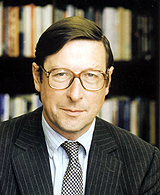
 Among the best-known and most prolific modern writers on military conflict as both news and history, Britain’s Sir Max Hastings has experienced war firsthand. As a television reporter and print journalist, he covered 11 conflicts, ranging from Northern Ireland and Vietnam to Biafra and the Falklands. He has held senior editorial positions at London’s Evening Standard and The Daily Telegraph and is the author of nearly two dozen books of military history. Highly regarded for both his prose style and the depth of his research, Hastings has also drawn criticism for his willingness to look beyond patriotic or political clichés to find the hard truths that underlie mankind’s fascination with war.
Why did you choose journalism rather than soldiering?
On an attachment to a Parachute Regiment battalion on exercise in Cyprus when I was 17, I realized how unsuited I was to the military life—I was chronically ill-disciplined, physically clumsy (in 1963 I was described as the worst pupil ever to get through the British army’s jump school) and pretty selfish. I retained my admiration for and fascination with warriors but realized that I would have to write about them rather than become one.
‘Only by experience can one learn to write convincingly about the normal plight of the soldier in combat, which means being exhausted, wet, filthy and hungry before the enemy even gets into the story’
How did you become a war correspondent?
After returning from a 1967–68 fellowship in America, I had a series of great assignments—Northern Ireland, the end of the Biafran War, the Middle East war, Vietnam, the 1971 Indo-Pakistani War, the 1973 Yom Kippur War and many more. I found that, as with most ambitious young journalists, war reporting was for me a hugely stimulating and rewarding experience, and I wasn’t too bad at it.
Did those experiences help in writing military history?
It has been a huge help that I saw quite a lot of the “sharp end” when I was young. Only by experience can one learn to write convincingly about the normal plight of the soldier in combat, which means being exhausted, wet, filthy and hungry before the enemy even gets into the story.
What are a war correspondent’s most important skills?
A lot of luck and some literary skill, skepticism but not cynicism, and a real sympathy for soldiers. One needs ruthless determination and persistence, and a willingness sometimes to break rules, to get to the front and see what is happening.
What about fear?
It is much less scary being accredited to an army, as I was in Vietnam and the Falklands, than roaming the countryside covering a guerilla conflict, which gets a lot of journalists killed. I have always been most frightened when I’ve been at the mercy of an African teenager with a Kalashnikov.
What was it like covering the Falklands War?
It was physically very harsh. Yet it was by far the most rewarding for me personally, because there were fewer than a dozen print journalists on the island and no live TV feed, so my copy got huge play in every British newspaper. It was the greatest adventure of my life, chiefly because we won and I came back in one piece.
How do war reporters differ from other journalists?
In some ways war reporting is easier than routine journalism, because one is simply called upon to describe dramatic events. The hard part is that many of today’s battlefield journalists are good writers and very brave but know pathetically little about armies, war and tactics.
How important is that knowledge?
Unless you know how to interpret what you are seeing, a battle just looks like a lot of men in camouflaged suits running about and shooting.
Which medium is now best suited to war reporting?
Print is much easier than television, because you don’t have to lug a camera—you can see without being seen. I could never have done for TV what I did as a print reporter in the 1973 Yom Kippur War, sneaking up to the Golan Heights and the Suez front with a colleague because we could get no official authorization to go to the front. But that was only possible because we had no cameras.
How did you begin writing books about warfare?
When I was 27 I wrote a biography of Montrose, King Charles I’s great general in Scotland in England’s Civil War. Jim Wade of the Dial Press in New York commissioned me to write a book on the RAF’s World War II bomber offensive. When the book was published in 1979, it sold well and won the Somerset Maugham Prize, which did a lot to put me on the map. Writing books is like any other of business—if you can find and hold a market, you keep at it.
Why should we care about military history?
The cliché is correct: Wars reveal human beings at their best and worst. The kind of military history I write isn’t chiefly about which divisions went which way and when; it’s about the behavior of people in extraordinary circumstances.
What is essential in a good military history?
The key ingredients are the same as those of any other kind of history: The book should keep you turning the pages, should try to tell you things about the past that are true, and should say at least some things a reader didn’t know already.
What is the worst mistake military historians make?
The biggest error is to impose the values of the 21st century upon the utterly different circumstances of the time. Then there are those who go on turning out nationalistic twaddle about “our brave boys.” The proper job of all of us is to try to tell the truth about what happened, even if it is sometimes uncomfortable and doesn’t feed patriotic myths.
What is your goal as a military historian?
My purpose is to explain to a modern civilian readership what human beings do in wars, what ordinary people did in extraordinary circumstances. My purpose always is to describe how people thought and acted then, what was going on in their minds.
Who are today’s best military historians?
My favorites are Antony Beevor and Rick Atkinson, because what they do is closest to what I try to do, but I am also a great admirer of Douglas Porch, Williamson Murray and Carlo D’Este—Carlo’s Decision in Normandy was written almost 30 years ago, but for me remains the best book on the campaign.
Your most recent book is about Winston Churchill. What do you think of him?
I am a huge admirer of Winston Churchill, one of the greatest human beings of all time and certainly Britain’s greatest war leader. But many aspects of the story are much more complex than people recognize. To me, the story is that of Churchill, himself a hero, always wanting more from the British people and the British army than they were capable of delivering.
Even though I thought I knew quite a lot about Churchill when I started the book, there is always more. I enjoyed writing this book perhaps more than any other I have done, because the man was so utterly irresistible, even when he was wrong.
Why are we still fascinated by World War II?
Because it was by far the greatest event in human history. There is always something more to learn, something more to say. But I don’t buy all the nonsense about the people of that era being “the Greatest Generation.” They were pretty much like any other generation, but when thrust into extraordinary circumstances many of them achieved extraordinary things.
What’s the best part of being a military historian?
I feel very lucky that I discovered quite a large readership for the kind of books I write and love doing them—the archive research, the interviews with veterans, the travels to many obscure corners of Europe and, later, the world. The compliments I have valued most about my books have been from veterans who say “Yes, that is how it was, how it really felt.”