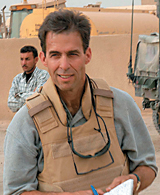
 Journalist and historian Rick Atkinson knows the face of battle far better than most who write about wars and those who fight them. The son of a career Army officer, Atkinson grew up on posts in Europe and the United States. In 1982 his articles for The Kansas City Times on West Point’s Class of 1966 won the Pulitzer Prize for national reporting, and in 1983 he joined The Washington Post. As the paper’s Berlin bureau chief, he covered the conflicts in Somalia and Bosnia and was the Post’s lead Gulf War reporter. Atkinson took a leave of absence from the newspaper in 1999 to begin work on the three-volume World War II history known as the Liberation Trilogy; the first volume won the Pulitzer Prize for history in 2003. He briefly returned to the Post that year to cover the invasion of Iraq and again in 2007. Atkinson is working on the trilogy’s final volume.
‘With some 8 million in the Army and 16 million total in uniform in World War II, nearly every family in America had a “blood interest” in the military. That’s certainly not the case today. I think that changes the emotional dynamic between the country and its military’
What led you from journalism to military history?
I wrote The Long Gray Line almost exactly 20 years ago, so fairly early in my career, I already had a foot in both newspapers and books. And having experienced the pleasure of both, I eventually came to the conclusion that if I was able to make a living at writing long-form narrative nonfiction, that’s what I’d do, because I find it more gratifying.
What was the genesis of the Liberation Trilogy?
I was an Army brat, born in Munich, and I grew up on Army posts at a time when World War II was still very much part of the landscape. My father had come into the Army in 1943 and was a career officer. And I was in Berlin for The Washington Post in the 1990s, and I was there for the endless succession of 50th anniversary commemorations of Normandy, the Battle of the Bulge and the end of the war, and I think that rekindled my interest in the war.
World War II didn’t start on Omaha Beach, and I recognized at some point there was a triptych to American involvement in the liberation of Europe. The first panel was North Africa, the second was Sicily and Italy, and the third and final panel was the decisive campaign in Central Europe. I also realized the story of World War II is bottomless, and we’ll never run out of things to write about. So I started thinking about the trilogy concept in 1995 and working on it full-time in 1999.
Why the focus on Europe rather than the Pacific?
Part of the reason is that when I first started thinking about the project, I was in Europe, and part of it is that you might say I’ve had a Europe orientation literally since birth. And I think the war in Europe just grabs my imagination in a different way. Plenty of people have done, and will continue to do, good books about the Pacific Theater, but the European Theater works for me in terms of finding the narrative, and the lyricism that comes from exploring a topic that really works on your imagination on a variety of levels, and for me that’s Europe.
What struck you about North Africa and Italy?
The events that unfolded beginning with Operation Torch in North Africa in 1942 and Operation Husky in Sicily in 1943 inform what happened in Normandy and beyond. North Africa, Sicily and Italy were absolutely essential to the Army’s development as an institution and to the development of the individuals I write about. For example, Eisenhower wouldn’t have been Eisenhower had he not gone through North Africa, Sicily and Italy. Both he and the American Army needed those experiences. I strongly feel we can’t understand what happened from D-Day on if we don’t have a good grounding in the formative experiences that came before.
How important a commander’s ego to his performance in Europe?
Ego is inseparable from any human enterprise, and war probably more so than most. In Eisenhower’s case, he was capable of sublimating his ego in service to the greater good—not that he didn’t have an ego, because he certainly did. When you’re talking about coalition warfare and global scale, you find that most of the successful practitioners tend to be able to check their egos at the door. That doesn’t mean that a general can’t be both flamboyant and successful—look at George Patton. It’s the clashing of egos, the insecurities, the effort to get diverse personalities to mesh and the capacity for growth, or lack thereof, that really intrigue me.
Who was the best combat leader in North Africa? In Italy?
Well, given there were a number of failures in each campaign, that sort of narrows the field. The two in North Africa that I admire right off the bat are Terry Allen, commander of the 1st Infantry Division, and Charles “Doc” Ryder, commander of the 34th Division. Both were very competent. They were both professional officers who were excellent practitioners of the combat arts.
In Sicily and Italy, I’m a big fan of Lucian Truscott, commander of the 3rd Infantry Division and then VI Corps, who was a truly superb combat leader. He really knew his stuff, and he continued to grow as a leader throughout the war. But I will tell you that the best tactician in Italy wasn’t American, he was General Alphonse Juin, who commanded the French Expeditionary Corps, attached to the U.S. Fifth Army. He stands out, particularly in the last couple of months, as someone who was extraordinarily gifted. I’d go so far as to say Juin was better than any of the British or American commanders.
Who was the most overrated combat leader in each theater?
In North Africa, I’d have to say Patton. He was only in command of II Corps for about six weeks, and though legend has it he revived II Corps’ fortunes and turned it into a highly competent, war-winning unit, it’s just not true. He was quite frustrated, he made mistakes, and he left after his six weeks really feeling a mixture of satisfaction and disgruntlement that he hadn’t performed as well as he’d hoped to and as well as he thought he should have.
And as much as I admire him for what he later did as supreme Allied commander, I’d have to say Eisenhower was the most overrated in Italy. He was only there as theater commander through December 1943, when he left for England to prepare for Operation Overlord, but he was not a particularly good field marshal. When we invaded Sicily in July 1943, there wasn’t really a good plan for what would happen 20 miles beyond the beaches, because Eisenhower hadn’t been particularly attentive to the notion of severing the Messina Straits that separate Sicily from mainland Italy. As a result, not only were the Germans and Italians able to reinforce Sicily they were able to escape when the time came. Four very fine German divisions got away almost intact because, frankly, Eisenhower and his immediate subordinates—particularly General Sir Harold Alexander—simply hadn’t been paying sufficient attention.
Which was the most important battle in North Africa? In Italy?
In both cases, the first battles were the most important. In North Africa, the landings in Morocco and Algiers were critical. If they hadn’t succeeded, nothing else could have happened. The landings were a novel enterprise and were one of the boldest operations of the entire war.
In Italy, the same holds true: The landings in Sicily had to be successful for anything else to work. And the subsequent landings on the Italian mainland were also important. Salerno, for example, was a very near-run thing; Gen. Mark Clark very nearly got his Fifth Army thrown back into the sea. Had that happened, it would have been a monumental setback, so the success in those landings was absolutely vital. Once the Allies got off the beaches, then preponderance could take over—they had more of everything than the other guys, but they had to be able to get ashore.
Is there really more to say about the Normandy invasion?
First, I think it’s important to assert that the story is bottomless, in that there will always be more to write about Normandy. The U.S. Army’s records pertaining to World War II—just the Army’s—weigh 17,000 tons. So, if you’re an “archive rat,” as I am, you’ll always be able to find new and interesting aspects to even as oft-told a tale as Normandy. And I also believe I’m writing one book that just happens to come in three parts, and it begins in November 1942, and Normandy is an iteration. Yes, people think they know the story, but I think those who are picking up the story from the beginning and understand how it fits in to the earlier campaigns will find there are still revelations.
How difficult is it to research these long-ago events?
I find that while trying to reconstruct something that happened 60-plus years ago is sometimes incredibly frustrating, it’s often not as difficult as we might think, given that the Second World War has to be the most recorded and scrutinized real-time event in our national history. And while secondary sources such as the official histories are very important, there needs to be a thrust toward originality in voice and in material. Frankly, at least half the fun of this process is rooting around in the archival sources. Having now been doing this for more than a decade, I have a pretty good feeling for archives large and small, both in this country and around the world. There is a staggering amount of material, so you don’t need latter-day oral histories, because the contemporaneous record is extraordinarily rich.
Do you see parallels between our current conflicts and World War II?
I frankly don’t see many parallels, except on the soldier level. When you’re with a rifle company in Iraq or Afghanistan, there are a lot of parallels with a rifle company at Salerno, because there’s something eternal about soldiering. The reasons why soldiers fight, and why they risk their lives for each other, are remarkably the same across time.
World War II was absolutely an existential war, in that our national existence and our way of life, and even Western civilization, were at stake. I personally don’t see that in Iraq or Afghanistan. World War II was a war of necessity.
How well do today’s soldiers and generals compare with their World War II counterparts?
I think today’s soldiers have a lot going for them that their grandfathers and great-grandfathers didn’t have in World War II. First, today’s soldiers are volunteers, while the Army of World War II, especially by 1944, was overwhelmingly a draft army. Today’s soldiers are generally better educated, more physically fit, better trained and, certainly on the small-unit level, they’re better led. Their officers are all professionals—there are no “90-day wonders” in today’s Army. The force today is roughly a half-million, as opposed to 8.3 million in World War II.
Another thing to consider is America is a much bigger country today than it was during World War II; our population now is something like 307 million, compared to about 137 million back then. That means with some 8 million in the Army and 16 million total in uniform in World War II, nearly every family in America had a “blood interest” in the military. That’s certainly not the case today. I think that changes the emotional dynamic between the country and its military.
I’m around soldiers a lot, and I admire them tremendously. I think they’re remarkably committed and capable. They’re every bit as good as the World War II generation. I think today’s generals are as capable and as well prepared—if not better prepared—than their World War II counterparts. Today’s field-grade officers have spent their entire professional lives preparing to become combat leaders, rather than being suddenly thrown into the maelstrom we call World War II. Moreover, today’s Army is extraordinarily combat-experienced. Who would have thought in 2001 that less than a decade later we’d have soldiers who have three or four combat tours under their belts?
What about modern small-unit tactics compared to those of World War II?
In terms of ground combat, some things are eternal: You find the enemy, fix him on the front and then outflank him. On the other hand, today’s soldiers—particularly in Iraq and Afghanistan—have a panoply of skills that would be quite foreign to World War II soldiers. That includes, of course, all the things in the counterinsurgency toolkit, but it also includes things like the ability to call in air strikes. In today’s Army, that’s down on the NCO level, while even by the end of World War II, they’d barely gotten to the point where anyone could call in tactical air support.
The sophistication of modern battlefield systems requires a set of capabilities that is much vaster than it was in 1944. When you look at the average American rifleman in the European Theater that year, it’s hard not to feel that he was, to some extent, cannon fodder. Generally speaking, he wasn’t highly educated, may have come from one of the lower mental categories and was given a rifle and sent out to do what needed to be done. Today’s soldiers are given rifles, of course, put they’re also given a whole lot more, because they’re asked to do a whole range of things that would have been unimaginable to their World War II counterparts. And we’re just talking about the infantry.
What is the value in studying military history?
Human history, and our national history, are unfortunately so wrapped up in wars and military events that, to best understand the past, we have to have at least a reasonable grasp of the causes and conduct of those military actions. Whether you’re a military officer or an average citizen—or somewhere in between—I think a study of our military history is illuminating of who we are as a people and as a culture.
Having a grasp of why things unfolded as they did in the past is vitally important to our current national life, too, in that it can help guide us through present dilemmas. For example, in July 1945, following the murder by U.S. troops of SS guards at Dachau concentration camp, Dwight Eisenhower ordered all his subordinates in the European Theater who had court-martial authority to conduct investigations meant to determine if any of their soldiers had been involved in abusing or killing German prisoners. His reason for initiating this theater-wide investigation were both coherent and very relevant to us today: He said, in effect, “We are the guardians of the moral high ground, and we cannot allow our honor as an army and as soldiers, or our national honor, to be stained. It’s important for us to know who we are and why we have fought this war.” Well, when you read that in 2009, you quickly realize its relevance to recent unfortunate events in Iraq. It’s that sort of revelation that happens over and over again through the study of military history.
As both a journalist and historian, what role do you think each plays in the shaping of what we come to accept as “history”?
As a historian, I spent a lot of time reading material written by the World War II war correspondents who covered North Africa, Italy and Western Europe. They were a very accomplished bunch, and I rely on them a lot more than most historians do. I suppose that’s partly because I feel a kinship with them, but also because they were paid observers who give a vivid picture of events that is difficult to find anywhere else. So I think having that sort of resource is absolutely invaluable to those of us trying to understand these momentous events long after all the principals and most of the participants are dead.
I have no illusions that going back and reading The New York Times’ coverage of the Battle of the Bulge gives me a real sense of what happened, but journalists’ accounts can give you the color and the nuance and their reflections after the events. Journalism and history are distant cousins, but they are related. On one level, journalism has a function that’s more important than history: That is to help keep the electorate in a political democracy well informed. That’s a sacred responsibility for journalists. History has a different function: It is an effort to illuminate the past in a way that gives us an understanding of where we are today and perhaps to give us some sense of where we’re going.
Where do you go from here, as both journalist and historian?
In the past 10 years, I’ve been back to The Washington Post twice—once to go to Iraq for the invasion, and again in 2007 for six months or so when I was between books. I have a long and deep emotional attachment to the Post, and I hope to keep some sort of affiliation. But I’m unlikely to go back into a newsroom in any meaningful capacity. I think I’ve made the transition to historian, and one of the things I’ve done with the trilogy is to teach myself historiography. It’s been my graduate program. I like being an historian. I like the lifestyle. I like the opportunity for lyricism, and I like the voice that it affords, since it’s hard to do a 250,000 word stories in the Post.
I’m not sure what I’ll do when the trilogy is done, which will be either the fall of 2012 or the spring of 2013. So I have some time to think about it, and I’m sure I’ll find something to keep me out of trouble.