The Romanian aircraft industry was created in the early 1920s because that country’s government did not want to rely on other nations to provide its aircraft and components. The delivery of foreign aircraft and parts was subject to the winds of political turmoil and often delayed. Also, many of the best foreign aircraft types were simply not for sale.
In order to overcome these problems and ensure that the Royal Romanian Air Force (Fortele Aeriene Regale ale Romaniei, or FARR) was capable of protecting the nation’s airspace, the government subsidized the creation of three major aircraft manufacturers. The Societatii pentru Exploatari Tehnice (SET) factory was established in Bucharest in 1923, the Industria Aeronautica Romana (IAR) built its factory in Brasov in 1925, and the Intreprinderea de Constructii Aeronautice Romanesti (ICAR) company was founded at Bucharest in 1932.
Unfortunately, the sudden growth of the aircraft industry and large government subsidies resulted in more graft and corruption than actual aircraft construction. In order to rectify the situation, the government nationalized IAR in 1935 and made it the primary supplier of warplanes while SET and ICAR were left to compete for limited government and civilian contracts.
IAR was chosen to supply the Romanian armed forces with warplanes because it had already demonstrated its ability and desire to build fighter aircraft. In 1930 the Romanian government issued specifications for a new fighter. Although the government did not expect much from its own infant aircraft industry, IAR nevertheless produced several prototype fighters in response to the specifications.
Although the prototypes held great promise, none was ready for mass production, and the government decided to purchase the Polish Panstwowe Zaclady Lotnicze (PZL) P-11B for its new fighter. The IAR engineers were dismayed at losing the contract but realized that the Polish design had many advantages over their own. They carefully analyzed the aircraft and incorporated many of its strengths into their future designs.
In 1934, IAR introduced two prototypes to challenge the PZL P-11B. The IARs 15 and 16 were both low-wing, single-seat monoplane fighters powered by 600-hp in-line and 560-hp radial engines, respectively. Many of the fighter’s features came from the original PZL P-11B. While both prototypes were faster than the Polish fighter, the Romanian government opted to simply upgrade the powerplant of the PZL P-11B. Mating it with the Romanian 640-hp IAR K9 engine produced an aircraft that was faster than both prototypes and saved the cost of building a completely new airplane. The new version was christened the PZL P-11F, and since it used an IAR engine, the company was awarded a contract to build PZL P-11Fs under license.
Undaunted by the setback of having its own design turned down, IAR continued design work on its next generation of fighters. Building on their experience, IAR engineers constructed a single example of a low-wing monoplane in 1935 that was christened the IAR 24. The aircraft was powered by a 350-hp Gnome-Rhone 7Kd engine, and because of its low power it was classified as a civilian touring aircraft. However, it contained many advanced features, including uniquely designed wings.
War clouds were already gathering in Europe, and Hungary, Romania’s old enemy, was rearming. Faced with the prospect of defending its airspace against any of several possible aggressors, the Romanian government decided to purchase a new fighter in 1936. The ideal choice was a Romanian-built fighter, since the growing political turmoil in Europe was certain to interrupt the delivery of aircraft from foreign sources.
IAR was more than ready to build the new fighter. The company had been working for several months on an improved design for a low-wing, single-seat monoplane fighter with a retractable undercarriage. Many of the design features, such as the special wings, had been successfully tested on the IAR 24, and the engineers believed that they had an outstanding aircraft in the making. Unfortunately, Polish designers had beaten them to the punch again. PZL had been refining the design of its P-11B for several years and had introduced the PZL P-24 in May 1933.
The P-24 was the ultimate progression of the earlier P-11 design. Although the aircraft were similar in appearance, the PZL P-24 was more heavily armed and had a more powerful engine, an enclosed canopy and several other refinements. Work on the PZL P-24 had continued throughout 1933 and 1934, and the second prototype was demonstrated at the Paris Air Show in 1934. Its performance was stunning, and the aircraft was labeled the fastest and best-armed interceptor in the world. The Romanian government was also impressed by the new Polish aircraft. Although the government would have liked to buy IAR’s design, the Polish fighter was a better aircraft. The PZL P-24 was the refinement of a proven design the Romanian Air Force was already operating. The Romanians purchased a license to build the P-24 equipped with the IAR-built 930-hp Gnome-Rhone 14 Kmc/36 engine.
Despite disappointment at the government’s choice of the Polish design, a team of IAR engineers led by Dr. Ion Grosu was convinced that its design was superior to the high-gull-wing configuration of the PZL P-24. The team studied the new Polish aircraft and combined its best features with those of the latest IAR design.
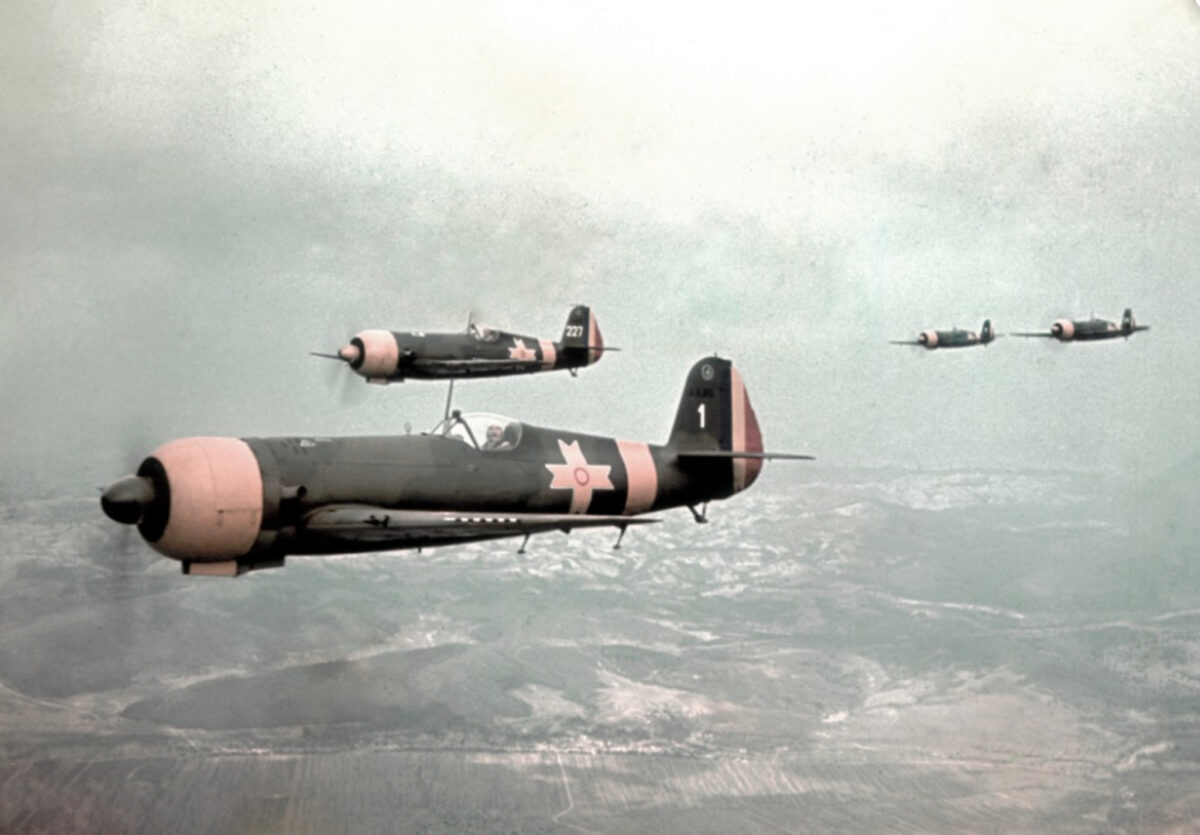
The resulting aircraft was unique in many respects. It was a low-wing, single-seat monoplane fighter with an open cockpit and retractable landing gear. It had a wingspan of 32 feet 10 inches, was 26 feet 91Ž2 inches long and stood 11 feet 10 inches high. It weighed 3,930 pounds empty and 5,040 with a normal fuel and ordnance load. The aircraft was powered by the 14-cylinder radial air-cooled IAR-built Gnome-Rhone 14K II C 32 engine, which generated 870 hp, resulting in a top speed of 317 mph at 13,000 feet and a maximum range of 590 miles. The prototype was armed with two FN Browning 7.92mm machine guns, but heavier armament was planned.
The simple statistics do not do justice to the brilliant design that combined the best features of a Polish and a Romanian aircraft. The fuselage forward of the tail was from the IAR design, while the entire tail section was taken from the PZL P-24. The wings were designed by IAR and had been tested on the IAR 24. The engine, engine mount and engine cowling were all from the PZL P-24. The cockpit instruments, internal cockpit components and gunsight were either Romanian or imported from foreign suppliers. The Romanian government was duly impressed with the new aircraft, which was officially christened the IAR 80, and ordered 100 of the new fighters on December 18, 1939.
The new fighters required 600 Belgian-made FN Browning machine guns, and the supply of them was disrupted by the German conquest of the Low Countries. The Germans eventually allowed the production of the machine guns to resume, but it took until November 1940 for the order to be released. The first 20 production IAR 80s rolled off the assembly line between January and February 1941. Several minor modifications differentiated them from the prototype. The production versions had the more powerful IAR 14K III C 36 engine installed. The cockpit was fully enclosed, and the pilot was provided with oxygen for high-altitude flight.
The initial batch of fighters was well received by the Romanian pilots, but they made several recommendations that the IAR engineers quickly adopted. The pilots considered the aircraft underpowered and lacking sufficient firepower for modern air-to-air combat. The IAR engineers interrupted series production to add the more powerful 960-hp IAR 14K IV C 32 engine to airplanes 21 through 50 on the assembly line. They were unable, however, to upgrade the armament package.
The Romanians, now firmly in the Axis camp, were set to participate in the invasion of Russia along with the Germans. The Romanian air force benefited from the new alliance, as Germany, in late April 1941, allowed the delivery of sufficient Browning FN machine guns for the IAR engineers to build the IAR 80A.
The new version was given the 1,025-hp IAR 14K 1000A engine and equipped with six Browning FN machine guns. An armored windscreen and seatback were added for the pilot’s protection, and a new Goerz gunsight was installed. Although the IAR 80A had a more powerful engine, the added weight of the guns, ammunition and armor plating actually reduced the top speed to 316 mph. Only eight IAR 80As had been completed when the invasion of Russia began, but the version proved quite satisfactory in combat, and by the end of 1941 three squadrons in Grupul 8 Vinatoare flew the IAR 80A in the skies over Russia.
The Royal Romanian Air Force served throughout southern Russia, supporting both the Romanian and the German forces of Army Group South as they advanced through the Ukraine.
The Romanians continued to operate the IAR 80s and 80As in Russia throughout 1942, and the air-to-air victory scores of the Romanian pilots continued to climb. Lieutenant Dan Vizante scored most of his 32 credited kills flying the IAR 80. However, the Russians were introducing new and better types of fighters, and the IAR 80s and 80As were soon outclassed on the Russian front. The IAR engineers tried several different modifications to improve performance. They tried to mate the Focke-Wulf FW-190’s BMW 801 radial engine and the Junkers Jumo 211 Da engine to the IAR 80 airframe. However, neither adaptation was successful, and the Germans found it more beneficial to outfit the Romanian air force with standard Luftwaffe aircraft.
Although the IAR 80 and 80A were eventually withdrawn from service on the Russian front, they continued to serve in Romania, protecting vital oil fields and ports from both Russian and American attack. A total of 236 IAR 80 and 80A fighters were built during World War II, and the planes served the Romanians well. The IAR 80 and 80A provided protection for Romanian troops during their many battles in Russia and protected vital installations in Romania until the end of the war.
This article was written by Timothy J. Kutta and originally appeared in the May 1996 issue of World War II magazine.
For more great articles subscribe to World War II magazine today!