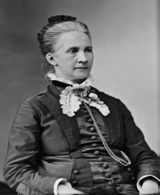
 Belva Lockwood, the first woman to argue a case before the Supreme Court, took her fight for women’s rights to the presidential campaign trail in 1884.
On September 18, 1884, an enthusiastic group of well-wishers gathered outside a farmhouse at Wilson ‘s Station, Maryland, not far from the nation’s capital. They had come to ratify the nomination of the most recently announced candidate in the presidential race of 1884. The nominee, an attorney, was smart, well spoken and media savvy. Her name was Belva Lockwood and she was about to become the first woman to run a full campaign for the office.
Twelve years earlier New York City publisher Victoria Woodhull had attempted a presidential bid, and Harper’s Weekly cartoonist Thomas Nast quickly labeled her “Mrs. Satan.” At Wilson’s Station, squaring off against national candidates Grover Cleveland, James Blaine, Benjamin Butler and John St. John, Lockwood knew that she too was challenging the prevailing idea of feminine propriety. Nearly a century before presidential longshots such as Margaret Chase Smith and Shirley Chisholm, and 124 years before Hillary Rodham Clinton’s historic run, Lockwood’s candidacy provoked heated debate across America about whether a woman could, or should, be president.
Born in 1830, Lockwood grew up the child of poor farmers near Niagara Falls, N.Y. Widowed at the age of 22, with a young daughter to care for, she fought family and social convention to become one of the very few women in the country with a college degree. Ten years of teaching in her home state, however, convinced her that she could pull more from life. Astonishingly, although there were no women attorneys in antebellum America, and women were not permitted to vote, she secretly dreamed of a life in law or politics.
In the winter of 1866 Lockwood moved to Washington, D.C., where she scraped together a living as a teacher, learned about Capitol Hill politics and, in 1868, remarried. Intent on pursuing her dreams, she applied for admission to several local law schools. Each turned her down. To post–Civil War America, the idea of female attorneys was still unthinkable.
In 1871, however, perhaps needing an infusion of tuition fees or emboldened by the decision of St. Louis’ Washington University law program to matriculate women, the District’s new National University Law School admitted Lockwood and several of her reform-minded female friends. The women, viewed as unseemly interlopers, were hassled by male students and placed in segregated classrooms. Lockwood persevered but ultimately had to petition President Ulysses S. Grant, titular head of the school, for her degree. A career in law was born out of hard work and struggle.
The 1870s brought Lockwood, now running a one-woman law firm in the capital, a livelihood and more challenges. Refused admission to the U.S. Court of Claims bar, she waged an ultimately successful five-year fight to get qualified women attorneys the privilege of practicing in federal courts. On March 3, 1879, Lockwood was sworn in as the first female member of the U.S. Supreme Court bar. In 1880 she became the first woman lawyer to argue a case before the high court.
Lockwood’s battle to become a fully accredited attorney, along with the publicity surrounding her speeches at meetings of the National Woman Suffrage Association, made her a fairly well-known figure. It was, however, her decision to run for the highest political office in the land that made her famous.
In 1884 women were permitted to vote in presidential elections only in the territories of Utah, Washington and Wyoming. Despite the considerable efforts of reform women and their male allies across the country and in Congress, the cause of woman suffrage had stalled. Liquor interests opposed to the women-led temperance movement, nervous party bosses and social prejudice all conspired to keep half the population from participating in the democratic process as voters.
The small, California-based Equal Rights Party drafted Lockwood as its presidential nominee in August 1884. On the one hand, the nomination was political theater, a lighthearted antic meant to draw attention to the question of why the “fair sex” was not permitted to vote. At the same time, it was also a serious political strategy devised by newspaper owner Marietta Stow in response to the rebuff given suffrage leaders, including Lockwood, at that year’s Republican and Democratic conventions. Stow had long argued that women could create their own terms of engagement in American party politics. She proposed that they run for elective office and establish a political party both as a way of educating themselves about politics, in anticipation of the day when all women could vote, and as a statement that women were to be taken seriously.
Lockwood accepted the party’s nomination on September 3 and immediately made it clear that she intended to be taken seriously on matters of political substance. She outlined a “grand platform of principles” that expressed bold positions and comfortable compromise. Lockwood promised to promote and maintain equal political privileges for “every class of our citizens irrespective of sex, color, or nationality” in order to make the United States “the land of the free and home of the brave.” She pledged the fair distribution of public offices to women as well as men. She opposed the “wholesale monopoly of the judiciary” by men and said that, if elected, she would appoint a reasonable number of women as district attorneys, marshals and federal judges, including the nomination of a “competent woman to any vacancy that might occur on the United States Supreme Bench.”
On the thorny issue of free trade, she initially supported high tariffs on imported goods to “protect and foster American industries,” but moved to a middle of the road position. She urged the extension of commercial relations with foreign countries to promote friendship, and advocated the establishment of a “high Court of Arbitration” to settle international commercial and political differences.
Lockwood stood fast with most liberal reformers in her support of citizenship for American Indians and the allotment of tribal land. She broke ranks, however, with many of her West Coast party colleagues on immigration, calling the controversial 1882 Chinese Exclusion Act “anti-Christian and unconstitutional.”
The media immediately added Lockwood’s candidacy to the mix of news. On September 17, the popular humor magazine Puck featured a cover cartoon lampooning Lockwood and Ben Butler, the presidential nominee of the Greenback/Anti-Monopoly Party. Three days later Frank Leslie’s Illustrated, a literary and news weekly, ran an article endorsing women’s right to be political candidates titled “Woman in Politics: Why Not?” Lockwood’s campaign picture accompanied the article. Washington newspapers reported her kick-off rally at Wilson’s Station and her eminently quotable quip, “I cannot vote, but I can be voted for.”
Despite the novelty, and even notoriety of a female candidacy, most journalists treated Lockwood with an even-handed professionalism. She encountered no greater mockery than did the male candidates. True, she had to endure silly lies about hairpieces and sham allegations that she was divorced, but Republican candidate James Blaine was portrayed so harshly that he threatened to sue the publishers of Puck . The Democratic hopeful, New York State Governor Grover Cleveland, was taunted about his out-of-wedlock child in cartoons and with cries of “Ma, Ma Where’s My Pa?” Lockwood, thick-skinned, realistic and a bit of a publicity-hound, took the press coverage in stride, and later commented that a campaign cartoon depicting her was a prized possession.
Suffrage women were divided over the wisdom of her campaign. West Coast activist Abigail Scott Duniway thought it would give opponents of women’s rights new pretexts for lies, ridicule and scorn: How, she asked, could “a disfranchised candidate of a disfranchised people” make anything but “a sorry run for any office?”
Susan B. Anthony, who knew Lockwood well, also refused to support the campaign, and complained about the candidate to a friend: “[I]f we women could all pull together! But we can’t—each has a plan & a plea.” Anthony continued to hope that the Republican Party would embrace the cause of woman suffrage. Lockwood knew better and, in a letter to Stow, wrote that the Republicans claimed to be the party of progress yet had “little else but insult for women when [we]…ask for recognition [of suffrage].”
Lockwood paid Anthony little mind. She recruited other leaders of the women’s movement to organize electoral ballots on her behalf while Anthony, after hearing Lockwood give a campaign speech in New York, cattily commented that the Washington lawyer spoke too much like a male candidate—and had dyed her hair. “So human,” wrote Anthony, “are poor mortal strongminded women!!”
Strong-minded aptly described Lockwood, who made the decision not just to run but to join other candidates who wanted to change the way presidential campaigns were waged. Earlier in the 19th century, candidates communicated their views through the newspapers and were often berated for public campaign speeches. Lockwood believed that candidates should tour the country and speak, in person, to voters. She had canvassed for Horace Greeley in 1872 and knew something about how to drum up a crowd and sell campaign paraphernalia. She was the candidate of a party without a treasury and quickly devised a business model that permitted her to reach the voters. She offered herself as a paid lecturer, crisscrossing the country with money earned from talks before audiences at state fairs and civic associations. People came out to hear her in large numbers. She drew 500 at the opera house in Cleveland, a thousand in Flint, Mich., and an unknown number while making whistle-stop appearances on a train traveling from Louisville, Ky., to New York.
Her open, inviting campaign style made the political cartoonists take notice. On October 11 The Judge, another satirical weekly, poked fun at her with a jibe titled “The New Ticket: The Campaign Is Now Open.” A week later she was considered such hot news that Judge ‘s editors put her on the cover in yet another satiric cartoon titled “Belva, dear!” Frank Leslie’s poked gentle fun at the lady candidate by publishing a drawing of the recent Belva Lockwood Club parades, organized by men who wore shapeless Mother Hubbard dresses, that were meant to belittle her campaign.
The November 4 election was tight and, when the ballots were tallied, Democrat Grover Cleveland squeaked by Blaine with a margin of less than 30,000 votes. With more than 10 million votes cast, Butler polled 175,000 votes, and Lockwood collected just under 5,000 votes in the eight states where men and women had gotten up ballots in her name.
Media spoofing continued despite the end of the campaign. Well-known Puck cartoonist Bernard Gillam put a scantily clad Lockwood at the head of the line of losers and their advisers in a sketch titled “The Busted Side-Show.” Commenting on the impact of an election that included several third-party candidates, The Judge also ran a cartoon in which Lockwood, Butler and Prohibition Party candidate John Pierce St. John pointed fingers at one another over the caption “Your Fault I Was Not Elected.” At Christmas Gillam again drew Lockwood and Butler, this time as “The Outcast Orphans.”
Lockwood, however, viewed her campaign efforts as entirely positive although others in the suffrage movement did not. Attorney Mary Greene, a member of a professional group for women lawyers called the Equity Club, claimed that the candidate had been “laughed at, whether just or unjust.” While in some quarters this may have been the case, Lockwood believed that, in a test of democracy, she had run as an acknowledged contender and had spoken her mind. Her talents had been celebrated along with the cause of women.
Lockwood had never expected women’s united support. “Women,” she told a journalist, “are divided up into as many factions and parties as men.” She also understood the irony of a voteless woman running for the presidency but seized on the nomination as a way not only to promote herself but also to awaken the country to the issue of women’s rights and the need for a constitutional amendment mandating woman suffrage. She showed that women could, as Marietta Stow was fond of saying, help to run “the great household of the nation.” Even those who insisted that the nomination was initially nothing more than a joke, admitted that Lockwood had become an effective candidate who, in the words of California attorney and suffrage activist Clara Foltz, “carried herself splendidly.” She succeeded, as she had hoped, in making the presidential candidacy of a woman a part of American political history.
Like 20th-century politicians, after the election Lockwood used her fame to ramp up her lecture appearances and to endorse commercial products such as nerve tonics. She was pleased to learn that babies and towns were being named for her. In May 1888, the Equal Rights Party again nominated her as its candidate. She accepted the nomination and again found herself criticized by some members of the suffrage movement. One male activist described Lockwood’s candidacy as “wholly unauthorized and in no sense representative.” Although she claimed to have ballots in several states, no votes were recorded for her in the final tally.
Lockwood was certainly as much of an opportunist as any male politician. She understood the art of self-promotion, but she was deeply interested in politics—in 1887 she had been part of a failed effort to start an Industrial Reform Party—and knew that public office would never come to women without a fight. Months before her 1888 campaign, Lockwood advised other women, “[T]o gain strength and to get organization…put nominees in the field at once….The country is prepared to-day for a boldly aggressive movement on the part of the women of the country….It is too late to take a weak or vascillating [ sic ] stand.”
Bold action and the pursuit of ideals continued to shape Lockwood’s life. She had long lobbied Washington on matters of foreign policy as a member of the Philadelphia-based Universal Peace Union. After her second presidential campaign, she increased her public appearances, in the United States and abroad, on behalf of the human rights organization, advocating, in particular, the use of arbitration and international courts as a means of preventing war.
Lockwood also maintained her small law office in Washington. She enjoyed the practice of law despite the prejudice that barred her from the expanding fields of corporate and railway law as well as judicial appointments. In 1906 she had a great triumph, winning for the Eastern Cherokee a share of a multimillion dollar judgment in a case argued before the U.S. Supreme Court. Lockwood had first become involved in the complicated case, which involved settlements from the sale of tribal land, three decades earlier.
The cause of woman suffrage was never far from Lockwood’s thoughts. Well into her 80s, she made public appearances, including two before Congress, urging passage of a constitutional amendment guaranteeing all women the right to vote. She died in 1917, three years before the 19th Amendment was ratified. A trailblazing attorney and presidential contender, Belva Lockwood wanted nothing more than an equal playing field on which women could engage the game of politics.