
The Red River rolled by at full flood, its muddy waters looking more like the Mississippi than the stream the Texas cowboys had hoped to find. Like most of the region’s rivers, the Red might rise suddenly and dangerously–as much as 25 feet in a day. Despite the currents of the swollen river, one trail boss was determined to get his herd of Longhorn cattle across. ‘Old Man’ Todd knew the dangers of herds as big as his getting backed up at a ford, waiting for the river to go down. With as many as 25,000 cattle from a dozen herds bunched up in a few square miles of rolling terrain, a full-blown stampede could be disastrous, and in any case the ground would soon be overgrazed.
Todd called one of his hands, Jim Foster, a cowboy young enough to be ‘generous with his life as with everything else,’ as Western chronicler J. Frank Dobie later said. The lead steers were driven into the river, but about halfway across began swimming in a circle. The jam of milling cattle had to be broken before the animals at the center were pushed under and drowned. Foster stripped to his union suit and drove his horse into the river. He climbed off the horse and onto the backs of the Longhorns, walking across the herd as if it were a logjam. Straddling one of the biggest steers in the herd, he forced it to swim to the far bank. The rest of the herd followed, and Foster spend the remainder of the day–from 9 a.m. to dusk–keeping the herd together on the northern bank, soaked to the skin in his underwear, until the other cowboys got across the river to relieve him. For this notable piece of work, Foster received the princely sum of one dollar, a standard day’s wage on the Chisholm Trail in 1871.
The Chisholm Trial ranks in the mythology of the American West with places like the Little Bighorn, the Long Branch Saloon and Tombstone’s Boot Hill. All of these real places have become so romanticized and fictionalized over the last century that it is often difficult to separate fact from fancy. The real-life experiences of those who rode the trail, though, need little embellishment to convey its lively story.
The Chisholm and other cattle trails–such as the Western, Goodnight-Loving and Shawnee–were born of economic necessity, for there was a tremendous demand elsewhere in the country for Texas cattle. During the decade before the Civil War, sporadic efforts already had been made to move cattle from Texas ranges to these lucrative markets, which ranged from the gold fields of Colorado and California to the tables of New York City and even Europe. In the 1850s, cattle were ferried across the Mississippi River to Illinois, where they were fattened on the lush prairie grass, then driven east and down the very streets of New York City. Drives toward Western gold fields ran afoul of dry deserts and marauding Indians. For a time, New Orleans served as a major market, then the railhead at Sedalia, Mo. Some drives were made over the Shawnee Trail to Kansas City or the railhead at Sedalia, passing through Baxter Springs, in southeastern Kansas. There, cattlemen ran into a stone wall. Many of their cattle carried Texas fever, a tick-borne ailment that could quickly spread to other stock in an area. Counties in the two states enacted their own quarantine laws, effectively creating a bottleneck for cattle drives. At the same time, outlaws and confidence men preyed upon the incoming Texans. Gunplay was common, and tension between cattlemen and local residents was at fever-pitch when war intervened.
After the Civil War, there were many young men at loose ends in Texas and an enormous number of unclaimed wild cattle–5 million of them, by one estimate. All that needed to be done was to round up the cattle, which were longhorned descendants of livestock brought in long ago by Spanish Conquistadors, and then brand them and deliver them to market.
In 1866, Charles Goodnight, 30, and 54-year-old Oliver Loving did just that. They pushed a herd of cantankerous Longhorns from Texas toward the Colorado mining camps. Loving had successfully made the trip before by driving north through Indian Territory (present-day Oklahoma), then west along the Arkansas River. But in 1866, the Kiowas and the Comanches were on the warpath. Instead, the two cattlemen, with the help of 18 cowhands, moved southwest along the Pecos River, then into New Mexico Territory. At Bosque Redondo, however, they found an unexpected market; an Indian agent bought all of their steers, but not the cows and calves, for $12,000. Goodnight returned to Texas, leaving Loving and more than a dozen hands to complete the drive into Colorado with the remaining stock. The following year, in another drive out of Texas, Loving was fatally wounded by Comanches.
Goodnight went on to do perhaps more than any other individual to spread the cattle-raising industry into Colorado , Montana and Wyoming. Through their dealing with him, such men as Western cattle-barons-to-be John Chisum and John Iliff prospered. (Chisum later figured in the Lincoln County War in New Mexico, which brought notoriety to Bill the Kid.) The route followed by Goodnight and Loving in 1866 came to be known as the Goodnight-Loving Trail, and hundreds of thousands of Texas Longhorns moved over it for the next few years.
But the Goodnight-Loving Trail was aimed toward Western markets, and was of little use to cattlemen who set their sights on more easterly market destinations–a 11,000-pound steer that sold for $8 in San Antonio fetched $23.50 in Kansas.
Because big herds from Southern states were not welcome in populated areas, the railroads quickly extended their lines into unpopulated central Kansas. There, towns like Abilene and Wichita boomed overnight, catering to the seasonal cattle trade with barbers, baths, bars and bordellos.
The man who breathed new life into the handful of cabins called Abilene was Joseph McCoy. Realizing that increased settlement around Sedalia was the death-knell for the cattle industry there, he began building shipping pens at Abilene, beside the Kansas-Pacific Railroad. An able promoter, he pointed out that cattle could be brought in and transactions made without interruption from ‘mobs or swindling thieves.’ In 1867, he sent riders out to approaching herds from Texas and spread the word. By the end of 1871, about 700,000 cattle a year were being driven into Abilene’s waiting pens. From there, the railroad hauled the animals to meatprocessing plants in Chicago and Kansas City. As settlement shifted westward into Kansas, so did the northern end of the Chisholm Trail–from Abilene to Ellsworth, Ellsworth to Dodge City.
The most famous of cattle trails bore the name of Jesse Chisholm, a trader who set up a post on the Canadian River in Indian Territory about halfway between Texas northern border on the Red River and the Kansas state line. His father was a Scot, his mother a full-blooded Cherokee. According to his family, Jesse spoke 14 languages and negotiated many treaties between the area’s Indian tribes and white settlers. In 1865 Chisholm charted a straight, level wagon road through the wilderness from his main trading post near present-day Wichita into the middle of Indian Territory. Chisholm died in 1868, at about 63, before the trail he began became part of the legend of the Old West. His epitaph read, very simply: ‘No one left his home cold or hungry.’
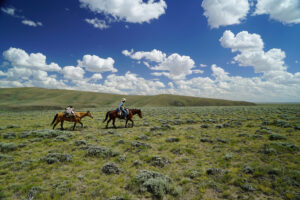
In 1867 one Colonel O. O. Wheeler and his partners were driving a herd of Longhorns north to Abilene, when, in Indian Territory, they came upon Jesse Chisholm’s wagon trail. As it was level and crossed rivers at easy fords, Wheeler and other cattle drivers who followed began using the trail as they crossed the Indian Nations. Soon Chisholm’s name was applied to the whole route from central Texas at San Antonio to Abilene and Ellsworth, Kansas, along with the numerous offshoots of the main trail. Soon a long, worn depression ran almost due north from San Antonio, passing through or near Austin, Waco and Fort Worth. The trail crossed the Red River into Indian Territory at Red River Station, a rude settlement about midway between Montague and Gainesville, Texas. In Indian Territory the trail passed spots known as Stage Station and Pole Cat Creek, and then moved into Kansas at Caldwell. There the trail branched three ways toward Wichita, Abilene, and Ellsworth, the western railhead of the storied Kansas-Pacific Railroad.
A drive up the trail began with a roundup in the south-and-central-Texas brush country, where the Longhorns continued to roam freely. The roundup might last a week or 10 days, after which the cowboys would spend several days cutting out the animals previously branded by their employer and branding those young animals not yet claimed–a favorite tactic of early Texas rancher Sam Maverick, whose name fell into common usage. Typical of the open-range ranchers of the region was Sam Johnson, who, with his brother Tom, settled on the Perdenales River west of Austin in the 1850s and quickly built a sizable and very profitable ranching business. Johnson lived to an old age, in 1908 witnessing the birth of his grandson Lyndon Baines Johnson.
The farther the herd moved from settled areas, the rougher the life on the trail–and the rougher the relations among the men. One new hand learned just how rough his comrades could be in ridding themselves of an unwanted hand. B.D. Lindsey, 18, joined a drive moving up the Chisholm Trail by lying about his experience in handling cattle. Although his scheme was soon found out, his willingness to work and learn won him a place on the crew anyway. Another green hand was not so welcome. At 30 years and 230 pounds, the cowboys thought him too old and heavy for trail work, and they soon devised a plan to run him off. Lindsey and his older co-worker were each told that one was spreading lies about the other, and soon an open animosity sprang up between the two. One night near Fort Worth, Lindsey was standing night guard when he recognized the older man’s figure striding toward him. As he approached, the man boldly announced that he’d had enough of Lindsey’s spreading lies about him, and that he would shut the boy’s mouth for good. Lindsey had been warned this was coming, and he deliberately drew his large Navy Colt revolver and leveled it at the big man’s gut. He fired six times at point-blank range; the muzzle flash ignited the man’s clothes and the surrounding prairie grass. Apparently unhurt, the man turned and ran for the camp, leaving a trail of wispy smoke in his wake. At camp he collected his pay and stomped off toward Fort Worth to begin his journey home. Only later did the men tell Lindsey that they had removed the slugs from the rounds in the Colt’s cylinder, and that the whole feud had been drummed up and was their creation. After that, Lindsey and the other men got along famously.
Every morning before dawn the last night watch woke up the cook as they left the camp. He worked the wrangler, who with the cook shared the drive’s housekeeping duties. While the cook started a fire with the fuels he had–sometimes wood, sometimes cow or buffalo chips–the wrangler saddled a horse and rode out to round up the remuda, the herd of 70 or 80 horses used by the drive’s dozen-man crew. The cow ponies were more wild than tame, and the best cutting and night horses were mustangs. (Cutting meant intercepting an animal an separating it from a group.) These wild horses were becoming hard to find in Texas in the 1870s, but every cowboy managed to find one or two for his string. As the drive moved onto the trail every morning, each man would point out the horse he wanted from his string and the wrangler or perhaps a more skilled roper would lasso and hold the animal while it was saddled. A horse you could walk up to and saddle was a horse easily stolen.
By dawn the cook had breakfast ready. As the cowboys rose from their bedrolls, they put on their hats and boots–in that order–and straggled over to the chuck wagon for their morning coffee. Invariably the coffee was the same, the cook throwing a fistful of Arbuckles Roasted into a pot of boiling water. According to trail tradition, occasionally the cook threw a horseshoe into the pot. If the horseshoe sank, it was said, the coffee wasn’t ready yet.
During the early years of the trail, the men often came across vast herds of American bison, or buffalo. ‘As far as the eye could see,’ on man recalled, ‘over the plains there was a solid mass of buffalo.’ Both the steers and the cowboys’ horses could smell a buffalo herd long before the men could, and the Longhorns became spooky around them. The trail boss often sent a scout ahead to locate and drive off buffalo herds in the area. If the cattle stampeded and got mixed with the buffalo herd, there would be little hope of cutting them out again.
Faced with seemingly endless numbers of these animals, the cowboys made great sport of hunting buffalo when they had the chance. By the mid-1870s, however, the professional buffalo hunters had all but exterminated the big herds from the southern plains, and even a lone bison bull became a rare sight along the Chisholm Trail. The animals lived on in the cowboys’ language; arriving at the end of a trail drive, the men compared their dirty, unshorn and ragged appearance to that of the buffalo–‘wild and wooly.’
While crossing Indian Territory, some drives were beset almost daily by Indians from the tribes that had settled there, either voluntarily or under duress. Cherokees, Seminoles, Creeks, Chikasaws and an occasional party of Comanche or Kiowa warriors would approach the trail boss and demand ‘Wahaw’–a steer–either as a toll for crossing Indian lands or as a gesture of good faith. Usually their request were granted; rejected tribesmen might start a stampede and carry off lost animals, a situation that in the long run would be more costly than turning over an undesirable animal in appeasement. The Indians’ requests became more frequent and plaintive as while buffalo hunters decimated the herds the Indians depended on, and their villages were forced to subsist on government rations, which were often tainted or erratic in coming.
Not all such requests came from Indians, however; at least one white ‘widderlady’ living along the trail amassed a very respectable herd by talking trail bosses out of yearling and lame animals that wouldn’t make it to market. It took several seasons for the cowboys to figure out what she was up to.
A herd on the trail might string out for as much as two miles, depending on the size of the herd, the terrain, and the animals’ speed. The going was best when the herd strung out to a formation of only three or four abreast. The body heat given off by animals on the trail was terrific, and cattle in closely packed herd lost weight quickly. Riders on the downwind side of the herd compared the experience to standing beside an open furnace. Blistered faces and hands were not uncommon among the unfortunate downwind riders.
Worse than the heat was the dust. The drag riders–usually the newest hands–at the end of the herd often came off the trail so thickly covered that the color of their clothing was obscured. Theirs was the most tiresome and menial job on the trial, prodding along the sick, lame and lazy animals that constantly dropped back. Individual Longhorns almost always maintained their positions in a trailing herd throughout the drive, with a few pushing to the front everyday and others falling back, so the drag riders couldn’t even look forward to seeing different animals. To the drag riders also fell one of the drive’s most unpleasant tasks; if a pregnant cow dropped out of the herd to give birth, a drag rider stayed with her. As soon as the calf was born, the drag rider shot the newborn and drove its mother back into the herd. An outfit on the trail had no way to care for an animal that couldn’t keep up with the rest of the herd.
Up ahead of the drag riders rode the flankers on either side of the moving column…and ahead of them the swing-men. These riders were responsible for keeping the cattle spaced properly along th trail The flankers and swing-men switched positions every day, but that helped little; unless the trail boss order a change in direction, these men had little to do, and so they fought boredom all the way to Kansas. The dust and heat weren’t much better than those experienced by the drags.
The trail boss was ultimately responsible to the herds’ owner for the success of the drive (and its profit). Consequently, he spent most of his time well ahead of the herd, scouting out open, flat bed grounds for the cattle and clear, nonalkaline streams for watering both men and animals. Watering was a crucial test of the trail boss. It was quite a compliment when one trail boss was said to be able to ‘water more cattle in a small lake of water and never get it muddy than any man I ever saw.’
Assuming the herd had been well-watered and had enough time to graze along the trail (for thirsty, hungry animals stampeded easily), once the drive had covers its 10-12 mile day’s quota, the trail boss would signal the location where the herd was to bed down for the night
The trail boss waved his hat slowly, so as not to spook the animals, to indicate where he wanted the herd milled. The cowboys on the near side of the herd moved out, and those on the far side closed in, guiding the Longhorns off the trail. Once on the bed ground, the point men at the head of the column continued turning the steer until the herd formed a huge, moving circle the slowed and stopped as the animals at last spread out the graze.
By this time the cook, who had driven the chuck wagon ahead of the drive, was well on his way to finishing supper. The staples of the trail–beans, cornmeal, sowbelly and biscuits–got old after a while, and on the rare occasion when a beef was killed for the crew, the cook was sure to prepare a dutch oven of Sonofabitch Stew. This mysterious concoction used parts of the animal not ordinarily eaten–brains, tongue, liver, kidneys, lungs and marrow gut. As one inventive cook said, ‘throw ever’thing in the pot but the hair, horns, and holler.’
The cowboys ate their supper in shifts, each man hobbling his string from the remuda and saddling his night horse. The cowboys chose the most surefooted, trustworthy animals from their strings as night horses; a cowboy on night guard often had to trust the horse’s instincts more than his own senses. White horses were never used as night horses–the old-timers said they attracted lightning.
After supper the hands might play cards around the dying embers of the campfire, but they soon went to bed, for each man had to stand a two-hour watch as night guard. They stood watch in pairs, slowly riding around the entire herd in opposite directions.
As the drive moved north, the frequency and severity of thunderstorms seemed to increase. As one cowboy put it, ‘Only one who has been in a Kansas storm can realize what it means.’ Distant rumblings and an occasional glimmer of blue light on the northern horizon usually meant one thing to the cowboy–the prospect of a cold, wet night in the saddle, followed by a day or more of rounding up strays from the inevitable stampede. The Longhorns drifted before the storm, slowly moving away from the approaching weather front. As conditions grew blustery the cowboys on watch began calling the ‘Texas Lullaby,’ an incoherent mix of high tones and syllable intended to calm the animals. As the weather deteriorated, the cowboys’ song took on a more desperate pleading tone. First one steer, then another, then the whole herd began sniffing the air and standing motionless. Sometimes a hazy, light glow of static electricity–St. Elmo’s Fire–spread through the herd, settling on the tips of the animals’ horns. The animals began moving quietly at first, milling. A searing flash of light followed by a crack of thunder would galvanize the herds into action. One old trail driver described the event as ‘one jump to their feet and another jump to Hell.’
Here the night horse proved its worth. The rider might be still recovering his night vision, while the horse bolted for the head of the moving mass of cattle. During a’stompede,’ as on the trail, the animals spaced themselves out in a rough column. After the first mile or so, the herd might be strung out enough for the cowboys to turn and mill it, breaking the momentum of the stampede. Most of the riders kept well clear of the herd; one or two skilled cowboys could turn a herd faster than a gaggle of yelling, whooping riders closing in from all sides.
Stampedes–especially at night, when they most often occurred–could be very costly. Lame, injured or old cattle were knocked down and trampled. Long, sharp horns sometimes maimed other animals. The Longhorns would not bellow or bleat on the run; only the high-pitched click-clack-pop of horn on horn sounded above the rumble of hooves.On occasion an entire herd might run headlong into a ravine or gully, the momentum pushing the leaders over the edge.
The problem was compounded considerably when several herds bedded down near each other and got mixed together in a a stampede. In such a situation the men would let the cattle scatter, for too large and fast a mill would crush those animals in the center. After one stampede of 11 herds waiting to cross the swollen Red River, it took 120 men ten days to cut the 33,000 animals back into their proper herds. Even on the rare stampede with no casualties, among animal or men, the price could be high; a four-mile run on a hot night might burn 50 pounds off a large steer. After a stamped all hands turned out at dawn to round up stragglers. It could be a tough chore, as a well-scared animal might run and walk 10 miles from the bed ground before dawn.
The end of the drive for most cowboys on the trail was the Kansas railhead towns. The ribald stories of the pleasures to be found in these towns told by veteran drivers raised the expectations of many new hands, and they were often disappointed by the reality they found. One Texan rode into a rough settlement and asked a local how far it was to Abilene. When told he was in the center of the town, he remarked, ‘I never seen such a little town have such a big name.’ Another cowboy, arriving in Wichita behind several well-fed heres, observed that the town was ‘a mile long, one hundred yards wide, and an inch thick.’
The stories of the bawdy houses were not much exaggerated, though. From a dozen families and a single general store in 1867, Abilene grew in four years of the cattle trade to contain ten saloons, five stores, two hotels and at least two ‘hotels’ of the other sort.
Most of the residents were temporary, arriving in the late spring before the first drive plodded into town, and leaving after the last drive in the fall. In time the permanent residents succeeded in moving the racier activities out of town into the so-called ‘Devil’s Addition.’
A host of figures, some still remembered, others long forgotten, roved in and out of the railheads at the end of the Chisholm Trail. They included lawmen and sometime-lawmen Tom Smith, Wild Bill Hickok, Wyatt Earp, Doc Holliday an Happy Jack Morco, and such avowed badpersons as Clay Allison, Belle Starr and the Clanton brothers.
In the end, it was the area’s permanent residents who made the Chisholm Trail obsolete. While the railroads moving west had made the trail a profitable route in the first place, they also brought farmers. Cultivated land meant fences and farm stock, which in turn brought more quarantines on Texas cattle. The cowmen had to keep moving west ahead of civilization. By the mid-1870s the drivers were switching to the Western Trail, a route that roughly paralleled the Chisholm Trail and ended at the railhead in Dodge City. Later they moved still farther west to the Goodnight-Loving Trail, which ran from west Texas to the new ranch lands in Montana, Wyoming and the Dakotas.
Like most of the West’s fabled institutions, the Chisholm Trail was remarkably short-lived. In eight seasons, more than 2 million head of Longhorn cattle went up the Chisholm Trail on their way to feedlots in St. Louis and Chicago and the open-range ranches of the northern Plains. In driving those cattle, the few thousand men who rode the trail established the place of the cowboy as the greatest of American folk heroes. The truth about them really needs no embellishment.
For more great articles be sure to subscribe to Wild West magazine today!