
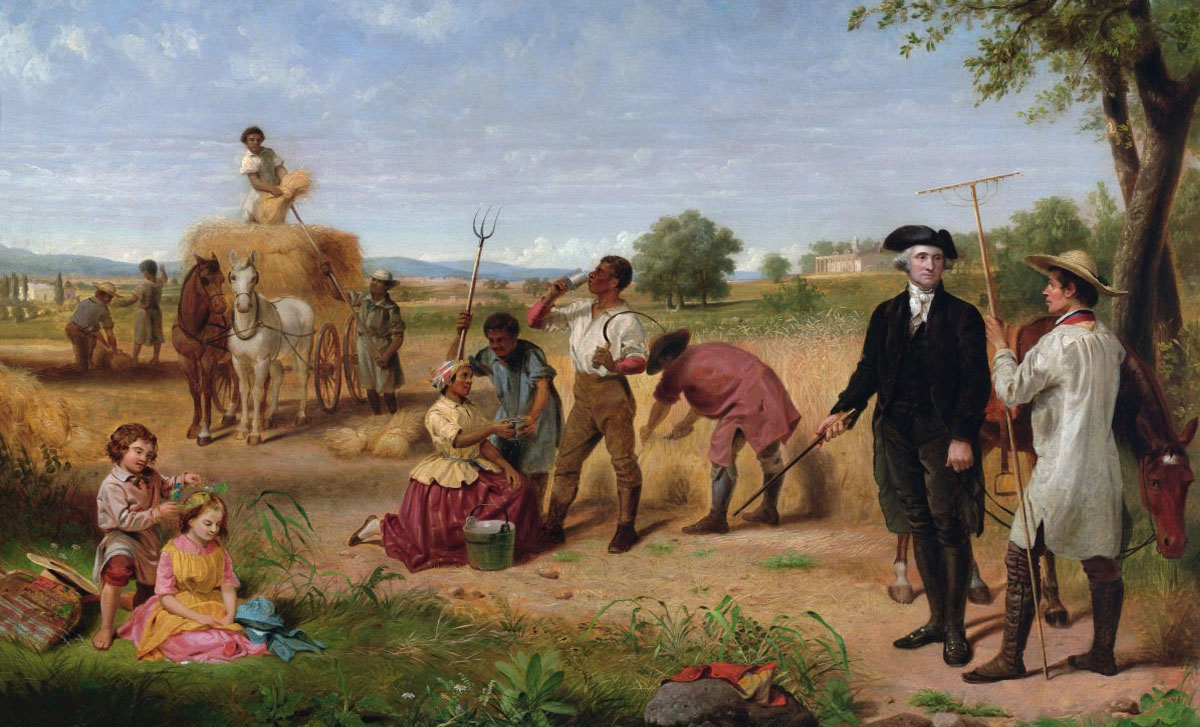
It was probably with a strong sense of relief that George Washington wearily made his way to his second-floor bedchamber on the evening of July 9, 1799. A self-described old man at 67 years of age and with little more than five months of life ahead of him, Washington had just completed a task that seemingly resolved an issue that had troubled him for decades. It was on that day that the former president finished writing his last will and testament, which spelled out his directions for freeing the more than 100 enslaved human beings that he personally owned. Much more than just a functional legal instrument, the will served as Washington’s final message to his country, and the manumission clause represented one of the most symbolic acts of his long and distinguished career in public service.
Given the nature of this type of document, Washington addressed a range of personal matters in dividing his estate among his heirs. Debts owed to him by family members were forgiven; personal items, such as the many swords and canes that he had acquired over the course of his public career, were distributed as cherished mementos; and the thousands of acres that Washington had acquired so assiduously over the years were parceled out among a substantial number of relatives. Because Washington had no offspring of his own, his estate was passed on to the children of his siblings, to the Custis family relations he gained by marriage, to a select few old friends and to his wife, Martha Dandridge Custis Washington.
The former president also made clear statements on other topics that were aimed at a much wider audience. He took this opportunity to reinvigorate his one-man campaign for the creation of a national university by authorizing a portion of his estate to help endow it. But the clause in the will to which Washington probably devoted far more attention than any other — and which he hoped would send an unmistakable message to his countrymen — dealt with the issue of slavery. With the stroke of a pen, Washington set in motion the apparatus intended to free 123 enslaved African-American men, women and children.
While Washington acted to manumit those slaves that he owned in his own right, more than 150 other enslaved workers living at Mount Vernon were the legal property of the heirs to the estate of Daniel Parke Custis, Martha Washington’s first husband, and they remained in bondage. Under Virginia law, the Custis (or ‘dower’) slaves could not be freed without payment of compensation to the heirs. At an estimated average value of 40 pounds sterling per slave, this would have amounted to a payment of more than 6,000 pounds. By comparison, the total profit Washington received from all of his plantation operations for the year 1797 was calculated at just less than 900 pounds sterling.
Many of the dower slaves were the spouses and children resulting from the intermarriage of Custis and Washington slaves. George Washington elected to honor the marital status of the Mount Vernon slaves, even though unions among the enslaved had no legal standing in Virginia. He followed through on his conviction by consistently working to keep the families from being dispersed, even when doing so would have been in his own financial best interest. He repeatedly declined to sell unneeded slaves if it meant that family members would be separated. In a 1786 letter, Washington emphasized his unwillingness to carry out any such transactions, stating that ‘it is…against my inclination…to hurt the feelings of those unhappy people by a separation of man and wife, or of families.’
It was this quandary — the desire to free his slaves, balanced against the sorrow that would result from being able to liberate some but not all of the Mount Vernon slaves — that was at the heart of Washington’s thoughtful deliberations over the provisions of his will. In the end he arrived at a compromise: He stipulated that those slaves he owned were to be freed, but only after the deaths of both himself and his wife. All the careful planning was needed in order to avoid witnessing the ‘painful sensations’ that were sure to result from the enforced separation of the intertwined families.
Three years earlier, when it came time for Washington to announce his decision to forego a third term as president, he had expressed his views on a variety of topics, but conspicuously avoided mentioning slavery. Instead, he maintained silence on the issue. Undoubtedly he viewed this most troubling of all problems as having the potential to destroy the fragile union that was his life’s work and chief political legacy. For both Congress and the president, silence signified that for the time being this most controversial topic had been laid to rest.
But to conclude that George Washington’s highest priority was to ensure the future of the nation at virtually any cost — and that potentially divisive issues such as slavery could not be allowed to threaten that goal — is to let Washington and the other founders off much too easily from the charge of hypocrisy. At the same time, it minimizes the struggle that Washington and many of his contemporaries experienced in arriving at their decision. George Washington may have had more depth and breadth of experience than any other man of his generation in dealing with the thorny questions associated with slavery. To examine the circuitous route by which Washington arrived at his parallel decisions — public inaction on the one hand, his personal motivation to resolve the specific issue of the disposition of the Mount Vernon slaves on the other — is to cast light on the difficult questions that had to be addressed.
Born into a world where slavery was considered a normal part of life, George Washington initially appears to have felt no qualms about following along the same slaveholding path taken by his father, by his many relatives and by virtually every other man of wealth and status whom he knew and respected. At the age of 11, George Washington inherited 10 slaves from his father’s estate. Just as he was ever eager to expand his landholdings, to improve the productivity of his farms and to win election to public office, he steadily acquired more slaves during the next two decades. Along with marrying well, another arena in which Washington was enormously successful, these achievements were the main components of the tried-and-true formula for acquiring wealth and social prominence in colonial Virginia.
Over the course of his lifetime Washington’s attitudes toward slavery seem to have undergone a marked transformation. From his initial unquestioning support for slavery as an economic institution and a wholehearted commitment to it as a core element of his personal prosperity, through time he became increasingly frustrated at dealing with its inherent inefficiencies, and he also grew troubled by the degrading effects it had on anyone who was deeply involved with it. This change of heart is evident at least by 1778, when he remarked that ‘every day [I] long more and more to get clear of [Negroes].’ At the same time Washington became convinced that continuing to own slaves would be a mistake, he decided to discontinue selling them. He commented, ‘The advantages resulting from the sale of my Negroes, I have very little doubt of…[but] my scruples arise from a reluctance in offering these people at public vendue.’ Some years later Washington expressed his opinion on the topic even more candidly, remarking, ‘Were it not then, that I am principled ag[ains]t selling Negroes, as you would Cattle in the market, I would not, in twelve months from this date, be possessed of one as a slave.’
Washington was caught in a conundrum from which he would never really find a way to extricate himself. By 1786 his thinking had progressed to the next level, marked by his statement that ‘I never mean to possess another slave by purchase; it being among my first wishes to see some plan adopted by the Legislature, by which slavery in this Country may be abolished by slow, sure and imperceptible degrees.’
These developments in Washington’s thoughts stemmed from the evolution, begun long before, of his disillusionment with the American colonies’ subservient role within the British mercantile system. Washington’s changing attitude toward Britain was influenced greatly by his dismay over his own steadily declining fortunes in navigating the tobacco export trade, which was the first of many steps he made along the path to his commitment to the cause of American independence. Just as Washington’s misgivings over America’s place in the British empire initially were related to his own economic concerns, the basis for his questioning the viability of slavery also first seems to have been related to financial considerations.
As early as 1766 Washington had veered from the staple-crop system based on tobacco production, which he had so eagerly embraced less than a decade before. Instead he turned to cultivating cereal grains, redoubled his efforts at achieving self-sufficiency and increased his commitment to commercial enterprises. Washington’s decision stemmed from his dissatisfaction with the tobacco consignment system, the declining international market for Virginia tobacco and his alarming descent into debt to his London factor. Characteristically, Washington took a series of bold measures to stem the tide of debt and place his plantation on a firmer financial footing. With the shift from tobacco to more diversified grain production, with wheat as his cash crop, new methods of cultivation could be used that had a dramatic effect on Washington’s labor needs. Gone were the many labor-intensive tasks related to growing tobacco: the numerous intermediate steps required to prepare seeds and soil; hand planting, processing, curing and transporting the crop; plus the backbreaking toil of hoe agriculture. Grain farming was a much less intensive occupation that could take advantage of animal power and a growing battery of implements and methods calculated to further reduce the human labor required.
Through time Washington succeeded in hoisting himself out of debt by more closely attending to his affairs, mastering the new art of wheat production, working to make Mount Vernon a more self-sufficient operation, and, not least of all, by benefiting from an additional influx of cash from the Custis estate. But even as he did so he found that, try as he might to develop new industries and occupations to employ all his slaves, he possessed many more unskilled black laborers than he would ever need. Although his close attention to his financial ledgers meant that Mount Vernon would remain a profitable venture for decades to come, it was clear to Washington that unless he was willing to divest himself of a significant portion of his workers, they would constitute an ever-increasing drain on his resources. Late in life, Washington summed up his predicament with his usual insight and precision:
It is demonstratively clear, that on this Estate [Mount Vernon] I have more working Negroes by a full moiety, than can be employed to any advantage in the farming system….To sell the overplus I cannot, because I am principled against this kind of traffic in the human species. To hire them out, is almost as bad, because they could not be disposed of in families to any advantage, and to disperse the families I have an aversion.
Just as George Washington’s eight years of fighting for American independence served as a catalyst for his conviction that a strong central government would be critical to the success of the new nation, it was during this period that his growing doubts about slavery seem to have received a significant boost. Washington’s general attitudes toward slavery already may have begun to change by the time he left Philadelphia in the summer of 1775 to take command of the Continental Army camped outside Boston. Even so, there is no question that he assumed that blacks would play little or no part in the prosecution of the war, other than in their traditional role of providing labor to support the American troops. The British had other ideas, however, and Washington was soon forced to reconsider his army’s policies in the matter.
Washington’s initial objection to using blacks as soldiers was manifested in a general order that excluded ‘Negroes’ from service, along with ‘Boys unable to bear Arms…and old men unfit to endure the fatigues of the campaign.’ Shortly afterward, Lord Dunmore, the royal governor of Virginia who had embarked on a campaign to harass the American home front and disrupt the war effort, offered slaves their freedom in exchange for enlisting in the king’s service. In response to Dunmore’s actions, and at least partly because of the continuing shortage of fighting men willing to enlist in his army, Washington and Congress soon changed the policy to allow ‘free Negroes’ to join the Continental forces.
Measures to allow enslaved blacks to join the army as well, and to reward them with their freedom in exchange for their service, were initiated over the next several years. One such scheme called for the legislatures of Georgia and South Carolina to create army units made up of slaves, who would then be freed following their discharge. This plan met with strong opposition in the two states involved, culminating in the threat that South Carolina might even withdraw its support for the war effort. Washington’s silence on the matter and his tempered reaction to the failure of the plan clearly indicate that he was fully aware of the volatility of the subject and foreshadows his decision to abstain from the heated debates on slavery that were to recur during the Constitutional Convention a decade later. The basic issue that Washington saw in 1779 was that the ‘Spirit of Freedom which at the commencement of this contest would have gladly sacrificed every thing to the attainment of its object has long since subsided, and every selfish Passion has take[n] its place — it is not the public but the private Interest which influences the generality of Mankind nor can the Americans any longer boast an exception.’ In other words, private interest already had reestablished itself as the dominant force in American society, and all efforts to affect the institution of slavery would henceforth be held accountable to it.
Nevertheless, the spirit of liberty that had been so invigorated by the events of the 1770s did manifest itself in a number of important measures affecting the status of America’s slaves. In 1777 the constitution for the new state of Vermont completely abolished slavery, and Massachusetts soon followed suit. Many other Northern states, such as Pennsylvania in 1780, adopted legislation aimed at gradual emancipation during this period, although it was not until 1804 that New Jersey finally enacted a similar law. Not surprisingly, in the South anti-slavery gains were much more modest. But three Southern states, including Virginia in 1782, passed laws that made it possible for owners to manumit their slaves. It was the provisions of this law that Washington had to respect in formulating the manumission plan outlined in his will.
With his status as the preeminent symbol of American independence confirmed in the days following the peace of 1783, Washington became the focal point for many who sought to bring the Revolution’s rhetoric on the inalienable rights of man to bear on other issues. Not surprisingly, probably the most prominent among them were men seeking to abolish slavery throughout the United States. Those who approached Washington on the subject reflected the remarkable diversity of perspectives and approaches found within the growing abolition movement. These included highly principled men, such as the Marquis de Lafayette and others who served during the Revolution, who knew Washington well. They argued their case on the proposition of universal freedom. Privately, Washington expressed his support for their views — he even encouraged schemes such as Lafayette’s idea to establish a colony of freed slaves in Africa. But publicly Washington maintained his silence.
From his position as presiding officer over the Constitutional Convention, Washington had a ringside seat to observe the deep political divisions in the assembly over the question of slavery. The sectional conflicts that had arisen during the war over the enlistment of free blacks and slaves, the differing approaches taken by the individual states in the regulation of slavery within their borders and the conflict over repeated attempts to restrict the international slave trade all served as precursors to the even more highly charged debates that were to come in the convention hall in Philadelphia. Throughout the extended political maneuvering that was required to resolve the many contentious issues on the table, Washington remained silent, at least outwardly. But his fundamental support for a constitution that would unify the nation behind a strong central government remained unshakable. From this perspective, slavery was a topic fraught with danger, and one for which a compromise solution was the best that could be achieved.
For Washington, and for the great majority of the founders, a provision allowing for the eventual prohibition of the slave trade was crucial to any acceptable compromise. Outlawing the slave trade had been a point of contention for decades and was perceived by abolitionists as the most likely first objective in achieving their ultimate goal. The slave trade was considered a great evil, even by many slaveholding Southerners who opposed abolition itself. Thomas Jefferson renounced the slave trade in his first draft of the Declaration of Independence. Virginia law prohibited further importation of slaves into the commonwealth beginning in 1778. It was almost inevitable that the slave trade became a particular focus of debate in the convention. Opposition to the slave trade was a hallmark of moderate opponents to slavery, such as Washington, who believed that slavery should be eradicated — but who also were convinced that it could not be ended immediately. By shutting off further importation of slaves, it was widely believed, the demise of slavery would come about in time.
Even though the slave trade proviso that was finally incorporated into the Constitution only stipulated that slavery could not be outlawed before 20 years had passed, it nevertheless represented a victory for moderates. Considered a crucial pro-slavery concession in the South, it was a bitter pill for radical abolitionists to swallow. Practically speaking, the compromise only postponed the ultimate resolution of the issue while giving both sides time to bolster their forces. The slave trade was prohibited in due course, but that act had much less impact than the moderate abolitionists had hoped would be the case. For as it should have been clear to anyone who bothered to examine the evidence closely, even by 1790 the influx of additional slaves was hardly needed to guarantee that slavery would continue to expand by natural means. With the benefit of another 20 years of imports, when the slave trade finally was prohibited it did little to inhibit the continued precipitous growth of the enslaved population in America. By 1860 the number of slaves had multiplied to more than five times what it had been 70 years earlier.
During the last years of his second presidential administration, Washington began to formulate plans for putting his personal affairs in order against the day when he would again, and finally, retire to private life. A major element of his plan called for easing the strain of overseeing his vast estate by seeking to sell or rent the great bulk of his property. He hoped to find a group of progressive English farmers who could be induced to migrate to America to farm the well-tended, but still lamentably infertile, Mount Vernon fields. For Washington this plan would seem to have been the answer to so many of his most heartfelt desires. Not only would he be free of the toil and aggravation caused by the day-to-day oversight of the plantation, he would also escape the frustrations of trying to adapt a system of slave labor to his innovative vision of Mount Vernon’s future. And perhaps best of all, Washington would presumably experience the satisfaction of finally witnessing firsthand the benefits of the many innovative farming practices that for years he had been trying to adapt from their English agricultural innovators.
The land scheme took on even greater significance for Washington because it was an integral part of his final, concerted attempt to solve in one clean sweep the vexing problem of the disposition of the Mount Vernon slaves. Given the substantial cost of reimbursing the Custis estate for the value of the dower slaves, finding a method whereby he could afford to free them under the provisions of Virginia’s 1782 manumission act was a challenge. The first indication of Washington’s ambitious plan is contained in a series of letters exchanged in 1794 between him and his secretary and close friend, Tobias Lear, and between Washington and the English agronomist Arthur Young. As Washington portrayed it to Lear, the plan consisted of two interrelated parts: selling his thousands of acres of western lands and selling or renting the four outlying Mount Vernon farms. By divesting himself of most of his acreage, he would no longer require large numbers of slaves to support himself. This, in turn, would allow him to set free the slaves that he owned. In addition, with the profits from the land sales, Washington hoped to be able to buy the dower slaves from the Custis estate in order to set them free. Thus would he overcome the problem of breaking up the intermarried families, since all the slaves could be freed at the same time.
Washington’s apparent willingness to sell off thousands of acres of land to finance his manumission plan suggests that he had come full circle in respect to the status of the Mount Vernon slaves. If much of Washington’s initial ambivalence toward holding hundreds of black workers in bondage was due to financial issues, this plan suggests that his moral concerns now were dominant. Freeing his slaves, even at great cost, had become the highest priority, and Washington was apparently willing to suffer a major reduction to his personal fortune to make that happen.
Just how far Washington had traveled in his odyssey from unabashed slave master to committed opponent of slavery is hinted at in a letter he wrote to Lear in 1794. Washington outlined the benefits that he hoped he would obtain from the plan, which included reducing his expenses to the point where he could support himself through occupations less onerous than farming. But he elaborated further in an aside marked private. ‘I have another motive,’ he wrote, that ‘is indeed more powerful than all the rest, namely to liberate a certain species of property which I possess, very repugnantly to my own feelings; but which imperious necessity compels.’
Unfortunately, Washington received only a few serious inquiries in response to his advertisements to sell his western lands and to sell or rent the Mount Vernon farms. As a consequence, nothing came of his plan to free the dower slaves. Although he never seems to have expressed his thoughts on the topic in writing, his disappointment must have been acute. When he wrote out his last will and testament, Washington was left with the unpleasant task of devising a final plan for the future of Mount Vernon’s slaves to ensure their freedom without forcing families to break up.
When Washington developed his compromise, which stipulated that his slaves would not be freed until the death of his wife, he was fully aware of the impact of his decision. Clearly uncomfortable with the knowledge that the freedom of so many depended on her death, after her husband died Martha Washington decided to implement the clause of his will to manumit her husband’s slaves. This was authorized on December 15, 1800 (to take effect the following January 1), just a year after George Washington’s death and almost 18 months before Martha Washington herself died. While there is no record of the reactions of the Mount Vernon slaves to this event, either on the part of those freed or those who remained in bondage, it must have been the cause of much sadness as well as joy.
With the failure of his land sales and rental scheme, Washington simply did not have the ready money needed to compensate the Custis estate for the value of the dower slaves. But although the legal wrangling to accomplish it may have ultimately proven unsuccessful — and such an act undoubtedly would have been unprecedented — it seems that George Washington might still have found a way to free the Custis slaves if he had been willing to devote a considerable portion of his estate to that end. As he had apparently seriously considered divesting himself of much of his landholdings just a few years earlier, hoping to pay for freeing the dower slaves, it is puzzling that Washington did not make one final attempt. Or maybe the final decision to give up on the effort to free the dower slaves simply reflects the exhaustion of an old, worn-out man. Whatever the reason, the decision indicates that there was an upper limit that even George Washington placed on the value of his principles. Unfortunately, there is no doubt that this was a condition shared by the vast majority of his slaveholding contemporaries. Nevertheless, Washington’s serious attempt to free all of the Mount Vernon slaves demonstrates his commitment to the principle of emancipation at a time when most of the founding generation of slaveholders were avoiding the issue entirely.
Washington’s will swiftly gained the public attention envisioned by its author, appearing in print almost immediately, with no less than 13 editions published in 10 different cities in 1800 alone. And yet, if Washington hoped that the decision to free his slaves would compel large numbers of his countrymen to follow his lead, he was sadly mistaken. In fact, his example failed to make a significant impression even on the members of his own family. Although Martha Washington controlled the dower slaves, they were still the property of her first husband’s estate. She only owned outright one slave, named Elish. For reasons known only to herself, she chose not to manumit Elish, instead passing him on to her grandson in her will. Of the family members who inherited the more than 150 slaves held by the Custis estate, none of them seem to have elected to free more than a very few.
Bushrod Washington, the Supreme Court justice and nephew of George Washington, and the inheritor of the Mount Vernon mansion and 4,000 acres of the estate, never freed the Mount Vernon slaves during his ownership of the plantation. And in fact he even engaged in the practice most abhorred by his famous uncle — the disruption of slave families through public sale. Finally, almost none of George Washington’s peers, either the obscure or the famous — not Jefferson, not Madison, not Monroe — elected to follow their president’s example. We can only speculate on how much suffering and injustice might have been spared succeeding generations if they had.
This article was written by Dennis J. Pogue and originally published in the February 2004 issue of American History Magazine.For more great articles, subscribe to American History magazine today!