As towns sprouted in the 19th-century American West — outside Army forts, at river crossings along wagon trails, in mining districts and at railheads — some of the first structures built were recreational facilities. Recreation for the almost totally male population inevitably meant the triple-W vices of the frontier: whiskey-drinking, whoring and wagering.
Saloons, brothels and gambling halls would appear almost overnight. In the early camps, the structure might be only a lantern-lit, dirt-floored tent, the bar simply a board stretched between two whiskey barrels, the prostitution facility just a cot in a wagon bed for the use of a single female strumpet, and the gambling outfit only a rickety table, a few chairs and a greasy, dog-eared deck of cards. As the towns grew and prospered, these primitive facilities were replaced by one-story wooden buildings with false fronts to make them appear even larger. And if the community developed into a city, saloons were housed in imposing brick buildings with ornate bars, huge back-bar mirrors and brilliant chandeliers. Some brothels became elegantly furnished parlor houses with attractive ‘boarders’ managed by madams whose names were famous throughout the West. The best-known sporting men of the West presided over and patronized gambling houses that were often the most impressive and elaborately accoutered structures of the cities.
The popularity of gambling in the West can be attributed mostly to the fact that all who left the relative safety and comfort of the East to seek fame and fortune on the frontier were, in a sense, natural-born gamblers. In the early West, gambling was considered a profession, as legitimate a calling as the clergy, the law or medicine.
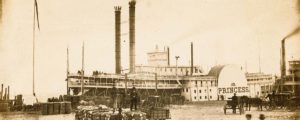
During the 25-year period prior to the Civil War, gambling flourished in the towns along the Mississippi from New Orleans to St. Louis and was a staple attraction on virtually every riverboat. This golden age of gambling produced some of the most memorable practitioners of the art — legendary professionals like Charles Cora, J.J. Bryant, Jimmy Fitzgerald, John Powell, Charles Starr and Napoleon Bonaparte ‘Poley’ White.
One of the popular gambling games of the 19th century was a bluffing game that evolved into American poker. Another, vingt-et-un (twenty-one), introduced into the United States through the predominately French community of New Orleans, we now call blackjack. Still another was Mexican monte. But undoubtedly the most popular gambling game in the West was faro, which drew its name from the Egyptian pharaohs depicted on the back of the cards.
The foremost faro player on the Mississippi was Italian immigrant Charles Cora. After winning $85,000 and breaking several faro banks in New Orleans, Vicksburg and Natchez during one six-month period, he was banned from many resorts. J.J. Bryant, perhaps the best-known professional gambler on the lower Mississippi, lost thousands to Cora.
Jimmy Fitzgerald and Charles Starr were early standard-setters of the sartorial splendor that became a hallmark of the 600 to 800 professional gamblers plying their trade on the river. Their expensive black suits and boots were offset by snow-white ruffled shirts and dazzling brocaded vests. Ostentatious jewelry advertised the gambler’s prosperity. Huge rings adorned his fingers. A stickpin with a large stone, called a ‘headlight,’ sparkled on his chest. In a pocket of his ‘flowerbed’ vest was an enormous pocket watch adorned with precious jewels and attached to a heavy golden chain that draped across the gambler’s chest.
The discovery of gold in California and the resulting rush of 1849 attracted many of the paddle-wheel and Mississippi River town gamblers to San Francisco, the new El Dorado of the West. By the early 1850s Portsmouth Square, the center of the City by the Bay, was ringed by large gambling houses where the doors never closed and enormous sums changed hands over the tables.
There was the Parker House, originally built by its owner, Robert A. Parker, as a hotel, but quickly converted to a casino as the gambling craze swept San Francisco. A large room downstairs contained three tables for faro, two for monte, one for roulette and a seventh for any other game desired. Professional gamblers paid $10,000 a month for the privilege of conducting their games in this room. A smaller room behind the bar went for $3,500 a month. Jack Gamble, an appropriately named sporting man, leased the entire second floor for $60,000 and outfitted all the rooms for games of chance. It was estimated that at the peak of the California Gold Rush upward of half a million dollars was stacked on the tables of the Parker House on any given day.
Flanking the Parker House on either side were two other famous resorts, Samuel Dennison’s Exchange and the El Dorado Gambling Saloon, owned by partners James McCabe and Thomas J.A. Chambers. Other houses on Portsmouth Square were the Verandah, the Aguila de Oro, the Bella Union, the Empire, the Arcade, the Varsouvienne, the Mazourka, the Ward House, the St. Charles, the Alhambra, La Souciedad, the Fontine House and the Rendezvous. As indicated by the several French names, some of these establishments were owned and operated by gambling syndicates from France, a country long known for its love of gaming.
As mining camps sprang up and grew in the hills surrounding San Francisco, the gamblers followed. Soon elaborate temples devoted to the goddess Chance were running day and night in Sacramento, Columbia, Nevada City and other Sierra boom towns.Among the former Mississippi riverboat gamblers who gained prominence on the California scene were Cora and Bryant. In San Francisco Cora continued to enjoy remarkable success at the faro tables, but luck completely deserted him after he resolved a difficulty with U.S. Marshal William H. Richardson on November 18, 1855, by shooting him to death on a San Francisco street. Shootings and stabbings were common occurrences in the city, and had this murder been committed a few months earlier Cora might have escaped punishment on the ancient claim of self-defense. But violence had reached such proportions in the city that residents were calling for reorganization of the Vigilance Committee that had been so effective against the criminal element in 1851. In that year vigilantes had executed or banished from the city many miscreants, and now, five years later, they felt another no-nonsense cleansing was called for. They tried Cora, found him guilty and on May 22, 1856, hanged him from the roof of their headquarters building.
Bryant’s California fortunes were better. After his arrival, he had purchased the Ward House, refurbished and renamed it the Bryant House, and soon became one of the most prosperous and influential men in San Francisco. In 1850, when the first election for sheriff was held in the city, he ran for the office. Although he spent $50,000 on his campaign and bet another $10,000 that he would win, he was defeated by the popular Jack Hays, a celebrated former Texas Ranger. Bryant sold his gambling house and moved on to the outlying camps, where he was financially successful. By the time he left California in 1854, he had reportedly sent $110,000 in winnings to his wife while maintaining a lavish lifestyle for himself. He resumed his gambling operations in the South and continued to prosper, but at the end of the Civil War he found himself destitute, as his wealth was in worthless Confederate currency. He was reduced to ‘roping suckers’ into a sharper’s crooked game. One of the suckers took offense and in 1868 shot him dead.
With the 1860s came the great mining excitement of the fabled Comstock Lode in Nevada. Most of the gambling activity in the Comstock was centered in Virginia City and nearby satellite communities. As in San Francisco, gambling houses dominated the main streets of the new towns. At the height of the boom an agent of the U.S. Geological Survey, studying recreational opportunities in Virginia City, found that the town of 18,000 had a gambling house for every 150 inhabitants. The best known of the many resorts in Virginia City was the Gentry and Crittenden Gambling Saloon, which featured a no-limit faro table presided over by the famous dealer Hamilton Baker. Other houses of note were Tom Peasley’s Sazarac, named after a new cocktail introduced by Julia Bulette, the queen of the town’s red-light district; the Delta Saloon, owned and operated by Jim Orndorff and Jack Magee; and Tom Buckner’s Sawdust Corner. Other prominent gamblers of Virginia City in its heyday were James ‘Kettle Belly’ Brown, Matt Redding, Jesse Bright, Gus Botto, Billy Dormer, Tom Diamond, Miles Goodman, Joe Dixon, Ramon Montenegro, Grant Isrial and Joe Stewart.
Gold Hill and Carson City were also outstanding towns for the sporting element during the Comstock bonanza years. The undisputed top man in the game at Gold Hill was William DeWitt Clinton Gibson, who was later elected to the Nevada Senate. The Headquarters, the Magnolia and the Occidental were all first-class gambling halls in Carson, and the leading sporting men were Vic Mueller, Tump Winston, Henry Decker, Gus Lewis, Mark Gaige and Adolph Shane. Dick Brown ran two establishments — the Silver State Saloon on the divide between Virginia City and Gold Hill, and the Bank Exchange in Carson City.
One of the most important events of the late 1860s was the completion of the transcon-tinental railroad. As the Union Pacific snaked across the Great Plains to meet the Central Pacific in its historic linkup at Promon-tory, Utah Territory, on May 10, 1869, it produced a number of end-of-track towns that collectively became known as ‘Hell on Wheels.’ They were gathering points for some of the lowest dregs of the sporting world, including hundreds of tinhorn, thieving gamblers. When the railroad pushed on, most of these towns disappeared. The sporting crowd simply loaded their tents, shacks, whiskey barrels, cots, gambling equipment and other paraphernalia on flatcars and moved to the next location at the end of the line. But a few points remained as permanent communities, and today the cities of North Platte, Neb.; Julesburg, Colo.; and Cheyenne, Wyo., can trace their origins to Hell on Wheels. Most of the honky-tonk crowd who preyed on the railroad construction workers during this period were forgettable small-timers, but a few went on to prominence among the gambling men of the West. Most, like John Bull, ‘Canada Bill’ Jones, Doc Baggs and Ben Marks, claimed to follow the respected profession of gambling, but were in fact confidence operators who fleeced their victims with three-card monte, thimblerig and other crooked gambling games. When the steel rails at last spanned the country, many of these sure-thing gamblers continued to work their swindles on railroad passengers, using the rail center of Omaha as headquarters.
They joined a large contingentof other crooked gamblers who formed the lowest echelon of the profession. Gambling, with its basic get-rich-quick appeal, had always attracted a criminal element. Perhaps the most famous member of this gallery of rogues was Jefferson Randolph ‘Soapy’ Smith, who worked his crooked scheme in Colorado for many years. It was Soapy who coined the expression’sure-thing game,’ once proudly proclaiming: ‘I am no ordinary gambler. The ordinary gambler hazards his own money in an attempt to win another’s. When I stake money, it is a sure thing that I win.’
Smith got his start and his nickname from a scam he developed in Leadville, in the Colorado Rockies. He had first worked the thimblerig game, a variation on the three-card monte swindle, which simply seemed to challenge a potential victim’s quickness of eye. Manipulating three walnut shells and a pea on a board, he would induce the sucker to bet on which shell concealed the pea, when in fact it was under none of them, for he had palmed it. When that racket grew old, he devised a new scheme based on the same principle that the hand is quicker than the eye. From a pile of paper-covered soap bars he would extract a few, remove the paper and apparently wrap $20 and $50 bills around the bars before replacing the covering. He would then allow members of his audience to select any bar they wished at $5 apiece. Of course, none of them contained any bills, because he had deftly palmed them in the wrapping process.
The decade of the 1870s saw the advent of the great trail drives of Texas Longhorns to the Kansas railheads and the birth of the notorious cow towns of Abilene, Newton, Wichita, Ellsworth and Dodge City. All became great gambling centers during their early days, and some of the most celebrated names in Western history are associated with this period. James Butler ‘Wild Bill’ Hickok, Wyatt Earp and Bat Masterson are remembered today as fearless lawmen of the cattle towns, but all were professional gamblers who spent many more hours at the faro or poker tables than they ever did patrolling the streets. Joining them were other professional gamblers whose names are remembered today for their gunfighting notoriety: Doc Holliday, Ben Thompson and Luke Short.
It was no accident that many of the top-flight gunfighters of the Western frontier were members of the sporting fraternity. Tough, steel-nerved young men who had acquired gunfighting reputations either in personal difficulties or as boomtown lawmen found themselves in demand as dealers in gambling resorts. There were two reasons for this. First, gunfighters of renown attracted patronage, as miners and cowboys were quick to seize the opportunity to match wits and gambling skills with frontier celebrities across a green felt table. Second, since the open display of large piles of cash was a constant attraction for criminals of all sorts, ranging from sneak thieves to holdup men, the mere presence at the tables of famous personalities known to be adept at the art of the draw and shoot discouraged any attempt to steal.
The 1870s also saw more ore strikes and additional mining districts. New boomtowns quickly emerged, most notably Deadwood in Dakota Territory, Leadville in Colorado, and Tombstone in southern Arizona Territory. All three became gambling meccas, and their names have been associated with some of the most famous Westerners of the 19th century. Wild Bill Hickok was shot to death as he sat in a poker game in a Deadwood saloon, and the hand he held — aces and eights, the ‘Dead Man’s Hand’ — became an enduring legend of the West.
Leadville, 10,000 feet high in the mountains, blossomed almost overnight into the largest city in Colorado, and at one point its boosters attempted to wrest the state capital away from Denver. At its peak, gambling opportunities were afforded in more than 150 resorts ranging from small saloons to elaborate theaters and concert halls. Some of the better known were Tom Kemp’s Dance and Gambling Hall, which in 1879 featured vaudeville song-and-dance star Eddie Foy; the Texas House, where proprietors Bailey Youngston and ‘Con’ Featherly provided a dozen faro tables around the clock; and ‘Pop’ Wyman’s Great Saloon, in which a large sign over the bar read: ‘Don’t Shoot the Pianist — He’s Doing His Darndest.’
Most of the leading Western gamblers, including Ben Thompson, Bat Masterson, Luke Short and Doc Holliday, spent a good deal of time — and money — in Leadville. There is a story that after dropping more than $3,000 at faro one night there, the volatile Thompson in a fury turned over the table, jerked out his six-shooter and shot out all the lights, sending panic-stricken patrons scurrying for the exits. Holliday, suffering one of those streaks of bad luck and near poverty that plagued all gambling men, shot another sporting man named Billy Allen in Leadville in a dispute over a mere $5 debt (see ‘Spitting Lead in Leadville: Holliday’s Last Stand,’ in the December 2003 Wild West).
Tombstone blossomed into a major city in the Arizona desert almost overnight and attracted many prominent professional gamblers, including Masterson, Holliday, Earp and Short. The leading drinking emporium in the boomtown was the Oriental Saloon. Its owner, Mike Joyce, leased the gambling concession to a triumvirate of Western sporting men — Dick Clark, a veteran of the Colorado mining camps; Lou Rickabaugh, a San Francisco sporting man; and Bill Harris, former owner of the famous Long Branch Saloon in Dodge City. When gambling became so popular in the Oriental that it adversely affected business at the other resorts in town, a group of competitors hired Johnny Tyler, a gambler of some gunfighting notoriety, to lead a gang of toughs into the Oriental every night, start a ruckus and intimidate patrons. The Oriental owners retaliated by offering Wyatt Earp, who had acquired a gunfighting reputation of his own, a quarter interest in the business if he would handle Tyler and his cohorts. To help him in this task, Earp employed Doc Holliday and sent for Luke Short and Bat Masterson to come to Tombstone and deal in the Oriental. This squad of gunfighting luminaries was too much for Tyler, who soon left town, and the Oriental returned to its air of decorum and its profitability.
Soon Bat Masterson and Luke Short also departed Tombstone — but not before Short had killed Charlie Storms, another well-traveled professional gambler of note, in a famous gunfight. Wyatt Earp and Doc Holliday stayed on to gain immortality for their participation in the most celebrated Western showdown of all, the so-called Gunfight at the O.K. Corral. Holliday also joined Wyatt in his vendetta ride to avenge the murder of his brother Morgan and the crippling of his brother Virgil. They left Arizona as fugitives wanted for murder, but they returned to their gambling profession and were never tried.
As great cities grew in the West during the 1880s, gambling emporiums grew with them. San Francisco, where gambling had flourished since the first days of the California Gold Rush, now harbored the Barbary Coast, a sin center of worldwide notoriety. Denver, Kansas City, Omaha, Tucson, Hot Springs, Ark., and the Texas cities of Austin, San Antonio, Fort Worth and Dallas were recognized as wide-open for gambling of all sorts — from cheating three-card monte scams to high-stakes poker and faro games in elaborate casinos. It was during this period that the Gamblers’ Circuit developed, with professional followers of the goddess Chance traveling around the country, sometimes following the seasons but more often following the latest report of a mining strike or a cattleman’s convention.
In the late 1890s, gold was discovered in the Klondike region of Canada’s Yukon, and the last great rush to a new mining district was on. Of course, along with the prospectors and mining men who flocked to the Klondike were members of the sporting crowd, the same types who had been early arrivals at every boomtown in the West since the Forty-Niners first arrived in California. They opened saloons, brothels and gambling houses and did a flourishing business separating the miners from their gold dust.
Some of the most colorful professional gamblers of the American West made it to the north country. Wyatt Earp was there. He and his partner, Charlie Hoxie, ran the Dexter Saloon in Nome, which they advertised as ‘The Only Second-Class Saloon in Alaska.’ When he sold his interest to Hoxie and returned to California, Earp is said to have accumulated $85,000.
George Lewis ‘Tex’ Rickard, the former city marshal of Henrietta, Texas, joined the rush and ran gambling games, first at Circle City in Alaska and later at Dawson in Yukon Territory. He made and lost a fortune, owned and lost two gambling houses, and made another fortune. It was in the Klondike that he first began promoting prizefights, an enterprise that would lead him into worldwide celebrity as the promoter of the multimillion-dollar-gate bouts of the 1920s featuring heavyweight Jack Dempsey.
The memorable gamblers of the Klondike gold rush included ‘Square Sam’ Bonnifield, Rickard’s mentor, and Louis ‘Goldie’ Golden, who once won $72,000 and Bonnifield’s gambling establishment from Square Sam in a poker game. Goldie lost it all back later when Square Sam, supplied with fresh funds by admirers, cleaned him out. Gambler Harry Woolrich was about to board a steamer to leave the north with $60,000 in winnings when he flipped a half dollar on a faro layout and made what he said was ‘one last bet.’ Twenty-four hours later, he had lost the $60,000 and his steamer ticket. William F. ‘Swiftwater Bill’ Gates won $30,000 in a poker game in Nome but achieved national newspaper coverage for his many amorous adventures.
The crooked gamblers seemed to congregate in the north country at the port town of Skagway, where, under the leadership of Soapy Smith, they relieved new arrivals and departing miners of anything of value. In 1898 Smith was grand marshal of a Fourth of July parade in Skagway; four days later Frank Reid, a member of a citizens’ committee, shot him dead in a gunfight in which Reid also received a fatal wound.
There were still a few wide-open gambling towns after the turn of the century, most notably the boom mining camps of Nevada, particularly Goldfield, Rawhide and Tonopah. Wyatt Earp and Tex Rickard were there, as well as such colorful gambling notables as George Wingfield, Riley Grannan and ‘Diamondfield Jack’ Davis.
Wingfield started out earning $25 a day as a dealer in the Tonopah Club, gambled successfully against other houses, invested his winnings in the mines, was worth more than $2 million by age 27 and became a power in Nevada politics. Grannan broke the faro bank in one saloon and bet his $52,000 winnings on one turn of a card against title to the house. He lost. When he contracted pneumonia and died in Rawhide, Herman W. Knickerbocker, a defrocked Methodist minister, delivered a moving eulogy to the famous gambler. Diamondfield Jack got his start as a bodyguard for Wingfield. Goldfield legend has it that when he expected trouble, he became a walking arsenal, wearing three overcoats with a pistol in every pocket, a bowie knife at his belt and a sawed-off shotgun slung across his back. Other fables attached to the man. He was said to have acquired his name from a field of diamonds he owned. The rumor that he had escaped death sentences on five occasions was greatly exaggerated; he had only been condemned to hang once, for a dual murder in Idaho, and had avoided the hangman’s noose when another man confessed to the crime.
The great age of Western gambling ended with the closing of the frontier and the rise of antisaloon and woman suffrage reform movements that swept across the nation in the first decades of the 20th century. These led inevitably to constitutional amendments prohibiting the manufacture and sale of alcoholic beverages and establishing the enfranchisement of women. State after state passed legislation outlawing casino gambling. Nevada alone bucked the tide. Casino gambling returned in the latter half of the 20th century on Indian reservations and in Las Vegas, a city devoted to gambling. Its great popularity led to legalization in many areas of the country, and now anyone wishing to wager money will have little difficulty in finding a place to do it. But the colorful professional gamblers of the Western frontier are long gone and generally forgotten.
This article was written by R.K. DeArment and originally appeared in the April 2005 issue of Wild West.
For more great articles be sure to subscribe to Wild West magazine today!