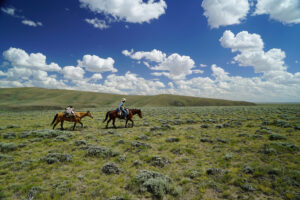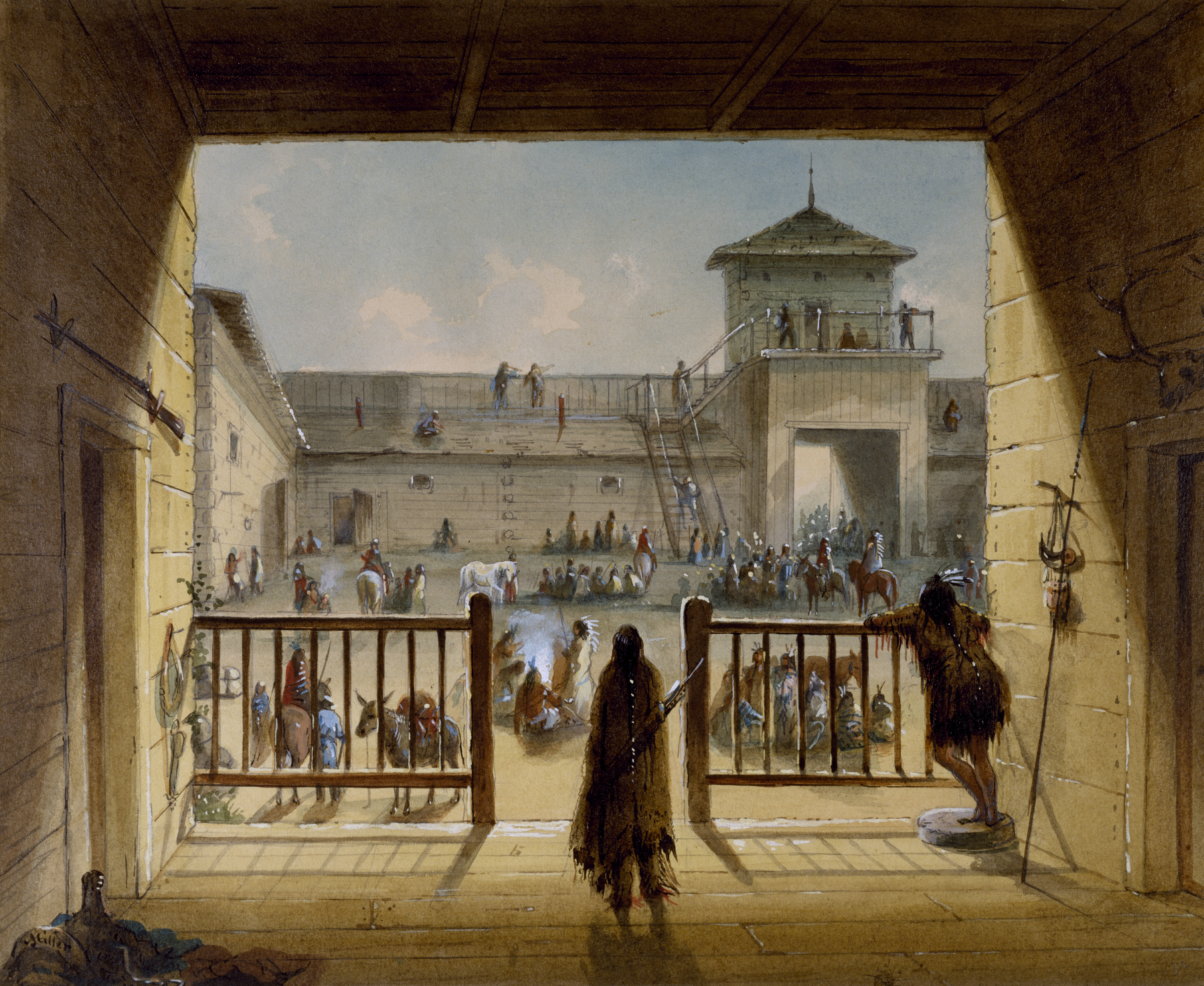
Bound for a fur trapper rendezvous in 1830, William L. Sublette hauled a wagon loaded with supplies over a grassy piece of ground at the confluence of the Laramie and North Platte rivers in what would become Wyoming. Sublette noted that the location, between the Great Plains and the Rocky Mountains, was favorable for a trading post that could provide goods for Indians and trappers. Four years later, he returned with partner Robert Campbell to build a stockaded ‘fort’ with 15-foot hand-hewed cottonwood logs forming the palisade.
On May 31, 1834, William Marshall Anderson wrote in his journal: ‘This day we laid the foundation log of a fort on Laramie’s Fork. A friendly dispute arose between our leader and myself, as to the name. He proposed to call it Fort Anderson. I insisted upon baptising it Fort Sublette, and holding the trump card in my hand, a bottle of champagne, was about to claim the trick…when [William] Patton offered a compromise which was accepted, and the foam flew, in honor of — Fort William, which contained the triad prenames of clerk, leader and friend.’
A year later, the partners sold Fort William to veteran mountain man Jim Bridger and his associates. They, in turn, sold out the following year to the American Fur Company — the same year Elizabeth Spaulding and Narcissa Whitman, the first white women on the Oregon Trail, stopped in at the fort.
By 1841, the log palisade had deteriorated to the point that the company built a new fort out of adobe, using a 2,000-year-old Roman recipe for lime concrete. Workers took limestone from the nearby bluffs, broke it up and cooked the lime out in hot kilns. They next mixed in sand, gravel and water, creating a simple but effective concrete. The company called this new post Fort John-on-the-Laramie after the company’s senior partner, John B. Sarpy. At some point a clerk shortened it to Fort Laramie and the nickname stuck.
From its inception, the fort acted as a contact point between whites and the native population of the region. This history prompted Lieutenant John C. ‘the Pathfinder’ Frémont to suggest, on his first exploratory trip through the Rocky Mountains in 1842, that Fort Laramie would make a good military post for protecting pioneers headed overland for the Far West. However, it took Congress three years to authorize the establishment of military posts along the Oregon Trail. Meanwhile, about 50,000 emigrants had already passed through Fort Laramie on their way to what they hoped would be the ‘land of milk and honey.’
Congress finally allotted $4,000 for the purchase of Fort Laramie in 1849, a move that coincided with the gold rush to California. Two companies of mounted riflemen and one company of the 6th Infantry comprised the fort’s first garrison. Military architect 1st Lt. Daniel P.
Woodbury designed a two-story post headquarters the year the Army took over, and today the 150-year-old structure is believed to be the oldest building still standing in Wyoming. Over the years, the building served as officers quarters, post commander’s residence and bachelor-officers quarters. Due to the boisterous nature of the bachelors (and their drinking parties), soldiers began referring to the quarters as Old Bedlam after the famous English sanitarium for the insane, Bedlam Asylum.
Next, Woodbury, with the help of a second engineer officer, 2nd Lt. Andrew J. Donelson, devised an overall plan for the post. The plan called for ‘a fence 9 feet high or a rubble wall of the same height laid in mortar.’ The traditional-looking fort Woodbury envisioned, however, was never to be. For one thing, the cost — an estimated $60,000 — was too high. Also, the military took the fort construction duty out of the hands of the Corps of Engineers and gave it to the Quartermaster Department, creating a breakdown between planning and execution.
Fort Laramie only partially came to resemble a true fort (i.e., one surrounded by walls). Nevertheless, with men stationed at Fort Laramie such as those of Company K, 2nd U.S. Cavalry (considered among the best cavalry regiments in the Army during the summer of 1876), no one could dispute Fort Laramie’s importance as a military outpost. Up to 350 men were stationed at the fort at any given time. From dawn to tattoo at 8 p.m., their ‘fatigue duties’ included the usual morning and afternoon drills, policing the grounds, cleaning the barracks, tending the horses and standing guard. In the 1870s, bugler William D. Drown described the daily routine of a soldier’s life at Fort Laramie: ‘I commenced the day this morning by being orderly bugler for the commanding officer, and at half past eight in the morning, attended guard mounting — and immediately after, saddled up and rode two miles and assisted in digging a grave. Returned at half past twelve — started again at one with the funeral procession, after which was marched home, dressed myself for evening parade, marched back again to the corral, assisted in flogging a deserter, came home, ate supper, and hear [sic] I am scratching it down in the old journal. Some people think a soldier’s life is a lazy one, but soldiers themselves think otherwise.’
Troopers found two duties especially harsh at Fort Laramie — cutting wood and cutting ice. Since the fort was situated on the edge of the Plains, trees around it quickly disappeared, forcing lumber and firewood details to travel 40 to 50 miles to Laramie Peak to supply the fort’s needs. Mule-drawn wagons hauled 24 logs at a time to the fort sawmill. Many of Fort Laramie’s buildings remained unfloored or incomplete from lack of available lumber, including the top floor of the hospital.
With temperatures plunging to 40 degrees below zero in winter and with a never-ending wind blowing snow across the open space, the fort used an estimated 5,000 cords of firewood annually, 1,550 cords in the coldest months. In 1866, Major James Van Voast calculated it would require 50 men working for a solid month without interruption of daily drills to supply winter firewood. Sawing logs into cord wood usually fell to prisoners.
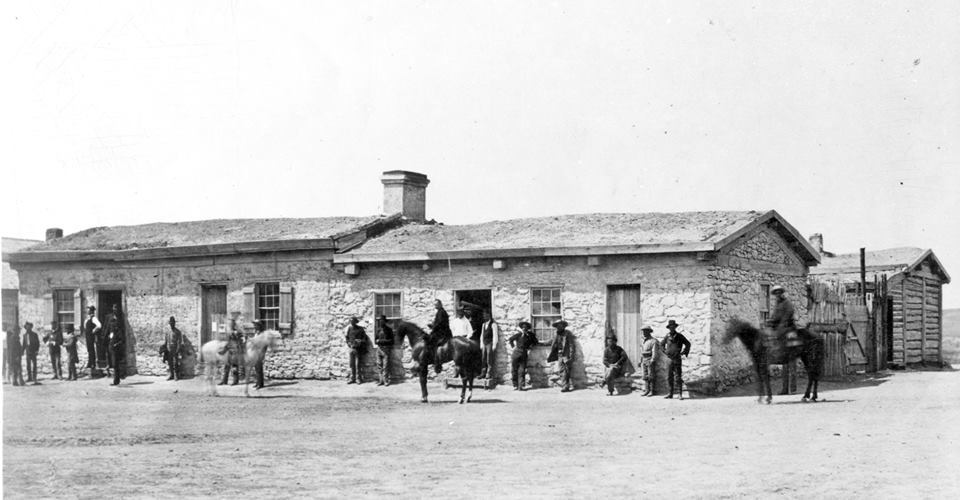
Cutting ice from the river in the subzero temperatures of winter was hard work. The soldiers bundled up in heavy buffalo overcoats and attempted to insulate their shoes by wrapping burlap around them. After sawing the frozen water into blocks, troops hauled them to the two sod-covered ice houses, located near the river close to the site of old Fort John, and stored the ice in sawdust. In summer, prisoners doled out carefully prescribed amounts to the sutler’s store, officers quarters and barracks to cool the drinking water.
By 1876, soldiers were cutting hay and lugging 2 tons of grain a day for the post’s horses and mules. The fort was often referred to as a ‘government work farm.’
Enlisted men also drew duty as bakers, whether or not they possessed any cooking skills. The same applied to teaching at the post school. The military required the children of the enlisted men and of the quartermaster’s civilian employees to attend classes three hours in the morning and three in the afternoon on weekdays. The 1877 roster showed 20 children enrolled — 14 girls and six boys. Officers’ offspring were invited to attend, but they never did. Instead, they were tutored at home until they were old enough to be sent back East to live with relatives or go to private boarding schools.
Although soldiers received an extra 20 cents a day for teaching, they hated it. They received endless ribbing from their compatriots and despised being shut in with often undisciplined students who disliked the confinement as much as the men did. More than one instructor showed up drunk, even though he would inevitably be fined $12 for dereliction of duty. Considering that soldiers drew $13 a month in pay, the fine was a steep price to pay.
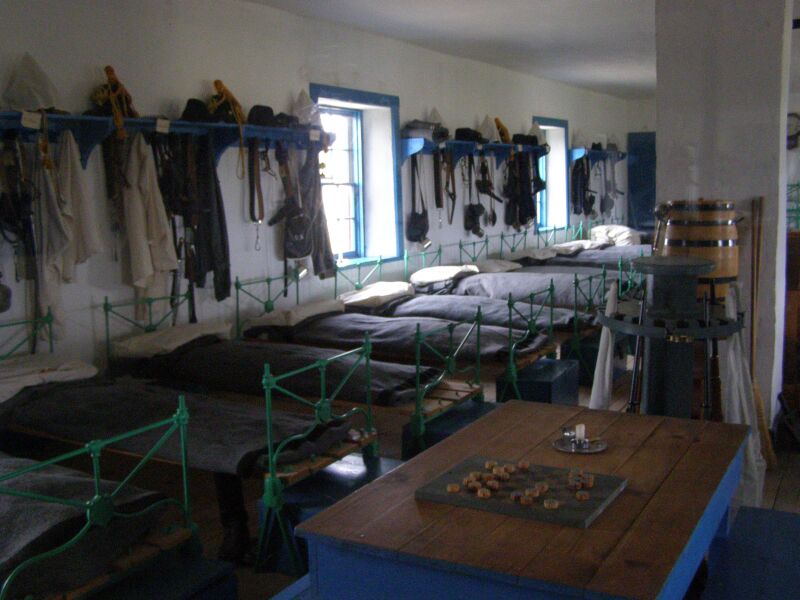
Of course, the men did receive free room and board — an iron bunk with wood slats and a ration of pork, beans, rice, potatoes and onions (if available), plus enough flour for each man to bake one loaf of bread per day. This uninspired selection spurred soldiers to come up with a jingle for bugle mess call: ‘Soupy-soupy-soup, with-out a single bean; porky-porky-pork, with-out a streak of lean; coffee-coffee-coffee-without any cream.’ The soil and climate around Fort Laramie provided poor possibilities for the men trying to supplement their dull diet by raising a garden. Nevertheless they tried — and mostly failed.
Some men, or their wives, kept cows, selling the milk and cream to the others and using the money to buy merchandise from the sutler’s store. The store opened in 1850 and by 1870 supplied the soldiers and their families with all the necessities, as well as a few luxuries such as draperies and carpet — provided the buyer was willing to pay for shipping from the States.
Fort Laramie’s military history spanned more than 41 years. The fort became the staging ground for Western expansion. Although Indians were a major concern throughout this period, they caused less than 2 percent of the emigrant fatalities along the entire Oregon Trail. Diseases such as cholera claimed the majority of the estimated 20,000 travelers who died along the way. Emigrant Jane Kellogg wrote in her journal in June 1852: ‘There was an epidemic of cholera all along the Platte River. Think it was caused by drinking water from holes dug by campers. All along the road up the Platte River was a graveyard. Most of the time of the day you could see people burying their dead.’
Within two months of setting out on their overland journey, emigrants arrived at Fort Laramie, a third of the trip accomplished. The fort represented the last trace of civilization — the last place to mail a letter home or hear from loved ones, trade in worn-out stock for fresh animals, rest up before tackling the arduous mountain passes and load up on supplies. Colonel Henry Carrington’s wife, Margaret, characterized the sutler’s store on the post in 1866: ‘The long counter of Messrs. Bullock and Ward was a scene of seeming confusion not surpassed in any popular, over crowded store of Omaha [Nebraska] itself. Indians…mingled with soldiers of the garrison, teamsters, emigrants, speculators, half breeds and interpreters. HERE, cups of rice, sugar, coffee, or flour were being emptied into the looped-up skirts or blankets of a squaw; and THERE, some tall warrior was grimacing delightfully as he grasped and sucked his long sticks of peppermint candy. Bright shawls, red Squaw cloth, brilliant calicos, and flashing ribbons passed over the same counter with knives, and tobacco, brass nails and glass beads, and that endless catalog of articles which belong to the legitimate border traffic. The room was redolent of cheese and herring and heap of smoke….’
Gold fever lured many travelers west. Joseph Price, whose dream of riches enticed him from his homestead in Missouri to the California fields in 1850, wrote to his wife, Elizabeth, on June 8: ‘We are now 200 and 80 miles from fort cearny [Kearny] and about 26 from Fort Laramie will reach there some time to morrow…as to the emigration to californa it is very large but from what I can learn we are in advance of at least three forths of the emigration and are all cheerfull at least tolerable cheerfull…as to indians I do not believe that we have been in the least danger as yet we are now in the country of the Souix [Sioux] they say they are entirely friendly we have seen 4 viliges of them some distance back they ware on the South Side of the [Platte] river came in I suppose to trade with the emigrants.’ Price spent the next two days at Fort Laramie before resuming his journey.
The Sioux and other Plains Indians would not remain so friendly. Tensions between the Indians and whites would escalate with the growing number of emigrants on the Oregon and California trails, the would-be prospectors on the trails to what would become Montana, the appearance of Pony Express riders, and then the arrival of telegraph lines and the railroad. In February 1851, the U.S. Congress authorized $100,000 ‘for expenses of holding treaties with the wild tribes of the prairie and for bringing delegates on to the seat of government.’ The treaty council with the Plains Indians took place in September of that year. More than 10,000 representatives of the Lakota, Cheyenne, Arapaho, Shoshone, Crow, Assininboine, Gros Ventre, Hidatsa, and Arikara nations gathered at Fort Laramie, along with 270 dragoons, Indian commissioners and statesmen, to forge a peace treaty that would allow emigrants to cross safely through Indian land on their way west.
The number of horses quickly overwhelmed the available grass, and the negotiations had to be relocated to the mouth of Horse Creek near current Lyman, Neb., where better grazing was available. Bringing together enemy Indian tribes naturally caused a few tensions, as did the arrival of Chief Washakie of the Shoshones. A Lakota warrior sought to avenge his father’s death at the hands of Washakie; however, a French interpreter successfully intervened. The flare-up ended quietly.
In the end, the First Treaty of Fort Laramie was concluded amiably. In exchange for emigrants traveling unmolested over the Oregon Trail and rights to construct military posts, the U.S. government promised it would pay the tribes an annual annuity of $50,000 worth of manufactured goods and provisions for 50 years as compensation for disturbing the tribes’ hunting grounds and the loss of grass. The treaty also established territorial boundaries for the Indian nations that signed the treaty and set up a system for providing restitution for depredations made by Indians or whites. Although the treaty contained a clause outlining punishment in the form of withholding all or part of an offending tribe’s annuity for violations of the treaty, nothing was said about penalizing the whites for their transgressions.
As a reinforcement of white power, government negotiator and Indian agent Thomas Fitzpatrick escorted a delegation of 11 Indian leaders to Washington, D.C., at the conclusion of the treaty agreement. One new Indian leader was so disturbed by the trip that he supposedly committed suicide on the way. President Millard Fillmore presented medals and flags to the chiefs at a White House ceremony, but the U.S. Senate was already reneging on the treaty. Although it upped the amount of the annual annuity to $70,000, Congress slashed the annuity period down to 10 or 15 years, depending on what the president wished to do at the end of the decade.
When the delegation returned to the West in 1852, Fitzpatrick brought with him only $30,000 worth of goods to be distributed as the annuity. The following year, he resubmitted the modified treaty to some of the tribes that had signed the original agreement. Few accepted the alterations without the ‘usual inducement’ of bribery, or possibly threats. Some never consented to the changes. Not that it mattered. The peace ended less than three years after the initial treaty signing.
On August 19, 1854, a group of Brulé Sioux assembled eight miles east of Fort Laramie near a trading post owned by James Bordeaux, who had, for a time, run Fort John for the American Fur Company. While waiting for the distribution of the annuities, the warriors killed and roasted a cow that had strayed or been lame (depending on the historical account) and had been left behind by a Mormon wagon train headed for Salt Lake City in present-day Utah. When the wagon train reached the fort, its leader, Hans Peter Olsen, complained about the loss. That same day, Brulé Chief Martoh-Ioway (Bear-That-Scatters) arrived at the fort and reported the incident, offering to hand over the offender so that his band would receive its annuities on schedule as per the treaty.
Lieutenant Hugh B. Fleming, then in charge, sent 2nd Lt. John L. Grattan and 29 men of the 6th Infantry, and Lucien Auguste, an interpreter, to receive the supposed cow thief and bring him into the fort for punishment. A recent graduate of West Point, the brash young Grattan marched into the Indian camp with two 12-pound cannons. Accounts differ as to what happened next, but it seems that Auguste was intoxicated and, having had some animals stolen, held a grudge against Indians. In villages the troops passed through on the way to the Brulé camp, Auguste dared the Indians to try to annihilate the whites, announcing that he was coming with ‘thirty men and a cannon,’ and that this time he would ‘eat their hearts raw.’
When Grattan’s detachment reached the camp, things quickly fell apart, and someone, either a soldier, Auguste or a warrior, fired a shot. Then the cannons blazed. When the fight ended, Grattan, Auguste and all the soldiers lay dead, along with an unknown number of Indians. The battle not only became what Fort Laramie lead park interpreter Rex Allen Norman labeled ‘the first skirmish of the Indian Wars’ but also made an indelible impression on at least one teenage Lakota witness — Crazy Horse.
Four years later, David A. Burr passed the Grattan battle site on his way west. He wrote the following entry in his diary dated June 27, 1858: ‘At 11 o’clock we reached & nooned at Bordeana [Bordeaux] Trading post distant 10 miles from [Fort] Laramie — This is the largest trading post I have seen, It is a real fort — as there is a square enclosed on two sides by the houses & the other are by a strong palisade….It was at this post that the Grattan massacre took place. We saw the grave where the 29 men who were killed are buried — Near here we saw an Indian burying ground. They place their dead on a scaffold elevated some 10 or 12 ft above the ground — with their head to the East.’
With only a small garrison stationed at Fort Laramie in 1854, the Indians could have pressed their advantage after the Grattan incident and overrun the place. They chose to remain more or less peaceful for the time being. That, however, did not stop the military from mounting punitive expeditions from Fort Kearny and Fort Leavenworth via Fort Laramie the following year.
When the Civil War broke out in 1861, the Union sent volunteer cavalry regiments made up of men who were not soldiers by trade to defend Western forts, including Fort Laramie. War in the East also meant that troops on the frontier were spread increasingly thin. Still, most of the men at the frontier forts wanted to see action. Lieutenant Caspar Collins, at Fort Laramie in 1862, wrote, ‘I never observed so many men so anxious to have a fight with Indians.’ On the other hand, an unidentified enlistee commented: ‘The soldiers did not hold hard feelings about Indians. I could always make friends with them, when they were treated right.’
The government, though, often did not treat the Indians right, as when gold was discovered in present-day Montana in the early 1860s and John M. Bozeman established a trail right through the Lakotas’ best hunting grounds (shaving 350 miles off the more roundabout Oregon Trail route). The government not only ignored Bozeman’s flagrant violation of the 1851 treaty but also authorized the War Department to improve the trail and construct Forts Reno, Phil Kearney and C.F. Smith along it to secure the road and protect gold seekers.
The Plains Indians, of course, were none too pleased. Merrill J. Mattes, a former Fort Laramie historian, wrote that ‘the justifiable indignation at the white man’s invasion was a perpetual menace.’ Soldiers dispatched from Fort Laramie engaged in sporadic skirmishes with bands of Indians. Raids on stage stations and routes, as well as the telegraph lines, paralyzed travel in the region for weeks at a time. When hostilities erupted at Mud Springs, near present Bridgeport, Neb., in 1865, troops from Fort Laramie, commanded by Colonel William O. Collins, engaged the Indians in one of several indecisive battles.
One such skirmish, however, cost Fort Laramie commander Colonel Thomas O. Moonlight his military career. After a band of friendly Brulés who had not joined in the raids were taken under guard from Fort Laramie to be delivered to Fort Kearny, they killed their guards and escaped (see ‘Lakota Escape at Horse Creek’ in the June 1998 Wild West). Moonlight personally led a force on a 120-mile manhunt, never finding the fugitives. But when he ordered the men to turn their horses loose to graze, the Indians swooped down on the camp and, in broad daylight, made off with all the soldiers’ animals. In a fit of rage, Moonlight burned his troops’ saddles and equipment. Then they hiked back to Fort Laramie. Shortly afterward, Moonlight was mustered out of the Army.
The closest Fort Laramie ever came to being attacked was in 1864. A detachment had been out scouting for signs of Indians. Finding none, they returned to the fort and unsaddled their mounts on the parade ground. Right under the entire command’s noses, about 30 warriors raced through the fort, making off with the horses. There were plenty of embarrassed men but no injuries.
When the Civil War ended in 1865, the Army sent large numbers of troops to guard the Western frontier. By 1866, the trail to Montana gold carried the well-earned nickname of ‘the Bloody Bozeman,’ as a combined force of Lakota and Cheyenne warriors besieged the route. Word came to Fort Laramie on Christmas night of a fight that claimed the lives of 81 men, including Captain William J. Fetterman, who was well-known around the fort. Fetterman had headed a detachment of troops out from Fort Phil Kearny to guard and escort a wood train. Before reaching the woodcutters, however, he had disobeyed orders and taken off after a band of Indians. His party had been ambushed and wiped out (see ‘The Fatal Fetterman Fight’ in the December 1997 Wild West). Embarrassed by this defeat, the Army sought a diplomatic solution to the escalating violence. The result was the Second Treaty of Fort Laramie in 1868, which the Senate ratified early the following year.
A bitter peace agreement for the Army, this treaty conceded victory to Red Cloud and his warriors by calling for the withdrawal of all soldiers and the abandonment and destruction of all forts along the Bozeman Trail. But it also stipulated that the Lakotas entirely relinquish their North Platte (Oregon Trail) territory, which included lands around Fort Laramie, and take up reservation living in the Dakotas.
Red Cloud’s people had traded at the fort for many years and were not happy about not being allowed to continue that practice. Ada Vodes, an officer’s wife stationed at Fort Laramie, described the scene on March 25, 1869: ‘At 8 o’clock, in came Red Cloud with a thousand Indians — young bold and dashing warriors — with their squaws and papooses. They came in two abreast, singing at the top of their lungs, and as they drew near the post, they formed into a line of battle around one side of the garrison…two companies of infantry were under arms for two or three hours — the artillery was brought to bear…everything had a warlike appearance for hours….Colonel Dye ordered them off, as they had no permission to come in such large numbers. One of the big chiefs made a singular noise, and they all started for their ponies…as they rode off, [the Indians] scattered off in all directions over bluffs and plains. It was a grand sight.’
Eventually, the Lakotas relocated to the Red Cloud and Spotted Tail agencies. Then, despite Indian objections, the military established posts at these agencies in 1874.
That year the U.S. government also violated the 1868 treaty by sending Lt. Col. George A. Custer to check out rumors of gold in the Black Hills. In a dispatch Custer wrote, ‘I have on my table forty or fifty small particles of gold in size averaging a small pin head, and most of it obtained from one pan.’ The latest gold rush was on. White miners illegally swarmed all over the reservation, seeking the precious metal. At first, soldiers tried to arrest miners and send them to Fort Laramie for incarceration. Next, the government sought to buy the Black Hills from the Lakotas. By the time that option failed, the military could not contain the whites.
Expecting problems from Sitting Bull’s band, which had refused to stay on the reservation, the Army made a pre-emptive strike in 1876. Under the command of Brig. Gen. George Crook, troops from Fort Laramie participated in the campaign on the Crazy Horse Fork of the Powder River and the Battle of the Rosebud. In 1877, the Lakota leaders gave up hunting rights in Montana and Wyoming and surrendered the gold-rich Black Hills. The need for frontier forts had all but disappeared in the West, but troops remained stationed at Fort Laramie for another 13 years or so. The railroad moved in, but it bypassed Fort Laramie, choosing to make Cheyenne its base. Cattle ranchers and settlers replaced emigrants ‘just passing through.’ With them came a need for a different sort of law and order in the West.
The Army abandoned Fort Laramie in 1890. The government auctioned off the buildings and land to local citizens. More than 50 structures were moved elsewhere, demolished or dismantled. The remaining 20 buildings fell into disrepair until 1937, when Wyoming purchased the site. A year later, ownership was transferred to the National Park Service, and Fort Laramie became a National Historic Monument. Congress redesignated it a National Historic Site in 1960. In 1999, Fort Laramie commemorated its 150th anniversary as a military post.
This article was written by Sierra Adare and originally appeared in the December 1999 issue of Wild West.
For more great articles be sure to subscribe to Wild West magazine today!